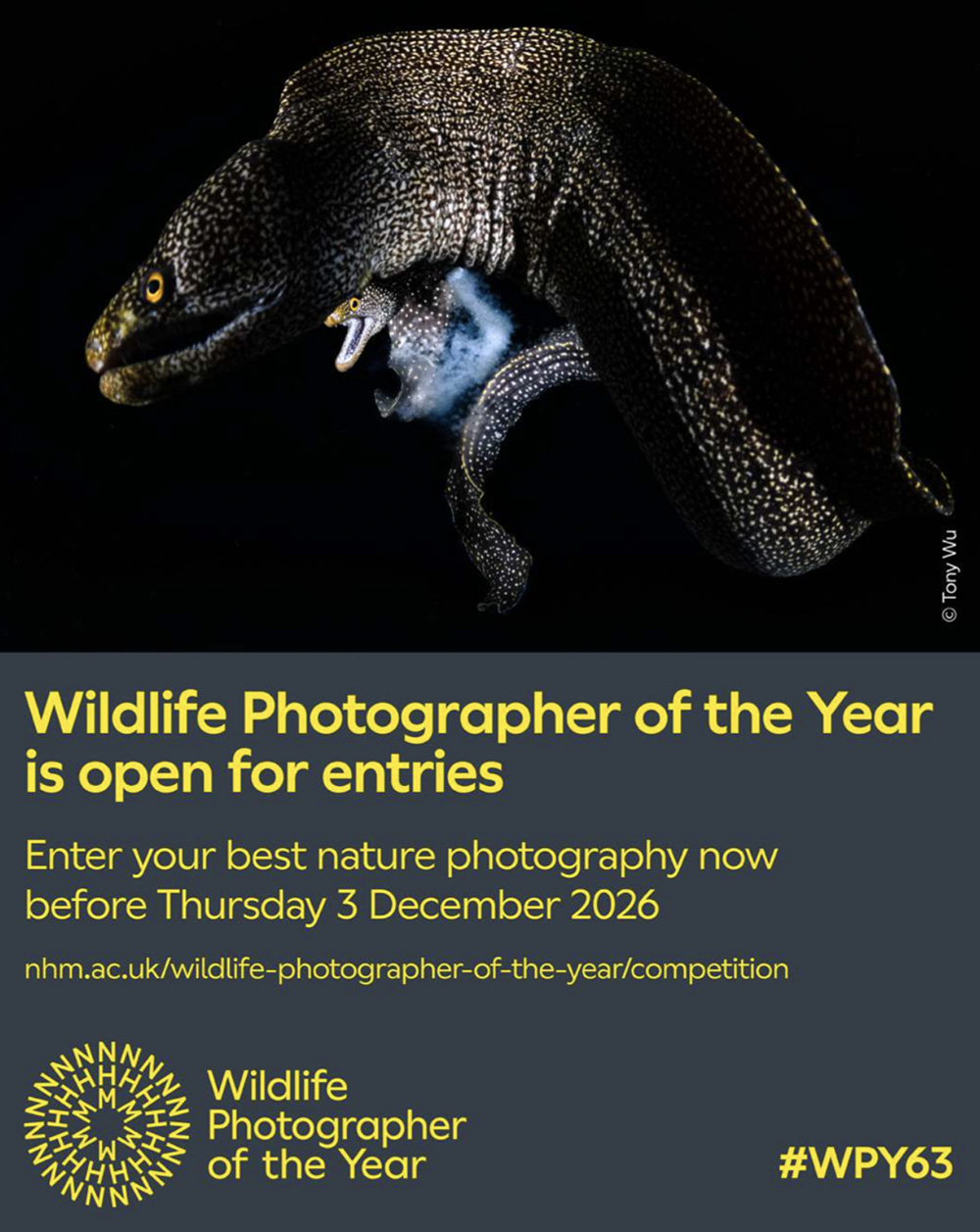
Three years. Four actually, if you count the year of our initial sighting and head-scratching.
That’s how long three friends and I have devoted to figuring out and documenting the reproductive social behaviour and biology of moray eels.
I am proud and delighted to share the news that one of my photos resulting from this project is the winner of the underwater category in the Wildlife Photographer of the Year contest for 2026 (WPY62).
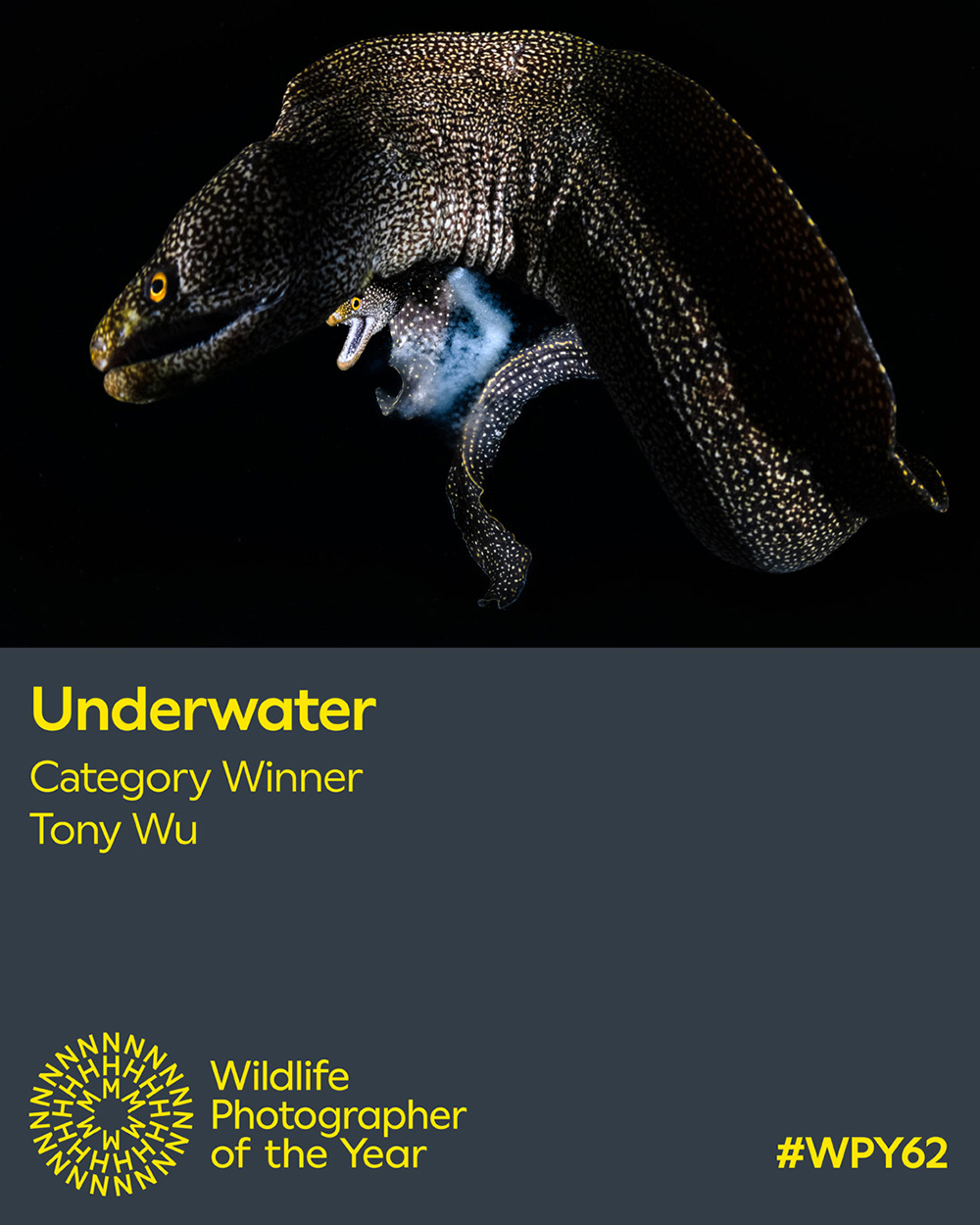
At this point, I have been thinking about eel spawning for exactly twenty years. My obsession began in October 2006 when I saw my first dragon moray eel (Enchelycore pardalis, not the species pictured above). I researched, soon learned that basically nothing was known about spawning eels. Ever since, I’ve asked anyone and everyone I’ve met who might have some idea of how these fish reproduce for clues. Nada.
This project, this subject, was the most difficult and challenging photographic endeavor that I have ever undertaken.
It was probably a good thing that the lucky break did not come until 2023, when we first stumbled upon spawning.
First of all, eel spawning takes place at night. It has to be dark, meaning you can’t use light. Not to see. Not to photograph. Eels seem to be relatively less sensitive to the red end of the visible light spectrum. They can tolerate weak, red light. But if you use strong red light, i.e., enough to accommodate normal human vision, it affects them. And if you turn on white light, fuhgeddaboudit. You’d be disrupting the eels’ behaviour, so that is an absolute no go.
No light = no autofocus.
Next, to say that the eels are lightning-fast is an understatement. They go up, they spawn, they go back. Around 1.5 seconds door-to-door in the case of my winning image. If you are not looking straight at them, you’ll never know that anything transpired. This in fact happened to me early on. While squinting to observe one pair of eels, another spawned directly behind me, almost on top of my head. I would have never known had one of my friends not been looking at me, gesticulating wildly. I spun around. There was nothing to see. Eels 1. Tony 0.
And even if you are staring at the eels when they spawn, it is impossible for our eyes and brains to process such rapid movement.
Let’s say you are in the right place, at the right time, aimed in the right direction, and you also manage to hit the shutter button. Capturing a coherent image with all the vital elements visible—male, female, gametes—means a fraction of a fraction of a split-second. Did I mention they go in unpredictable directions for unpredictable distances?
Also, remember that it’s dark. So the only light available is that which you apply, i.e., via flashes.
So there you have it. A summary of the photographic challenge. No light. No autofocus. The decisive moment being measured in milliseconds. Not to mention the usual challenges of being in the sea, at night, with limited air supply.
Easy peasy.
This is why I say that it was probably for the best that my chance to document this came now.
My friends Koji, Mei and Oyama-san were the ideal people to work with. Each of us has specific skills, experiences, and things we are good at. None of us alone could have pulled this project off. In fact, it was the exact combination of our abilities and temperaments that made it possible. Mei was the first among us to see spawning. She started all of this! Koji is a marine-behavior savant. Absolute world-class. Oyama-san is one of the most dedicated, diligent and insightful researchers I have ever come across.
Modern cameras can shoot many frames per second. The more fps, the better the odds of getting the decisive moment.
The flash I needed, the Backscatter HF-1, appeared exactly when I needed it, almost like magic, just weeks before I started. The flash can keep up with shooting at high frame rates. This was critical, because remember, the only light on the subject is the light one creates.
The lens that I ended up using the most was a modified Nikonos RS 13mm fisheye, courtesy of Isaac Szabo, certified genius and talented underwater photographer. Isaac had two(!) images among the Underwater category finalists in the contest this year.
National Geographic Society came into the picture with funding. I did not plan for this. I would never have thought to ask for it. But it happened. And thanks to NGS, I was able to transform this effort from me trying to get a photograph, to us researching and documenting the reproductive behaviour and biology of moray eels via direct observation in the eels' natural environment—the first time this has ever been done.
I won’t go into detail here about our research. I will just make the point that figuring out the social structure and behaviour of morays during the reproductive season was not just fun (and hard, hard work), but also a prerequisite for even having a hope of capturing this image. Our first academic paper, describing the reproductive behaviour of Gymnothorax eurostus, was recently accepted by the journal Marine Biology. I expect it will be published soon.
Lastly, I will highlight the fact that among the four of us, only one is an academic, a newly minted PhD. We had no academic institution behind us. Three out of four of us are not qualified to research anything, at least not on paper. We had no official anything, as a matter of fact. We are proof of what you can accomplish when you’re not educated enough to be convinced that you cannot.
The award ceremony was wonderful, as always. It was nice to see familiar faces, as well as to make new friends. The atmosphere of comraderie is palpable. I was particularly pleased to see many underwater photographers among the attendees. Especially the younger ones. I look to them to carry on the mission of figuring out and highlighting the beauty of lesser-known, non-charismatic subjects.
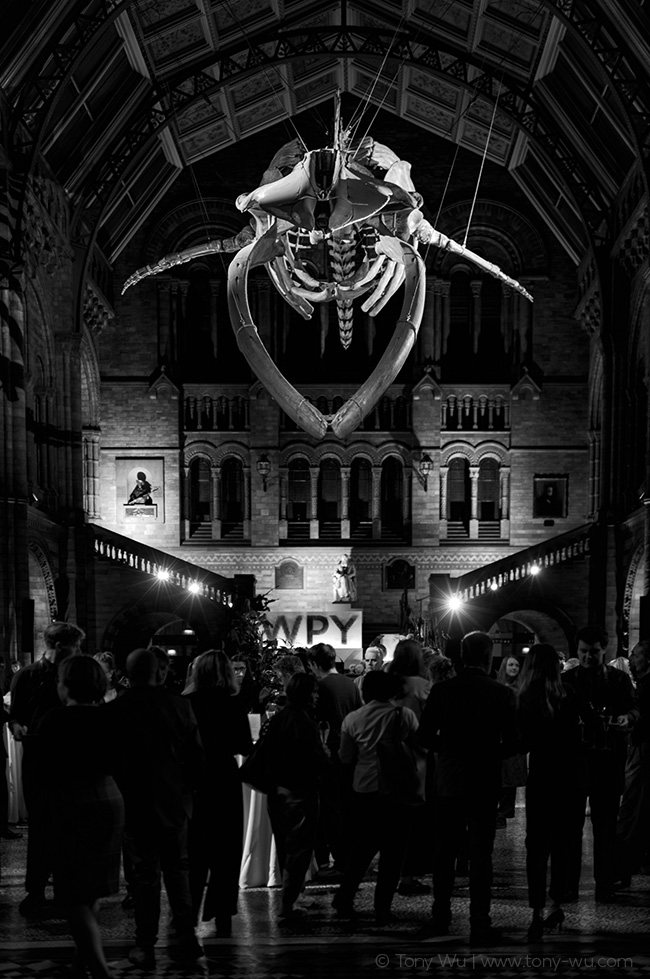
The event is held each year in Hintze Hall, the main atrium of the Natural History Museum London. The museum is of course jam-packed with people during the day. Upon closing at 17:50, the museum needs to prepare for the WPY evening. I don’t know exactly how things go in the hour+ prior to the event, but I imagine there is a considerable measure of chaos and consternation. It is no small feat to prepare the area beneath Hope the blue whale to host a dinner and show for hundreds.
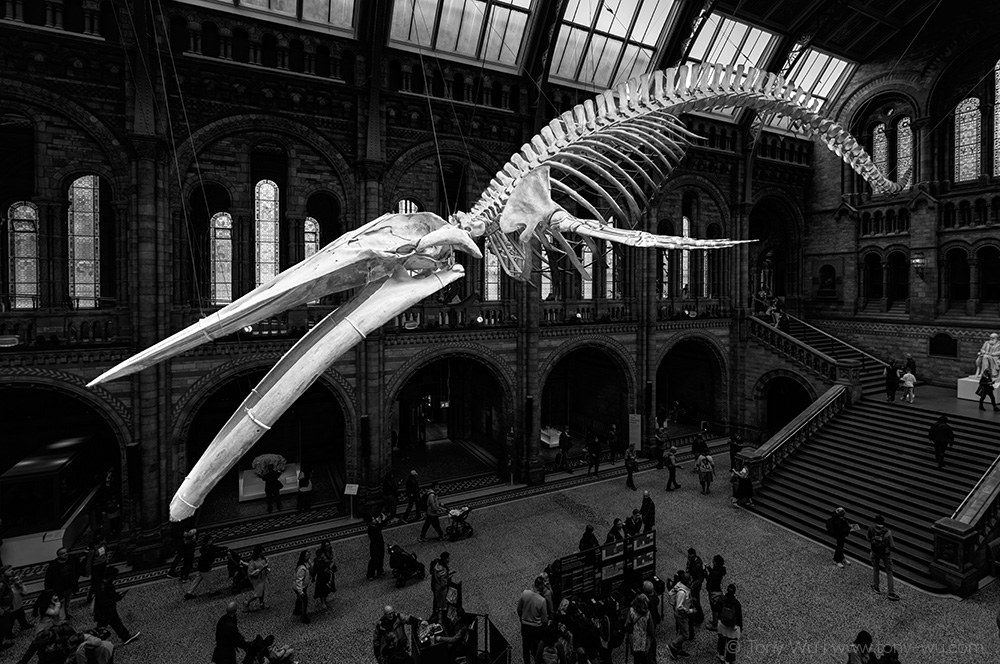
Category winners each received this blue whale, which I assume represents Hope as she would have looked in life.
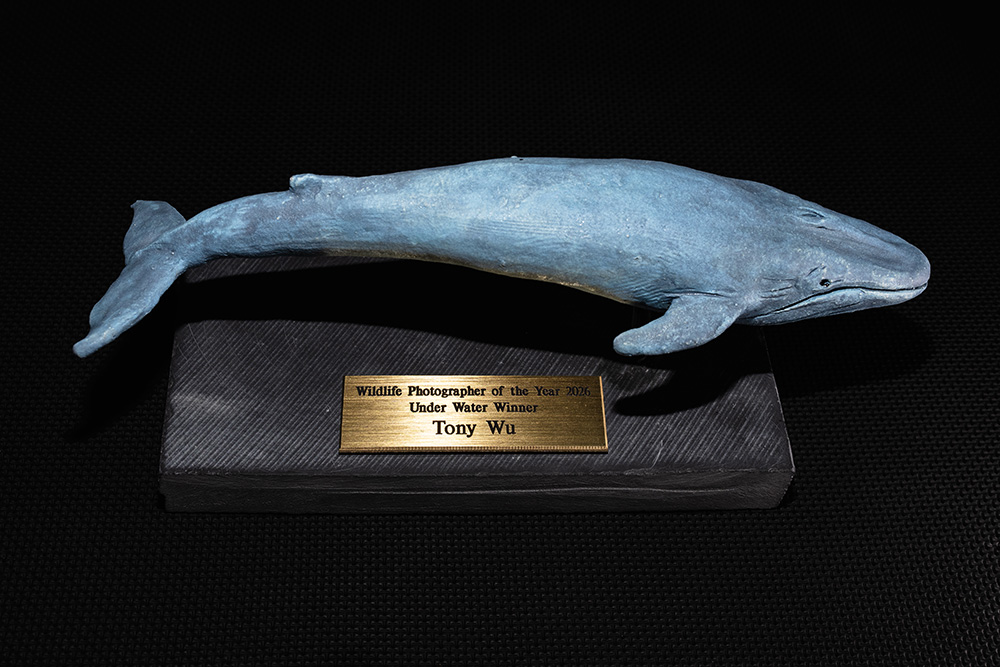
It is particularly meaningful, given how much time I've spent with blues, including swimming along several times with individuals within arm’s reach, accepting the gift of a spat-out krill from one, and finding myself two blue-whale lengths or more deep while freediving (more accurately, sprinting underwater at max effort), wondering how in the heck I’d ever get back to the surface alive (nearly didn't). They are…in case it needs to be said…big. And gorgeous. The experience of having one stare straight at you, follow you with its eye, stays with you for life.
The museum live-streamed the entire award ceremony. If you’d like to watch it, the link is here. My part starts around 2:01:00.
There is a meet-and-greet the night before the award ceremony. Photographers and friends who’ve already arrived in London have an opportunity to get together for a chat in a cozy venue on museum grounds. It is an opportunity to say hello and catch up. The award event the next evening goes quickly. There isn’t much time for conversation.
A feature of this first evening is a welcome speech from Gemma. She manages the competition, has done so for years. She says hello, tells us important things we should already know and need to remember, then chides us for inevitably forgetting. It’s a tradition. Especially the forgetting part.
There are two things you need to know about Gemma. She hates giving speeches. She hates having photos taken.
Naturally, I took photos of her while she was giving her speech. What are "friends" for?
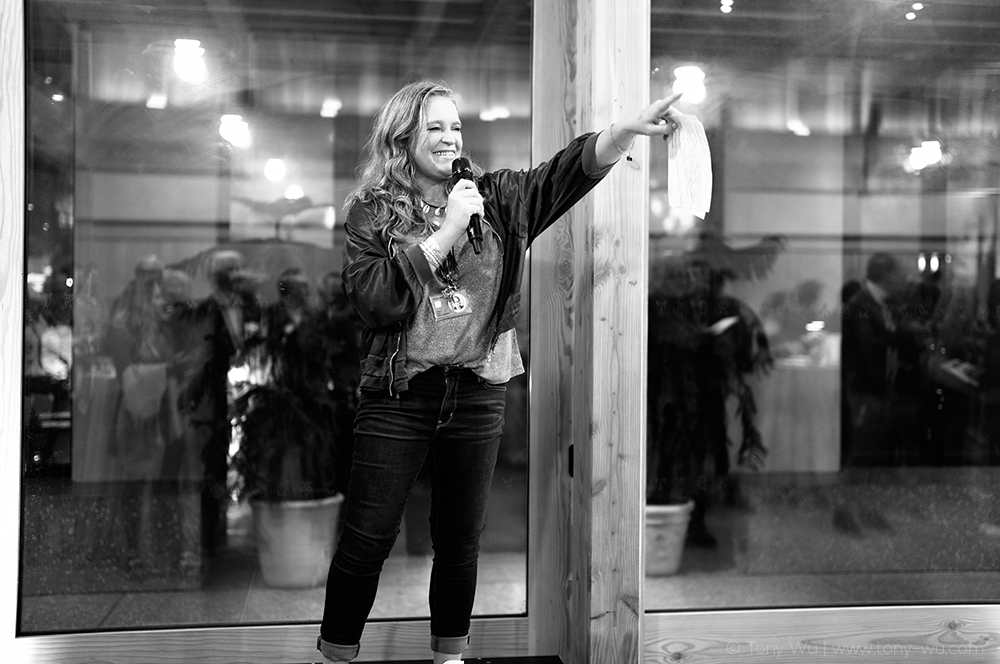
Always on the lookout for critical behaviour, I managed to catch the moment Gemma gave a shout-out to her adoring fans. That’s just the kind of person she is. Magnanimous.
The official WPY exhibition launch took place on the final night, with hundreds of invited guests. This year featured two large puppets(?) that ambled through the crowd. One was something with two horns. I was too far back to see. I assumed it was a bovine of some sort. There was a giraffe as well, which—being tall—was something I could discern.
“Huh, there may never be another occasion when a blue whale and a giraffe are together like this,” I thought. Hence, photo.
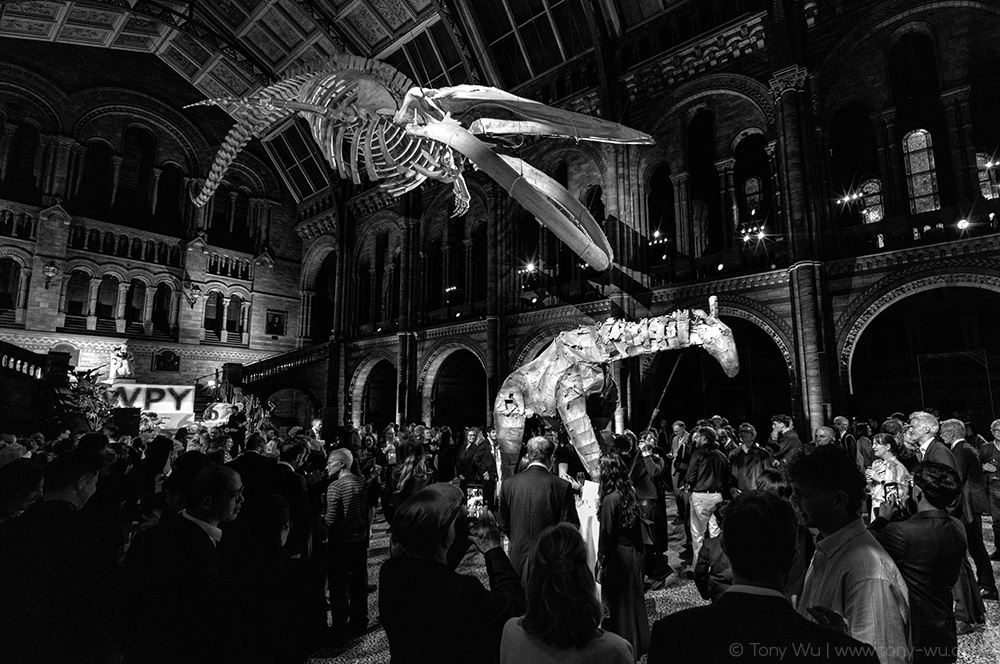
Here is a view of Hintze Hall that same evening, looking straight in from the museum entrance area:
This year was the year of bloopers, at least for me.
When I got to the airport in Japan, I found out that I need a visa to go to the UK, officially called an Electronic Travel Authorisation (ETA). I have traveled to the UK dozens of times over decades. This was news to me. Fortunately, I was several hours early, so I had time to fumble through the application procedure. I accidentally applied for a full-on immigration visa. Doh. Then managed—with help from concerned airline staff—to find the correct application for the ETA. ETA approval in hand, I got to the UK. While in-country, I was informed by relevant authorities that my application to immigrate was stupid. Not the word they used, but I got the message. And yes, I concede the point.
About 30 minutes prior to the award ceremony, I found myself half-dressed. There are three button holes at the top half of my tuxedo shirt. There are nice pretty button/ clasps that go into these three holes to prevent the shirt from flying open. Under normal circumstances, this poses no issue. Insert buttons, shirt secured. There was one minor problem though. The buttons were in Japan.
There I stood, facing the mirror, shirt askew. “This will not do,” I thought as I struggled with the implications.
Mental gears cranked. Creaking sounds and puffs of smoke ensued. The answer revealed itself.
I had a second pair of cuff links. Don’t ask why I had four cuff links but no shirt buttons. I used two of the cuff links to secure two of the button holes. They looked not entirely out of place. The third hole, however, did what buttonless button holes are wont to do. As long as I stood completely straight and still, the shirt sat pretty. One whiff of movement and it opened right up, introducing my mid-torso to a rather refreshing autumn breeze.
More turning of jet-lagged mental gears.
I had surgical tape. Don’t ask why I packed surgical tape but no shirt buttons. I used the surgical tape to tape the remaining buttonhole shut. I had to tape the inside of the shirt of course. The process involved creative articulation of fingers and thumbs. Eventually I got it all to work. Most surprising is that no one noticed and it all held together for the evening.
Take that, MacGuyver.
When I eventually got back to the hotel room, it was around 02:00. I wanted to shower and sleep, but I made time to post a short announcement/ thank you note in Japanese on Facebook, then crashed. I did not have time to go online for a day and a half or so. When I did, I noticed several messages, not a one that I understood. The messages were from people who do not speak Japanese. They hinted at something gone horribly wrong.
Friends in Thailand cleared it up.
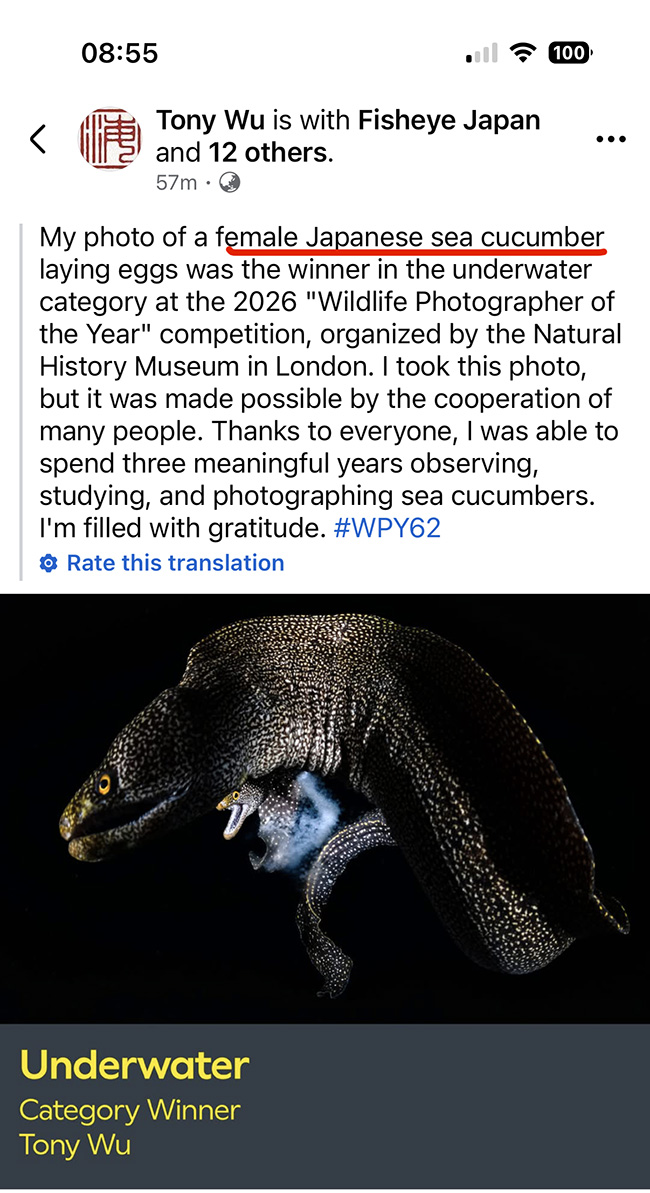
Facebook’s AI had decided that when I wrote the Japanese word for Gymnothorax eurostus moray eels, what I actually meant to write was sea cucumber. A sea cucumber that lays eggs, no less. Presumably sits on them until they hatch.
Silly me. Where did I go wrong?
Later, the Guardian decided that moray eels (or sea cucumbers as the case may be) are mammals:
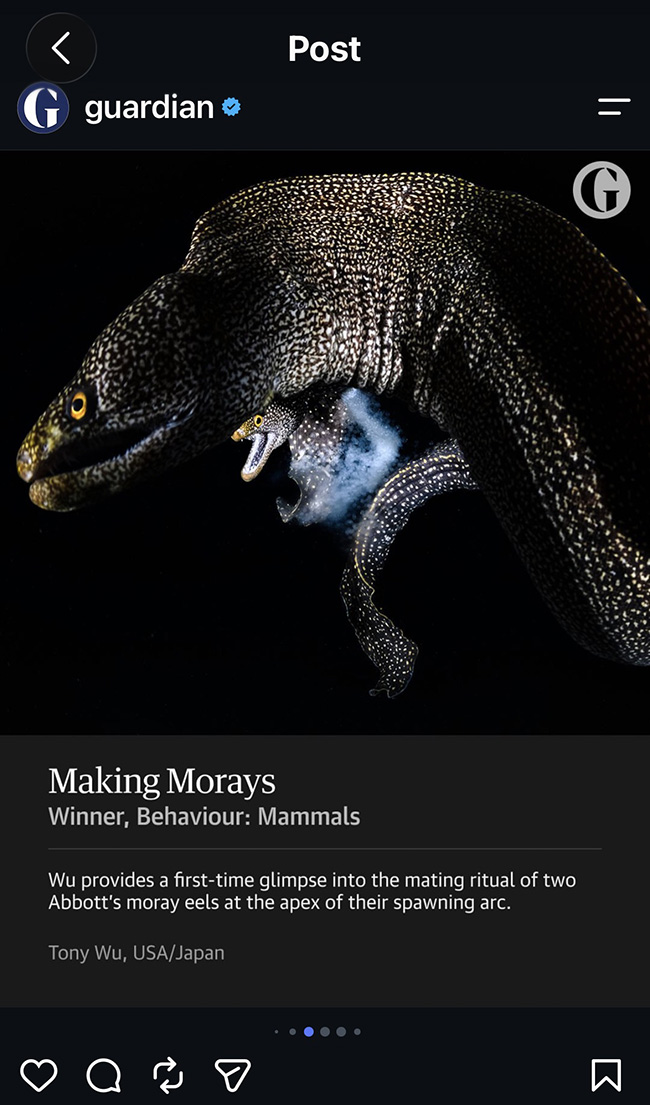
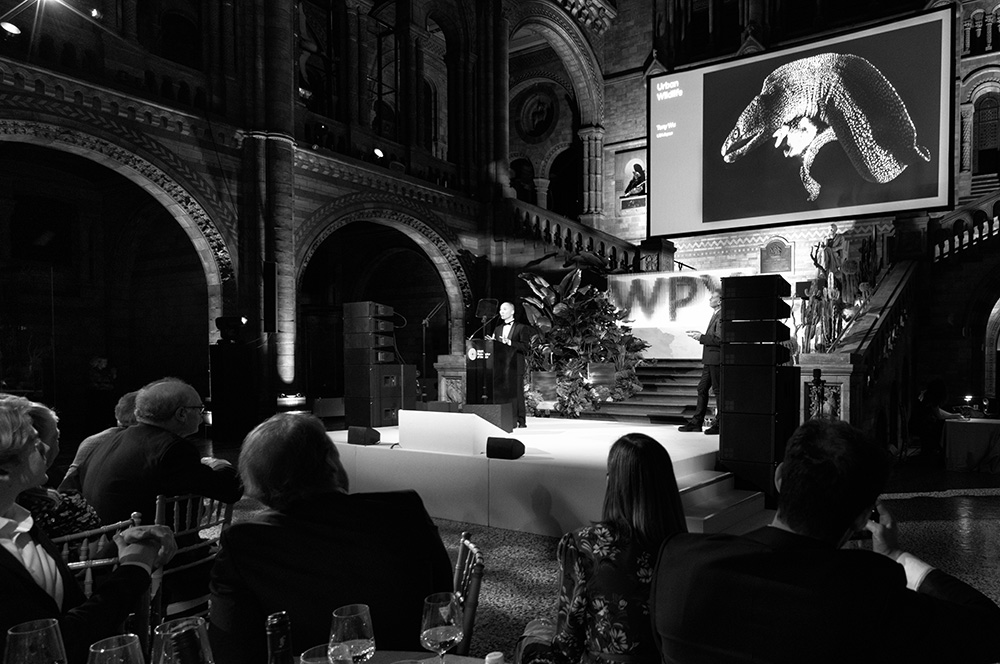
To be fair to the Guardian, WPY itself mis-labeled the category as Urban Wildlife during the award night (See photo above of me on stage).
This is all just proof that editors are necessary.
It is not the first time something like this has happened. Back in 2022, when my spawning starfish photo won the Underwater category, National Geographic Thailand decided that I had photographed mating electric eels:
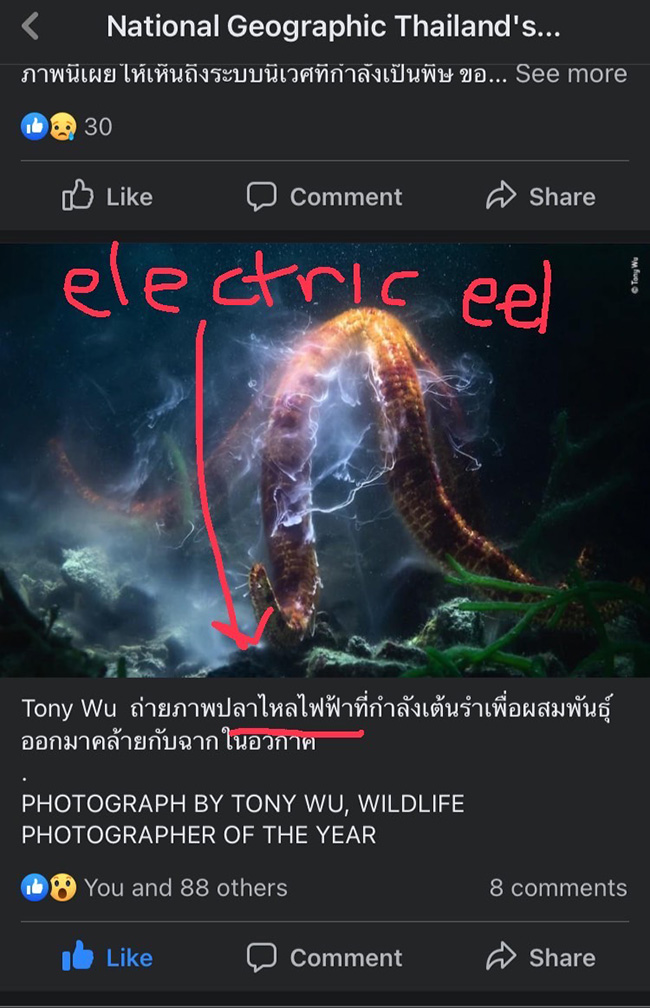
The only thing I was upset about was that I hadn't thought of that myself!
And finally, I saw this parked in front of the main gate of the museum:
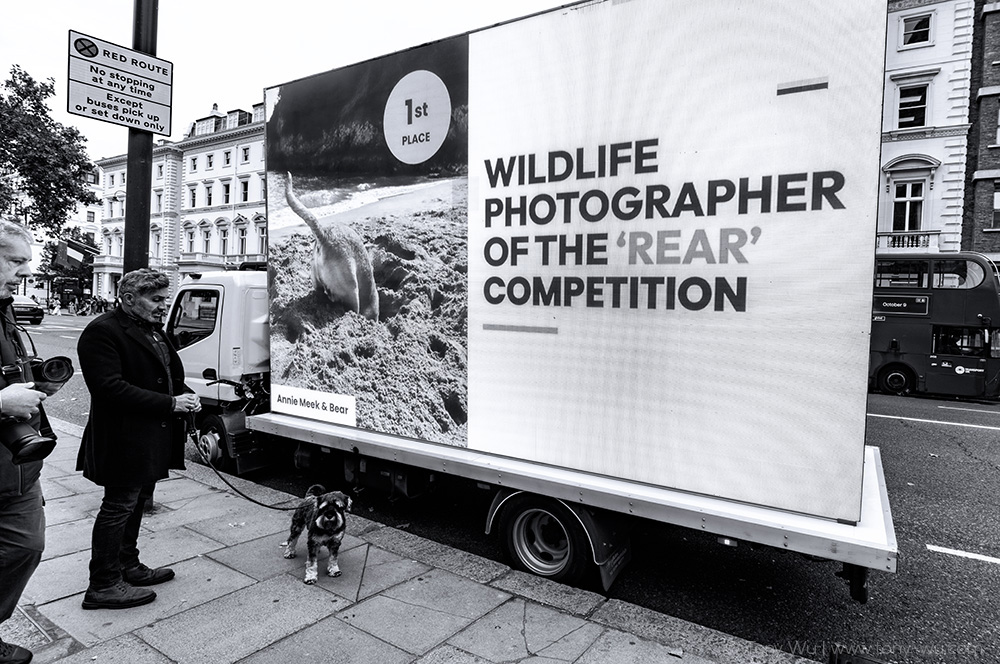
It was an advertisement for Yumove digestive supplements for pets.
"Cheeky," I thought.
I was, of course, obliged to wait for a representative of the target audience to show up before taking a photo.
Maybe Yumove will sponsor next year’s contest? I sense a new category waiting to happen.
Speaking of which, I will be one of the judges for the upcoming WPY63.
I did this for WPY60, not that long ago. It is a lotta work. This year there were more than 64,000 images. All judges have to look at every image. Say you take 10 seconds per image on average. That’s > 640,000 seconds. As basic algebra teaches, x = !!!!!!!!!!!!!!!!! collapse.
The upside is that judges get to see the best collection of entries in any nature photography contest in the world.
The process culminates with all of us coming together in a cold, dark room next year for a week. Long days, minor breaks, little to no sunshine. The process can be exhausting, draining, frustrating. I can say from my previous experience though, seeing the final result makes the toil worthwhile.
As a bonus, I get to take more photos of Gemma.