This is a follow-up to my earlier post titled Quality of Light, where I set out the case that sometimes it makes sense to think beyond using standard diffuse, wide-angle lighting for photographing underwater. Images I took with the help of the Backscatter MF-1 and MF-2 (latest model is the MF-3) feature heavily in that post, as the MF strobes provided me with lighting options that had not been readily available before.
This post addresses other important aspects of lighting, namely power and speed.
I am going to start with the conclusion.
I have been using the Backscatter HF-1 almost since the day it came out in 2024. It is my favourite all-around strobe ever, because of its power and speed.
My objective with this post is to explain why I love the HF-1 and to share specific examples of how the flash's capabilities have helped me to take photos that otherwise may not have been possible.
Before I get into it, let me state for the sake of clarity that this is not a paid/ compensated post. No one asked me to write this. Backscatter was not originally aware that I was writing this, but is now because I mentioned it to them last week in the course of other communication. Backscatter has had no advance knowledge of the contents of this post, and may or may not like/ agree with my views. Backscatter sent me two HF-1 units in 2024 at my request. I purchased two strobes thereafter because I like them so much.
Let me start with this image, which was the winner of the Underwater category of the 2026 Wildlife Photographer of the Year contest (WPY62).
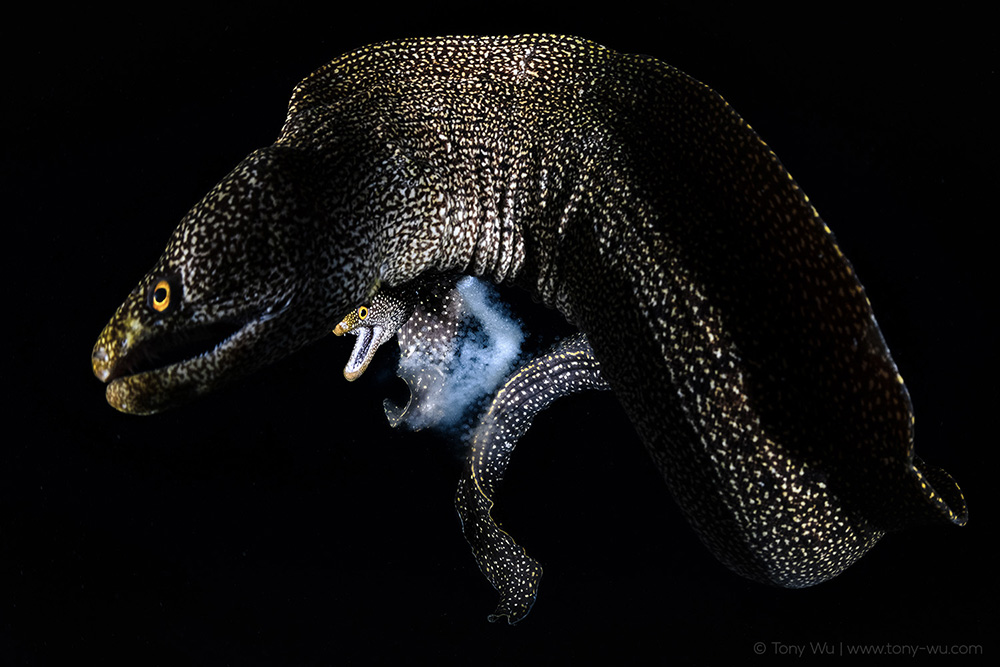
The image above is one of many that came out of a three-year research project, during which friends and I documented the reproductive behaviour and biology of four species of moray eels. The photo shows spawning moray eels. The male in the foreground has done his thing and is headed back to the cover of coral (Yes, yes, I know. Men.). The female, on the other hand, is still hard at work. She is shooting out eggs and stirring them in with the male’s gametes to maximise odds of fertilisation.
The moment depicted is a fraction of a fraction of a split-second. Describing it as the blink of an eye would be to grossly overstate the duration.
This image would not have been possible without the HF-1.
"Why?” you might wonder.
Because of two things—power and speed.
Let me define those terms before going on, so we share the same understanding.
By power, I mean the output of light, the absolute quantity. This is often expressed as guide number, which helps for comparisons among different strobes. The bigger the number, the more light the strobe produces. FWIW, the guide number for the HF-1 at full power is 29, with two extra levels above full that provide guide numbers of 34 and 40. The guide numbers are expressed in metres at ISO100.
If this is semi-gibberish to you, don’t worry about it. The exact definition and calculation are less important than hands-on experience.
The bottom line is that the HF-1 pumps out a lot of light. And the light coverage is wide and even to boot.
This description is an intentional simplification. If you are interested in charts, comparisons and such, people who do tests under controlled conditions can tell you more.
I prefer to get into the ocean, find something stationary, take photos. Figure out how things work.
The HF-1 provides more light output than any strobe I have ever used. This is not to say that there are no other strobes that can do the same, or perhaps even produce more light. Many strobes have come out in the past two years since I started using the HF-1. I have not tried them all, so I am not in a position to assess.
What I am saying is that finding myself with such a massive upgrade in light output was welcome. And necessary actually, in order to document the types of cryptic behaviour that I have been pursuing in recent years.
All other things being equal, having the option to apply more light is better than not having that choice available. You can turn down light. You can’t turn up light that isn’t there to begin with. (I know you can use software to futz with exposure, but that is a different subject.)
However, having a flash that can output lots of light does not ensure success in situations where fractions of a second can mean the difference between an incredible image and ^&$%*(OI#!!!!
You need a strobe that is capable of throwing off light over and over, as quickly as possible (to keep pace with rapid shutter rates), in a sustained manner (i.e., dropping as few frames as possible).
This is what I mean by the term speed.
How quickly can the strobe recycle to provide the power that you need? Emphasis on “power that you need."
Manufacturers’ specs often provide recycle time to full power, a useful benchmark. We would all rather have 1 second recycle after shooting at full power than 3 seconds, for instance.
But in most real-life situations, one doesn’t need full power.
More useful to me is, for example, how quickly can the strobe recycle back to say, 1/8th power?
If the recycle time is rapid enough, you can shoot at that setting and keep shooting until you stop shooting. The practical implication is that you open up the possibility of capturing behaviour too rapid for our eyes, brains and reaction times to follow, by pairing your strobe's power and speed with the rapid frame rates of modern cameras.
This is where the HF-1 excels.
I have spent much of my time in recent years trying to document split-split-split-second moments. Things that take place so quickly that I can’t actually see and perceive what is happening, much less react to it in a deliberate manner.
The amorous eels above are a perfect example.
Here is another one, the moment of birth of a Hexagrammos otakii greenling:
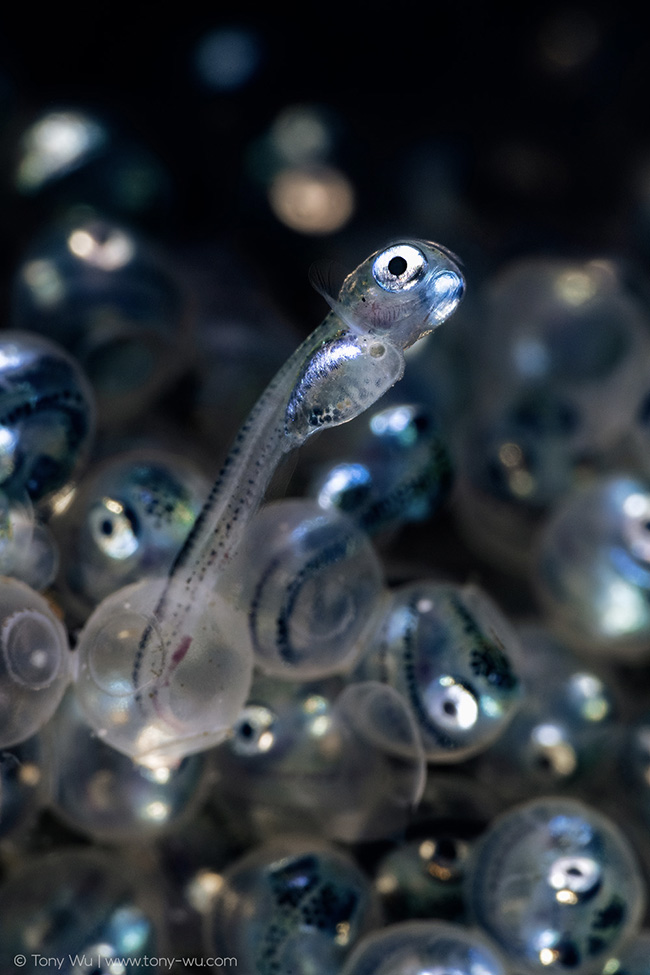
The juvenile is probably around 1cm ( about 0.4 inches) in length. The entire hatching process can take some time, but lift-off happens quickly. Sort of a “wait for it….wait for it…WTF? Where'd the baby go?"
Close-up, at super-macro scale and distance, I only needed a fraction of the HF-1’s full light output. I don’t remember the exact settings, but I’d wager that I had my strobes at maybe one notch above lowest power, for f16 @ ISO500.
I used a Sony a1, mechanical shutter at 10fps. The HF-1 strobes kept up, meaning that the time the strobe required to recycle back to the power setting I was using was faster than 1/10th of a second, for the duration that I had the shutter depressed. This made it possible to capture the exact instant when the young fish achieved escape velocity (after many, many failures and accompanying expletives over the course of many days).
Another example from colder climes—freshwater in this case—is this male pink salmon (Oncorhynchus gorbuscha) shooting through a curtain of bubbles during reproductive season:
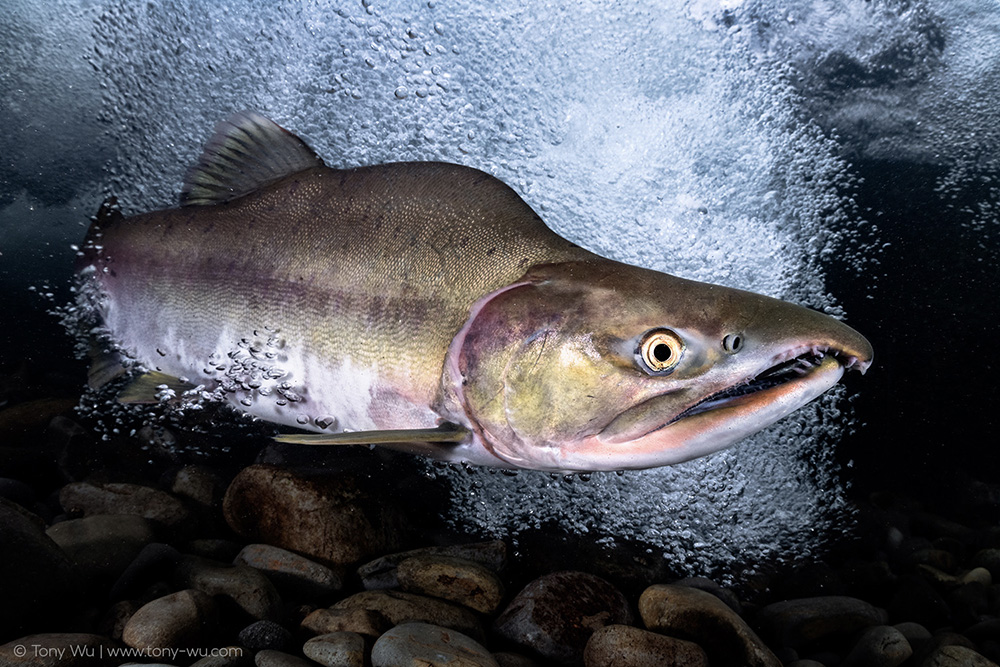
I picked a spot that allowed me to lie prone in front of a waterfall. I waited. And waited. Fish charged through. I missed. And missed. Not because of equipment, but because my reactions were too slow. Predicting and reacting to the moment a fish jets out from a continually morphing maelstrom of mayhem is difficult.
In this instance, I caught a glimpse the tippy-tip of the fish’s rostrum (aka, nose) just before the fish emerged.
I was able to photograph several frames, again at 10fps, every frame fully illuminated by my HF-1 units. Time elapsed was maybe a third to half a second.
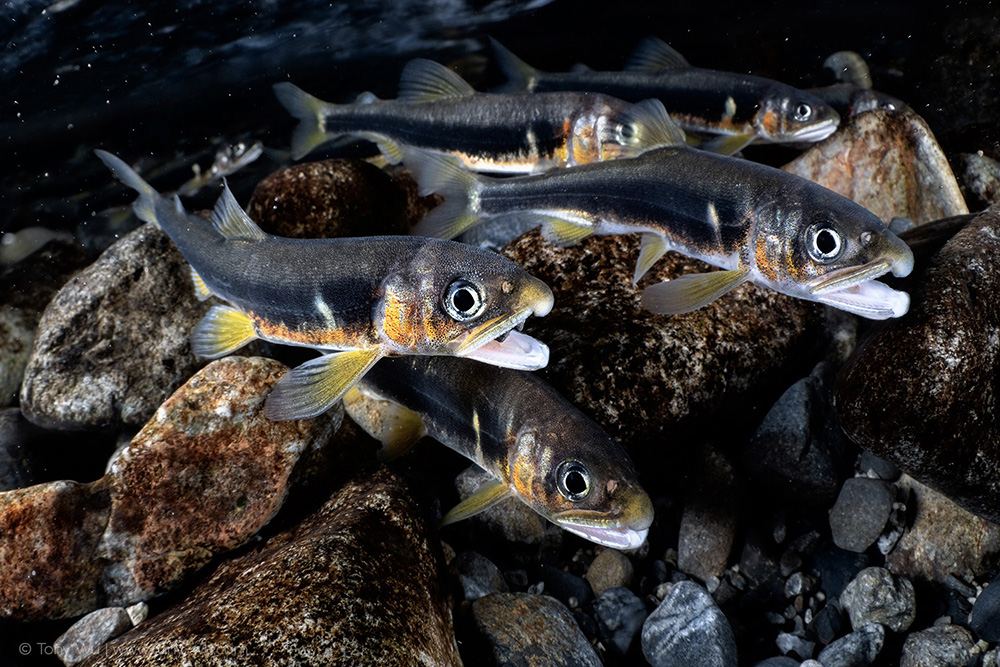
The next photo shows spawning of ayu sweetfish (Plecoglossus altivelis), an amphidromous fish species, in a river.
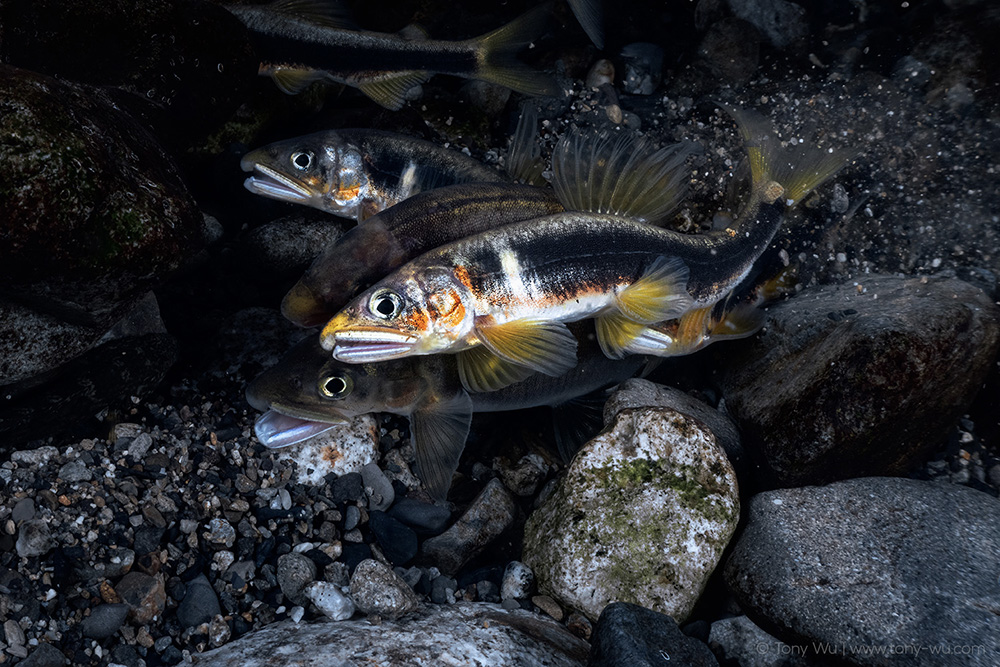
The colourful one with flared fins and an expression of triumph is the primary male. The drab fish beneath is the female. The others behind are more males trying to get in on the action. Despite what appears to be less-than-optimal positioning of the secondary males, these fish must succeed sometimes, fertilising a portion of the eggs during the spawning scrum. Otherwise, why bother?
Like many other spectacular moments in nature, the lead-up to spawning can be uneventful and oh-so-ridiculously boring. The ayu lull you into complacency. Then spawning happens. Or rather, happened. By the time you’ve cottoned on, it’s ancient history.
This is what it looks like when a pack of the smug little fish rush past to mock your sluggish reactions:
At the risk of being repetitive—power and speed.
I got lucky, pressing the shutter when I did, but the fleeting nature of the decisive moments in all of these instances is such that the chances of hitting the exact point in time by shooting a single frame is exactly zero.
Rapid-firing results in lots of less-than-useful RAW files after the fact. I generally do not photograph in this manner. I shoot relatively few frames, having been conditioned by the 36-photo limit of film.
But there is no alternative when attempting to capture behaviour of this nature.
Until recently, the primary bottleneck for most underwater imaging of this nature has been light. More specifically, the inability to apply artificial light at quantities and rates sufficient to keep up with modern cameras.
The HF-1 has gone a long way to solving this problem.
It can’t keep up with the highest end of the fps spectrum (which I think is the Sony a9iii at 120fps at this point), but in many instances, the HF-1 can shoot continously for long enough and rapidly enough to open up the possibility of documenting impossible-to-see decisive moments.
In practical terms, this means the bottleneck is now less about equipment and more about human perception and reaction time.
I should point out that besides helping me to document split-second behaviours, the HF-1 has been particularly helpful in two other situations.
The first is sort of obvious—those cases where showing entire sequences is useful.
Take this series of three images showing Centropyge vrolikii angelfish spawning for instance:
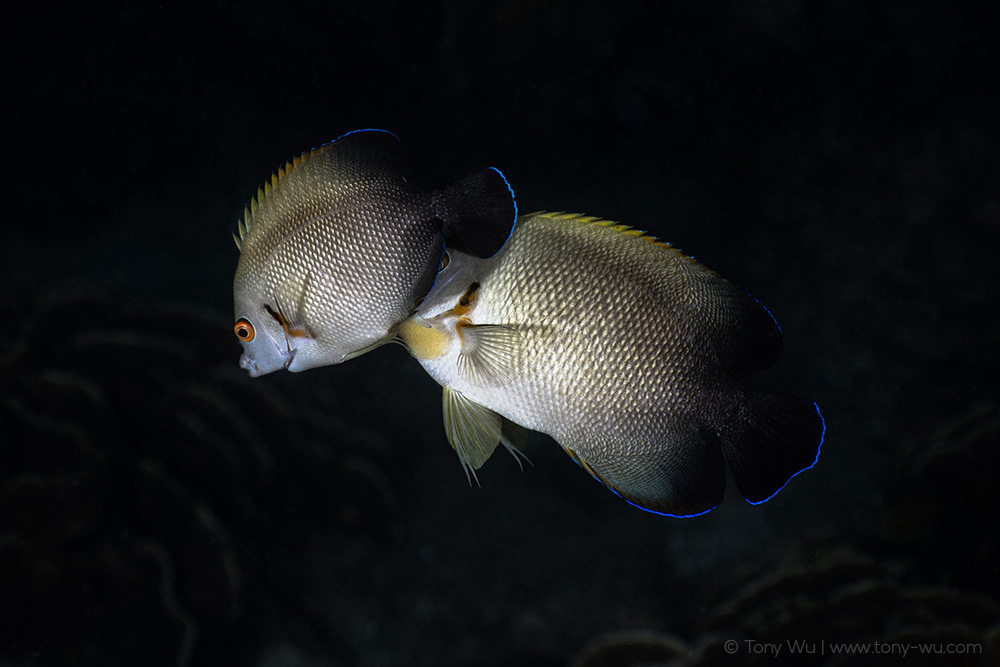
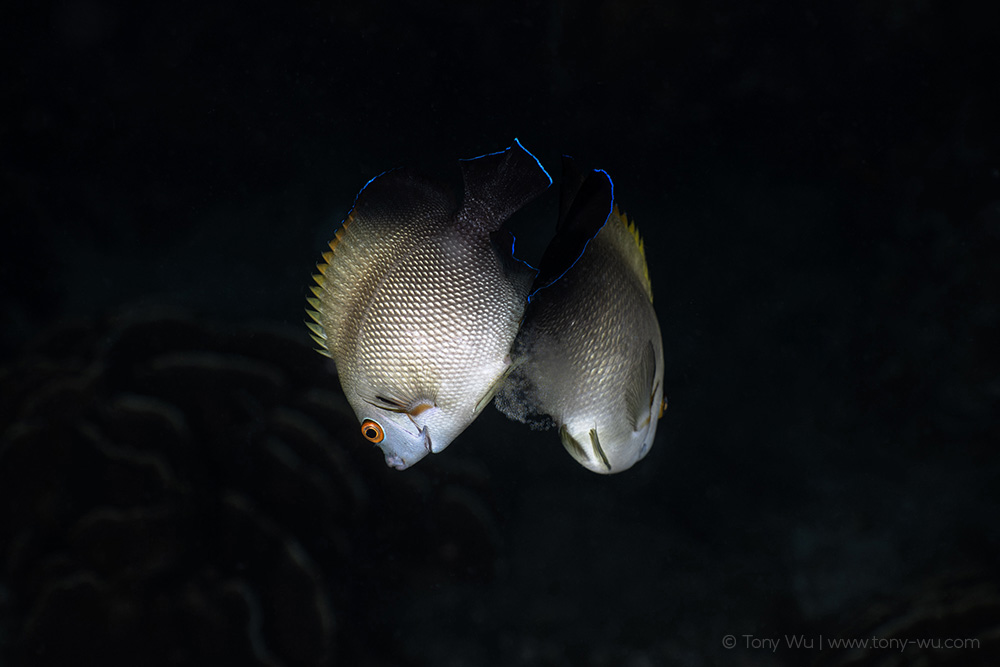
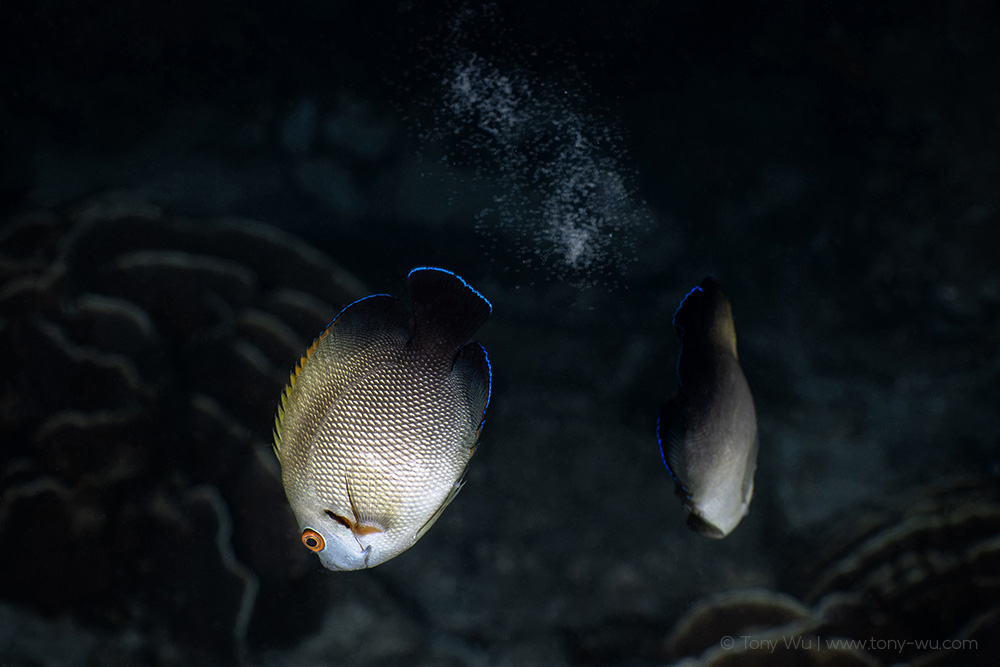
I used a Nikon D850. The camera shoots 7fps, meaning these three consecutive images depict elapsed time of less than ½ a second.
Three back-to-back images convey more information than a single image can.
Cool, no?
You might think that three images in a row is not impressive, meaning that many strobes can do the same. Some probably can. But I also have behavioural sequences comprising 10+ images, all well lit. And then there are those times when it is necessary to take several shots in a row, pause for a split-second, do it again. And repeat. Performance in real-life situations like these is difficult to measure and convey in easy statistics like guide number. I can just tell you, the HF-1 works.
The second situation might be somewhat counterintuitive. The HF-1 has proven useful in circumstances where there is little-to-no action, or where movement is super-duper slow.
A good example is the following photo showing developing embryos of Japanese pygmy squids (Idiosepius paradoxus). The eggs are tiny. They are arranged on a blade of seagrass.
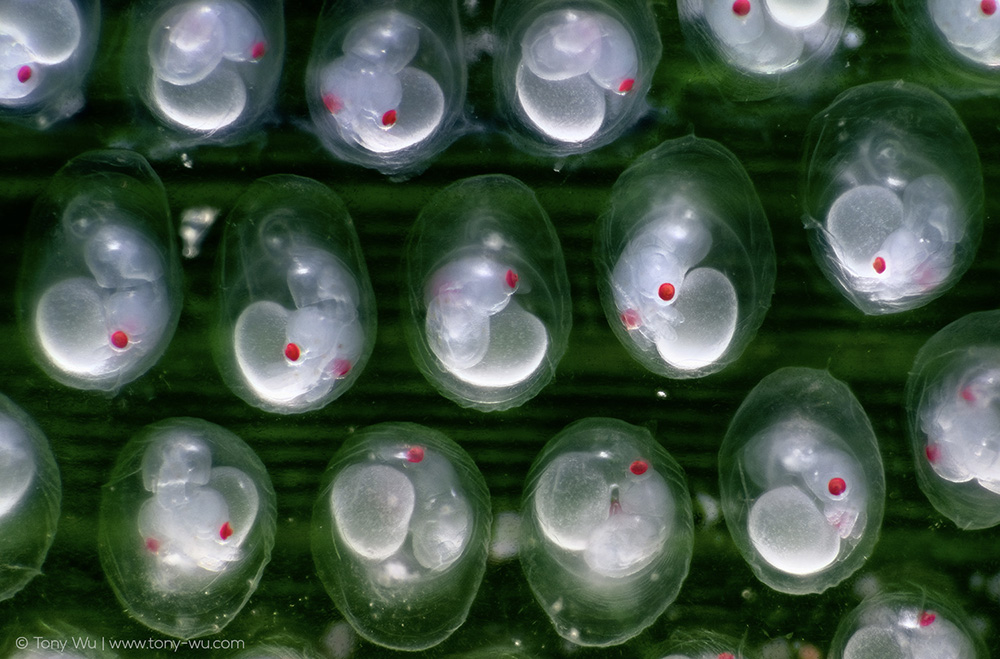
My equipment was a Sony a1, 90mm macro lens, and an SMC-2.
If you’ve used a similar set-up, you’ll know how frustrating it can be. Every movement is magnified. Depth of field is razor-thin.
On top of that, the ocean is always moving.
The substrate shifted. The seagrass swayed. I was moving. The camera was moving. All of this motion was subtle, barely perceptible, but more than enough to make photography difficult (such an absurd understatement).
Using the HF-1 gave me the slight edge I needed to even have a hope of success. Once again, at such close proximity, the power required was not high. Recycle speed was rapid. This allowed me to shoot multiple continuous frames whenever I thought I had achieved correct focus. (As an aside, I used one HF-1 as a trigger, the other as a remote. This increased the odds of producing consistent lighting, since the remote flash never moved.)
My eyes hurt. My body ached. My success rate was so low as to round to zero.
But I eventually succeeded, and I am now a certified expert in deleting useless RAW files.
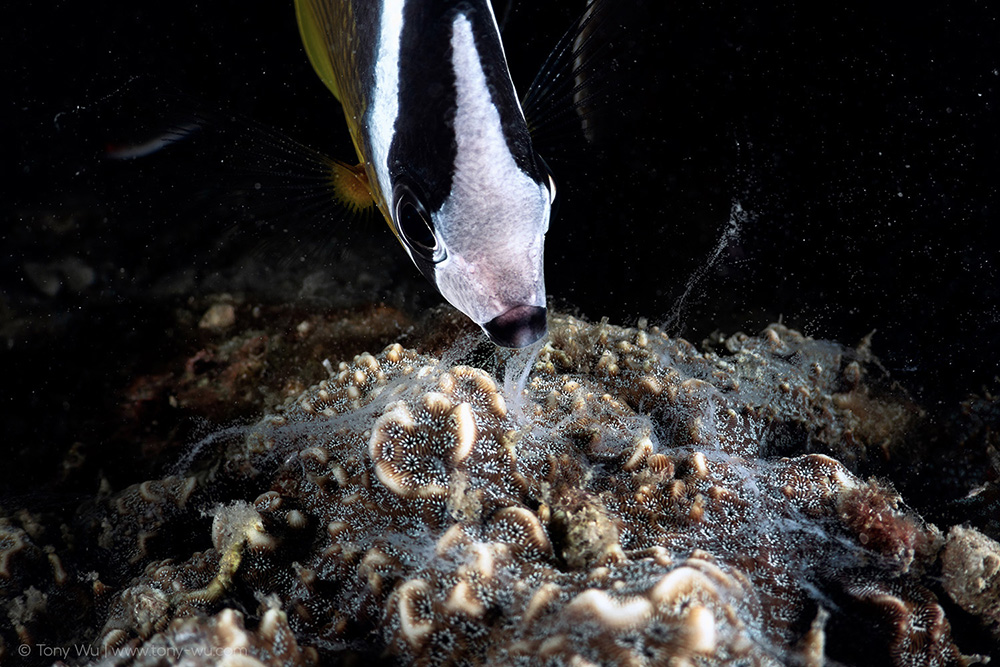
Above and below are a couple more examples of when the HF-1 made the shot. More accurately, my HF-1 flashes made it possible for me to shoot sequences comprising dozens of sequential frames, with every frame well-lit, then immediately do it again, and again, and again. Until I was able to capture the precise millisecond that matters.
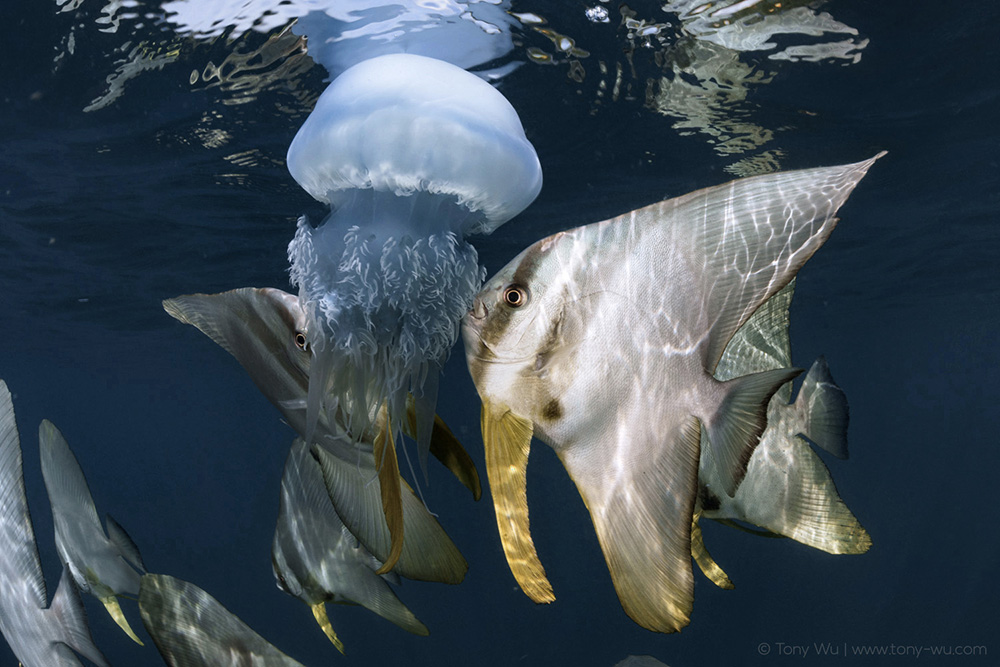
I have now been using my HF-1 strobes since mid-2024. I know the flash well.
The strobe literally helped me take an award-winning image, plus many more photos that capture critical moments of behaviour. It has provided me with both the power and the speed needed to photograph events that would have been much more difficult (likely impossible) to capture with older lighting gear.
Let me wrap-up by considering the question: "What makes a strobe good?”
This is, after all, probably what you want to know.
The most accurate and honest answer is something along the lines of, “Whatever best suits your needs.”
Since I started devoting a lot of time to researching and pursuing difficult-to-document behaviours, power and speed have become increasingly important. The more power at my disposal, the better the chances I have of applying sufficient light. The more speed I have, the better the chances I have of capturing the decisive and critical split-second with that light.
In other words, greater power + speed stacks the odds for success in my favour.
If you are hoping to take behavioural images involving rapid movement, you can’t go wrong with the HF-1.
The flip-side is to ask whether the HF-1 (or other similar strobe) is right for someone who is not pursuing such subjects.
Yes and no.
The HF-1 is undoubtedly a great choice if you’re photographing wide scenes in clear tropical conditions, say lush soft corals covering a reef or wall. The flash produces lots of even light, 160º of coverage with the dome diffusers, 140º with the flat diffusers. The same probably holds true for wide scenes in cold green water, as the selection of diffusers for the HF-1 includes 4500ºK for this exact situation. Diffusers also come in 6500ºK, 5500ºK, and ambient. To date, I’ve only used the 6500ºK and 5500ºK, because those are the ones that have best suited the conditions I’ve been working in. I always have the others with me though, just in case.
For other situations, strobe choice can be more nuanced. Say you love photographing nudibranchs that don't move much. One could argue that hauling big, powerful strobes on a long overseas trip might be overkill. But what if you get word of a pair of plump orange frogfish lounging atop a gorgeous sponge? Or maybe a purple lacy Rhinopias posed to perfection in crystal-clear blue water? You’d probably be happy to have powerful strobes.
Cost is always a consideration. Larger, more capable strobes are more expensive than smaller ones.
And finally, there is the pain-in-the-rear factor. Bigger means heavier and bulkier. Bigger can also mean difficulty photographing in restricted spaces. Bigger strobes that boast a wide angle of coverage can even be counterproductive in some situations, like when you want to apply selective lighting for smaller subjects. (Discussed in my previous Quality of Light post.)
This is why there is no single correct choice. No such thing as a best flash.
The optimal choice is always the flash or flashes that best meet your personal circumstances.
HF-1 strobes have become my go-to when I need power and speed above all else. Spawning moray eels—spawning anything actually—are the perfect example.
When flexibilty and a desire to sculpt illumination are the primary considerations though, I use my MF-2 strobes. The same holds true when I know I will be working within tight, restricted spaces.
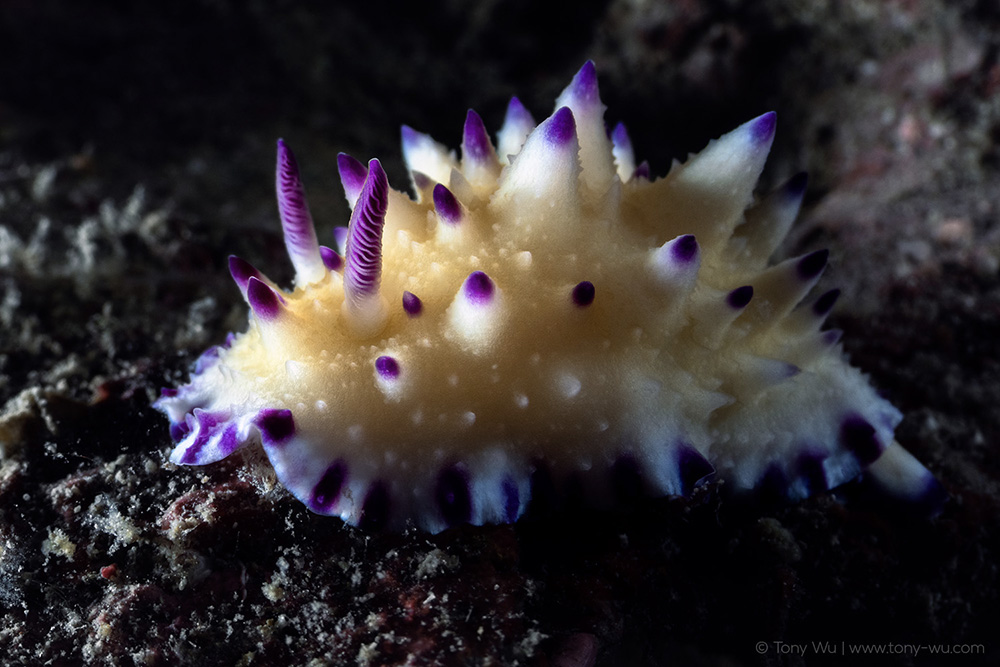
And then there are situations when I need both. Say for example, using diffuse light to mimic ambient or act as fill, while using directional, sculpted light to emphasise the main subject or behaviour. In such instances, I would use a combination of HF-1 and MF-2 flashes, refining as appropriate by using the diffusers and snoots made for these strobes.
My purpose in writing post this is not to be a salesperson. This post and my previous one about light quality are together intended to offer you a top-level view of what I consider to be the three foundational principles for lighting underwater—power, speed, and quality—without resorting to technical jargon.
The Backscatter HF-1 and MF-2 are the primary strobes that I use now.
But the concepts I've set out apply irrespective of which make or model of flash you choose.
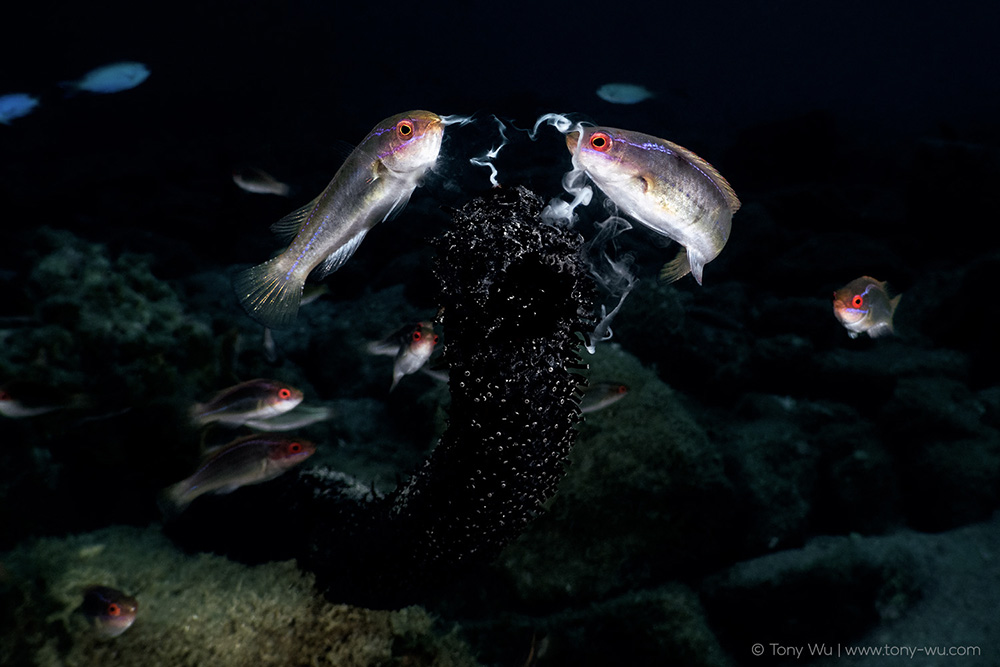
I’ll leave you with two more photos made possible by the HF-1. The main animal depicted in both images is a decidedly non-charismatic black sea cucumber (Holothuria leucospilota). This species is not particularly popular among divers, because the animal usually looks like an elongated turd. A prickly one at that. Ouch.
This is a male engaged in broadcast spawning:
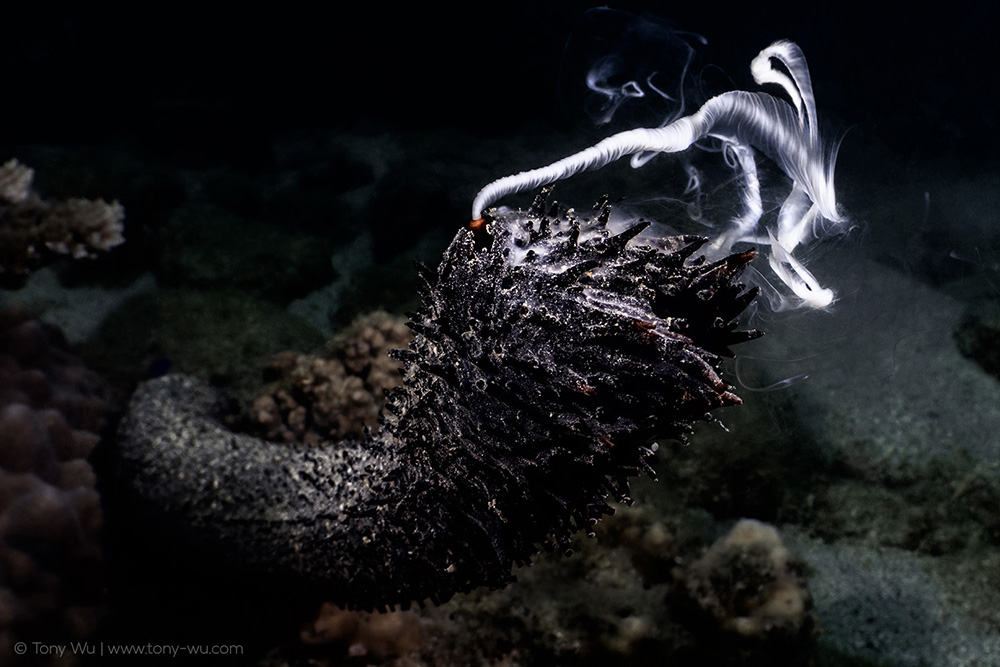
Spawning cucumbers broadcasting genetic material into the sea sway in a haphazard fashion at an irregular pace. The emissions, ahem, are also not predictable. It happens. Stops. Trickles. Stops. Gushes. Stops. Spurts again when you’ve given up. All while the cucumber swings around at random. Currents and swells wreak havoc on streams of gametes too. Photographing is a frustrating endeavour.
To close, one final image involving a male cucumber and split-second action.
I’ve titled the photo ménage à trois.
Please consult a knowledgable adult if you need this explained. And then ask them why/ how they know.
Note: For objective testing of a variety of strobes, see this article by Backscatter. I had no idea they were doing this. I came across it as I was proofreading this post. The article provides numbers and charts for comparison among many strobes, useful if you’re in the market for a new flash, or even if you just want to learn more.