This is Acropora coral spawning.
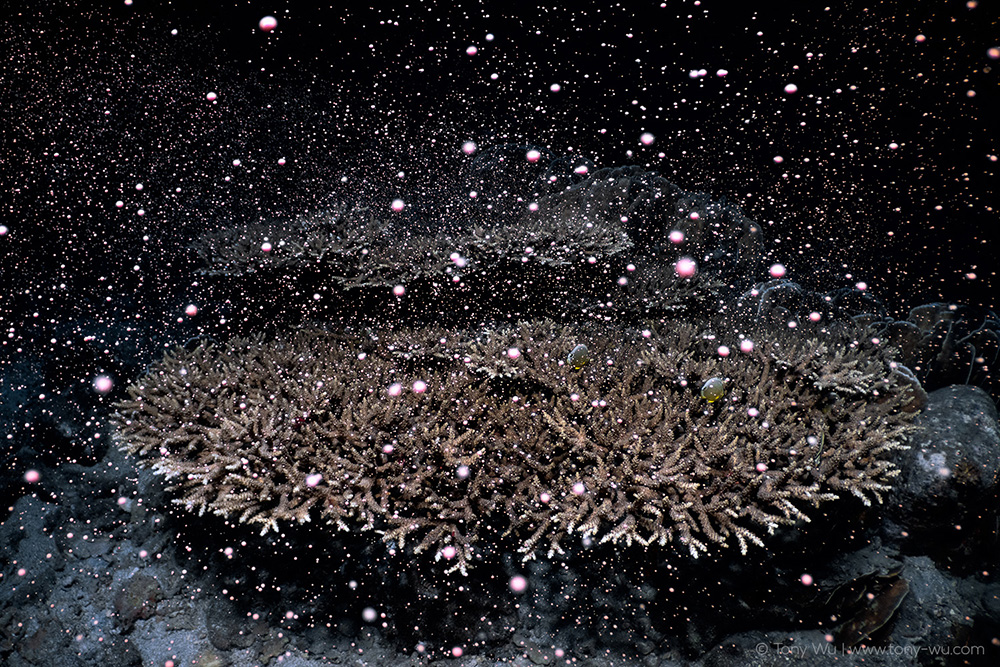
The pretty pink balls are bundles of gametes, i.e., sperm and eggs, released by polyps—individual corals that comprise coral colonies. As the bundles float up to the surface, they split open to release their contents, the goal being mixing of gametes to make cute little coral babies, called planulae (planula = singular). Planulae then saunter off to find a suitable place to settle, with the hope of establishing a new colony.
This reproductive strategy is called broadcast spawning. Once settled, corals can't move, so instead of getting together like more mobile animals do, they cast their genetic material out into the water, all at the same time.
Sheer quantity ensures many opportunities for success, in spite of high loss due to factors like predation and stranding.
Fish love a free dinner as much as anyone else. Corals like this tend to be in shallow water near land. Currents can nudge bundles and planulae onto shore and into other dead-ends like tide pools.
Coral spawning is a reasonably well-documented thing. In many places, researchers and divers have figured out when spawning takes place, down to the pertinent day or days, as well as time. People travel from all over the world to areas like the Great Barrier Reef to witness this spectacle. In Japan, there are popular spots in Okinawa and other areas.
I've always wanted to see this happen, but have never been able to find the time to go to well-known spots on the appointed days. Such areas also tend to be crowded, which would make photography a frustrating endeavour.
Surfacing after a dive one night, a friend said, "I think the coral is going to spawn tonight." We were in a location we'd collectively dived thousands of times. Although we were aware that it was the correct season for coral spawning, figuring out the timing was not the focus of our efforts. We were occupied with other things.
My friend had seen polyps preparing bundles though, the telltale sign of impending reproductive activity. He described the location. I knew it immediately.
We went back in after a while. Just three of us.
Soon thereafter, little pink packets appeared. A few at first. Tentative, wobbly bundles that seemed unsure of themselves. They jiggled and swayed on their way to the surface some eight meters above (25ft give or take). The upward flow became a steady trickle. Dozens turned into thousands. Tens of thousands. Hundreds of thousands. Until the sea became a blizzard of pretty pink pellets.
I picked the spot that I did for a couple of reasons. First, my two friends were not in my line of sight. This is important when photographing with a wide perspective. Second, there was an ever-so-subtle current, just barely perceptible.
You see how the coral colonies extend far into the background?
The current flowed from the background directly toward me.
"When the bundles rise," I reasoned, "the current should bring everything toward me." No matter where I positioned myself and where I looked, the frame would be filled with gametes. But with coral formations stretching back in a row and ocean current herding bundles in my direction, the result would be visual depth—pink balls near me appearing large; ones in the background looking smaller and smaller with distance, fading into darkness just like the colonies of coral.
As Hannibal from the A-Team was fond of saying, "I love it when a plan comes together."