Finally. My junk gear is sorted. My batteries (both literal and figurative) are charged. My head is (as) clear (as can be expected). And I’m headed to Ambon.
This will be my third visit to Ambon in as many years, but this trip will be anything but routine.
My hopeless mess before packing
It’ll be my first opportunity to stay at the new Maluku Divers resort, which is conveniently located right next to the area’s main muck diving sites. The new resort was designed and built by my friend Yos.
Also, this will be the second Night Safari I’ve run this year. The first was at Kasawari Lembeh Resort (also designed and built by Yos) in the Lembeh Strait back in late February. Here’s a video from the Lembeh Night Safari to give you an idea of some of the awesomely cool stuff we saw.
The basic idea behind the Night Safari concept is simple. Instead of diving during the day, we’ll spend several days diving only after dark, when lots of creepy crawlies come out. Life doesn’t get much better than that now, does it?
Given the new resort’s prime location next to the main muck sites, access to Ambon’s nightlife should be easy, and I’m hoping that we’ll see lots of neat things like mating behaviour, predation, and of course, a plethora of bizarre, butt-ugly critters.
I also have a lot of new equipment and crazy ideas to try out. For example, I have three SOLA 600 lights with me, which I’m planning to use both as focus lights and for video.
I’ve never attached a focus light to my housing before, mainly because underwater lights tend to be bulky, unwieldy and clumsy…not exactly conducive to sneaking up on wildlife. The SOLA lights are unbelievably compact and easy to use, so putting one on my housing is a no-brainer. The built-in red light should also be quite handy for approaching shy animals at night.
I’ve also downsized strobes and am only taking Inon S-2000s, six to be precise. Some people seem to think that you need strobes the size of VW beetles in order to take decent photos. I relied almost entirely on YS-50s and YS-30s back in the day (how many of you remember those?), so I’m hoping that my “small is beautiful” gamble will pay off, especially since I don’t anticipate doing much wide-angle work on this trip.
Finally, I have a bunch of knick-knacks I’ve knocked together to try out (with a lot of help from my friends at Aquaforum and Zillion), some of it geared toward trying to take better video footage underwater with my DSLR cameras, some of it just experimenting with light as I always do. I have no idea if any of the stuff will work, but there’s only one way to find out. Right?
My somewhat neater mess after packing
If you’re joining me in Ambon…see you soon! If you’re not, I’m hoping to have a decent enough net connection during my month-long stay to post photos every once in a while, so please check back for updates.
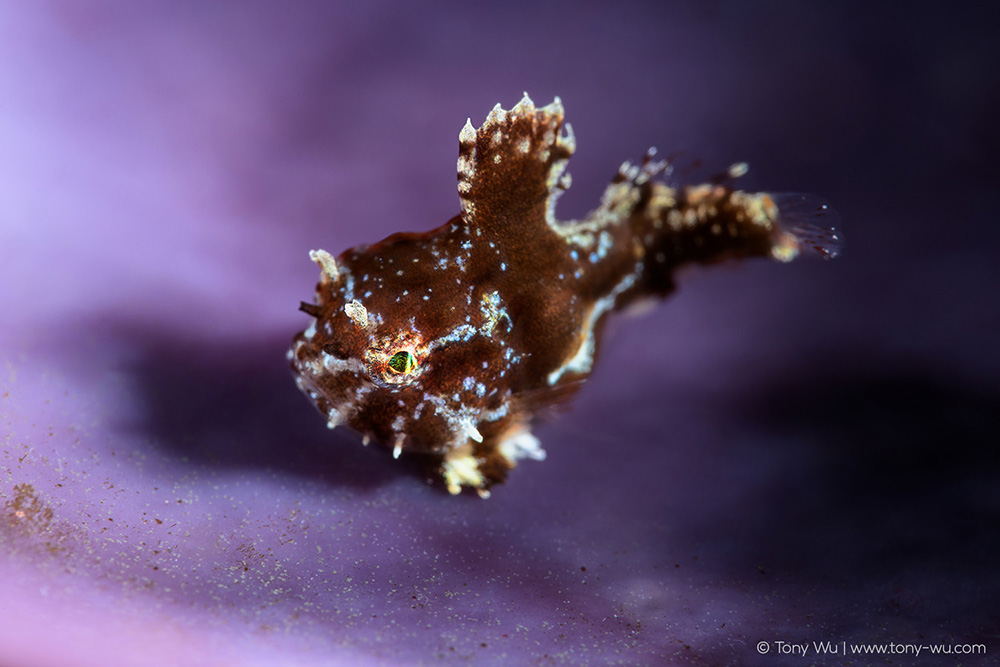
Incidentally, here’s a bit of video (shot by Chutinun Mora) of the recently described Maluku frogfish, aptly named Histiophryne psychedelica, which to date has only been seen in Ambon.
If you’re contemplating a dive adventure later this year, there are still a couple of spaces open for my trip to Ambon.
The trip, which I’m running jointly with Wetpixel and Eric Cheng, is scheduled for 7 to 16 November. We’ll be staying at the new Maluku Divers resort, situated right on the best muck sites in Ambon.
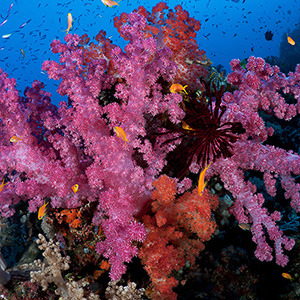
There are lots of Coleman shrimp on fire urchins in Ambon!
If you’re a fan of muck diving and observing amazing critter life in shallow water at close quarters without any other divers around(!), Ambon is worth considering.
Ambon hit the news recently because of the unusual new frogfish discovered there, but from personal experience, I can say that there’s a lot more to see than just the frogfish (sightings of which are unpredictable).
Tiny cuttlefish hunting in shallow water
With so few divers around + relatively easy diving conditions, it’s not difficult to spend quality time with animals that are considered rare or difficult-to-approach elsewhere.
In short…the conditions are ideal for observing and documenting marine life behaviour.
Our plan is to do a lot of night diving, which means that the chances of seeing predation, mating and other fun stuff increases significantly. Up to this point, it has been difficult to do extensive night diving in Ambon, because there was no dive resort near the muck sites!
As you can tell from the video, it was a fantastic trip…great participants, the perfect venue, and lots of amazing marine life!
Diving through the night was an experiment of sorts…one that fortunately worked out really well. To cut to the chase, the night life in Lembeh was totally fascinating.
Some of the same animals we encountered in normal daylight hours were out and about at night as well, but for the most part, there were different critters and/ or activities.
Not a big surprise, but there were many more crustaceans and cephalopods around in the wee hours than in the day, and even critters we came across during normal hours seemed to be more active at night (like flounders, octopuses, frogfish, etc.)
We managed to see a bit of courtship and mating activity as well, though some of it (like the porcupine pufferfish mating I photographed) took place after everyone else left.
The biggest surprise for me was how easy and pleasant it was to dive on a night schedule.
I expected to be cold most of the time (I even brought along a wool cap, sweater and sweat pants which I never used), but actually, the water temperature and conditions were great through the night.
In addition, waking up mid- to late-morning and jumping into the water for a first dive at 17:30 or so proved to be a very civilised schedule. With much of the morning and afternoon free to chill out, sort through photos, charge batteries, check gear, etc., the night schedule was…well…easy.
Having so much time before the first dive also meant I never went in without charged batteries, lens cap still attached, CF card missing…or any of the other common flub-ups that happen when you’re in a rush or don’t have sufficient time to double-check gear before hitting the water.
I hesitate to speak for everyone on the trip, but I think we all felt this way, and several people asked to be kept informed if there’s another night trip, because they liked this one so much!
I am, in fact, running another night trip later this year in Ambon together with Eric Cheng and Wetpixel.
It’s basically the same idea…diving mostly at night…concentrating on the dive sites collectively referred to as the Twilight Zone. It’s been difficult to dive these prolific sites at night for many years now, but with the new Maluku Divers resort situated close by, we’ll have easy access to Ambon’s critter central.
I have no doubt that it’s going to be an awesome adventure. The underwater topography is similar to, but different from, that of Lembeh, and though there’s certainly an overlap in the resident critter life, Ambon’s marine community is unique…which means lots of new animals and behaviours to see and enjoy.
If you’re interested in checking out Ambon’s night life in November I set out additional details toward the bottom of this post. Otherwise, take a look at the trip description on Wetpixel. Click here for an online presentation about Ambon that I put together previously.
Finally…something of note… I did almost all the sorting, adjustments, editing and output for this video using Aperture 3.
I upgraded to Aperture 3 just before heading out to Lembeh (I’ve used Aperture since the first version), and one of my goals for the trip was to figure out the strengths and weaknesses of this latest update.
Through the process of cataloging thousands of image, video and audio files, and then editing them into the video clip above…I learned a lot(!) about Aperture 3…much of which I think will be useful to other photographers.
Give me a bit of time to recover, and over the next week or so, I’ll jot down some thoughts about what’s good and what’s not with Aperture 3.
Note: Apparently, the little frogfish that gets run over by the urchin on a rampage is an as-yet unidentified species.<strong>Correction: Just received updated information that the unfortunate frogfish is a Histrio histrio, aka sargassum frogfish, which is unusual, since it’s sitting on the bottom with no sargassum seaweed around. Apparently, there is an article being written now about this, based on observations from the Virgin Islands.
It seems like only last week that I got back from my last trip (oh wait…it was only last week).
Getting unpacked and re-organised has been a logistical nightmare. With only a few days to get everything done, I need everyone else I deal with to be efficient…but alas, the world doesn’t work that way…so I’m certain that a significant proportion of my “to do” list will end up being a “to do when I get back” list (as well as others that are fated to be on my ever-growing “never actually got done” list).
I’m not complaining though, as I’m heading to one of my favourite dive destinations…the Lembeh Strait. I’ll be taking part in The Night Safari, organised by my friends David and Sanah at Scubacam.
In case it’s not obvious from the name of the trip/ event, we’ll be diving mostly at night. We’ll be staying at Kasawari Lembeh Resort, and the entire resort is switching over to a night schedule. Hopefully, many of the critters of Lembeh will be kind enough to do the same and keep us entertained with amazing sights through the wee hours of each evening.
Diving through the night will pose some challenges. First, since we’re doing three dives a night, we’ll have to adjust time zones…so to speak…and be active through the night and rest during the day.
Second, we need lots of light, so I’m packing a few torches as backup (as if my equipment weren’t heavy enough already).
And finally, even though we’ll be in the tropics, I have no doubt that it’ll be chilly in between dives…so if you’re one of the somewhat deranged lucky people joining this adventure, make sure to bring warm clothes!
I’m also excited because I’ll have a chance to hook up with many friends and acquaintances at various times before and after The Night Safari, including a couple of friends from Thailand, Nagamatsu-san from Aquaforum in Japan, Aey and Mean from FiNS Magazine, Eric from Wetpixel, Edward and Jacqueline of Nauticam, and Ryan from Reef Photo.
It’s going to be an action-packed, eventful few weeks!
It’s been a while since I’ve updated my Upcoming Trips page, largely because I’ve been travelling so much that it’s been difficult for me to hammer out logistical details and communicate with relevant counter-parties.
The year-end quiet period has given me some time to (just barely) catch up, so here’s a long overdue update of some of my trips for the near future, set out in chronological order. (I’m doing my best to keep my Upcoming Trips page updated, so bookmark that page if you want to check back later for more trips.)
The Night Safari Lembeh (27 Feb-6 Mar): I’ll be heading to Kasawari Lembeh Resort again soon, this time for the primary purpose of checking out the night life. As far as I know, this Night Safari trip is the first-ever organised effort to focus on diving at night in the Lembeh Strait. It’ll be fascinating(!) to see what happens late at night, when most (sane) people are asleep.
In addition to David and Sanah from Scubacam, Aey and Mean from FiNS will be on this trip…and Eric Cheng will be joining as well a few days into the trip. If you’re looking for advice about photography or how to prepare your images for print, you’d be hard-pressed to find a better-informed or nicer group of people.
There are still a few spots left for this trip, so click here to drop David and Sanah an email to sign up! More details here.
Humpback Whale Acoustic Research in Tonga (29 Jul – 7 Aug): In addition to the trips I have scheduled to swim with humpback whales in August this year, I’ve been working with a marine acoustics researcher friend of mine to try to set up a long-term study of humpback whale acoustics.
By way of background, my friend Dr. John Potter is a brilliant acoustics researcher who has studied underwater acoustics and marine mammals for over 20 years, pioneering techniques and a new understanding of how marine mammals use sound and how they’re affected by man-made sound in the ocean. John is a frequent consultant to sonar companies, navies, governments and NGOs concerned about the acoustic impact on the marine environment. Basically…he knows his stuff. In fact, he was the marine acoustics expert featured in the movie The Cove.
I first met John when he was the head of the Acoustic Research Laboratory at the National University of Singapore, which he started back in 1996. Among the interesting things he shared with me was an amazing video that he and other PhD friends put together showing the source, directionality and strength of humpback singer song in Hawaiian waters…a short sample of which is below:
Though it may not be immediately obvious, this is ground-breaking stuff. By using rebreathers, video cameras, audio recorders and distance measuring devices, John and the other researchers were able to construct this real-time representation of where a humpback’s sound comes from, how strong it is (in decibels) at various distances, and also the directionality of sound.
Cool, eh? (Actually, even more cool is the fact that John et al were the ones in the water on rebreathers gathering data first-hand!)
After several years of brainstorming and planning, we’re ready to try undertaking a new project in Tonga. We won’t be using rebreathers, but we will be pursuing new insights into the characteristics and behaviour of humpback whale singers.
The basic idea is to use a cross-disciplinary approach of combining data in the form of photos, video, high-frequency (i.e., whale-safe) ranging systems, and custom-designed hydrophone arrays to measure singer size, record their songs and other social sounds, and try to discern whether there are any meaningful correlations between songs and whales.
Our intention is to consider basic but as-yet unanswered questions such as whether bigger whales sing louder than smaller ones, whether some whales have deeper voices than others, what role if any age plays in song structure and singing behaviour, etc.
In other words, John and I would like to combine my knowledge of the whales in Tonga with his acoustics expertise to achieve something meaningful.
In order to undertake this project without having to beg for funds, we’re asking for help from people who’d like to take part in this research effort by joining us for a few days on the water, aboard John’s 52ft (on deck) yacht Jocara, which is now based in Tonga (yes, he relocated his boat to Tonga in 2007 in part as preparation for this), managed and operated by our mutual friend Christy.
We’re hoping to kick off this effort with two back-to-back trips in 2010:
Trip 1: 29 Jul – 2 Aug (4 nights aboard Jocara)
Trip 2: 3 Aug – 7 Aug (4 nights aboard Jocara)
To cover operating costs, we’re looking for four people on each of the trips, with cost/ person at US$1250. This includes everything while on the boat, as well as discussions that John will lead about marine mammal acoustics, and marine mammal photography advice/ discussions about humpbacks in Tonga from me (excludes accommodation, meals, etc. off the boat, and air travel).
While this isn’t going to be as intensive a photography-oriented trip as the others I have planned, we will get into the water at every opportunity, and we will be taking photos and recording video.
If you’re interested in learning more about humpback whales and helping out with cutting-edge acoustics study of whale song, please contact me via my contact form.
To be honest, this is a departure from the type of trip I usually do, but it’s something that I believe will be worthwhile over the long-run in expanding our knowledge about these graceful marine mammals.
As with the humpback whale calf-count that I started a couple of years ago, John and I will make every effort to share via the internet any insights we gather, and we look forward to feedback and contributions from all interested parties.
Sperm Whales, Ogasawara (early-mid October): Following on the incredible success of last year’s inaugural trip to Ogasawara, I’m planning another visit to Ogasawara in October this year.
Among the highlights of last year’s trip, we photographed and video-ed a group of female sperm whales eating a giant squid and possibly teaching the calf in the group how to hunt for squid (which means this year…we’ll have to photograph a giant squid engaged in a life-or-death struggle with a sperm whale!)
While in Ogasawara, I also realised that it’s possible to ID sperm whales by markings on their lower ventral areas, and I subsequently compiled a summary of nine individual whales that we encountered. I’m hoping to build on this ID catalog over time, working with the local whale watching authorities to see if we can document repeat visits to the area by these enigmatic cetaceans.
The exact trip dates depend on the ferry schedule between Tokyo and Ogasawara. Last year, the ferry schedule was only announced in July, and the trip was from 8 to 19 October (though I had a good idea of the probable schedule a few weeks prior to the official announcement).
Also, the exact cost depends upon the class of berth aboard the ferry, the number of people on the trip, and the number of days we’re out on the water…so participation in this trip requires a measure of flexibility. A reasonable estimate is Yen 600,000-700,000/ person for 8-9 days on the water.
Yes, I realise that’s not terribly specific…but that’s the nature of the situation, and it’s totally worth the effort and pain-in-the-rear factor when you’re face-to-face with sperm whales. Just ask any of the people who were with me this year!
If you’re interested in going to Ogasawara in early- to mid-October to look for sperm whales, please contact me via my contact form.
The Night Safari Ambon (7-16 Nov): Yes, yes…I’m obsessed with night life this year. After helping to plan the Night Safari Lembeh trip, I realised that the conditions in Ambon are ideal for a Night Safari type of excursion as well.
First, Maluku Divers have just recently opened their new resort, which is located right atop the best muck dive sites in Ambon. This means access to dive sites is easy…and night diving is possible/ practical in the area for the first time in many years.
Second, the new resort was designed and built by my good friend Yos, who coincidentally designed and built Kasawari-Lembeh Resort as well. Yos is a diver himself, and he has really good taste, so I have no doubt that the accommodations and facilities at the new resort in Ambon will be as nice and photographer-friendly as at Kasawari-Lembeh Resort.
And finally, the critter life in Ambon harbour is simply amazing! Need I say more?
I’m arranging The Night Safari Ambon in conjunction with Eric Cheng and Wetpixel, so there will no doubt be lots of experienced underwater photographers on the trip with lots of stories and advice to share. If you’re interested in joining this adventure, please refer to the trip summary below:
Dates/ Diving Schedule: Arrive 7 November 2010, depart on 16 November.
The planned diving schedule comprising 21 dives is:
7 November: Arrive/ set up cameras
8 -9 November: Normal day-diving schedule
10 November: Transition schedule: 14:30; 17:30; 20:30
11-13 November: Night schedule: 17:30; 20:30; 23:30
14 November: Transition schedule: 14:30; 17:30; 20:30
15 November: Off-gas/ Optional land tour (separate cost)
16 November: Depart
Diving Style: Ambon has a combination of reef and muck diving. For this trip, we will be concentrating on muck/ critter diving, and we will devote much of the trip to diving in the evening and night. Although the resort is situated at the best critter sites, we will dive from boats. The dive sites are located inside Ambon bay, and most of the time, we will be diving in relatively shallow water.
Because we will be diving a lot at night, you will need to bring adequate lighting. A minimum of two torches (three would be better) plus lots of batteries would be a good idea.
Also, while the muck sites are sheltered and shallow, there can be strong current at times. Our night dives will be concentrated during the period between new moon and first quarter moon, so in theory, the current will not be strong.
However, you never know with Mother Nature, so we’ll need to be flexible and adapt to prevailing conditions.
Finally, the dive sites we will be diving are where the newly described Maluku frogfish (Histiophryne psychedelica) has been found. We will, of course, hope to see this elusive fish, but to date, only a handful of these animals have been spotted, so please manage your expectations accordingly.
Accommodation: Twin-share rooms at the newly completed Maluku Divers dive resort, which is located at the prime muck dive sites at Laha. All rooms have hot water and aircon, as well as two editing desks with charging stations for batteries. The resort is equipped with back-up generators, so we’ll be insulated from power outages on the island. There is no Nitrox available at this time.
Meals are Indonesian fare, primarily comprising fresh fish and seasonal vegetables. If you have any special dietary requirements, please inform us well in advance so the resort can try to accommodate. Please bear in mind that Ambon is a remote location and some things are not always readily available.
Getting There: There are regular flights to Ambon from Bali, Manado and Jakarta on Lion Air and Batavia Air. While it is possible to make reservations yourself, it’s best to let the resort handle domestic flight reservations, coordinated through Dan Baldocchi. Domestic itineraries and prices generally firm up within three months of the date concerned, so expect that final itineraries will become clear around mid-August.
Power Supply: Power in Indonesia is 230V/ 50Hz. There are charging stations in the cabins and in the dedicated camera room. Plug shape is recessed two-prong, Type F on this page: http://users.telenet.be/worldstandards/electricity.htm