Posts Tagged Australia

Whales, Whales, Whales

If you’ve been following my ramblings in recent months, it’s probably obvious that I’ve been spending an increasing proportion of my time with large cetaceans. My schedule for next year is no exception, with 12 to 13 weeks or so planned for sitting on a boat staring at the ocean hoping something will show up whale photography.

For those of you who are crazy enough to contemplate joining me on one of these adventures, I’ve set out basic trip descriptions below.

If you read on, you’ll no doubt notice that many of the trips are already booked. This is because I keep a list of people who contact me in advance, and I do my best to get in touch with anyone who’s expressed interest before announcing trips on my blog. I also send out an e-newsletter in advance of posting to this site.

If you’d like to get a heads-up for future trips, please contact me via my contact form, or sign up for my trip newsletter.

Please let me know if you’re interested, even if the itinerary you’re keen on is full, as I keep a wait list for each of the trips. Life happens sometimes, and people who’ve signed up end up needing to change their plans.

Blue Whales, Sperm Whales in Sri Lanka
Dates: March/ April 2012
Availability: Fully booked

This trip requires someone who is accustomed to less-than-ideal circumstances, can deal with frustration, and can accept the possibility of being totally and utterly skunked.

Sounds like fun, no?

To be a good fit for this adventure, you need to be very, very experienced in the water, be easy-going and cooperative, and have a stable, mature personality.

On the upside, there is the prospect of seeing scenes like the images below, as well as other potential surprises:

Sperm whale swimming upside-down to check me out with sonar

Blue whales(!) swimming in blue water

Minke Whales in Australia
Dates: 28 June to 7 July
Availability: One spot available
Location: Fly into/ out of Cairns, transfer to Port Douglas
Accommodation: Liveaboard trip

Minke whales have been on my to-do list for a long time. As far as baleen whales go, they’re relatively small, running six to ten metres in length. They’re inquisitive…as in, they’ll come right up to boats and people in the water given the right mood. They’re also reasonably easy to find…if you get the timing and location right.

For these reasons, I’ve planned a trip Down Under to spend some quality time with the minkes that congregate at the Great Barrier Reef.

We're heading over during absolute peak minke whale season
We’re heading over during absolute peak minke whale season.

The plan is to get on a boat in Port Douglas on 28 June, cruise overnight to minke central and sit there until we leave on 6 July to head back. That’s eight full days with minkes, only minkes, and just minkes.

We’ll be in the Great Barrier Reef Marine Park, so we’ll be following the well-established guidelines for in-water interactions with the small cetaceans, letting the whales dictate the pace and proximity of interactions.

I specifically picked the timing for this trip based on advice from my friends John Rumney, who is one of the leading authorities on minkes Down Under, and Julia Sumerling, who has many years of minke experience under her belt from working as the video/ photo pro on Mike Ball’s boat.

To cut to the chase, our trip will be during peak, peak minke time.

For whatever reason, the minkes show up like clockwork at this time, and more importantly, they demonstrate the greatest level of interest in people around this period.

Incidentally, the minkes in this area are a subspecies known as dwarf minke whales, which were first described in 1986. From what I gather, there is still no population estimate for this subspecies, and no consensus on the taxonomy for minke whales in general.

For more information about the dwarf minkes, please see the excellent summary prepared by the CRC Reef Research Centre (PDF file).

Minkes are curious, and some will approach really close
Minkes are inquisitive, and some will approach really close.

Humpbacks Whales in Alaska
Dates: 22 to 31 July
Availability: Fully booked
Location: Trip begins and ends at Juneau, Alaska
Accommodation: Liveaboard

This is the Megaptera Mania! trip I’m running with Jon Cornforth.

I’m really excited about heading to Alaska for the first time. I’m not so keen on the fact that it’ll be colder than I normally like, but bubble-net feeding and dramatic, mountainous terrain in the background will hopefully make it worthwhile, and also worth a repeat visit in 2013.

Humpback whales bubble-feeding at sunset in Alaska

Humpback whale breaching in Alaska

Humpback Whales in Tonga
As soon as we wrap up in Alaska, I’ll be heading over to Tonga for my annual stay, and to continue my calf count project. After the record number of baby whales I ID-ed this year, I can’t wait to see what happens in 2012!

My schedule for Tonga is still evolving, but here’s how it looks at this time:

Trip 1: 21 to 28 August. This is the second part of the Megaptera Mania! trip. Fully booked.
Trip 2: 29 August to 06 September. Two spots available.
Trip 3: 08 to 17 September. Fully booked.
Trip 4: 25 September to 3 October. Four spots available.

Tahafa, calf #14 of the 2011 season, with mommy

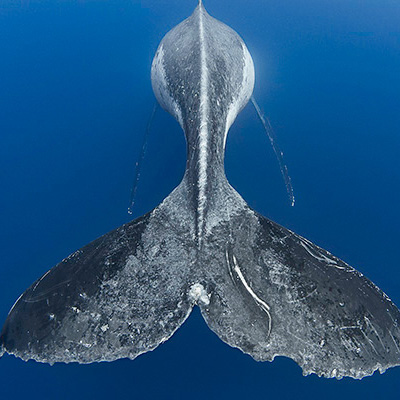
Fluke of a humpback whale singer

Fighting Sea Lions

Here’s another photo that I like from my recent trip to Western Australia, a picture of two Australian sea lions fighting:

Two fighting Australian sea lions
Two male sea lions having a friendly discussion

The animal on the left is a juvenile, and the one on the right is a mature bull. Despite appearances, they’re not having a serious conflict. They’re play-fighting, sort of like the way dogs tussle with one another sometimes.

I’m not 100% certain, but I assume that this type of behaviour is to establish social status, as is common among many other animals.

In this case, the older individual sauntered up to the little one, greeted it, then bullied it a bit. Much to his credit, the little one stood his ground, though he did make a few strategic retreats during the encounter.

As you can see from the image, sea lions kick up a lot of sand and other stuff when they wrestle. This, plus the fact that the sea lions swim extra super-fast when they’re playing around, makes it relatively difficult to get clear photographs of such behaviour.

Sea Lion Silhouette

Sea lions are sort of awkward and ungainly on land, especially mature individuals, because they’re large, heavy and aren’t really built for taking strolls on the beach.

Underwater however, it’s an entirely different story. Even big bulky boys like the one in this silhouette shot are sleek and swift, capable of executing a pinpoint turn in the blink of an eye.


Sea lion silhouette

Sayonara Sea Lions

Our final day with the sea lions was less eventful than the previous few, but a lot of fun nonetheless.


Sea lion sniffing its surroundings like a puppy

It’s been a terrific trip, and I have a lot that I’d like to share, but I’m still preoccupied with what’s going on in Japan.

Even as I’m writing this, I’m watching footage on TV of a few people who were just rescued from the freezing conditions in northeast Japan, followed by a discussion of the ongoing crisis at the Fukushima nuclear plant. It’s still difficult to fathom the scale of devastation, suffering and chaos.

Given the general uncertainty in Japan and reports from friends living near me that there’s still very little food or fuel available, I won’t be heading back to Japan until it makes sense to do so. For the time being, I’ll be even more homeless and disoriented than usual.

Two of a Different Kind

Today was another action-packed day, with about four hours of fun in the water with our sea lion friends. Among the day’s highlights, there was one particular pinniped with a penchant for kissing everyone:


Young sea lion coming in for a kiss

We also had a nice swim with a New Zealand fur seal (Arctocephalus forsteri), which was unusual. There aren’t too many of them in the area, and they tend to be shy. But the one we swam with wasn’t terribly standoff-ish. With a little patience, we were able to get close enough to get a good look.


New Zealand fur seal hanging upside-down, with flippers sticking out of the water

The fur seal seemed to enjoy floating at the water’s surface with its flippers sticking out in the air. Perhaps this cute position is for thermal regulation, or maybe it’s just for fun. In any event, the encounter was a terrific bonus.

I’m keeping my fingers crossed and hoping that our good luck with weather, water and animals so far will hold through tomorrow, which is our final day on the water.

Pinniped Pair

Here’s a photo from today, a pair of sea lions (Neophoca cinerea) taking a break, no doubt exhausted from the effort of keeping us entertained:


A pair of sea lions crashed out on a bed of seagrass

The one on top is a juvenile we’ve seen every day this week. It’s easily recognisable by the scars on its head. The bigger one plunked down on the bottom is an older male.

More Whiskers

After a bit of a slow start in the early morning, we had another great day with our pinniped friends today. This is one of the juveniles we played with, showing off his whiskers, just like in the photo I posted yesterday.


Chilling out in the surf with a juvenile sea lion

I want to write more about the fun we had, but I’m totally preoccupied by the devolving disaster in Japan. Radiation levels throughout northeast Japan and the Tokyo area have risen dramatically in recent hours, and there’s the potential for the situation to get much worse.

People who want to flee northeast Japan can’t, because there’s not enough fuel for everyone’s cars, so many people are stuck.

And with reports of radiation levels already at 10-40x normal right now in Tokyo and surrounding suburbs…Japan’s largest population center is at risk.

I don’t even know if it’s safe to go back after wrapping up here.

Whiskers

Today was my first day in the water with Australian sea lions (Neophoca cinerea). Given what’s going on in Japan right now, I’ve been struggling with whether to post photos or not.

On the one hand, it’s difficult not to be preoccupied and worried about the chaos and confusion back at home.

On the other hand, no matter how bad things get, life has to go on, and there’s nothing to be gained by being depressed.

I’m still not quite sure what the right thing to do is, but my gut instinct is to focus on the task at hand. When I get back to Japan, I’m sure there will be a lot to deal with, but for the time being, here is a picture I took today, highlighting one of the things that makes these sea lions so cute…whiskers:


Australian sea lions have lots of whiskers

It was a great first day. Somewhat windy and choppy in the morning, which resulted in less-than-ideal visibility, but the sea lions were cooperative, and we all had many opportunities to interact with the playful pinnipeds.

Histiophryne Help Again

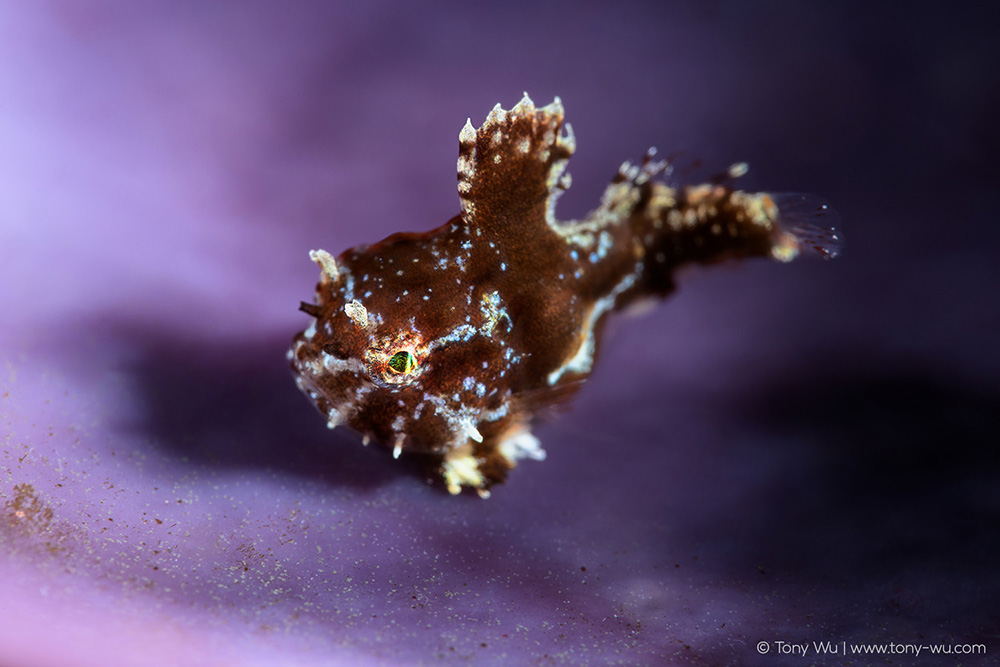
While chatting with Rachel Arnold about the unidentified Histiophryne frogfish I posted about last week, she sent me this snapshot of a preserved specimen of another undescribed Histiophryne frogfish:

unidentified histiophryne frogfish

Rachel took this photograph at the Australian Museum in Sydney. The fish is a fairly old specimen caught in Currarong, NSW, Australia in May 1968 by a person identified on the specimen tag as K. Deacon.

According to what Rachel was told, there used to be sponge gardens in that area, but they have since disappeared, perhaps due to pollution.

It seems like this might be the only existing record of this fish.

I know it’s difficult to discern what the living fish would look like, but if anyone’s seen a strange-looking frogfish that resembles the one in the above photograph hanging out in a sponge garden in New South Wales, can you let me know?

Happy Valentine’s Day

two sea lions

How I Tricked A Sea Lion

In the process of looking through images for an article, I came across this photograph, which I haven’t posted or published before. It’s an Australian sea lion (Neophoca cinerea) that I met last year.

sea lion

If you’re concerned about the fish-in-distress, don’t worry…it survived. Here’s the story:

While we were playing together, the sea lion dashed off and zig-zagged around the seabed, occasionally “looking over its shoulder”, so to speak, indicating for me to tag along.

Actually, we had been cavorting in the shallows for the better part of an hour by that point, so the sea lion most likely knew I would do my best to keep up, but it sure seemed like he turned back to check on me a few times.

After zipping around for a bit, he slammed on the brakes, shoved his face into a pile of seaweed, executed a pinpoint 180º turn and presented me with a fish…taking obvious pride in his find. I took a few photos, then indicated as best that I could that I didn’t need a snack, and I wasn’t particularly interested in holding the fish in my mouth.

He must have understood, because he let the fish go and looked at me with a puzzled, somewhat insulted, expression, as if asking: “What is wrong with you?”.

Meanwhile, the poor little fish tried to swim (actually…limp) away, but the sea lion would have none of it. He executed a quick flourish and re-captured it, once again presenting the despondent fish to me.

Once again, I deferred.

Once again, he questioned my sanity…as the fish made a desperate, but hopeless, dash for freedom.

Once again, he snagged the (now thoroughly exhausted) fish and offered it to me.

And yes…once again…I indicated “No, I am absolutely not going to chew on the fish, no matter how pretty it is.” this time, doing a flourish of my own accentuated by a couple of flips in the water…as an attempt to distract the persistent pinniped.

Fortunately for the fish, my little ruse worked. The ever-curious sea lion spit out the (now completely panicked, hyperventilating) fish, and swam over to check out why I was doing flips in the water.

…then, there was a “Wait a second…” moment (picture light bulb over Elmer Fudd’s head), when the sea lion looked at me, looked back at where he’d left the fish, and realised that he’d just been duped.

In far less than the blink of an eye, he was back to where his catch had been, but by then, the little fish had managed to disappear into a morass of seaweed.

The sea lion made a complete mess of the seaweed in an attempt to relocate his prey/ toy, but in the end, he stopped looking and gave me the cold shoulder..until of course, I did a few more flips in the water and he zipped right over to play again.

The point of the story? Somewhere out there is a fish that owes me.

Related posts:
Sea Lion Sequel
Fun with Sea Lions
Me At Work During Leap Year
Socialising with Sea Lions