Archive for Places, Adventures RSS Feed

Wait For Me!

I sometimes hear voices in my head while I’m observing marine life…particularly when the water is frigid and I’m feeling the effects of hypothermia.

Yesterday, I saw these two Hypselodoris infucata nudibranchs, a teensy little one along with a much larger individual.

They were both grazing on a rock, and over the course of perhaps ten to twenty minutes, I watched as the big one put some distance between itself and the little slug.

The small one took notice at a belated juncture, and dashed off (at a snail’s pace…literally), almost as if trying to catch up.

It was at this point that I heard a discussion ensue between these two invertebrates…primarily the little one screaming “Wait for me!” while the big one just grunted.

The little nudibranch took a wrong turn, however, and ended up on a high cliff (from its point of view)…staring out over the chasm that separated it from the other nudibranch.

It was heart-wrenching.

And even more odd (as if this post could get any stranger), the little nudi’s voice that I heard was a high-pitched manga-esque Japanese voice (think…Sailor Moon).

I think perhaps I need to seek professional help.

two nudibranchs

Hairy Frogfish

The water has been getting colder by the day here. Yesterday’s afternoon dive was bone-chilling, and I contemplated not going in at night…but I’m glad I did.

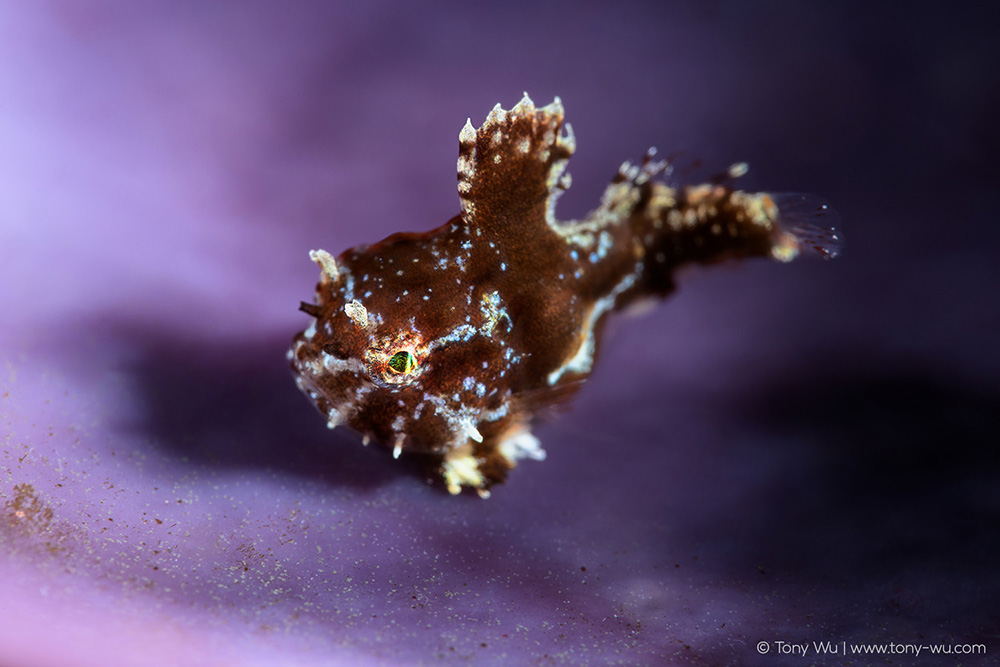
We found a cute little hairy frogfish (Antennarius striatus).

hairy frogfish

Incidentally, there is no “hairy” frogfish per se. It’s the striated frogfish species Antennarius striatus, which happens to be hairy.

A few years ago, I had an entertaining encounter with a bigger hairy frogfish which was looking for a meal. I put together a short video of the frogfish here. The video/ audio isn’t terrific quality, as I was just learning how to use the various software packages, but it’s a fun story nonetheless.

The Five Stages of Courtship

There is arguably much that we can learn about ourselves from observing fish.

Over the course of two dives yesterday, I watched a number of male porcupine pufferfish (Diodon holocanthus) pursue females. The males were keen to mate. The females…apparently not so enamoured with the concept.

After looking through the photos I took, I believe I’ve identified a 5-step process in prickly piscine courtship (which may, in some respects, merit further consideration in the context of H. sapiens courtship).

Stage One: Shock and Awe
In my initial encounter, I watched a lone female attract the attention of one, two and then three would-be suitors. The males chased her in circles; left, then right; up, then down; around again; up again; down again…until she was literally puffing to catch her breath (as was I).

porcupine pufferfish

While the chase was on, the males bit the female continuously. In what manner the males thought this would make the female happy…I’m not certain. All I know is that I saw bits of skin come off every once in a while.

The males bit each other too, though clearly the inter-male biting was significantly more vicious. In one instance, one fish took a big chunk out of the gut of another, leaving a hole. Ouch.

Stage Two: Hide and Seek
Eventually, one of the males chased the other two away, and he was left to claim his prize…or so he thought.

The female, being ever so wily, hid in a bin, peeking out at me and imploring me not to give away her location.

porcupine pufferfish

Meanwhile, the ever-enthusiastic male (note his eager-beaver smile) scoured the sand for his missing love interest. You would think the male would’ve looked in the obvious place…but no. It took him a while to catch on…even though I was sitting there looking right at the female.

I had to leave the star-crossed piscine pair at this point, as my no-deco time was up, but after getting back to land for a decent surface interval, I jumped back into the water (at a different site) and picked up another porcupine pufferfish pair engaged in precisely the same “Come here baby”-”Not on your life” discussion.

Stage Three: Delirium
As the sun began to set, matters became more pressing, as the male was overcome by the need to fulfil primordial urges. The amorous look in his eye gave way to something bordering on psychosis, and his smile morphed into an expression more akin to a frustrated frown.

porcupine pufferfish

Stage Four: All-out Chase
Having beaten out rival males and woo-ed the female with all his charm (read: bit her repeatedly until she inflated with irritation) to no avail, the male at some point abandoned all pretence and just flat-out chased the female as fast and hard as he could.

porcupine pufferfish

In response, the female puffed up even more (the theory being…if I may attempt to read the mind of a female porcupine pufferfish…that as a puffy prickly pincushion, she would be less appealing to the male), and swam with all her might.

This particular female made use of me a few times by hiding under my fins, inside my BCD, under my body…all of which worked for a while as the testosterone-fueled male swam in angry little circles looking for his elusive quarry…but eventually, he always found her.

In short…no matter what she tried, the male refused to be denied.

Stage Five: Run For Your Life
In the final stage, the female gave up on playing hard-to-get, and simply swam as fast and hard as she could for deep water, hoping…no doubt…to ditch her persistent companion.

On this occasion, I wasn’t able to follow in the deep dark abyss, but from previous experience, I know that the female probably relented at some stage, and the pair shot up toward the surface at high speed, pausing at a depth of around 10 to 12 metres to release sperm and eggs into the water column.

Once fulfilled, the male would’ve swum away, leaving the female in peace…finally…alone…in the dark…relieved.

porcupine pufferfish

Shrimp Poo

Hairy shrimp (there are lots of hairy animals in Lembeh Strait) are fascinating animals.

They’re tiny (like…”squint-really-hard” tiny), and they completely blend in with the moss-like fuzz (let me know if I lose you with the scientific jargon) on lots of stuff in the water.

I first saw one of these in Ambon, but it was so small and enigmatic that I posted a photo of it wrong-side forward. I thought the tail was its front part, and the head the rear-end. Duh.

As it turns out, these shrimp are probably quite common. It’s just that they’re so small and well hidden that most people don’t notice.

Yesterday, I had a chance to photograph one of these cryptic crustaceans again.

hairy shrimp

Perhaps this Lembeh shrimp heard about my inability to distinguish front- from rear-end of its green-tinged Ambon kin…and decided to take a dump so even a thick-headed person like me would stop and say “Hey, wait a second.”, which I did.

And just to be sure that I really got it, the shrimp defecated again for (or at?) me a bit later on.

hairy shrimp

Oh yeah…the eggs that the shrimp is carrying also helped me to see which end was which.

Perhaps I should take offence at animals poo-ing in my general direction, but I’ve had considerably bigger things take a dump on me before, so I wasn’t bothered in the least.

Note: I still don’t know what this shrimp actually is. Help?

The Other Half

Here’s a head-scratcher for Sunday morning.

If you cut a nudibranch in half straight down the middle, will it survive?

Apparently, the answer is yes.

half nudibranch

I came across this 50% nudibranch (tentatively Discodoris sp.) during an evening dive several days ago. Other than the fact that it looks like it was either sliced in half or perhaps born that way, this sea slug was completely happy, crawling along the bottom doing its usual nudibranch thing.

Odd, no?

Then there was this flounder, which we encountered on a different night dive.

half white flounder

The posterior half of this fish is all white. At first glance, I thought something had attacked it and stripped the fish’s skin. Perhaps something did skin this fish, but upon reflection, it seems more likely that it was just born this way…since the white area looks exactly like the skin that’s normally on the underside of a flounder (i.e., white, textured, without the camouflage).

Like the nudibranch, this fish seemed perfectly happy going about its business, unperturbed by its lack of camouflage for half its body.

The Lembeh Strait is a tough place for marine animals. There are predators lurking in every nook and cranny, under the sand, and swimming above.

In this context, it’s amazing to come across two such animals…one missing a half and the other with half totally exposed.

Me At Work

Transitioning from day diving to night diving for the Night Safari event was easy. We had a 24-hour break when we converted over to the night schedule, so I had some time to offload nitrogen and get a bit of rest.

Transitioning from night diving to day diving, however, has been much more difficult, with only a few hours between the last dive of the night dive schedule and the first dive of the day schedule.

So…for the past day or so, I’ve been feeling like this:

sleepy crab

Which explains this snapshot that Eric took of me during our morning dive today.

That’s me in the background, and some of my equipment in the foreground. Note the unique technique I employ to get a black background.

me at work

Night Safari Wrap Up

Today was the final day of our week-long Night Safari trip at Kasawari Lembeh Resort. Most everyone concluded the trip with two dives this morning, leaving at least 24 hours before the SilkAir flight back to Singapore tomorrow afternoon.

It’s been a terrific trip, and one thing’s for certain: Lembeh Strait is filled with activity at night! From miscellaneous cephalopods on the prowl, to mass opistobranch spawning (by the thousands!) and creepy crawlies scavenging for food…it was literally non-stop action through the night.

To wrap-up the event, we took a group photo this evening. Since the trip revolved largely around diving at night, it seemed only fitting to take the photo after dark, using the very same strobes we used this week to illuminate our photographic subjects:

group photo

Afterward, we had a bit of fun with Julian, who was here in Lembeh last year with us too (and will also be with us at the Night Safari Ambon later this year).

He was looking for a portrait photo of himself, so this is what I came up with:

julian

(Somehow, it just didn’t seem possible right to take a serious photograph of Julian.)

And finally, to wrap up…a huge thanks to Scubacam for handling all the trip logistics, and especially to the wonderful staff and dive guides of Kasawari Lembeh Resort, who stayed up to the cold, wet, wee hours of the morning with us, making the Night Safari Lembeh a big success.

I’ll be at Kasawari for a while longer, so I’ll post more photos soon.

Baby Flamboyant Cuttlefish

This was one of our most memorable finds over the past few nights…a tiny, tiny, tiny baby flamboyant cuttlefish (Metasepia pfefferi). It was about two-thirds the size of my thumbnail, sitting all alone on the bottom.

baby flamboyant cuttlefish

For its small size, the little cuttlefish sure had attitude. It flashed colours continuously, and gesticulated a lot with its many arms.

baby flamboyant cuttlefish

The Crab and The Nudibranch

Crabs are comical. There’s no doubt about it.

Following on the crab/ pipehorse test of wills I saw two nights ago, last night I watched as a crab and nudibranch matched wits.

From the outset, I had little doubt that the crab would come out the better of the two, but it was still a lot of fun to watch this mini-drama unfold.

It all started when I saw a nudibranch (Marionia pustulosa) making its way across the bottom. We’ve seen a lot of these nudis recently, so I didn’t give it much thought, and I was about to swim by…when I noticed something ambling across the sea bottom toward the nudibranch.

Within seconds, I watched as a crab walked in front of the nudibranch and grabbed the unsuspecting sea slug’s rhinophores to pull it down to a more crab-friendly level. The crafty crustacean proceeded to mount…yes, to mount…the nudibranch.

crab and nudibranch

Of course, no self-respecting opistobranch wants to be seen in public with an unattractive accessory like this crab (much less to have its photo taken with one), so the hapless nudibranch resisted.

The besieged sea slug took off at top speed (for a nudibranch), but the nimble crab quickly changed strategy. It grabbed on from the side as the nudibranch sped away (again at top nudibranch velocity) and clambered atop the fleeing slug.

crab and nudibranch

Once astride the nudibranch, the crab sat back(ward) and rode off into the proverbial sunset (there was, of course, no sunset, since it was just after 22:00 and underwater, but the mental image makes for a nice ending).

crab and nudibranch

The Crab and The Pipehorse

The ocean at night is witness to many a drama. Some involve life-and-death struggles between predator and prey. Others are just funny.

Last night was the first night of the Night Safari hosted by Kasawari Lembeh Resort. We started diving around 17:30, and I came up out of the water on our last dive at around 02:30 the next morning. The moon was full and bright, and Lembeh Strait was teeming with activity.

On the last dive, one of the guides pointed out a little pipehorse (Acentronura sp.), which looks exactly like it sounds…half pipefish, half seahorse.

pipehorse

Like many of the other animals we came across, this little pipehorse was quite active, prowling the bottom looking for food. I followed as it made its way across the sandy bottom of a site called Pantai Parigi, taking photos as and when the opportunity arose, since the pipehorse, like most Sygnathids, was camera shy.

pipehorse

Along the way, the pipehorse grabbed hold of various objects with its prehensile posterior…to steady itself and pause for short breaks.

The funny part came when the pipehorse latched onto a well-camouflaged crab:

pipehorse

Grumpy by nature, the crab was none-too-happy about the situation, and shook the bewildered pipehorse loose a few times. In each instance, the pipehorse turned with a puzzled expression, then wrapped its tail around the crab again…only to be dislodged once more.

Eventually, the crab grew weary of the clueless pipehorse and trundled off in a huff, as indignant crabs are wont to do.

I should’ve taken more photographs, but it’s difficult to hold steady when you’re overcome with uncontrollable laughter.

Happy Monday

Here’s another juvenile fish, an adorable longhorn cowfish (Lactoria comuta) that we saw on our last of three dives yesterday. So cute you just want to give it a name and pinch its cheeks.

longhorn cowfish

It’s Monday morning here, and it’s full moon tonight. Our planned schedule of night diving starts tonight, so we’re resting during the day, prepping our equipment, and keeping our fingers crossed that there will be lots of action tonight.

Baby Dragonet

Perhaps because there are lots of little nooks and crannies in which to hide, Lembeh Strait is home to a plethora of juvenile animals…like this baby fingered dragonet (Dactylopus dactylopus) I came across the other day:

fingered dragonet

The colouring of this fish matches the substrate so well that it’s difficult to tell that the fish is there, even when you’re staring directly at it!