Archive for Photography RSS Feed

Whale Poo-ed Again

This just happened a few hours ago:

Group of sperm whales, with one defecating<br />
Group of sperm whales (Physeter macrocephalus), with one defecating

You know? I really seem to have a knack for getting poo-ed on by whales.

Endangered Australian Sea Lions

My time with the wonderful Australian sea lions (Neophoca cinerea) is over (much too quickly, as always), and I’m on the road again.

Endangered Australian sea lion (Neophoca cinerea. Carnac Island, Western Australia.
Endangered Australian sea lion (Neophoca cinerea)
perched in shallow water at Carnac Island in Western Australia

I treasure any time that I can spend with pinnipeds, but I’m particularly attached to this colony.

You see…Australian sea lions are endemic to Western Australia and South Australia, and they’re listed as endangered on the IUCN Red List.

Estimates I’ve read put the total number of these animals in the thousands, maybe up to 12,000 individuals or so, though I’m not sure whether there’s been any methodical census undertaken in recent years.

The specific sea lion colony I’ve visited several times is located at Carnac Island in Western Australia, which is the primary haul-out area for Australian sea lions in this vicinity.

Within this context, the Carnac colony seems especially vulnerable…for a couple of reasons.

First, the community comprises only males. Yup. No females at all.

Now…the individuals that frequent Carnac probably aren’t celibate. They presumably travel a few hundred kilometres up the coast at the appropriate time (i.e., mating season) to strut their stuff in front of pretty female sea lions.

As far as I’ve been able to gather, this is the only instance of a pinniped colony that is a boys-only club. No one knows why this colony is the way it is. It just is.

But with no females in the area, it’s clear that this colony cannot be self-sustaining. There needs to be inflow from other sea lion colonies.

Australian sea lion (Neophoca cinerea). Carnac Island, Western Australia.
Endangered Australian sea lion (Neophoca cinerea) relaxing on a bed of seaweed

The second reason is people. No surprise there I suppose.

Some years ago, when I first visited this colony, I was shocked to see rampant abuse of these animals and their home by boaters…people who were drunk, loud, and well…stupid and obnoxious.

Among other things, I saw people kicking sand at sea lions, throwing objects at them, dragging large kites across and over them, etc.

(I wrote at length about what I observed, so if you’re interested, please click here to read more. It’s pretty appalling.)

Anyway, it seems that despite the passage of over six years since my first visit, things haven’t changed much.

CALM, the agency with oversight over Carnac Island and the sea lions, has since been rebranded as Department of Environment and Conservation (DEC), but protection for the sea lions doesn’t seem to have improved in any substantial manner.

Boaters still descend on the island during weekends, and the sea lions still have to contend with lots of boats, loud music, and intoxicated people traipsing over the beach.

I understand that DEC has stopped people from driving their boats onto the beach (yes, it was actually ok to drive right into sleeping sea lions before), so they do deserve credit for that.

Still…it’s odd.

The same people who seem perfectly happy with inebriated boaters harassing the sea lions are quite quick to scold sober tourists who visit Carnac to observe and interact with the sea lions on their own terms.

Representatives of DEC approached us on three occassions to tell us, among other things, that: “It is the closed season for sea lions.” Puzzled, I asked the natural question: “When is the open season?”

After a momentary pause to consider the unexpected query, the guy driving the Marine Parks boat said: “Swimming with sea lions is indefinitely closed.”

Well, I’m not a native speaker of English, but to me, “indefinitely closed” seems more like a ban, not a closed “season”.

The thing is, I saw a number of advertisements in (government-supported) tourist booklets and brochures promoting in-water encounters with sea lions. That doesn’t exactly jive with a ban, does it?

So I’m not really sure what the situation is.

Perhaps no one is.

Anyway, this confusing behaviour isn’t new; it’s been the same since I first visited in 2007.

Which I guess is my point: So long as the relevant authorities choose to place priority on delivering mixed messages to tourists rather than on addressing real harassment, the endangered sea lions are going to have a rough time.

As it happened, I saw fewer sea lions this time than during any prior visit; where it was normal before to see over a dozen lying on the beach, we never saw more than five on this visit (usually far fewer).

There could, of course, be any number of reasons behind this; it’s difficult to pinpoint any single cause.

But I can’t help but think that ongoing harassment by boatloads of irresponsible people, made possible by the complicity of DEC, must be a contributing factor.

Australian sea lion. Carnac Island. Western Australia.
Interspecies communication at its best,
with the sea lion deciding when, where and how to interact

Greetings from Down Under

Australian sea lion, from our first day on the water:

Australian sea lion in shallow water
Greetings from Down Under

Peekaboo Pinniped

After a brief, hectic stopover at home(?) to swap out gear and pack clean underwear, I’m hitting the road again…traveling Down Under this time to see if my precocious pinniped pals are in a playful mood:

Australian sea lion (Neophoca cinerea) in Western Australia
I’m heading out to see if my sea lion (Neophoca cinerea)
friends are in the mood to play. (Duh…of course they are!)

To assist me in this quest for Australian sea lion camaraderie, ten human friends (yes, I have human friends) will be joining this adventure. The more the merrier, as we’ll need to swim hard to keep the whiskered ones entertained enough to stick around.

Humpback Whale Prints

I get to meet some awesome people in the course of my adventures.

Last year for example, I spent a couple of weeks in the company of Tom Perkins, along with his fantastic(!) crew and friends, aboard his expedition vessel Dr No.

During the trip, Tom requested prints of two images I took during the 2012 humpback whale season in Tonga for display on his yacht, with this one (taken while I was with him) being his favourite:

Humpback whale heat run
Humpback whale heat run in the saloon of Dr No

Before I ramble any further, let me just say that my time aboard Dr No was one of the best experiences in my life, thanks to the quality of the people I met (+ yummy food courtesy of culinary wizard Lisa + hyper-energetic puppy Honey + mind-blowing amazing experiences).

Tom is, without qualification, one of the most down-to-earth and inspiring people I’ve ever come across. We talked at length, shared many laughs (oh the fantastic stories!); but most of all…I learned from him. He never failed to make me think, and more importantly, to make me want to achieve bigger and better things.

Not surprisingly, the crew aboard Dr No totally rocked, as Tom surrounded himself with only the best people. Any apprehension I had about spending an extended period aboard a private yacht with people I had never met dissipated as soon as I got to know Tom and his crew.

And to round out the trip, I also met a few of Tom’s friends, who were of similarly high caliber and had done some jaw-dropping amazing things.

Male and female humpback whale engaged in courtship

Anyway, I’ve been pretty bad about marketing and selling prints. When I say “pretty bad”, I mean I’ve never done it…for two main reasons: lack of time; and inability to find someone reliable who is as much a stickler for detail and quality as I am.

When Tom requested the prints, I had, by coincidence, just initiated a working relationship with a print maker who makes my files look out-of-this-world beautiful…so I was able to get prints made for Dr No.

They are photographic prints (i.e., not inkjet) on Fuji Crystal Archive paper, which I think is the best photographic paper ever made. If you remember the days of Cibachrome, the look is similar…a full-bodied, deep luster that makes the photos pop off the page.

My mounting option of choice, acrylic face-mount with dibond backing, protects the images and results in exhibition-quality products that truly shine.

I’ve also received several follow-up requests from people I met aboard Dr No, including for the print below. It’s hanging above my friends Jantoon and Sonia’s newborn son Eric.

(Someday, perhaps, I’ll post an edited video of Jantoon trying to teach me to sail. It’s…well…rather amusing.)

They wanted it to be one of the first things he learns to recognise; I’m hoping subliminal messaging will produce an eager young apprentice, i.e., strong lad to lug my equipment for me in a few years time!

humpback whale heat run photograph
Young Eric, my apprentice in training

I’m in the process of re-doing my blog, so I’m planning to have a section dedicated to prints when I re-launch my site. For the time being, I’ve selected just a handful of humpback whale images for limited edition runs of 50 prints per image, meaning once I hit 50 prints of a given image, I’ll retire it from all prints forever. Each one is signed and numbered.

Given the low print run and labour/ equipment/ travel/ risk/ experience/ time-intensive nature of creating these prints…from taking the relevant photo through to the approval of each final product…as well as the unique nature of the photographs, the prints are priced accordingly.

I’ll have a list of images available for print purchase on my new site, but for the time being, if you’re interested in investing in a custom print, please drop me a line via my contact form.

I’m also in the process preparing five sperm whale prints for presentation and sale at a talk I’m giving for the Nantucket Historical Association in early July. Those prints will each be #1/50.

I’ll post more details about the talk once the logistics are finalised, in case you live near the area or will be visiting during that time.

Boisterous Baby Baleen

In case you’ve ever wondered what it’s like to be approached by an attention-starved baby whale, this should give you an idea:

Baby gray whale (Eschrichtius robustus) in Baja, Mexico
Baby gray whale (Eschrichtius robustus) seeking out attention

This energetic little calf just couldn’t get enough of us. Over and over, the young baleen swam over to our boat, stuck its oddly shaped head out of the water to peek at us, and demanded our full attention.

Of course, the tiny tyke couldn’t have spent so much time with us had its mother not been extremely patient and cooperative, even coming over herself a few times to give us a good looking over.

Baby gray whale in Baja, Mexico. Eschrichtius robustus
Baby gray whale or attention queen?

When you see and experience things like this, it becomes all the more difficult to imagine the deliberate carnage humans once wreaked upon these inquisitive and friendly animals.

Sharks. Slaughtered.

It seems like no matter where I go, I come across sights like this:

two very small dead sharks, sea of cortez
All that’s left of two little sharks

The fact that I took these photos inside a national marine park in the Sea of Cortez just compounds the tragedy.

two dead hammerhead sharks, sea of cortez
Two hammerheads. Sadly, just their heads.

All the sharks pictured above were small, basically pups. I suppose it should be obvious that killing young sharks means fewer individuals of breeding age going forward, which of course means fewer and fewer sharks in the future…but I guess this self-evident point escaped the person or people responsible.

To make matters worse…there were many, many more shark heads scattered on this particular beach. I gather that it’s not a particularly unusual sight in the area, which begs the question of what purpose a national marine park serves. If any.

Blue Whale Spout

Blue whales have a distinctive spout, one that you’d expect from the largest animal ever to have lived on the planet.

Blue whale (Balaenoptera musculus) spout
Blue whale (Balaenoptera musculus) spouts go high in the air

Blue whale spouts are unmistakably tall, shoot straight up, and are a cinch to spot from far away (assuming there’s minimal wind, of course).

Despite facing challenging conditions (in the form of ongoing strong winds), I’ve had the good fortune of seeing dozens of blue whales up close during my virgin visit to the Sea of Cortez.

I still have a few more days left before I head Down Under to seek out the company of sea lions. Though the winds are forecast to continue, I’m keeping my fingers crossed for continued good luck.

Sand Dunes

Just for a change of pace, here’s a picture of some sand dunes we explored:

Sand dunes. Baja, Mexico.

The parched terrain was a pretty stark contrast to the adjacent sea.

Gray Whale Greeting

It’s been windy for a few days, too windy to head out into the Sea of Cortez for the past couple.

So we hopped in a car and drove over to the other side of Baja for to spend a few hours looking at gray whale (Eschrichtius robustus) females with calves…quite a treat, since I’ve never seen gray whales before.

Gray whale calf (Eschrichtius robustus) with mother underneath

The recovery of the gray whale population that visits this area is a success story. Relatively docile and slow-moving while they are in the protected lagoons raising their young, these whales were hunted extensively back when killing whales was the in-thing.

These days, the whales enjoy the sheltered waters of Magdalena Bay, safe from both marine and human predators. Instead of hunting them, people go out in boats, letting curious whales approach and check everyone out.

Within the next month or so, these whales will leave, eventually heading north to feed in colder waters. Many of the calves won’t make it, as they’ll have to run the gauntlet of waiting orcas, but most hopefully will, with the females returning to this area in the future with their own adorable offspring.

Posing Pinnipeds

I love pinnipeds. They make me laugh.

We came across hundreds of California sea lions (Zalophus californianus) out in open ocean the other day…barking, frolicking, and being generally ridiculous.

California sea lion, Zalophus californianus
A friendly sea lion greeting

There are a lot of sea lion colonies around, but from what I gather, it’s rather unusual to see so many individuals together in open water, so it was quite a treat to be among them (though they certainly smelled bad at times!).

Perhaps the most amusing sight was watching them catch some R&R, thermal regulating by sticking their flippers up in the air while dunking the rest of their bodies in the water.

Here’s a pair of the posing pinnipeds, which for all practical purposes looked to me like a sculpture you might find at a museum of modern art:

California sea lions (Zalophus californianus), thermal regulation, Baja, Mexico
Two California sea lions making like a modern art sculpture

In this instance, it was a husky male and adorable female. On a thermal-regulating date perhaps?

Feeling Blue

Time to head out again. But before I do, I thought I’d share a couple of recent photos of blue whales, as partial offset for the silliness of my two previous posts.

blue whale (Balaenoptera musculus brevicauda) diving into the blue
Adult blue whale diving into the blue

As you can see, the time of day, visibility and quality of light determines the mood of an image. Even though both whales are diving, the feeling conveyed by each photo is completely different.

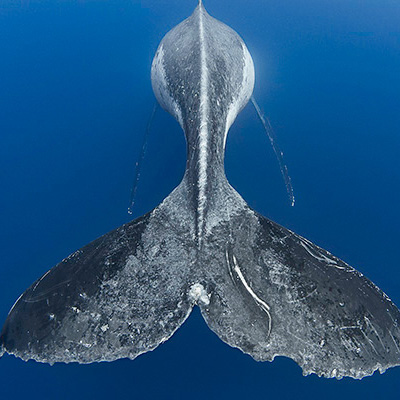
Lunging blue whale (Balaenoptera musculus brevicauda)
Lunging blue whale, fluke slicing through the water

With natural light photography, you can’t pick your light, but you can, and should, try to get into position to make the best use of whatever light is available. Assuming your subjects cooperate of course.

Note: Photos taken with permit.