Archive for Marine Life RSS Feed

Vignettes from the Eastern Fields

I’m back in Port Moresby. Everyone has left the boat, so it’s quiet time for a day. I have yet to pack, which means I’m looking for ways to procrastinate.

Got up early this morning. Not sure why, given the lack of immediate pressure to get anything done. I’ve had three cups of coffee so far, sorted out a handful of logistical issues, and scarfed down more cookies than I probably should have.

Outside, the winds are howling…running a continuous 30 to 35 knots, exceeding that every now and then, while pelting rain adds a bit of excitement from time to time. A nearby boat apparently sank last night. The few trees that line the harbour’s edge, short ones with sparse foliage, are doubled over, appearing as if they’ve been sucker-punched by Mother Nature.

We were forced back to the coast earlier than scheduled, which is unfortunate, but all-in-all, the past few weeks of diving in the Eastern Fields of Papua New Guinea has been awesome. The water was clear; marine life plentiful; and until the winds and swells picked up a few days ago, the weather ideal.

This being my fifth trip to the Eastern Fields (spanning about 16 weeks since 2004), you’d think I might have grown tired of diving the area. Not a chance.

Large school of bigeye jacks (Caranx sexfasciatus) in Papua New Guinea
Large school of bigeye jacks (Caranx sexfasciatus)

The Eastern Fields is a submerged atoll comprising around 150 square nautical miles. That’s really big. Actually…really, really big. It means the extinct volcano that spawned the atoll was enormous, almost beyond comprehension.

The reefs are about as close to perfect as you can get, given the realities of modern-day pressures like shipping traffic, commercial fishing (especially shark finning!), and marine pollution. This remote atoll and associated reefs have some of the best dive sites in the world, including one site that is the most action-packed reef dive I’ve ever experienced. And despite the fact that Captain Craig has been visiting the area every year since 1992, there are still many parts of the Eastern Fields he’s never dived. In fact, we explored and named four new sites over the past few weeks.

In short, the Eastern Fields is a magical place, which is why I keep going back, and will continue to do so as long as I’m able.

Pristine coral reef atoll, Eastern Fields
This is a pristine reef top: a profusion of coral in two metres of water.

Diving Carl’s Ultimate
As Craig tells the story, the first time he took my friend and mentor Carl Roessler to this reef, Carl was so amazed that he asked Craig to name the site after him.

The first time I went in, I understood why.

The site is small. Small enough to swim around in 10 to 15 minutes if there’s no current working against you. Small enough to swim over in much less time.

What the site lacks in size, however, it makes up for in action.

The best way to describe what Carl’s is like, is perhaps to allude to the story of Goldilocks and the Three Bears. Just like the perfect porridge in that tale, Carl’s Ultimate is the perfect reef.

It’s located in the perfect spot with the perfect shape, size and orientation, so that currents are neither too strong, nor too weak, and hit at precisely the right angles during both incoming and outgoing tides to make it a happy place to be for fish and other marine life.

When the currents are running at Carl’s, there are, as many have put it: “More fish than water,” ranging from tiny ones like damsels and basslets to impressive dogtooth tunas, trevallies, barracudas, groupers, reef sharks and even a large hammerhead on this trip.

Thousands of fusilier damsels and magenta slender Anthias swarming over staghorn coral at Carl's Ultimate dive site
Thousands of fusilier damsels and magenta slender Anthias
swarming over staghorn coral at Carl’s Ultimate dive site

On normal charters, Craig only spends a day or so at this site, as most people want to travel around and dive multiple locations across the atoll. While I certainly understand why visitors want to see a broad sampling of what the Eastern Fields has to offer, I’d be perfectly content to sit at Carl’s for an extended period of time, doing two, maybe three, long dives a day timed to coincide with peak currents, and hence peak action.

In fact, that’s exactly what we did on the second of the two recent itineraries. After leaving port, we went straight to Carl’s and stayed for four days. The tides were exceptionally long and strong, meaning peak fish time was jaw-dropping crazy.

When Craig and I planned the dates for this itinerary at the end of 2009, we consulted forward schedules for moon phases and tidal flow, picking dates specifically for this reason. Who knew the two of us could actually get something right?

Corals and swarming fish at Carl's Ultimate dive site
Carl’s Ultimate dive site: Hard corals, soft corals, sea fans, sponges, swarming fish
…even an inquisitive squirrelfish (Sargocentron spiniferum)

The action at this site is so dramatic that I can’t recall ever having taken a macro lens down before, but I did this time. Craig performed his excited-little-girl-who-ate-too-many-sugar-cookies impersonation and said he wanted to show me a “really pretty” fish. Sceptical though I was, I had no choice but to humour him; it’s the only way to settle Craig down.

He showed me a colony of Pseudanthias lori, which were down relatively deep (33m or so), swimming upside down, at an odd angle, in erratic fashion, at high speed over a wide area, beneath a ledge that obscured nearly all available light. In other words…perfect conditions for photography (not).

With the aid of a rebreather, I was able to stay down for an extended period to get a few images, which only made Craig more giggly when I showed him. I should’ve known better.

This is one of several male Pseudanthias lori individuals in the colony:

Pseudanthias lori basslet, Carl's Ultimate dive site, Eastern Fields
Beautiful Pseudanthias lori basslet at 33m, Carl’s Ultimate dive site

Pseudanthias lori basslet, Carl's Ultimate dive site, Eastern Fields
Same fish, different angle, just as spectacular

To give credit where credit is due, Craig certainly has an eye for cute, colour-coordinated fish (with a particular penchant for pink).

Exploration and Discovery
As I mentioned above, we dived, explored and named four new dive sites during the trip: Xanadu, Soi 16, Jellybean Corners, and Silk Road.

Xanadu is a small passage Craig had never noticed before. The outer wall is gorgeous, with corals covering the entire reef, and lots of fish swarming about. The passage from the outside to the interior of the atoll was healthy as well, with troops of multi-hued parrotfish milling about, pooping streams of newly manufactured white sand here and there. During our second visit to this magical place, several co-adventurers came across mating white tip reef sharks. I named the site Xanadu in recognition of its unspoiled condition, and in keeping with Craig’s Asia-themed nomenclature for the sites in this area.

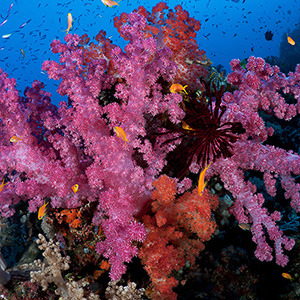
Red soft coral, Eastern Fields, Papua New Guinea
Strawberry-red soft coral at Xanadu dive site

Soi 16 is a submerged barrier reef near Emmmo. The terrain comprises a series of bunkers or “hills”, for lack of a better term, interlaced with channels and cut-out areas. The hills are covered(!) with corals, both hard and soft, and there are tonnes of fish swarming above…fusiliers, jacks, surgeonfish (the largest school I think I’ve ever seen), trevallies, etc. There was so much fish traffic in the area that diving the site reminded me of standing on a street corner in Bangkok. It was the 16th of January, so we called it Soi 16.

Soft coral and fish, Eastern Fields, Papua New Guinea
Soft coral and fish at Soi 16 dive site

Jellybean Corners is also at an opening in the atoll, where the outside walls rounds off into two nice corners at opposite sides of the passage opening. When I first dropped in, a gang of adorable baby grey reef sharks paddled in say hello, at least ten of them, perhaps as many as 20.

Though there wasn’t much current when we went there, I’m pretty certain the site gets hit with significant water flow, as there is a profusion of large, multicoloured soft corals on both corners. The brilliant yellows, reds, oranges and pinks of the plush soft corals reminded me of jellybean flavours, hence the name we assigned the site.

Yellow soft coral, Eastern Fields, Papua New Guinea
Colourful soft corals like this abound at Jellybean Corners

Finally, we dived and named another small passage in the same general area as Xanadu. Once again, it’s a passage Craig has probably passed many times, but hadn’t noticed. (It would perhaps be appropriate to insert a snide remark about Craig’s power of observation here, but I guess I shouldn’t do that to him, should I?)

Near this passage, the wall folds in and out in an S-curve pattern, covered wall-to-wall with a profusion of corals, mostly hard structures, but also some fans and soft corals closer to the actual passage opening. I gave this site the name Silk Road, in reference to the meandering pattern of the reef, and to go along with nearby site names Mantchuria, Great Wall of China, and Xanadu.

Soft coral, Eastern Fields, Papua New Guinea
Soft coral at Silk Road dive site

It’s amazing to think that after 20 years of diving in the Eastern Fields, Craig is still finding new sites. The possibility of being the first person to explore a section of the reef is an incredible feeling, something I hope to experience again in the future.

Silly Sallie Story
A trip aboard MV Golden Dawn wouldn’t be complete without a silly story of course, preferably at the expense of my good friend Captain Craig. You would think that after all these years, Craig would’ve learned to be on guard when I’m around. To some extent, he has, but his (futile) efforts to foil my schemes just make it more fun to pull pranks on him.

Sallie’s whale shark encounter is a perfect example.

On the second day of the first itinerary, Sallie had a close encounter with a whale shark at a site called Point P. She was alone, in crystal-clear water. The whale shark practically came up and planted a big wet kiss on her cheek.

Naturally, she was delighted, and showed several of us photos and video when we got back to the boat.

The proverbial light bulb went off almost instantly, and I got everyone to agree not to tell Craig about the whale shark…until dinner.

Whale shark with barracudas, Papua New Guinea
Sallie’s whale shark, with barracudas in the background for bonus points

At meal time, Sallie sat next to Craig, showing Craig pictures on her camera, innocently(?) asking him to help her figure out what she had seen during the day (i.e., Sallie batting eyelashes at Craig in feigned damsel-in-distress manner).

She started with a genuine puzzle, the shadow of what appeared to be a hammerhead shark in the deep. She moved on to several other fish; then showed him a series of whale shark photos, starting with one taken at a distance, gradually getting closer and closer.

If you’ve read my posts about Craig over the years, it should perhaps come as no surprise that he fell hook, line, and sinker for the “Help me, Obi-wan; you’re my only hope” performance that Sallie put on. (The fact that she’s a lawyer and devious by nature certainly didn’t hurt.) She played the part to perfection, luring Craig directly into an immaculately choreographed trap.

Seated across from Craig and Sallie, I got up and started to video Craig’s reaction when Sallie showed him the whale shark photos. Greg recorded Craig’s reaction from another angle.

Demonstrating the mental acuity for which he and Elmer Fudd are renowned, Craig immediately became suspicious. He was perhaps already inclined to doubt Sallie’s whale shark sighting, but seeing me stand up to video his reaction prompted Craig to undertake critical analysis of the situation at hand:

“Hmmm, Sallie is showing me whale shark photos; but I didn’t see a whale shark; and Tony and Greg are video-ing me,” he thought.

“This can’t be good.” (pause for brain to process).

“Wait a second.” (pause while pained expression crosses his face).

“Tony obviously wants to see me react to Sallie’s photos. He must be setting me up.” (pause for Eureka!-moment expression).

“Aha! Tony probably gave her photos from somewhere else to put on her camera, which means there was no whale shark.” (pause for brain to rest and recover from prolonged exertion).

“Well, I’ll show him who’s smarter!” (pause for look of smug determination to appear on his face).

And so it was that Craig opened his mouth (as planned) and stuck his foot in it (once again, as planned), while I recorded the moment for all to savour:

What Craig didn’t count on, of course, is that I set him up to anticipate the set up, thereby resulting in his being set up even though he deduced that a set up was in progress and concluded (in error) that he had foreseen and hence averted said set up. Nice set up, no?

In all fairness, I couldn’t have pulled this one off without Sallie’s deft manipulation of Craig’s ego, which just goes to show you that sharks are definitely not the most dangerous animals in the sea.

Links to Sallie’s video of the whale shark: Video 1; Video 2

Equipment Note
I started using a KISS rebreather back in 2004 with Craig, during my initial visit to the Eastern Fields. The rebreather units themselves haven’t changed much since then, but there have been some notable improvements in peripherals, two of which I think worth highlighting.

First is the Shearwater Predator dive computer. I don’t usually get excited by dive computers, but this one is perfect for diving with KISS rebreathers.

Shearwater Predator dive computer
Shearwater Predator dive computer (before hooking up to O2 sensors)

The Shearwater computer can integrate directly to the O2 sensors on KISS units, thus eliminating the need for bulky, clunky O2 gauges we used previously. Moreover, the computer’s colour-coded OLED readout is dead-simple to understand:

Green = all good.
Red = problem.
Yellow = maybe problem.
Orange = slightly more of a maybe problem.

The display automatically adjusts brightness based on ambient light, and the interface is intuitive. The only minor issue I’ve experienced is that it’s difficult to take the battery out, as the compartment is snug, and there’s no tab or tool that makes it easy to yank the power source out when it needs replacing. Not a huge problem, but seems like one the manufacturer could address easily.

Bottom line though…I can’t imagine diving a KISS unit without the Shearwater Predator now.

Tony Wu, KISS rebreather, Shearwater dive computer
Me using the Shearwater computer. The bubbles are from a leak. Doh.

Second is the Nautilus Lifeline. When you’re on a rebreather, you don’t give off many bubbles. Plus, if you’re like me, there’s a tendency to stay down longer than divers using scuba tanks (mild understatement), so it’s tough for spotters on the surface to keep track of you.

This is a particularly relevant issue on Golden Dawn trips, since Craig’s itineraries tend to be to remote areas, many in open ocean with the potential for strong, unpredictable currents.

Safety sausages are the usual precaution against getting lost, but they can be cumbersome to carry and unwieldy to deploy/ put away. In some cases (especially with relatively compact safety sausages), they can be easy to miss in bright light or bad weather.

Nautilus lifeline
Nautilus lifeline

The Nautilus Lifeline incorporates GPS capability and a VHF radio, so you can (a) communicate with your dive boat (or any other nearby vessel with a radio for that matter) if you surface and no one is around, (b) tell them your exact GPS location, and (c) broadcast an emergency distress signal if you find yourself in a real bind.

Like the Shearwater, the Nautilus employs colour-coding:

Nautilus lifeline controls
Nautilus lifeline: Green to chat;
Orange to hail on Ch. 16; Red to broadcast GPS position.

It’s an electronic gadget, so you have to keep it charged, and having one doesn’t preclude carrying a safety sausage as well, but the Nautilus Lifeline seems like an ideal fit for rebreather divers. It’s probably a good idea for normal scuba diving as well.

If you’re contemplating a trip on Golden Dawn and plan to dive with a rebreather, Craig has a couple of Shearwater computers and Nautilus units aboard for rental.

Divers using Poseidon Discovery Mark VI rebreather
Jenny (foreground) and Frederick (background) trained on rebreathers this trip

The Alchemy Challenge
Meet Megamouth, a drab, nondescript sponge I came across at a dive site called Tokyo Express:

Sponge on reef, Eastern Fields, Papua New Guinea
Megamouth: Steadfast solitary sentinel of the sea

It was so dull that I’m almost certain no one else gave it a second glance during the dive. Among colourful sea fans, resplendent soft corals and glittering tropical fish, it was a lump. A lone, unappreciated lump with no lump-friends nearby, and no polychromatic costume to induce the adulation of camera-toting divers.

Paradoxically, the sponge’s intrinsic lack of charisma attracted me to it. I found myself drawn to the pigment-challenged poriferan, unable to resist staring, feeling something akin to compassion for the aesthetically uninspiring organism before me.

I stared and stared, first from one side, then the other; from above, then below; and finally, after perhaps five minutes or so, I decided to photograph it. A while later, I ended up with one of my favourite images from the trip, depicting the lackluster sponge in the best possible light (please forgive the pun).

Emphasising the sponge’s characteristic “mouth” and its position on a ledge with nothing else around, I used the curvature of the reef and just a tinge of deep blue to impart the somber mood of a tireless, solitary sentinel standing watch over Poseidon’s realm.

In hindsight, I probably should have taken a normal photo at normal exposure of the same area and subject, to give you a better appreciation of how utterly uninteresting the sponge looked, but I wasn’t thinking about writing this text at the time.

Anyway, here’s a photo challenge for you: The next time you’re on a dive trip, see if you can create an inspiring, visually pleasing image of a ho-hum subject, something most people would pass by without a second thought.

It’s not easy, and it can certainly be frustrating trying to turn lead into gold, so to speak, but it can also be exceptionally rewarding when you succeed.

Transforming the mundane into something inspiring…photographic alchemy, so to speak…will hone your photography skills, and more importantly, your imagination and creativity.

Manta, Manta
For some reason, PNG and manta rays don’t mix for me. I’ve been to the manta cleaning station at Gona Balubalu in Milne Bay three times, where, despite assurances that “Mantas are virtually guaranteed,” I’ve never seen one there. All I’ve ever done is sit at the rock and twiddle my thumbs. I have, in fact, become quite adept at it.

In the Eastern Fields, the site that vexes me is Mantchuria, where there are inevitably multiple mantas “last week” and “the charter after you”, but never when I’m there. Sigh.

Well, as of the first itinerary of this trip, I’ve finally broken the string of manta ray no-shows. I saw one manta.

Manta ray, Eastern Fields, Papua New Guinea
The only manta I’ve ever seen in PNG

Other people on the trip saw more (figures, doesn’t it?), but I’m resigned to my fate, so it’s not a big deal.

The main reason I bring up the topic of mantas is that we had a repeat encounter with one. On 14 January, several of our divers photographed a relatively friendly female at Mantchuria; four days later, we bumped into her again at Carl’s Ultimate.

The two sites aren’t an enormous distance apart, but still…it’s cool that several people on the trip had the presence of mind to make the connection between the two sightings.

The ray in question was recognisable from a missing chunk of her body and unique marks on her belly as well.

I, of course, didn’t see her on either occasion, but Adam in particular was lucky enough to have the manta approach while we were at Carl’s Ultimate, go underneath and flip belly-up to him, then swim along for an extended period. Adam was all grins when he surfaced. Quite understandable given his unforgettable interspecies interlude.

Wrap-Up
There were, of course, many more notable experiences and adventures during the trip. It’s impossible to write about everything that happened; the best I can hope to do is convey a sense of how much fun we had (a lot!), and how terrific the company was on both trips.

MV Golden Dawn, Papua New Guinea
My home for the past month: MV Golden Dawn

I’m grateful as ever to the brave and foolhardy people who volunteered to be trapped on a boat with me for an extended period of time: Franck and Beck, Thomas, Adam, Sallie, Frederick and Gina, Jenny, Dan and Kozy, Colin and Nana, Sue, Bart and LeAnne; with special commendation to Jim and Greg, who each deserve a medal for surviving two back-to-back trips(!) with me; and last but certainly not least, my good friend Eric, who has been busy working a real job and was unfortunately feeling a bit under the weather during much of the trip.

In addition, I am indebted to a number of parties for their help and cooperation to make this trip a success: Captain Craig, master and commander of MV Golden Dawn; my friends at Wetpixel; Dan Baldocchi (thanks for coordinating the logistics!); Zillion; Aquaforum; PNG Japan; and Air Niugini.

Craig and I are plotting more adventures soon (he’s such a glutton for punishment), including the possibility of a very special rebreather-only trip to explore the twilight zone of the Eastern Fields (deeper waters, from 40m on down); an exploratory cruise to check out the southern reefs of the Louisiade archipelago, areas of which we believe few (if any) people have ever dived; as well as more exploratory trips.

If you’d like to get an early heads-up for one-of-a-kind adventures like these, please sign up for my trip newsletter.

Thanks for reading!

PS: If you’re planning a trip to PNG and are flying with Air Niugini, take note of the company’s baggage policy for divers: Air Niugini offers the following baggage allowance for scuba divers; International flights – 20kgs (44lbs) plus an additional 15kgs (33lbs) per person. Domestic flights – 16kgs (35lbs) plus an additional 15kgs (33lbs) per person. Air Niugini honours the International allowance for International passengers in direct transit on same day to a domestic port in PNG.

PS for the gang on the 2nd trip: It’s called an airboat or fanboat.

Sea fans and soft coral, Eastern Fields, Papua New Guinea
Sea fans and soft coral at Northern Passage

Fusilier damselfish, Carl's Ultimate dive site, Eastern Fields
March of the Damselfish, Carl’s Ultimate dive site

Soft coral with bigeye trevallies, Eastern Fields
Soft coral with curtain of bigeye trevallies in background

School of barracudas, Eastern Fields, Papua New Guinea
Small school (more like a classroom) of barracudas

Soft coral, Eastern Fields, Papua New Guinea
More soft coral at Jellybean Corners

Heading Back to the Eastern Fields

A new group of friends is aboard MV Golden Dawn with me now, so it’s time to head to sea once more to visit unspoiled coral reefs and say hello to friendly marine life like this:

Large school of bigeye jacks (Caranx sexfasciatus) in Papua New Guinea

Will be back in a couple of weeks.

Off to Papua New Guinea

It’s a brand new year, and time for me to head to one of my favourite dive destinations…the Eastern Fields of Papua New Guinea. It’s been slightly over two years since I was there last, so I’m anxious to get back and see how things are.

As of this morning, I have news from Captain Craig of MV Golden Dawn that the conditions are fantastic. Keeping my fingers crossed that it’ll stay that way.

One of the highlights of my previous visit was when we stumbled upon a plump, pink frogfish at a dive site called Shaw Thing.

This discovery caused Craig to clap his hands in the water, skip around, and squeal like a gaggle of giggly girls high on helium.

Pink frogfish (Antennarius commerson) in Eastern Fields, Papua New Guinea
This pretty pink piscine caused Craig to squeal with delight

Not that there’s anything wrong with said hypothetical congregation of snickering schoolgirls of course. It’s just that Craig so wants everyone to take him seriously and accord him the respect otherwise due to the captain of a marine-going vessel.

To this end, he invests considerable effort in trying to look steadfast and stalwart:

Craig Dewit, MV Golden Dawn
Craig trying (in vain) to look captainly

…but just can’t quite seem to pull it off (the dopey expression being an obvious contributing factor).

So back on the boat, pursuant to the Frogfish Incident, I felt obliged to advise him, as a caring friend, that tittering about in the water doesn’t help his cause.

We’ll see if he’s learned his lesson.

For everyone joining the upcoming trips…safe travels and see you soon!

Dead Humpback Whale Calf

Early on 2 January, a baby humpback whale washed up on the beach in Odawara, which is about 60km south of where I am in Japan.

Dead humpback whale calf on the beach in Odawara, Japan

Yesterday, I travelled to the site to meet friends from the scientific community, who were planning to perform an autopsy to try to ascertain the cause of death. As it turned out, the local authorities didn’t have the proper equipment available to handle the whale, so the autopsy had to be postponed for a few days.

Fortunately, it’s the middle of winter here, so the carcass will keep to some extent, but the laws of nature dictate that additional deterioration will occur by the time dissection takes place.

Also, the cetacean pathologists will be at a meeting outside of Japan by then, so unfortunately, the cause of death will probably never be known.

Researchers measuring deceased humpback whale calf

To the best of my knowledge, the animal was dead when it washed ashore.

Some patches of skin were missing, which is to be expected given the situation. There were some minor abrasions here and there as well, but nothing to suggest that injuries were the reason for the little humpback’s death.

All that we were really able to ascertain is that the baby was male, measuring 6.87m in length. It probably weighed one to one-and-a-half tonnes or so, though we didn’t have the equipment to confirm that.

Penis of dead humpback whale calf

Baleen of dead humpback whale calf

My friends told me that the whale was the smallest humpback ever to have been recorded in a beaching/ stranding in Japan. Most babies that have washed ashore here have been in the eight- to nine-metre range. This is the third such beaching of the 2011-2012 breeding/ calving season in these waters.

[Amendment: I misunderstood what my friends told me about the size of the calf. I've received the full list of recorded humpback whale calf strandings in Japan, and it is clear that this beached calf is the smallest to be recorded during the winter season. The other records for this time of year reflect body lengths of between eight and ten metres, which implies that they were older, perhaps yearlings. The actual smallest dead humpback whale calf record in Japan is 6.11m in Ibaraki prefecture, found on 24 June 2002. The second smallest is 6.60m in Oita prefecture, found on 19 May 2004. So this one becomes the third smallest on record, but the smallest during this time of year.]

I’ve literally seen hundreds of baby humpback whales, but this is the first dead one I’ve come across.

The size of the calf suggested to me that it was quite young, perhaps a couple/ few months at most. It appeared to be about the same size as the larger calves in Tonga attain by early September each season, which is about two to three months into the breeding/ calving season there.

Researchers with dead humpback whale calf
Researchers hard at work collecting data

I arrived on location quite early, around 07:15, so there weren’t many people around and the light was still subdued. There was a brisk, bone-chilling breeze coming in from the sea. It took a few moments to collect myself when I saw the carcass.

Death, I suppose, is never a pleasant subject, but I’ve rarely had problems dealing with reality. In this instance however, I got a little choked up. I’m not ashamed to admit that I feel a particularly strong emotional bond with humpbacks, given the hundreds, perhaps thousands, of hours of my life I’ve devoted to them.

With light levels changing rapidly and the prospect of spectators showing up, I had to work quickly though, so I whipped out my cameras and commenced photographing. As soon as I started concentrating on handling problems like balancing white-out from harsh backlighting against the all-black of the whale’s body, the immediate shock of confronting the dead whale wore off.

Single hair follicle protruding from tubercle of dead humpback whale calf
Single hair follicle protruding from tubercle

The most interesting part of the experience for me was seeing a hair follicle protruding from one of the tubercles on the humpback’s rostrum. I knew in concept, of course, that each of these tubercles has a single hair inside, but it’s normally not possible to observe tubercles so closely.

When the researchers pointed the hair out to me, I think I let out what can only be termed a shriek of excitement.

I flopped belly-down on the rocks and got soaked by the incoming surf a couple of times while looking at and photographing the hair, but the cold seawater drenching was worth it.

That single hair was confirmation that what lay before me was a mammal, evolutionary kin in a way, though we look almost nothing alike and lead such different lives.

It’s tempting to wonder, even speculate, about what led to this animal’s death, but in reality, there’s just no way to be certain. Even with an immediate autopsy, the ability to ascertain the cause of death wouldn’t be assured.

All we can do is measure, record, learn what we can…and hope that there aren’t too many more.

Researcher examining dead humpback whale calf in Japan
Researcher examining the humpback whale calf

My Top 10 Underwater Photographs for 2011

Putting together Top 10 lists is a popular thing for websites to do at the end of the year.

I generally avoid trends, but I like this one, because the process of stepping back and getting perspective on what you’ve experienced and achieved over the preceding 12 months is an excellent way to set goals for the upcoming year.

It’s also a nice opportunity to recap and share some highlights of the year…to recall the good times, as well as the challenges.

I’ve just skimmed through my blog posts from 2011, and picked out ten of my favourite photos, listed in chronological order.

The first is this image of Ron Leidich and Terry Ward in the entrance of one of the hidden lakes in Palau’s Rock Islands:

Entrance to hidden lake in Palau rock islands
Ron and Terry in a tunnel leading to a hidden lake in Palau’s Rock Islands

I like this picture because it encapsulates everything about the unique and educational experience I had in February of exploring Palau by kayak. Getting into and out of concealed lakes was often a logistical challenge, to say nothing of the difficulty involved in documenting the experience with photos.

To capture this image, I had to swim several times between our mother boat and the island in order to haul my gear up and over sharp rocks and hydroids into the narrow opening, then get Ron and Terry into position and set up the lighting before ambient light levels fell and the incoming tide trapped us.

We were on a tight schedule and only had one try, with a window of 20, no more than 30, minutes, so I was elated (shocked almost!) when the shot actually worked.

The second photo I picked from the trip is a more traditional underwater image of a coral reef in shallow water.

Thriving coral reef in an area that was devastated by El Niño in 1998 and crown of thorns thereafter
Thriving coral reef in an area that was devastated by
El Niño in 1998 and crown of thorns thereafter

It’s not technique, lighting, composition, etc. that makes this photo stand out for me. It’s the fact that this reef is living testimony to the tremendous self-healing and recovery capability of Mother Nature. It’s a symbol of hope…a reef system that defied all the doom-and-gloom, end-of-days pronouncements by experts in the wake of the massive El Niño in 1998. It’s cause for optimism.

Next up are two photos of Australian sea lions (Neophoca cinerea), the first of a friendly young sea lion coming in to give my camera a neighborly nuzzle and kiss:

Young Australian sea lion coming in for a kiss

…and the second of two sea lions play-fighting:

Two fighting Australian sea lions
Two male sea lions having a friendly discussion

I love interacting with pinnipeds, and these two photos taken together show the extremes of their behaviour. If you’re a dog-lover like me, you’ll have no problem imagining what it’s like to swim with these precocious animals. It’s like being surrounded by hyperactive labrador retrievers…except that you’re in the water, and they can swim (a lot!) better than you.

A shadow hung over my time with the sea lions this year, as the earthquake+tsunami+nuclear reactor meltdowns in Japan took place just as I arrived in Western Australia, but the fact that I was with great friends (including three terrific kids who had an absolute blast with the sea lions) helped to balance things out.

I’m planning a return visit in March 2013, so let me know if you’re interested.

Pretty soon after playing with the sea lions, I took an exploratory trip to Sri Lanka, where I had some amazing luck. Among the highlights was an encounter with a manta ray that head-butted me twice:

Rear view of a manta ray feeding at the ocean surface

I like this angle, because it’s different from most manta images. It took a lot of swimming and a number of attempts to get the manta’s tail lined up just right, when the tips of both of the animal’s wings were out of the water.

The back story of this head-butting manta is interesting, and worth a read if you like enigmas. Naturally, there was some debate about whether the manta really made a sound or not before colliding with me.

I’m 100% certain of what I heard, and there was another person in the water with me who heard/ saw the exact same things. Capt. Craig of Golden Dawn also reported a similar sound from a manta in PNG; I’ve appended a note to my original blog post with Craig’s comments. Have a read, and please let me know if you come across mantas (or other rays) making odd sounds.

Also during that trip, I managed to swim through the biggest cloud of sperm whale poo I’ve come across so far. You gotta admit, it’s impressive!

This is the biggest dump I've ever seen from a sperm whale.
This is the biggest dump I’ve ever seen from a sperm whale.

You might think it odd that I’d pick such a photo for my ten favourites of the year, but c’mon, no one can resist gawking at that enormous effluent emission.

As if batoid head-butts and odontocete defecation weren’t amazing enough, I had the mind-blowing experience of having two blue whales swim toward me, slow down to make eye contact, wish me a good day, then merrily carry on with their official whale business:

Blue whales swimming in blue water
Blue whales(!) swimming in blue water

In case there was any doubt, I can confirm that blue whales are…big!

Then it was off to Papua New Guinea, where I spent a month aboard MV Golden Dawn, harassing Captain Craig and Bob Halstead.

I didn’t do much macro photography this year, but on this trip, I nailed a super-macro shot of Dinah’s goby (Lubricogobius dinah), a fish I’ve been wanting to photograph for a decade or so:

Super-macro shot of Dinah's goby (Lubricogobius dinah)
Super-macro shot of Dinah’s goby (Lubricogobius dinah)

Photographing Dinah’s goby involved using a rebreather, lugging an elaborate camera set-up, and putting in some deco time, but it was worth the effort. Bob and Dinah Halstead documented this fish and had it described, so it was an honour to have Bob find the fish for me, and to be able to help Bob get a print made for Dinah!

My final two picks for the year are from Tonga. It was such an amazing season, with a record 48 humpback whale mother/ calf pair IDs, that it’s extremely difficult to select just two photos.

This picture is special because the adult female is one that I first photographed and ID-ed in 2009. I recognised her immediately on sight. She had the same even-keeled temperament that she did two seasons ago, and her calf was playful, confident and friendly, just like her calf in 2009.

Humpback whale mother and calf in Tonga
Toluua, humpback whale calf #32 of the 2011 season, with mommy

And last but not least, I am quite fond of this photo of a male humpback whale singing:

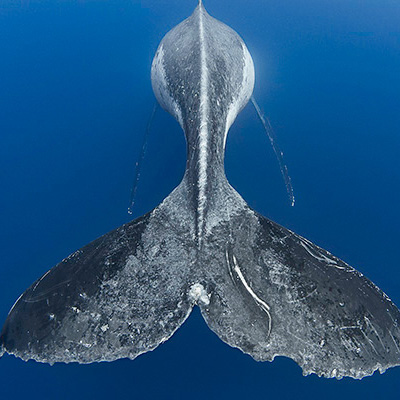
Fluke of a humpback whale singer

I’ve spent time with and photographed a lot of singers, but this had to be the most cooperative one ever. From the moment we made eye contact, I could tell that the whale didn’t mind my presence. The white along the sides of its body, and the curly, twisty scar on the right side of its fluke really give the whale character, making for a beautiful portrait of a beautiful animal.

Well…there are certainly many more photos that I liked, but a Top 47 list doesn’t have quite the same ring to it as Top 10 does.

All of these images are more than just pictures to me. They are reminders of incredible experiences, of memories and lessons learned that no amount of money can buy, of another year well spent exploring the world, making friends, and…hopefully…becoming a better photographer and person.

Humpback Whale Singer Audio

Locating humpback whale singers underwater is a challenge, but it’s fun. There’s nothing quite like tracking down a singer bit-by-bit, swimming along, scanning the water until the vague outline of a cetacean emerges from the misty blue haze.

Sound travels so well underwater that it’s extremely difficult to gauge direction and distance. Also, singers can stay down for extended periods of time, often diving too deep to see, sometimes swimming as they sing, sometimes sitting in plain sight but countershaded so well that you cruise right past them.

We found 14 singers this season, which is pretty high. Single-digit tallies are more common, not necessarily because there aren’t more singers around, but due in large part to the amount of time and effort it takes to track a singing whale down.

We came across the first singer of the season on 13 August, pictured below:

Humpback whale singer, Tonga 2011. Note the lopsided fluke.
First humpback whale singer I came across in the 2011 season.
Note the lopsided fluke.

The water wasn’t clear (bad viz. characterised the season), but the whale wasn’t too deep, about 15m (around 50ft) or less at the fluke from what I remember. It stuck around long enough for everyone to get a good look, and for my friends Debbie and George to record some video. (Debbie actually recorded the video. It was enough for George just to stay out of the way.)

They just forwarded me the following audio tracks of the singer, which they extracted from the video footage (Thanks Debbie, George!).

It may not come across in these recordings, but it seemed like the bass this year wasn’t as deep and booming as normal. I hung directly overhead this one and several others this season, and I didn’t get the same intense reverberation in my body as I have in the past.

Here’s a video from the 2010 season showing what it’s like to make a short courtesy call to a singing humpback whale. This one was considerably deeper, 20-25m at the fluke.

Whales, Whales, Whales

If you’ve been following my ramblings in recent months, it’s probably obvious that I’ve been spending an increasing proportion of my time with large cetaceans. My schedule for next year is no exception, with 12 to 13 weeks or so planned for sitting on a boat staring at the ocean hoping something will show up whale photography.

For those of you who are crazy enough to contemplate joining me on one of these adventures, I’ve set out basic trip descriptions below.

If you read on, you’ll no doubt notice that many of the trips are already booked. This is because I keep a list of people who contact me in advance, and I do my best to get in touch with anyone who’s expressed interest before announcing trips on my blog. I also send out an e-newsletter in advance of posting to this site.

If you’d like to get a heads-up for future trips, please contact me via my contact form, or sign up for my trip newsletter.

Please let me know if you’re interested, even if the itinerary you’re keen on is full, as I keep a wait list for each of the trips. Life happens sometimes, and people who’ve signed up end up needing to change their plans.

Blue Whales, Sperm Whales in Sri Lanka
Dates: March/ April 2012
Availability: Fully booked

This trip requires someone who is accustomed to less-than-ideal circumstances, can deal with frustration, and can accept the possibility of being totally and utterly skunked.

Sounds like fun, no?

To be a good fit for this adventure, you need to be very, very experienced in the water, be easy-going and cooperative, and have a stable, mature personality.

On the upside, there is the prospect of seeing scenes like the images below, as well as other potential surprises:

Sperm whale swimming upside-down to check me out with sonar

Blue whales(!) swimming in blue water

Minke Whales in Australia
Dates: 28 June to 7 July
Availability: One spot available
Location: Fly into/ out of Cairns, transfer to Port Douglas
Accommodation: Liveaboard trip

Minke whales have been on my to-do list for a long time. As far as baleen whales go, they’re relatively small, running six to ten metres in length. They’re inquisitive…as in, they’ll come right up to boats and people in the water given the right mood. They’re also reasonably easy to find…if you get the timing and location right.

For these reasons, I’ve planned a trip Down Under to spend some quality time with the minkes that congregate at the Great Barrier Reef.

We're heading over during absolute peak minke whale season
We’re heading over during absolute peak minke whale season.

The plan is to get on a boat in Port Douglas on 28 June, cruise overnight to minke central and sit there until we leave on 6 July to head back. That’s eight full days with minkes, only minkes, and just minkes.

We’ll be in the Great Barrier Reef Marine Park, so we’ll be following the well-established guidelines for in-water interactions with the small cetaceans, letting the whales dictate the pace and proximity of interactions.

I specifically picked the timing for this trip based on advice from my friends John Rumney, who is one of the leading authorities on minkes Down Under, and Julia Sumerling, who has many years of minke experience under her belt from working as the video/ photo pro on Mike Ball’s boat.

To cut to the chase, our trip will be during peak, peak minke time.

For whatever reason, the minkes show up like clockwork at this time, and more importantly, they demonstrate the greatest level of interest in people around this period.

Incidentally, the minkes in this area are a subspecies known as dwarf minke whales, which were first described in 1986. From what I gather, there is still no population estimate for this subspecies, and no consensus on the taxonomy for minke whales in general.

For more information about the dwarf minkes, please see the excellent summary prepared by the CRC Reef Research Centre (PDF file).

Minkes are curious, and some will approach really close
Minkes are inquisitive, and some will approach really close.

Humpbacks Whales in Alaska
Dates: 22 to 31 July
Availability: Fully booked
Location: Trip begins and ends at Juneau, Alaska
Accommodation: Liveaboard

This is the Megaptera Mania! trip I’m running with Jon Cornforth.

I’m really excited about heading to Alaska for the first time. I’m not so keen on the fact that it’ll be colder than I normally like, but bubble-net feeding and dramatic, mountainous terrain in the background will hopefully make it worthwhile, and also worth a repeat visit in 2013.

Humpback whales bubble-feeding at sunset in Alaska

Humpback whale breaching in Alaska

Humpback Whales in Tonga
As soon as we wrap up in Alaska, I’ll be heading over to Tonga for my annual stay, and to continue my calf count project. After the record number of baby whales I ID-ed this year, I can’t wait to see what happens in 2012!

My schedule for Tonga is still evolving, but here’s how it looks at this time:

Trip 1: 21 to 28 August. This is the second part of the Megaptera Mania! trip. Fully booked.
Trip 2: 29 August to 06 September. Two spots available.
Trip 3: 08 to 17 September. Fully booked.
Trip 4: 25 September to 3 October. Four spots available.

Tahafa, calf #14 of the 2011 season, with mommy

Fluke of a humpback whale singer

Season’s Greetings…almost

A confluence of circumstances has kept me from posting anything since I hunkered down and cranked out my calf count summary at the end of October.

I’ve answered approximately three million emails (give or take a handful); I’ve caught up on current events (given the way things are going, I kinda wish I hadn’t); I’ve finally rid my site of hacks that were doing all sorts of funky things (in the worst possible connotation of the word funky); I’ve had a bunch of meetings (both physical and virtual); I’ve helped judge a photo contest; I’ve hit the gym and gotten back into decent shape; I’ve organised most of my trips for next year; I’ve read a pile of research papers about cetaceans and other marine life; I’ve managed to sleep at least a few hours a night; and I’ve even gotten some work done. Whew.

By way of proof that I’ve actually been working, here is a video of sperm whales that Smithsonian Magazine posted recently to complement an article about these amazing animals in the December 2011 issue, titled Call of the Leviathan:

The footage is from recent trips I took to Dominica and Ogasawara to photograph sperm whales. I can’t take credit for the excellent editing though. Brendan, the photo editor at Smithsonian Magazine, did a bang-up job of making my footage look decent. (Thank you Brendan!)

And this is a link to an interview I did with Radio Australia recently about the humpback whales in Tonga. It’s short, but important.

Here’s the audio in case you can’t access the link:

There were suggestions by another person in an earlier interview that humpback whales use their pectoral fins to stroke swimmers in the water, sometimes even lifting swimmers en masse into the air out of exuberance. Poppycock.

I’m the first to admit that being in the water with humpbacks can be a magical, almost mystical, experience, but there’s no good that can come of people visiting Tonga and expecting to be stroked by whales. None whatsoever.

Bruce Hill, the presenter of Radio Australia’s Pacific Beat program, was kind enough to give me an opportunity to set more realistic, and safe, expectations for anyone who might be contemplating a trip to Tonga. (Thanks Bruce!)

Anyway, I’m back at the helm, and I’ll be posting more from now on, including information about upcoming trips.

To get back into the swing of things, here is one of my favourite humpback whale fluke photos. It was a stormy day back in 2005, and it’s the only time I’ve ever seen two adult humpbacks tandem tail-slapping. Their slaps weren’t in sync, plus the seas were rocky, so it took quite a few tries to nail the right timing and composition.

Humpback whales tandem tail-slapping in Tonga

48 Baby Humpback Whales!

48! That’s right…four dozen!!!

That’s the record-breaking number of humpback whale babies that I’ve ID-ed and catalogued since getting back from Tonga several weeks ago.

To put that into some context…that’s 2x the number of babies we counted in 2010.

Moreover, our previous record was 31 mother/ calf pairs (in 2009), meaning that we blew past the high tally two seasons ago by 17! Or to look at it another way, this year’s count trounced the previous high by a factor of more than 1.5x!

In case it’s not entirely obvious, I’m really excited. Like, giddy-little-kid-who-scarfed-down-too-much-halloween-candy excited.

First, because having so many baby whales is obviously terrific news for the ongoing recovery of the southern hemisphere humpback whale population. And second, because it’s vindication.

Back in the day, when I first started visiting Vava’u, the generally accepted wisdom was that there were perhaps a half dozen babies, maybe a few more, that were seen in the area each season. Within short order, I started to believe that there were more. Many more.

In fact, back in 2004, I went out on the proverbial limb (where I have tendency to find myself) and said there might be 40 or more babies in a season.

It’s taken a number of years, but this season’s calf count finally proves that 40 to 50 baby humpback whales in the Vava’u area is not only do-able, but is almost certainly an underestimate in some seasons.

Although I’ve photo-identified 48 mother/ calf pairs, there were many more whales that I either didn’t see, or did see but wasn’t able to ID. In fact, I have a number of photos of mother/ calf pairs that I think are additional ones. The thing is…I can’t be 100% sure, so I haven’t included them. Bummer, but all-in-all, it’s better to be conservative than to incorporate questionable data.

Summary of humpback whale calf sightings in Tonga during the 2011 season

One thing that I want to make clear…even though I’ve put in the time to organise, sort through and compile the data, there are actually a lot of people involved in this effort.

To name but a few: The many people who joined me in Tonga (62 people this season, hundreds more in the past!), who in effect, funded the time to undertake this project; Friends who’ve contributed photos and IDs this season, like Shawn, Douglas, Allan and Ma’ata; Friends like Mark and Karen, who sent me valuable information to help piece together theories about false killer whale attacks and escort relationships; The boat captains and crews (Endangered Encounters, Whale Watch Vava’u), whose dedication to keeping us safe and happy was invaluable; and Takaji and Emiko, who’ve been working with me on this project since we started.

In other words, this project is a group effort, involving dozens of people from all around the world. Thank you very much!!!

Given the high number of whales, the full summary is big. It’s a 64-page PDF file and about 196MB. To make this information as accessible as possible, I’ve prepared two different files available for download. The first is the 15-page summary, which is an overview of the key points but does not contain any of the photo-ID sheets. It is a 3.4MB file.

The second is the full 64-page document, which contains the 15-page summary plus photo-ID sheets for every ID-ed calf. It is 196MB.

Right click on the relevant link below to download the files.

Humpback Whale Calf Encounters in Tonga 2011 – Summary Only (v1, 31 October 2011)
Humpback Whale Calf Encounters in Tonga 2011 – Full File (v1, 31 October 2011)
Humpback Whale Calf Encounters in Tonga 2011 – Full File (v2, 01 November 2011, updated 201142 Faua to show split dorsal fin. Thanks to Robert Pierce for pointing out the split fin!)

In addition, I’ve uploaded all the location data for our calf sightings to two Google Maps. The first is this one, which shows the locations of all of our encounters with humpback whale mother/ calf pairs that I was able to ID:


View 2011 Humpback Whale Calf IDs Tonga in a larger map

The flags represent GPS data; the blue dots are hand-marked locations. I encourage you to click through to the full map, as there are notes for each of the encounters, and it’s much easier to view the information on the full map.

The second is a map that shows the locations of mother/ calf pairs that we encountered, but were unable to establish IDs for. The red pins are mother/ calf pairs I wasn’t able to ID; the green pins are mother/ calf pairs initially marked as unknowns, but later assigned IDs after reviewing photographs. Again, if you click through to the full map, there are notes for each of the sightings.


View 2011 Unidentified Humpback Whale Calf IDs Tonga in a larger map

Finally, in case you have a bad connection and can’t download either file, I’m appending the text of the summary to the end of this post. I can’t, however, include the four summary tables, which set out all the encounters and timelines. The only way to view those is to download one of the two files.

One request: If you have photographs and sighting information for humpback whale mother/ calf pairs from this season that are not in my summary file, please let me know. It would be just so awesome to cross the 50-calf mark!

I will post updated versions of my calf count file as and when additional data comes in.

Here’s the introductory text of my humpback calf count summary for the 2011 season in Vava’u, Kingdom of Tonga:

Introduction
This document is a summary of humpback whale calf encounters in and around the Vava’u island group in the Kingdom of Tonga during the months of August to October 2011.

During our stay this year (05 August to 01 October), we identified 45 humpback whale mother/ calf pairs over the course of 73 in-water encounters, with three additional IDs contributed by friends, for a total of 48 humpback whale mother/ calf pairs.

We initially recorded 33 sightings of calfs that we were unable to identify at the time of encounter. We were later able to assign IDs to two of those 33 in the process of preparing this summary, lowering the total unknown calf sightings to 31.

This is the highest number of mother/ calf pairs we have identified and tabulated since commencing this annual calf count project in 2008.

This season was notable in other respects as well:

  • There were reliable reports of whales arriving in the Vava’u area by mid-June, with calf sightings reported before the end of June. This is several weeks earlier than the timing in a hypothetical average season, and contrasts with the relatively late arrival of the whales in 2010. The whales did not, however, seem to leave the area any earlier than normal.
  • Overall whale behaviour/ disposition was “neutral”, meaning significantly less standoffish than in 2010, but not as approachable as in “friendly” seasons like 2009.
  • We documented three returning mothers. The mother of 201132 Toluua was also the mother of 200913 Luna, easily recognisable by her unique dorsal fin. Of note, her relaxed disposition was the same as it was two years ago, and both juveniles were friendly and inquisitive. The mother of 201107 Fitu was the same as the mother of 200920 Mama’s Boy. And the mother of 201115 Tahanima was the same as the mother of 200814 Jet.
  • We documented three mother/ calf pairs travelling between Vava’u and Toku Island, about 40km away. Travel among islands is not unusual, but it is the first time we have documented this taking place with photographs and GPS data.
  • For the first time, we recorded data pertaining to escort relationships with mother/ calf pairs. Over half of all mother/ calf pair encounters involved at least one escort, which seems to be a relatively high ratio viz. other humpback whale breeding and calving grounds.
  • We documented two long-term associations between an escort and mother/ calf pair: At least 14 days for 201114 Tahafa and at least 18 days for 201142 Faua. This is the first time we have observed/ noticed this. Such long-term associations seem to be unusual, or perhaps not well documented.
  • Of interest, in both cases of long-term escort association, the mother/ calf pairs undertook the 40km journey between Vava’u and Toku while in the company of their respective long-term escorts.
  • We also documented three occasions when escorts with mother/ calf pairs were singing, or vocalising in a song-like manner: 201114 Tahafa, 201121 Uataha and 201130 Tolunoa. We have come across this behaviour on multiple occasions in previous seasons as well.
  • There were two juveniles with all-white pectoral fins, the first we’ve seen in the Vava’u area. They were 201127 Uafitu and 201142 Faua.
  • We documented several juvenile whales with injuries that suggest coordinated attack by a pod of marine mammals, possibly false killer whales (Pseudorca crassidens).

Overall, there was an abundance of whales this season, a lot of interesting social interaction, and many opportunities to observe and record humpback whale behaviour. This document focuses upon the mother/ calf pairs and associated whales. For additional background information, please refer to the following blog posts:

Swimming with Humpback Whales in Tonga | 2011 Season Part 1

Swimming with Humpback Whales in Tonga | 2011 Season Part 2

Swimming with Humpback Whales in Tonga | 2011 Season Part 3

Swimming with Humpback Whales in Tonga | 2011 Season Part 4

Swimming with Humpback Whales in Tonga | 2011 Season Part 5

Swimming with Humpback Whales in Tonga | 2011 Season Part 6

Swimming with Humpback Whales in Tonga | 2011 Season Part 7
Swimming with Humpback Whales in Tonga | 2011 Season Part 8

All of this work has been and is being done on our own time, with our own resources. We are not receiving financial or other assistance, and we are not affiliated with any person or organisation involved with cetaceans.

If you have photographs of humpback whale mother/ calf pairs from the 2011 season in Vava’u that are not included in this file, or additional information about whales already included in this document, please contact Tony Wu.

Reference documents:
2008 Calf Summary, 2009 Calf Summary, 2010 Calf Summary

Methodology

  1. Our basic methodology has remained unchanged since commencing this calf count project, with our core ID team comprising Tony Wu, Takaji Ochi, and Emiko Miyazaki.
  2. We recorded GPS locations for all sightings of humpback whale calfs upon initial visual and/ or radio confirmation. We used Garmin GPS 60 and GPS 72H handheld units for marking GPS locations and converted to Google KML format using HoudahGPS. When GPS units were not available, we marked locations by hand on a map.
  3. Where possible, we entered the water to photograph mother/ calf pairs and other associated whales if any.
  4. We made notes of behaviour, easily recognisable physical traits, and any other noteworthy circumstances.
  5. For the first time, we have recorded the number of escorts with each mother/ calf pair sighting, for the purpose of tracking escort activity from this season onward.
  6. When we were able to take photographs of sufficient quality and quantity to establish an ID, we named and assigned a numerical ID to the relevant calf.
  7. In those cases where we were unable to get sufficient photographs to establish ID, we did not name the calfs. We recorded the sightings as unknowns and cross-checked any photos of such juveniles with subsequent ID-ed whales to look for possible matches.
  8. We have uploaded all the GPS and hand-marked location data to Google Maps, where the locations of all ID-ed calfs and unidentified calfs are available for viewing. GPS locations are also embedded as hyperlinks throughout this document when there is text that refers to date and location of sightings. Clicking the hyperlinks will take you to Google Maps to view the relevant location.
  9. The photographs contained in this document represent a small portion of the images we collected. For most ID-ed calfs, we have many more images for verification purposes.

Observations

  1. Figure 1 below illustrates our cumulative calf counts over the past four seasons (incorporating all ID-ed juvenile whales each season, including those contributed by third parties). While we recognise that there are inherent differences in each season (different periods of stay, varying number of boat days, weather variations, etc.), the slope of the line representing cumulative calf count has appeared relatively similar across previous seasons. With the addition of data for 2011 however, a divergence in the slopes of the curves for 2009 and 2011 from those for 2008 and 2010 is apparent. This makes intuitive sense against the backdrop of the number of calf encounters, overall whale mood and other conditions in each season.
  2. Cumulative count of humpback whale calf IDs in Tonga
    Cumulative count of humpback whale calf IDs in Tonga

  3. During our stay this season, we had 73 encounters with 45 mother/ calf pairs that we identified over 76 boat-days on the water (compared with 22 calf IDs over 81 boat days in 2010; 26 calf IDs over 59 boat days in 2009; 16 calf IDs over 67 boat days in 2008; 14 calf IDs over 53 boat days in 2007). This worked out to 0.59 Calf/ Boat-day, with a boat-day being defined as a single day of approximately six hours on the water on a boat looking for whales. These figures do not include calf IDs contributed by other people.
  4. Graph of humpback whale calf IDs per boat day in Tonga
    Humpback whale calf IDs per boat day in Tonga

  5. As is apparent from Figure 2, this season was exceptional, with the Calf/ Boat-day ratio significantly exceeding the levels recorded in each of the previous seasons. In our 2010 summary, we posited that a Calf/ Boat-day ratio of 0.25 might represent the norm, with 2009 being an outlier. With this season’s ratio of 0.59 however, the question of whether there is a normal level or not becomes more intriguing.
  6. It is certainly possible that our experience in 2011 is exceptional, and that we will not see a similarly high number and density of humpback whale mother/ calf pairs in the Vava’u area in the future. However, given the 0.44 ratio recorded in 2009, and our personal recollections of similarly high numbers and frequency of mother/ calf pair encounters in 2004 and 2005, it seems possible that there is no “norm”, and that the Calf/ Boat-day figure may vary unpredictably within a relatively broad band.
  7. What this underscores is that extrapolating from limited observation in any single season to draw conclusions about the dynamics of the southern hemisphere humpback whale population is inadvisable. Only long-term observation and consistent recording of data may eventually reveal underlying patterns and trends.
  8. In addition to the calf IDs we established, we received three more mother/ calf pair IDs from friends (201115 Tahanima from Shawn; 201143 Fatolu from Douglas, 201148 Favalu from Allan/ Ma’ata), bringing the total ID-ed calf count to 48.
  9. In 2009, we commenced recording sightings of unknown mother/ calf pairs (those whales which we are unable to ID at the time), by marking GPS location, taking notes about behaviour, and taking photos when possible, for the purpose of trying to establish IDs at a later point. This year, we recorded 33 unknown mother/ calf pairs. We were later able to establish IDs for two of those 33 (Unknown calf #10 = 201146 Faono; Unknown calf #27 = 201147 Fafitu), meaning that we ended up with 31 unidentified calfs (compared with 16 in 2010; 24 in 2009).
  10. Figure 3 depicts the total Calf Sighting Ratio for 2009 to 2011, where we have defined Calf Sighting Ratio as = (Total ID-ed calf count + Total unidentified calf count)/ Total boat-days. This ratio was 1.01, which compares with 0.49 for 2010 and 0.85 for 2009. This ratio provides a reasonable indication of the overall level of humpback whale mother/ calf pair activity in the Vava’u area.
  11. Graph ofCalf Sighting Ratio for 2011 Humpback Whale Season in Tonga
    Calf Sighting Ratio for 2011 Humpback Whale Season in Tonga

  12. We again found mother/ calf pairs throughout the entire topography of the Vava’u Island group without apparent clustering or preference for a specific area. As with 2010, however, there were not many sightings in North Bay, once again consistent with our experience from most previous seasons. 2009 was the exception, when we recorded a significant number of encounters in North Bay. We recorded more encounters in the Toku area than in previous seasons. This may, however, have been due to the fact that calm conditions prevailed for a number of days in the latter part of the season, allowing several visits to Toku. See map of ID-ed mother/ calf pairs and map of encounters with unidentified whales.
  13. The pattern of sightings once again supports our notion that, for the most part, humpback whale mother/ calf pairs use Vava’u as a transit area, visiting for a short duration before moving on, returning to the area at a later date in some instances. Within this context however, we have documented a number of repeat sightings over extended periods of time:
    • 201103 Tolu (4 encounters/ 30 days);
    • 201114 Tahafa (9 encounters/ 33 days, Vava’u to Toku to Vava’u);
    • 201120 Uanoa (3 encounters/ 27 days);
    • 201123 Uatolu (2 encounters/ 29 days, Toku to Vava’u);
    • 201130 Tolunoa (2 encounters/ 33 days); and
    • 201142 Faua (2 encounters/ 18 days, Toku to Vava’u).

    This adds to our long-term repeat sightings in previous seasons:

    • 201005 Ikumi (11 encounters/ 31 days);
    • 201008 Lele (3 encounters/ 11 days);
    • 200904 Stitches (4 encounters/ 23 days); and
    • 200912 Luna (3 encounters/ 13 days).
  14. Of note is that in three of the long-term sightings for 2011, the relevant mother/ calf pairs were sighted in both Vava’u and Toku. This is the first time we have documented travel by mother/ calf pairs between the two locations, which are about 40km apart.
  15. As was the case in 2009 and 2010, the ratio of female to male juveniles favoured females. This year, we counted 13 females and 10 males. In 2010, it was 7 female to 4 male. In 2009, it was 14 female to 9 male. Given that this relationship has remained in favour of females for three consecutive seasons, it’s tempting to speculate that females may represent a greater proportion of overall calf births than males. Since it is not possible to establish the sex of every juvenile encountered, we cannot be certain of this however, and need to consider other possible explanations as well. It could be the case, for instance, that mother/ calf pairs with female babies tend to be more favourably disposed to interacting with people.
  16. Graph showing ratio of female to male humpback whale calfs in Tonga
    Ratio of female to male humpback whale calfs in Tonga

  17. We documented long-term escort relationships with two of the mother/ calf pairs sighted over an extended period of time. In the case of 201114 Tahafa, the same escort stayed with the mother/ calf pair from at least 01 September to 14 September (14 days). In the case of 201142 Faua, the same escort remained with mother and calf from at least 20 September to 07 October (18 days). To the best of our knowledge, such long-term escort + mother/ calf relationships have not been documented previously in this area.
  18. Spurred in part by observation of these long-term escort + mother/ calf relationships, we commenced recording escort sightings this season. In several instances, we were able to observe the effects of escorts on mother/ calf behaviour. In some cases, the adult females appeared to dislike the attention of the males; in other cases, the presence of an escort seemed to have a calming effect. We have made notes of such behaviour in the individual ID pages that follow.
  19. Out of 48 ID-ed mother/ calf pairs, 30 were accompanied by escorts in at least one encounter with the relevant mother/ calf pair, a ratio of 0.63. Out of 76 total encounters with those 48 ID-ed mother/ calf pairs, 40 encounters involved at least one escort, a ratio of 0.53. In the case of unidentified mother/ calf pairs, the ratio was 0.35. We only calculated one ratio for unidentified mother/ calf pairs because we had only one encounter with each pair. In any event, the proportion of mother/ calf pairs accompanied by escorts was high. Subjectively, this is consistent with our experience in previous seasons.
  20. Graph showing frequency of escort whales accompanying mother/ calf pairs in Tonga
    Frequency of escort whales accompanying mother/ calf pairs in Tonga

  21. We documented three repeat mothers this season, making a total of five females that we’ve documented returning to the Vava’u area with second babies since 2008.
    • The mother of 201132 Toluua was the same as the mother of 200913 Luna. Her unique dorsal fin made it easy to recognise her, and her overall friendly disposition in both 2009 and 2011 made it relatively easy to photograph her and the calf. Of note, both Toluua and Luna were inquisitive and pro-active in their approach to people in the water.
    • The mother of 201107 Fitu was the same as the mother of 200920 Mama’s Boy.
    • The mother of 201115 Tahanima was the same as the mother of 200814 Jet.

    List of female humpback whales that we've documented returning to Vava'u with a second baby
    Female humpback whales that we’ve documented
    returning to Vava’u with a second baby

  22. We documented several juvenile whales with injuries that suggest coordinated attack by a pod of marine mammals, possibly false killer whales (Pseudorca crassidens). Refer to summary pages for 201107 Fitu, 201114 Tahafa, 201120 Uanoa, and 201144 Fafa to see the wounds. See also this blog post for a discussion of this topic.
  23. We documented two juveniles with all-white pectoral fins: 201127 Uafitu and 201142 Faua. This is interesting because these are the first such calfs we have seen in the Vava’u area. In previous seasons, we had wondered where the adults with all-white pectoral fins come from, as we had not seen any juveniles with this trait.

Just For Fun

In the process of going through many GBs of data to put together my humpback whale calf count summary, I came across the image below.

School of barracuda with humpback whale mother and calf in the background.
School of barracuda with humpback whale mother and calf in the background. Seriously?!!!

It’s certainly not the best photo I’ve ever taken, but hey…how many times do you get to snorkel down to a decent-sized school of barracuda and take a snapshot with a humpback whale mom and baby in the background?!

It would’ve been more effective if the barracuda had been cooperative enough to heed my pleas to: “Turn sideways!”, but the fish were, for whatever reason, horizontally challenged.

Incidentally, I’ve made it through the 45 mother/ calf pairs I ID-ed while in Tonga, and confirmed that I didn’t double-count any of them.

Even better, after careful review of the images, I think I may have two or three more to add to the tally.

If all goes well, I’ll post the summary file and accompanying maps in the next day or two.

2011 Humpback Whale Season in Tonga: Part 8

It’s been a while since I’ve had a chance to post. Things got a little hectic toward the end of my stay in Tonga, and my re-entry into urban life has been as chaotic as usual. But I’ve finally settled back into (some semblance of) a normal routine, and I’m hard at work catching up on my to-do list mountain.

Final Calf Encounter
Before departing Tonga, I was fortunate enough to have one last encounter, with a humpback whale calf that I had not come across before…Fanima (female), the 45th(!!!) calf of the season.

Fanima was a big baby when I met her. I estimate that the mini-Megaptera was close to half the length of her mother, which suggests that she was born early in the season.

Perhaps in part because the calf was relatively mature, mom was laid back. She seemed, in fact, almost entirely unconcerned with what the little one got up to. Fanima played and splashed at the surface with considerable vigour, executed many a whimsical twirl, checked the boat out on multiple occasions, and peered with intense curiosity at anyone in the water.

Fanima (calf #45) was my final calf encounter for the 2011 season. Given her relatively large size, Fanima was probably born early in the season.
Fanima (calf #45) was my final calf encounter for the 2011 season.
Given her relatively large size, Fanima was probably born early in the season.

We did, however, have a bit of drama.

Before I had a chance to take any photos, an escort appeared without warning out of the deep, surging up beneath Fanima’s resting mother, waking the female from her slumber. Not surprisingly, Fanima’s mom bolted, with calf in tow. Females of any species…as it turns out…don’t enjoy being taken by surprise.

When escorts approach suddenly like this, relaxed mother/ calf pairs often take off and swim at high speed for considerable distances.

I was alone in the water at the time, and groaned in despair at the prospect of having lost the opportunity to ID the calf.

Fortunately, mother and baby settled again after only a few minutes. Mommy, it seems, decided that she liked the escort and let him stay. Whew! I’ve seen this happen before, but less often than I’ve seen the swim-swim-swim-away scenario play out.

With that, we spent a wonderful hour or so cavorting with Fanima, mother and escort…a perfect way to wrap-up an incredible season of humpback whale encounters.

Humpback whale calf Fanima having fun swimming upside-down

Incredible Season
2011 was my tenth humpback whale season in Tonga, my ninth consecutive one.

It was also the most amazing. I think I learned more about humpback whale behaviour over the past two months than I have in all the other seasons combined!

The relatively high number of whales this season was certainly a big factor. After all, the more whales there are, the more there is to see.

But I think the cumulative weight of previous experience may have tipped the scales as well. Bits and pieces from seasons past seemed to fall into place, affording me a glimpse of the bigger picture…like the moment when a jigsaw puzzle finally coalesces.

I’m still processing everything I experienced and learned this season, but here are some key points that come to mind:

Record number of baby whales: To date, I’ve ID-ed 45 humpback whale mother/ calf pairs. My previous record was 31 mother/ calf pairs in 2009, set out in this file: humpback whale calf count file for 2009.

I have to double-check the IDs to make sure I didn’t double count, but I have a reasonably high degree of confidence in this tally, given the many(!) hours I’ve invested squinting at the finer details of whale body patterns, dorsal fins, flukes and other markings. Of course, I’m hoping to receive additional data that will increase the final count, but in any event, I’m 100% certain that there were many more babies in the area.

Record-breaking mother was a repeat from 2009: The mother that broke the previous high count of 31 was a female that I had previously ID-ed with a calf in 2009. The female in question was the mother of Luna (calf #13, female, in 2009) and returned this season with Toluua (calf #32, female). I recognised the mom on sight because of her unique dorsal fin, but also…more interestingly…because of her personality/ disposition. See Part 5 for a discussion of this inspiring encounter.

This is now the third female I’ve documented returning with a second calf. There might be more repeat mothers in this year’s crop. I just haven’t had time to do a methodical comparison yet.

Worst visibility ever: The underwater visibility this season was consistently the most mucked-up and worst that I’ve experienced to date. There have, of course, been periods of poor visibility before, but the less-than-ideal conditions persisted for the entire season. Visibility was poor far offshore as well, in areas that would be clear under more normal circumstances.

I have no idea what caused this prolonged phenomenon. I’m guessing it’s a lingering effect of the prolonged El Niño/ La Niña cycle that finally ended a while ago, but really…who knows?

Earliest whales ever: Somewhat offsetting the bad visibility was the fact that the whales showed up as early as I can recall. I wasn’t in Tonga at the time, but I received reliable reports of whale sightings in June, with the first babies spotted in late June. To put that in perspective, I usually expect the earliest humpback whale calfs to be spotted in mid- to late-July or so.

You might recall that the whales showed up relatively late last year, so this marks a stark contrast between the two consecutive seasons.

One thing I’ve been keen to see is whether the whales leave Tonga earlier than usual as a result of their early arrival in the area. We’re a third of the way through October now, and while the number of whales has declined, it seems like there are still quite a few around, as one would expect at this stage in a “normal” season. I’ve received several reports of excellent in-water encounters over the past few days.

Toluua (calf #32, female), who's mom is the same as the mother of Luna, calf #13 of 2009!
Toluua (calf #32), who’s mom is the same as the mother of Luna, calf #13 of 2009!

Lots of whales as well: Going hand-in-hand with the early arrival of the whales was the seemingly high number of humpbacks.

Last season, it seemed as if there weren’t as many whales around as in a given “average” season. This year, there were certainly some days when there were few whales to be found, but in general, an abundance of whales characterised the season.

Go figure…Escorts are actually interesting: I’ve always considered escort whales that associate with mother/ calf pairs a bit of a nuisance. They often “push” the female/ baby whales and make them swim at high speed for prolonged periods, making it difficult to get a look in the water, much less take photos.

But I started noticing a few things about the escorts this season.

For instance, in Part 3 of my updates, I documented one escort hounding two separate mother/ calf pairs (calf #17 Tahafita and calf #18 Tahavalu) on consecutive days, with both mother/ calf pairs seemingly doing their best to get away from the pesky male in question. I named him “Two-timer”.

Two-timer’s plight was a clear contrast to the way that the presence of an escort seemed to settle Tolu’s (calf #3, male) mom, as I described in Part 2, and also to the way that Tahafa’s (calf #14, male) mom seemed to take comfort in the presence of her long-term escort, as I set out in Part 5. Recall also from the write-up about Fanima (calf #45, female) above, that Fanima’s mom only took a few minutes to accept the presence of the escort.

Perhaps this is obvious, but it seems that female humpbacks are receptive to overtures from some males, but not others.

I’ve also seen this behaviour among sperm whales, where females seem to “like” or “not like” individual adult males, so perhaps this is a universal phenomenon? (For my own good, I’ll resist the temptation to draw any parallels to human female behaviour, however obvious.)

Escort relationships can be long term: I had always assumed that escort relationships with mother/ calf pairs were relatively short term. Actually, to be more accurate, I hadn’t given the topic much thought, as ID-ing mother/ calf pairs was my priority, and escorts were just sort of “in the way”.

This season, I’ve documented two relatively long-term relationships between an escort and a mother/ calf pair.

The first involved Tahafa (calf #14, male), with a single escort staying with the mother/ calf pair for a period of at least 14 days (1 to 14 September), as I described in Part 6. The second was Faua (calf #42, female), with a single escort present from 20 September to 7 October, a span of 18 days (just received photo documentation of this latest sighting).

My understanding from communicating with researcher friends in Hawaii is that no one else seems to have documented such long-term associations between an escort and a mother/ calf pair before. (If you know of any such documentation, please clue me in!)

Perhaps this is a phenomenon unique to the whales that frequent Tonga; perhaps it’s a fluke (excuse the horrible pun); or perhaps this happens elsewhere as well, but hasn’t been documented because it’s difficult to follow a particular escort + mother/ calf for an extended period.

Of additional interest, both of these escort + mother/ calf groups travelled the 40km distance between Vava’u and Toku. Maybe having an escort around is something mothers prefer when crossing open ocean? (See discussion of Pseudorca attacks below.)

In any event, picking up on these fascinating escort/ mother/ calf dynamics has sparked my interest in escorts, and from this season forward, I’ll be keeping records of the number of escorts we see with mother/ calf pairs, as well as taking careful notes on their behaviour, and photographing them more carefully for ID purposes (just what I need…more self-imposed work!).

Tahafa (calf #14), the undisputed star of the season

Singing escorts: One other escort behaviour that has me scratching my head is singing. Most people associate singing behaviour with lone males, hanging in the blue, belting out their haunting melodies. Males can also sing while they swim. In fact, “travelling singers” seem to be nearly as common as stationary ones, at least in Tonga.

But over the years, we’ve also come across a number of males singing when they’re with mother/ calf pairs. Again, I haven’t kept meticulous records of this, but in general, this seems to take place when more than one male is involved. It can sometimes be when the whales are resting, and at other times, when the whales are swimming.

We had two such observations this season. The first was with Uataha (calf #21). Two males approached the mother/ calf pair; there was a bit of commotion; and then there was an escort with the mother and calf…singing. The whales settled in shallow water, not moving much.

The second instance involved Tahafa (calf #14, male). In this case, there were multiple males challenging the primary escort repeatedly over the course of many hours. Amid the chaos and pandemonium, at least one of the males was singing…really loud! I think it was the primary, long-term escort, but I can’t be certain. There was a lot of action, and the whales definitely weren’t settled.

What does this mean? I’m not sure, but I do know that humpback whale singing behaviour is much more complex and nuanced than a lone male crooning while hanging head-down in the water.

Escort ratio is high: One final note about escorts…the ratio of mother/ calf pairs with at least one escort present is high in Tonga. This season, out of a given 10 mother/ calf pair encounters, somewhere between 4 and 5 will have had an escort or more (I’ll have a precise figure after I review all the data). My understanding is that such a high prevalence of escorts with mother/ calf pairs is unusual.

If you think about it, escorts should prefer single females over ones with babies, on the assumption that escorts are males looking to mate.

From memory, the ratio has always been high in Tonga, but again, I haven’t kept careful records to date. I did keep careful records this year though, so when I produce my calf count summary for this season, it will include a breakdown of escort relationships as well.

More about this topic in Part 6.

Pseudorca attacks: With the combined evidence from the injuries on Tahafa (calf #14, male), Fafa (calf #44, female), Fitu (calf #7) and Uanoa (calf #20, male), the case for false killer whale attacks on humpback whale babies around Tonga seems like an open-and-shut case.

Maybe such attacks are a contributing factor to reason why there are long-term escort + mom/ calf pair relationships discussed above?

It will be interesting to see whether we come across more such attacks in the future, and also if we see these particular babies back in Tonga in upcoming seasons. Scarring should make it relatively easy to spot them, assuming they survive and also return to Tonga.

See Part 7 for a detailed discussion of the rationale for pointing the finger at Pseudorca crassidens.

Travelling mother/ calf pairs: This season, we’ve ID-ed three mother/ calf pairs that have moved between Vava’u and Toku: Tahafa (calf #14, male); Uatolu (calf #23, female); Faua (calf #42, male).

I’ve always taken it for granted that mother/ calf pairs travel, and my data from previous years has suggested that Vava’u is more of a stopover place than a long-term home, but it’s nice to have incontrovertible photographic and GPS proof.

Abundance of white pecs: Whales with all-white pectoral fins were back in numbers this season. I haven’t done a final count, but we photographed at least 10, including, for the first time, two babies with all-white pectorals fins…Uafitu (calf #27) and Faua (calf #42, male). Faua’s mom also has white pecs.

Why is this important? Because whales with all-white pectoral fins are relatively easy to spot and track, and there usually aren’t that many that visit Tonga. This is only the second season during which I’ve come across so many of them. Last year, for instance, I didn’t see any, though friends report seeing one, possibly two.

What this suggests to me is that it’s not always the same group of whales visiting Vava’u.

Dearth of split dorsal fins: Along similar lines, we only came across two whales with split dorsal fins this year. Actually, it was more like 1.5, since one of the two only had a mild split.

Why is this important? Because whales with split dorsal fins are also easy to recognise. Last season, there were quite a few. In most seasons, like this one, there are zero to extremely few.

This again suggests to me that it’s not always the same group of whales visiting Vava’u.

Male humpback whale swimming past at high speed, fending off challengers for the female (dark whale visible lower left background)
Male humpback whale swimming past at high speed,
fending off challengers for the female (dark whale visible lower left background)

Lots of singers; bass not so bass: There seemed to be a relative abundance of singers this season. This probably makes sense, given the apparent abundance of whales overall. Somewhat unexpected, however, was the number of singers we came across toward the end of the season.

I generally expect there to be more singers early in the season, because I believe that singing is part of the interaction/ communication/ competition among males in association with social status and securing the right to mate.

Early in the season, there should be more females around, so I’d expect competition to be high. Toward the end of the season, there should be relatively few whales remaining (including eligible females), so logically, there should be less competition among males.

This year, however, half of the 14 singer encounters we logged took place between 14 and 22 September, pretty late in the season…so once again, the whales defied my efforts to make sense of their behaviour.

Also worth noting, the bass in the song this season wasn’t quite as deep and booming as I’ve experienced in the past. Even while hanging a couple of metres directly above singers on multiple occasions, I didn’t feel the same “oomph” that usually characterises the low notes in humpback whale song.

Crystal Ball Gazing (Sort of)
Last year, I felt reasonably confident about setting out a case for a baby boom this season, because the deck seemed to be stacked that way. There were babies around, but not a record number by any means, and we came across a lot of behaviour associated with reproduction.

This year, there were heaps of whales and lots of babies. It seemed like there was a reasonable level of mating-associated activity….heat runs, courting pairs and such…but not quite as much as in 2010.

So what do I think is going to happen next season?

To be honest…I have no clue.

With so many babies born this year, probability should favour fewer, rather than more, little ones next season.

But…no one really knows how the greater population of southern humpbacks decides where to go. Judging by the ever-changing number of white-pec whales and individuals with split dorsal fins, for instance, I don’t believe that the same whales visit Tonga each season. I think it’s more likely that individual whales cycle around various areas, which could explain why we more often see readily ID-able individuals every couple/ few years, rather than in consecutive seasons.

As such, there is certainly some chance that a significant proportion of female whales that have mated elsewhere this year will, for some reason, again converge in Tonga, resulting in another baby boom. From memory, there were lots of babies in the consecutive seasons of 2004 and 2005, for instance.

On the other hand, there were relatively few babies in 2008, moderate numbers in 2006, 2007, 2010, and very high numbers in 2009 and 2011.

So basically…there’s no obvious pattern. There are without doubt a host of variables at play, most of which we probably don’t know about, much less understand.

If I had to make a guess though, I’d wager the chances of another 40+ baby year are relatively low, and we’ll end up with a count in the 20s. In other words…a reversion to the mean.

While I’m taking a stab in the dark, I’ll go out on a limb and predict substantially better visibility, on the theory that the particles in the water are the result of prolonged rains and warm weather due to the El Niño/ La Niña cycle.

Time will tell if gut instinct is pointing me in the right direction, or if the whales, weather and water outsmart me.

One of my best friends in Tonga

Wrap-Up
I’d like to wrap up my final long-form blog post for the 2011 humpback whale season with a really big “Thank You!”

Even though I’m doing all the work of keeping track of whales, cataloging photos, recording GPS data, taking notes and producing the summary file, a lot of people have contributed to the calf sighting and ID process…some of whom I’ve named in my periodic updates this season, most of whom I have not.

Some people have contributed photos and sighting data; others have contributed knowledge and experience, responding to my numerous emails and other messages that start with: “Do you happen to know…?”.

I’m particularly grateful for the trust and friendship of everyone who has travelled to Tonga with me, not just this season, but in past years as well. Besides having lots of fun, you have made it possible for me to spend the time to collect and collate my annual calf count data.

During and after each season, I spend hundreds of hours going through the data collected, organising it, and parsing it into easily understandable format. Then I put together a summary file and Google Maps, which I post to the internet…so that anyone who is interested can see the results. (I’m getting to work on the 2011 file now!)

In short, your generosity and support have allowed me to crowd-fund this research effort.

So to sign off for now…to all the people who have joined me this season and in the past, from the United States, Japan, Singapore, Taiwan, China, Thailand, Hong Kong, Korea, Sweden, Russia and Canada…Thank you, 有り難うございました, 谢谢, ขอบคุณครับ, 감사합니다, tack, Спасибо, and for the Canadians…Thank you, eh.

I’ll post my 2011 summary file as soon as I can (with 45+ babies to work through, it’s going to take a while!), and also my Tonga trip schedule for 2012.

If you’d like to consider travelling to Tonga with me next season, please drop me a short note via my contact form.

Previous Posts from the 2011 Humpback Season in Tonga:
Swimming with Humpback Whales in Tonga | 2011 Season Part 1
Swimming with Humpback Whales in Tonga | 2011 Season Part 2
Swimming with Humpback Whales in Tonga | 2011 Season Part 3
Swimming with Humpback Whales in Tonga | 2011 Season Part 4
Swimming with Humpback Whales in Tonga | 2011 Season Part 5
Swimming with Humpback Whales in Tonga | 2011 Season Part 6
Swimming with Humpback Whales in Tonga | 2011 Season Part 7

Previous Calf Count Summary Files and Maps:
Humpback Whale Calf Count, 2009
Humpback Whale Calf Count, 2010

A treat of delicious homemade gelato from my friends Franco and 'Ofa to bid us farewell
A treat of delicious homemade gelato
from my friends Franco and ‘Ofa to bid us farewell

2011 Humpback Whale Season in Tonga: Part 7

It’s been another eventful and educational week.

My calf count is up to 44 ID-ed mother/ calf pairs now (with several uncertain pairs to which I may be able to assign IDs after more careful review).

The new calf IDs this week comprised:
- Fataha (#41), accompanied by an escort;
- Faua (#42, male), the second calf with all-white pectoral fins that we’ve photographed this season. Mom also had all-white pectoral fins. This pair were also in the company of an escort;
- Fatolu (#43, female), ID contributed by my friend Douglas Seifert (who has been here with his lovely wife Emily for the past couple of weeks and has been kind enough to contribute valuable calf-sighting information and photographs…thank you!). No escort with this pair;
- Fafa (#44, female), another injured calf with wounds similar to those of Tahafa (#14, male). No accompanying escort.

Faua (#42, male), the second humpback whale calf with all-white pectoral fins this season. Mommy also has white pectoral fins.
Faua (#42, male), the second humpback whale calf with all-white
pectoral fins this season. Mommy also has white pectoral fins.

Resightings included:
- Uatolu (#23, female), which I originally ID-ed at Toku Island on 02 September, and Douglas Seifert photographed in Vava’u on 20 September (19-day interval). This is the second example we have documented this season of a mother and calf travelling between the two locations;
- Uanoa (#20, male), accompanied by an escort. We originally ID-ed this calf on 29 August. I subsequently received a photo of this calf from Kristy Peacock, a guest at Mounu Island Resort, taken on 24 August. I photographed this calf again on 24 September (an interval of 32 days from first documented sighting) and was able to determine that the calf is male;
- Tahafa (#14, male), our ninth(!) encounter with this injured calf. We have now documented this calf going from Vava’u to Toku then back to Vava’u, between 23 August to 24 September, a span of 33 days. For a detailed timeline of the first eight encounters, please see Part 6.

Overall, it seems that there are still many whales in the area, including mother/ calf pairs. We have, however, ID-ed fewer new calfs this past week than in previous equivalent periods. This could be due to chance, but I have a feeling that the lower tally may reflect the fact that we’re approaching the tail-end of the season, with an accompanying decrease in the number of births.

One other observation: It may just be my imagination, but there seems to have been a proliferation of singers in recent days. Maybe we’re just noticing more, or perhaps there are actually more whales singing now.

I’d always assumed that the prevalence of singing would be greater during the early part of the season rather than the latter, but maybe I was mistaken. In the past 10 days, we’ve come across 10 singers, and on Wednesday, we came across one of the most complacent and cooperative singers I’ve ever encountered.

Humpback whale calf Uatolu (#23, female), the second calf I've documented travelling between island groups, thanks to help from Douglas Seifert
Humpback whale calf Uatolu (#23, female), the second calf I’ve documented travelling
between island groups, thanks to help from Douglas Seifert

Tahafa Back in Vava’u
The big story this week revolves around injured baby humpbacks.

First, there was Tahafa, the injured male calf that I’ve written about extensively in previous posts.

Humpback whale calf Tahafa (#14) with mom resting in a head-down position
Humpback whale calf Tahafa (#14)
with mom resting in a head-down position

Tahafa has, without a doubt, shaped up to be the star of the season. Over 33 days and through nine encounters, we’ve watched as this little calf has developed from a wee little tyke suffering from grievous bodily harm (see Part 3 for photos) into a happy, healthy young lad full of energy and confidence.

This alone would be amazing enough, but we’ve also now tracked this baby from Vava’u to Toku (accompanied by a long-term escort that mommy seemed to take a shining to) and back to Vava’u again. On 24 September, we again came across mom and baby, this time playing in the inner waterways of Vava’u. We had last seen the pair on 16 September in Toku, some 40km away.

As with our last sighting, mother and baby were not accompanied by the escort that kept them company for at least 14 days (1 to 14 September), suggesting that the parting of the ways I documented as taking place between 14 and 16 September was a permanent separation. (Refer to Part 6 for more details).

The good news is that Tahafa’s injuries seem not to have led to any serious long-term damage. Over the past month or so, the calf’s wounds have healed well:

Tahafa's wounds are generally healing well
Tahafa’s wounds are generally healing well

In our recent encounters, the young humpback has been extraordinarily playful…tail-slapping, breaching, flopping around…doing all the fun things that baby humpbacks do as they explore their surroundings:

Overcast skies didn't stop Tahafa from enjoying himself
Overcast skies didn’t stop Tahafa from enjoying himself

Healthy, happy humpback whale calf Tahafa playing near the surface
Happy, healthy humpback whale calf Tahafa playing near the surface

At this stage, I’m confident that Tahafa will make it through the season and head south with his mother.

He’s not completely clear of the woods though. The large chunk taken out of the anterior portion of his dorsal fin hasn’t entirely healed over. It looks as if some flesh is still exposed; viewed from the side, the base of Tahafa’s dorsal fin seems to have some tearing.

If you compare the photos below to the image I posted in Part 3 though, you’ll see that the wound appears much better than before, so at least there has been visible healing progress.

Tahafa's wounds are mostly healed, except his dorsal fin, which still has areas of exposed flesh
Tahafa’s wounds are mostly healed, except his dorsal fin,
which still has areas of exposed flesh

There has been some discussion/ speculation about what may have been responsible for these wounds, with theories spanning tiger shark attack, run-in with a boat, and ambush by a group of marine mammals.

Bear with me for a little longer, and I think I can set out a strong case for marine mammal attack, based on a series of images showing similar wounds on three other baby humpback whales I’ve ID-ed this season, and also upon information/ input from a couple of fellow photographers.

The Case for Marine Mammal Attack
Let’s start with the latest calf I’ve ID-ed, a female named Fafa (#44), which we came across on 22 September. Fafa and mother were not accompanied by an escort.

Though not quite as extensive as Tahafa’s wounds, Fafa’s injuries were apparent from the moment I saw her.

This calf was covered with small circular and semi-circular wounds, identical to those on Tahafa. Also like Tahafa, Fafa had multiple wounds distributed all over her body, as opposed to a single wound or wounds concentrated in one place.

Humpback whale calf Fafa (#44, female) re-entering the water after breaching. Note the wounds all over her body.
Humpback whale calf Fafa (#44, female) re-entering the water after breaching.
Note the wounds all over her body.

Particularly egregious was an injury to the calf’s fluke, with a chunk taken out, resulting in a tear to her right fluke:

Large chunk missing from humpback whale calf Fafa's (#44, female) fluke
Large chunk missing from humpback whale calf Fafa’s (#44, female) fluke

Upon closer inspection of underwater photographs, there are marks that look like an impression left by a bite mark, sort of like what happens when you go to the dentist and he/ she takes an impression of your teeth. The bite marks are all small, suggestive of a relatively small mouth:

These marks on Fafa's mouth look to be impressions left by the upper and lower jaw of whatever animal attacked this calf
These marks on Fafa’s mouth look to be impressions left by
the upper and lower jaw of whatever animal attacked this calf

Fortunately, Fafa seemed unfazed by whatever trauma had befallen her, as the calf was playful and brimming with positive energy.

My encounter with Fafa got me thinking about another calf I had seen much earlier this season, Fitu (calf #7, photographed on 18 August).

I posted a picture of Fitu back in Part 2, when I noted the unusual clover-like marking on the calf’s back, magnified in the graphic below. Given the wounds I’ve since seen on Tahafa and Fafa, my belief now is that this clover-like pattern is also the result of attempted bites by a similarly sized mouth.

These marks on Fitu's (calf #7) dorsal surface look like unsuccessful bite marks
These marks on Fitu’s (calf #7) dorsal surface
look like unsuccessful bite marks

In addition, upon closer inspection of photographs of Fitu, I noticed what appears to be a dental impression on Fitu’s left pectoral fin, again perhaps the result of an attempted bite:

Possible bite impression on left pectoral fin of Fitu (calf #7)

While I was grappling with these data points, we had another re-sighting on 24 September, this time of Uanoa (calf #20, male), with mom and escort.

Uanoa’s mom has a prominent white patch on both flanks, which makes her relatively easy to recognise. The water was murky, skies overcast, and whales on-the-go when we came across them, so I only had one drop to take a look and get photos.

From mom’s white patch, and more importantly…the missing tip of the calf’s left pectoral fin, I was almost certain it was Uanoa, a hunch I was able to confirm later that evening after I downloaded images.

Uanoa (#20, male) is missing the tip of his left pectoral fin, possibly from a bite
Uanoa (#20, male) is missing the tip of his
left pectoral fin, possibly from a bite

In isolation, the missing tip of the calf’s left pectoral fin might not mean much. But taken together with the wounds and markings on Tahafa, Fafa, and Fitu…I’d say there’s a reasonably high chance that the same type of culprit is behind all of these injuries.

Earlier in the week, Mark Strickland contacted me to suggest that Pseudorca crassidens, commonly known as false killer whales, might be more likely candidates for coordinated attacks on humpback whale calfs than pilot whales (I had previously suggested pilot whales as possible perpetrators).

Mark had an incredible encounter with these marine predators some years ago in Thailand, when he came across a bunch of them hunting sailfish.

To cut to the chase, Mark saw these pack hunters in action, chasing down and obliterating the large fish. A person in the water was stabbed through the leg and abdomen by the fleeing prey and had to be taken to the hospital for emergency treatment of a perforated colon. Fortunately, she made it through OK.

Anyway, given Mark’s direct experience with false killers (and my lack of such experience with them), I took his feedback seriously.

I then asked another friend, Douglas Seifert, for his thoughts, and he mentioned that false killer whale attacks are generally characterised by “raking” marks on their victims. Sure enough, upon close inspection, both Tahafa’s and Fafa’s bodies exhibited such marks.

Example of raking marks on injured calf Tahafa's pectoral fin
Example of raking marks on injured calf Tahafa’s pectoral fin

Douglas also passed me copies of some peer-reviewed papers about Pseudorca, one of which made reference to another paper that documented false killer whales attacking and killing a humpback whale calf in Hawaii (Hoyt, E. 1983. Great winged whales, combat and courtship rites among humpbacks, the ocean-not-so-gentle giants. Equinox 10:23-47).

So…while it’s difficult to be 100% certain without witnessing an actual attack myself…I believe that the photographs of four injured calfs from this season (Tahafa, Fafa, Fitu, Uanoa), along with the feedback/ input from Mark and Douglas, make the case for a marine mammal attack (probably false killer whales) about as watertight as you can get.

This year certainly isn’t the first time I’ve seen injuries like this on humpback whale babies here, but it’s the first time I’ve had a critical number of well-documented/ photographed subjects to study, augmented by the advice and guidance of two knowledgeable friends.

Sing Me A Song
To round out the week’s experiences, we came across one of the most cooperative singers I’ve ever encountered. Perhaps, in fact, the most cooperative.

In reasonably calm water (with bad visibility unfortunately), this singer adopted the classic head-down pose and remained stationary with fluke at around 10-15 metres for 10-15 minutes at a times. When he came up, the whale didn’t move far, and when he went down again, he stayed shallow.

Most of all, the singer didn’t seem to mind our presence, even though it was clear that he was aware of the pesky little humans hanging around, listening to his solo performance.

One of the most cooperative singers I've ever come across, in the classic head-down posture
One of the most cooperative singers I’ve ever come across,
in the classic head-down posture

One thing I’ve noticed is that the bass of this year’s song isn’t quite a “booming” as in previous seasons. Even when I hovered directly above this singer, the low notes didn’t reverberate through me quite as strongly as I’m accustomed to.

This has been the case with all the other singers we’ve encountered this year (14 to date), so I assume it’s a characteristic of this season’s tune.