Archive for Media RSS Feed

Photography Chat

Over the past several months, I’ve had a series of enjoyable Skype chats with photographer Jon Cornforth, sometimes about nothing in particular, often about equipment and other toys, and most recently, about an amazing dual-hemisphere humpback whale extravaganza that we’re planning for next year (trip details to come soon).

Jon is probably best known for his landscape images, but also loves the underwater world; I spend most of my time submerged, and only occasionally photograph stuff above the water line.

Despite the differences in our areas of focus (whoa, majorly bad pun), there are many common themes and issues that crop up. I also find that when I talk with fellow photographers like Jon, I learn a lot, get new ideas from time to time, and occasionally get smacked by one of those (rare) Eureka! moments.

At one point, we joked that some of the stuff we talked about might actually be interesting for other people who are into photography, whether for work, passion or both. So…we decided to record a recent conversation, embedded below:

Among the topics of discussion, I asked Jon what his “go-to” equipment is for landscape photography (in large part so I can work out how he takes those jaw-dropping images), and Jon queried me about dome ports for his housing. To make it easier to find the stuff we talk about, there’s a list of links at the end of this post for the equipment and manufacturers we mentioned. (Please don’t read any meaning into whether a particular brand is listed or not. It’s just a roster of the products, manufacturers, destinations and people that happened to come up during our chat.)

The conversation is about 49 minutes long. If you’d rather download a file and listen offline, the audio is also available via my podcast on iTunes.

Update: By request, you can download the audio file (m4a format, 61MB) by right-clicking this link: Photography chat with Jon Cornforth.

Dramatic clouds and ocean waves at sunrise from Koki Beach near Hana
Sample image Jon took with the equipment we discuss,
dramatic clouds and ocean waves at sunrise from Koki Beach near Hana

Since we’ve taken the time to figure out how to do this, we’ll probably record another discussion in the future. If there’s anything you’d like us to address, let me know via my contact form.

Australian sea lion in shallow water
Example of half-half image shot with small dome,
a topic we touch upon in the discussion

Canon EOS 5D Mark II
Canon EOS 7D
Canon 17-40mm f4L
Canon 16-35mm f2.8L
Canon 70-200mm f2.8L IS (Jon has version 1)
Canon 70-200mm f4L (Jon recommends non-IS version if you’re just taking landscapes)
Tokina 10-17mm f3.5-4.5
Zeiss 28mm f2
Zeiss 35mm f2

Lowepro
Gitzo GT1541 tripod
Acratech Ultimate Ballhead
Kirk L brackets
Singh-Ray filters
Canon infrared remote RC-6

Pro One domes
Ikelite
Subal
Seacam
Aquatica

MV Golden Dawn
Bob Halstead
Walindi Plantation Resort

Into The Deep

If you find yourself in Edinburgh in the near future, check out Into The Deep, an outdoor exhibition of underwater images being held at St. Andrew Square.


Into the Deep exhibition at St Andrew square in Edinburgh

Several of my photographs are on display, including my image of four sperm whales (Physeter macrocephalus) that received first prize in the Underwater category at the Veolia Environnement Wildlife Photographer of the Year competition last year.


My photo of four sperm whales

Part of the Edinburgh International Science Festival, the exhibit was put together by Steve and Kathy Bloom, whom I had the pleasure of meeting while I was in the UK in October.

The exhibition is free of charge, and open from 08:00 to 18:00 daily until 1 May 2011.

Photographs above courtesy of Steve and Kathy Bloom.

The Eels of Larike

Toward the end of my stay in Ambon, I visited Larike village, which is about an hour away from Maluku Divers by car. I went to check out the resident eels.

Yup. Eels.

On previous visits, I had seen and photographed the eels of another village called Wai (I posted some of the photos here), but this was my first visit to Larike.

It just so happens that Hafes, one of the friendly team at Maluku Divers, is the Raja of Larike…literally, the King of the village. As a result, getting information about the eels and arranging a visit was a relatively straightforward proposition (or, as straightforward as things can be on an island).

I made two trips to the village, the first of which was late one afternoon to check out the layout of the area, as well as the temperament of the eels.

On that initial visit, one of my top priorities was to determine how friendly the eels exactly were. There’s friendly…and then there’s really friendly. I was hoping for the latter, in order to get compelling footage.

Hafes was my guinea pig, as you can see in the picture below.

I asked him to stand in the river while the eels slithered up to check out his feet. I didn’t realise it at the time, but Hafes wasn’t completely certain that the eels wouldn’t devour his toes, so hats off to him for keeping his cool (well, almost doing so if you discount the muffled shrieks of panic).


A very brave Hafes staring down the large eels of Larike

Once we (actually, Hafes) had established that the eels would only slime, not eat, you, we headed back to the resort, where I packed my gear for a return visit the following morning to get footage for this video, The Eels of Larike:


Background music by Erenst Michael Puturuhu
Downloadable copy available via iTunes.

While I had my head dipped into the water with a couple dozen eels around my head, Hafes took a few snapshots, no doubt relieved that it was me, not him, this time who was face-to-face with the horde of serpentine creatures.


Me at work with eels. Andy looking dorky and getting in my way.

Note: Andy, the dude not brave enough to stick his face in the water, is the owner of Maluku Divers. He fancies himself an artist, but it was a struggle just getting him to hold one of my lights correctly. The things I have to put up with.

I’m not certain what kind of eels these are, but I suspect they are a species of the genus Anguilla, perhaps the Indonesia shortfin eel Anguilla bicolor bicolor. (Update 4 Feb 2011: They are more likely Anguilla marmorata, common name = giant mottled eel.)

Like other eels of this genus, these elongated fish are catadromous. They begin life at sea in a mass spawning session. As larvae, they’re known as leptocephali. They develop into a form called glass eels, and then elvers when they become pigmented. They then return to rivers to mature, and eventually go back to sea to spawn.

Actually, there’s a lot we don’t know about these types of eels (no surprise, eh?), but one thing is for certain. Global populations of Anguillid eels have declined precipitously in recent years (again, no surprise, right?). Some of the decrease is probably due to overfishing/ overconsumption (think: unagi), but habitat destruction no doubt plays a role too.

One thing that attracted me to Larike is that the village is just metres away from the ocean. The eels can come and go as they please, so in a sense, it’s a refuge for these animals. In many “advanced” countries, rivers have been dried up, dammed up, silted up or otherwise stuffed up by our collective short-sightedness.

Eels can’t complain and don’t attract cute-cute, hug-hug attention for NGO fund-raising campaigns, so most people don’t know about them.

“Save the Eel!” just doesn’t make the grade as a marketing slogan.

If you’d like to learn more about eels, I can recommend: Eels: An Exploration, from New Zealand to the Sargasso, of the World’s Most Mysterious Fish, which I just finished reading not too long ago. It’s not the most succinct of titles, but it’s a fascinating book about a subject that you might not otherwise have occasion to learn much about.

When you visit Ambon, it’s worth take a little time at the end of your stay to drop by Larike and see the eels. The river is a center of activity for the village, so there are usually people about. The eels are totally accustomed to people wandering around, so it’s not difficult to see them.

Take a towel, some drinking water, bug repellent and a mask/ snorkel if you want to stick your head in the water.

To close this post, here are a couple of photos of kids from the village:


Girls at the river in Larike Village


Boys at the river in Larike Village

Notice that the girls are actually working. The boys are…well…doing important boy stuff like posing for the camera.

Video: Ambon Beneath The Waves

I’ve had my head buried in my computer for the past few days putting together the following short video with a selection of images and video clips from my visits to Ambon:


Downloadable copy available via iTunes.

Of particular note, the background music is a local song called Panggayo, which Michael was kind enough to sing for me.

If you visit Ambon and dive with Maluku Divers, there’s a good chance that Michael will be the guy who picks you up at the airport…so be sure to tease him tell him what a talented singer he is!


Michael chillin’ with his guitar

He has a wonderful voice and is proficient with a number of instruments, including guitar. I’m really happy he agreed to help with the video, since finding appropriate music for a slideshow/ video is always difficult. Featuring local talent adds a nice touch to the finished product.

Enjoy the video, and visit Ambon if you get the opportunity!

Note: If you’re interested in reading about the workflow I used to put this video together, I summarised the main points in this post.

Wildlife Photographer of the Year 2010

Sperm whales have been good to me.

More by chance than design, they’ve played a role in every major contest I’ve entered.

Back in the year 2000, I won the grand prize at The Blue Earth Underwater Photo Contest (the largest underwater photo contest in Japan) with my image of a sperm whale with its mouth wide open and a longline hook in its mouth.

A year later, my book Silent Symphony received the International Prize for Books of Underwater Images at The World Festival of Underwater Images in Antibes, France. One of the photographs in the book was of a sperm whale.

This year (I haven’t entered any contests during the interim), I submitted a handful of images to the Veolia Environment Wildlife Photographer of the Year competition (co-organised by Veolia, the Natural History Museum and BBC Wildlife Magazine) and was fortunate enough to have this photograph of four sperm whales selected as the winning image in the Underwater World category:


First place in the Underwater World category of the Veolia Environment Wildlife Photographer of the Year 2010

Being in London for the past few days has been an incredible experience…first, seeing so many beautiful images collected and displayed in a magnificent venue (the Natural History Museum), and second, having the opportunity to meet so many gifted photographers covering the entire range of nature photography.

If you live in London, or happen to be in one of the cities that hosts the travelling photo exhibit in the coming months, I highly recommend making time to see the selected images. They are, in a word, inspiring.

Finally…a huge “Thank You!” to the organisers and sponsors for putting on a terrific contest, arguably the best of its kind in the world, and for giving me the chance to meet so many wonderful people.

Talk: National Museum of Nature and Science

Last Friday evening, I did my first-ever talk in Japanese at the National Museum of Nature and Science, located in Ueno Park in Tokyo. My presentation was about sperm whales, and was the last in a series that accompanied a special exhibit about mammals, organised in conjunction with Asahi Shimbun and WWF Japan.

The talk was in the main exhibition hall, adjacent to a large life-size display of a sperm whale head with a giant squid in its mouth. My photo of a real sperm whale with giant squid in its mouth was located in front of the display.


Notice the sophisticated pointer I used.

A lot of people showed up (thank you!), perhaps the most for any of the talks held in conjunction with this exhibition (which says a lot about the high level of interest here in marine mammals).

Given that I had never made a public presentation in Japanese before, I was somewhat nervous, but I got into the groove fairly quickly and didn’t stumble too much (I think).

I did struggle for proper word choice a few times, but fortunately, Yamada-san from the museum’s Department of Zoology was on hand to help me through difficult topics like explaining the inner workings of a sperm whale’s enormous head.

After the talk, I answered a few questions, said hi to friends who were kind enough to drop by and listen to me ramble, and then went out for a couple of beers + great food with Yamada-san and a few other people from the museum.

All-in-all, a terrific evening.

I’d like to extend special thanks to Tamura-san from Asahi Shimbun for inviting me to do the talk, and also to the National Museum of Nature and Science for taking a chance on my Japanese language proficiency!


The best (and only) shot of a blue whale I have

Interview: Adventures in Motion

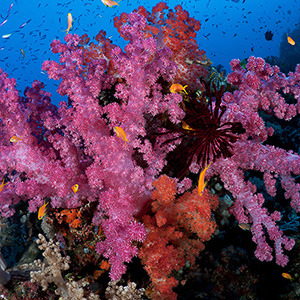
diver with soft coralThis is a PDF copy (958kB) of an article about multimedia storytelling, written by Ethan Salwen for the Fall 2010 issue of Currents magazine, which is published by The North American Nature Photography Association.

It’s probably obvious if you’ve followed my site for a while, but I think this topic is a really important subject for everyone who’s interested in visual media…especially for photographers.

Ethan did an excellent job of distilling lots of information and ideas from the people he interviewed for the article into a meaningful overview.

As part of his background research, Ethan contacted me, and we had a terrific discussion over Skype about some of the attractions and potential pitfalls of adopting new technology and software.

Fortunately, I had just finished editing my Night Safari video using Aperture 3, and I was right in the middle of putting together my video about diving in the Eastern Fields of Papua New Guinea, so basically, I had a lot to say!

Ethan also spoke with my friends Mary Lynn Price (the driving force behind DiveFilm) and Eric Cheng (the driving force behind Wetpixel), as well as several other talented media professionals in order to collect views from people with a diverse set of backgrounds and wide range of experience.

Whether you’re just getting started in photography or you consider yourself an old-hand, I highly recommend reading Ethan’s article.

While you’re at it, check out the The North American Nature Photography Association website. All issues of Currents magazine will be available online for NANPA members starting with the next issue.

Related Post: The End of Photography

ギャラリートーク:大哺乳類展-海のなかまたち

9月24日(金)国立科学博物館にて、18:00から30分マッコウクジラについて講演する予定です。

国立科学博物館の特別大哺乳類展(朝日新聞WWF Japan協賛)は、7月10日から9月26日まで開催されており、すでに8月中旬で、入場者20万人以上に達しています。

現在、僕が小笠原で撮影したマッコウクジラがダイオウイカをくわえている写真が展示されています。この瞬間を撮らえた写真は世界初です。


マッコウクジラとダイオウイカ

今回のトーク内容は、小笠原とドミニカ国で撮影した写真と映像を見ていただきながら、世界の一番大きな肉食動物と一緒に泳いだ経験、例えば、クジラが発するソナーの感覚、自分のフィンをかじられた瞬間、十数頭に囲まれた経験、ドミニカで出会った「スカー」という特別に触れるマッコウクジラの話などを予定しています。

もちろん、全部日本語で話すつもりです。僕の日本語を動物研究部脊椎動物研究グループ長の山田格さんが助けてくれると思います。

ギャラリートークは無料ですが、博物館の入場に1、400円がかかります。しかし、金曜日の場合、17:00以降に二人で入場すると2,000円です。詳細はこのページを見てください。

皆んなのお越しをお待ちしています。

Talk: National Museum of Nature and Science in Tokyo

The National Museum of Nature and Science in Tokyo has been holding a special exhibition on marine mammals in conjunction with the Asahi Shimbun and WWF Japan.

The exhibition started on 10 July and winds up on 26 September. As of the middle of August, over 200,000 people have visited the exhibit!


Female sperm whale with giant squid in its mouth.

My photograph of a female sperm whale consuming part of an Architeuthis giant squid is on display as part of the exhibit, and I am scheduled to give a talk on what it’s like to be in the water with sperm whales on Friday, 24 September, from 18:00 to 18:30.

Since the museum is in Tokyo, I’ll be doing my best to give the talk entirely in Japanese (gulp). Fortunately, Tadasu Yamada from the Division of Vertebrates in the Department of Zoology at the Museum will be on hand to help translate when I exceed the limits of my Japanese vocabulary.

I’m not exactly sure how the talk will go, but I’m planning to take along some sperm whale images and video clips from my recent trips to Ogasawara and Dominica.

If you can make it to the talk, I’ll tell you what it’s like to be in the water next to the largest living carnivore on the planet, to have your fin chewed by a sperm whale, to get ping-ed by sperm whale sonar, to watch a large group of socialising whales, and even to stroke an unusual sperm whale named Scar that seems to seek out human attention.

My talk is free, but there is an admission charge of 1,400 Yen to get into the museum. There’s a special rate of 2,000 Yen for two people together if you enter the museum after 17:00 on that day.

If you happen to be in Tokyo on 24 September, please drop by and say hello! Details are on this page (in Japanese).

Interview: Amateur Photographer

This is a PDF copy (380kB) of an interview in the most recent issue of Amateur Photographer magazine in the UK, written by Jade Lord.

She did a particularly good job of distilling some sense out of my rambling and making me seem (somewhat) respectable.

Check out more content in the magazine.

luggage

The End of Photography

Here is the presentation that I gave recently at TDEX on 10 and 11 July at the Queen Sirikit Convention Center in Bangkok (See…this is proof that I did more than just overeat while I was in Thailand!).

The 26.5-minute talk is entitled “The End of Photography”, and it’s a summary of my views on the implications of the switch to digital technology for photographers and other content creators.

To be clear…I’m not referring to pixel-counting, the pros/ cons of CF cards vs. SD cards, which computer to use, which processing software to use, or any other technical issue.

The primary point I’m trying to convey is that the switch from analogue to digital has far-reaching implications for all photographers, most of which we’ve collectively only begun to explore and appreciate.

I believe that the issues I set out are fundamentally reshaping the way we can (and should) conceive, plan and execute creative endeavours.

There’s one thing you’ll have to bear with if you watch/ listen to the presentation.

The plan was to have a video camera record the talk, so I could splice in some video footage to liven up the presentation video and also to highlight the occasions when I was pointing things out on my presentation slides.

As it turned out, the video camera wasn’t actually on when I gave the talk, so there are some “slow” sections during the presentation, when there’s no visual action to go along with my rambling, just a static slide.

Hopefully the content of my talk will prove so compelling and spell-binding that you won’t even notice.

In case you’re interested, I put the presentation together in Keynote (part of Apple’s iWork suite), recorded the audio with a Zoom H4n hooked up to a Sennheiser EW 122-P lavalier microphone via a sound board at the venue.

After the talk, I synced the timing of the slides with the audio track by using Keynote’s built-in Record function, and then used Final Cut Studio (specifically Final Cut Pro and Soundtrack Pro) to edit the audio.

Using Soundtrack Pro made a noticeable difference in audio quality, as the presentation environment was “challenging”, i.e., open area with lots of competing ambient noise, echo, random people walking by, etc.

Eric’s Adoring Fan Club

Eric and I gave two talks each at the Thai Travel and Dive Expo in Bangkok this weekend.

Here’s a snapshot of Eric showing a photo he took of flamboyant cuttlefish while we were in Lembeh back in March, using the Inon wide-angle macro lens:


Eric Cheng speaking at TDEX 2010

Both of us are accustomed to public speaking, so for the most part, things went smoothly…nothing unexpected or out of the ordinary…except, of course, for a spontaneous gathering of a gaggle of giggling girls expressing undying adoration for young Mr. Cheng (no doubt related to his adroit handling of the aforementioned phallic lens):


Eric enthusiastically explaining his mastery of all things long

Being the consummate professional that he is, Eric took things in stride (note the dopey expression on his face, visible even from behind), even deigning to pose for a group photo with his doey-eyed fan club after he had finished expounding on f-stops and lens angles:


Eric trying not to show how pleased he was with the situation

Despite relishing the attention lavished upon him, young Eric did appear somewhat uncomfortable at times, particularly during the photo session…when he was careful to keep his hands in his lap, lest he inadvertently infringe upon the modesty of one of the innocent young lasses around him:

It is, however, a sad fact of life that all good things must come to an end. The captivated co-eds soon lost interest in my friend, leaving him alone, staring into the distance with a forlorn, pensive expression:


Eric, after being abandoned by his harem

Actually, I was with Eric for the rest of the afternoon, but he seemed rudely disinterested in any attention I attempted to lavish upon him.

Go figure.