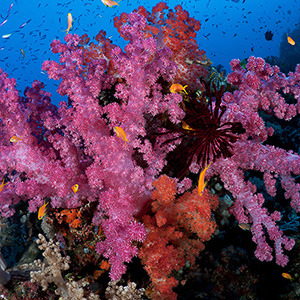
Playing around with multimedia software again. This is a short slideshow/ video of my recent trip to swim with Australian sea lions in Western Australia.
I’ve uploaded a version to my iTunes podcast, or you can right click here to download a higher quality quicktime movie (59.9 MB) if the mood strikes you.
I’ve been laid up with a slight fever for a couple of days. Not a big deal, but it means I’ve been languishing in a general fog pierced by the occasional moment of clarity. I hate feeling so not-in-control, so I decided to do something productive and figure out how to encode and post video in Flash format.
To date, I’ve preferred using Quicktime because of better output quality, but sometimes people have trouble viewing Quicktime files, especially PC users. Plus, I received a few emails from non-Mac users who were unhappy they couldn’t view the PNG screen saver I made recently because it only works for Macs.
So, I still can’t make screen savers for PCs, but here’s a Flash video of the PNG screen saver. If you want the screen saver, you gotta get a Mac.
I realised recently that it’s been some time since I’ve changed the screen saver on my computer, so I took a break today to put together a new one with a few images from one of my favourite destinations, Papua New Guinea.
The screen saver only works with Macs, so if you have a Mac and want to give it a try, right click and download here (12 MB). It’s a disk image file (.dmg), so once the file’s downloaded, just double click to open, then double click the png.saver icon to install the screen saver.
If you missed the previous screen saver of sea lions I put together, it’s available here.
Both are optimised for my 15-inch MacBook Pro at 1440 x 900 screen resolution. I think they’ll be ok on bigger screens, but I’m not entirely sure.
This is the second PixTips video blog for FiNS Magazine, which I did together with David Cheung, who owns and runs ScubaCam in Singapore.
In this episode, David and I chat about o-rings and flooding, with David giving a few pointers that are useful for everyone, but particularly for people just starting out with underwater photography or video. It’s a serious topic (and a painful one for anyone who’s ever flooded expensive camera gear), but as you’ll see, we had fun too.
If you’re relatively tech-savvy and want to see a larger and clearer version of the video, there’s also a higher-resolution quicktime file available on the new FiNS Magazine iTunes podcast, which you can download and watch on your computer or iPod.
FiNS Magazine has just started an iTunes podcast. Every issue of the magazine will be available in full in PDF format via iTunes, and there will be special features and videos too.
This is definitely the way forward. Publishers relying solely on print and snail mail (with occasional, somewhat pathetic forays into new media with static websites) are so yesterday.
This is way too cool. Many people know that toothed cetaceans (like dolphins, sperm whales, killer whales, etc.) use echolocation as a sensory tool to find their way around and to hunt for food.
Researchers have traditionally viewed baleen whales (like humpbacks) as being unable to do this. Until now.
A research team (comprising members from the Hawaii Institute of Marine Biology, Woods Hole Oceanographic Institution, University of New Hampshire, NOAA’s National Marine Sanctuary Program) has documented humpback whales making clicking sounds, quite possibly in pursuit of prey.
A recent press release from NOAA on this exciting discovery is here. And here’s a recording of the humpbacks (Source).
This is beyond cool in so many ways, but what excites me is the fact that this is a discovery that flies right in the face of established “knowledge”. I get so fed up with people whose minds are closed to new possibilities that I absolutely love developments like this that turn fact into fiction.
Together with FiNS Magazine, I’m starting a video blog called PixTips to cover topics related to underwater photography and video.
In this first episode, I provide an overview of how to take photos using a technology called sTTL, which allows you to simulate TTL photography underwater (provided you have the right set-up), and demonstrate the technique using a Nikon D200, Zillion housing and Inon strobes.
(Note: Something I realised I neglected to mention in the video…this isn’t the only way you can shoot TTL underwater. If there’s enough interest, I’ll try to cover some of the other ways in another video.)
To watch the video, you can:
Click on the graphic below to view the video in your browser (You need quicktime installed and also need to wait for the file to download. A video screen will replace the “Q” when the video is ready.),
Right click to download an iPod version under the graphic below,
Video of the world’s first live birth of a manta in captivity. Healthy baby female, about 1.9 metres across, born at the Churaumi Aquarium in Okinawa, Japan. Video is from a TBS news broadcast. (They appear to have deleted the page with the video)
The video file is 1.7 MB. Click the graphic below and wait for the quicktime file to load. Note: A few people have had problems viewing the quicktime file. Others have not. I have no idea why. In any case, if you can’t view the embedded file, click below the graphic to download an mp4 file which should play in Quicktime, iTunes and on your iPod.
I put together a screen saver with some of the images from my sea lion trip earlier this year. It only works on Macs, so if you’ve got a Mac and would like a sea lion screen saver, right click here to download (4.8 MB file). Just double-click the file to open and install.
With all the travelling and general chaos of life, it took me a while to put together another animated slideshow/ podcast from my recent trip to the Lembeh Strait.
This one is about an octopus I came across early one morning, when a few dive guides and I went exploring relatively undived areas. Four of us spent 50 minutes seeing absolutely nothing. In fact, two of the guides were already sitting back on the boat by the time I got back around the 50-minute mark.
Then, the guide I was with, Lembeh Strait veteran Wilson, spotted an octopus in a bottle. Anyone who’s been to Lembeh knows that octopuses in bottles are really common, so normally, I probably would’ve passed this one by. But after 50 minutes of zippo, I stopped for a look. And a good thing I did.
I then spent the next 50 minutes being entertained by this rather pugnacious cephalopod, who actually reached out, grabbed my dome port and tried to push me away.
I’m not an easily offended person, but this was just downright rude! Anyway, as it turned out, the octopus had a perfectly logical and rational reason for being unsociable.
Click on the video above to find out why the octopus was being so grumpy (it might take some time for your browser to download and play the file), or subscribe to my podcast via iTunes here to download the file for your iPod and automatically get updated whenever I put one of these together. Enjoy!
If you’ve been following my blog for the past month or two, you can see that I’ve stretched the limits of my coding capabilities (actually, I have none) and managed to put together a few podcasts and have them broadcast via Apple iTunes, as well as post them to my blog.
What exactly is a podcast? Not being a tech person, I’m not sure if there’s an official definition. But the way I look at it, podcasts are a way for anyone with access to the net to broadcast words, images, voice, video and any combination thereof to the rest of the world.