Archive for April, 2009

Paddling Pinecone

In keeping with the cute theme, here’s a pineconefish (Monocentris japonica), known as a matsukasa-uo (マツカサウオ) in Japanese.

These adorable paddling pinecones are here in Izu all year-round, with juveniles like this one hiding in crevices and in between rocks. Adults get pretty big, say 20cm or so, and apparently head out to open water and go deep.

Their choice of habitat, coupled with a tendency to turn tail to the camera, makes it a bit of a challenge to get a nice photo of these fish.

Another point of interest…they have light-emitting organs on each side of their face (not visible in this photo).

pineconefish

Japanese Inflator Filefish

This is a Japanese inflator filefish (Brachaluteres ulvarum), so named for its ability to inflate its body to appear bigger…presumably as a means of self-defence.

I had no idea this fish had special powers.

I just took the photo because the filefish is cute and has pink lips…presumably to match the background?

filefish

Piscine-Pondering Pioneer

During this trip to Izu, I’ve had the good fortune of getting to know one of the pioneers of recreational diving in this area…Shinohara-san…a little better.

He was one of the first few people to start a dive shop here twenty-some years ago, and he’s still as active and enthusiastic as anyone I know.

shinohara-san

In addition to taking time to answer my endless list of questions, he’s been kind enough to introduce me to lots of people, and also take me around to some great restaurants (more on that later).

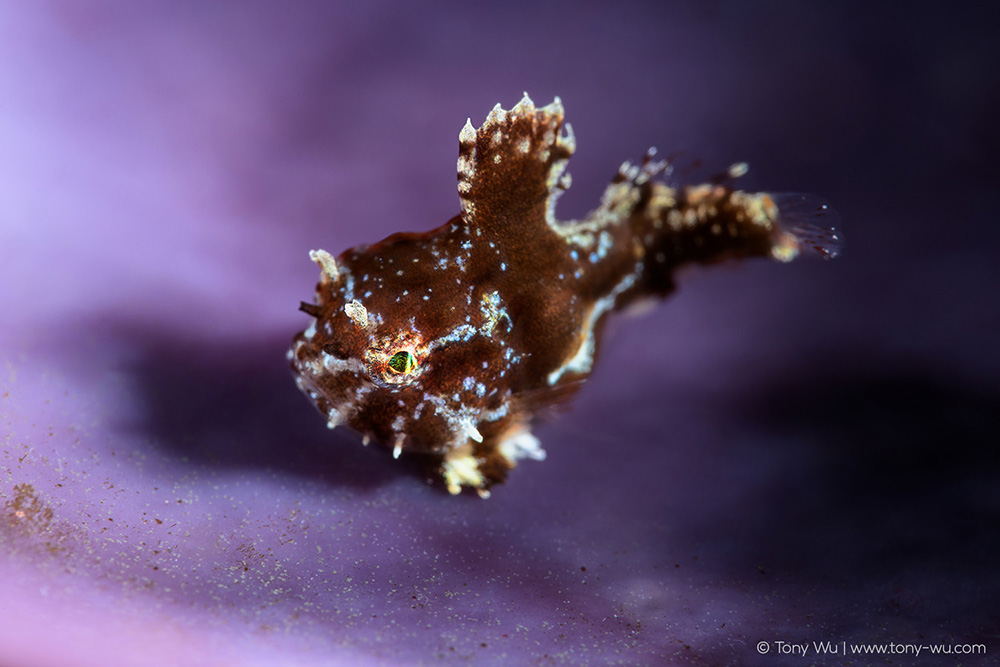
As if that weren’t enough, we sat in his shop a couple of days ago poring over guide books to try to figure out some fish IDs I’ve been puzzling over…the most difficult of which was my little piscine pokemon from Lembeh.

After a bit of sleuthing and plenty of head-scratching, I think we figured it out. We decided that it’s most likely a pitted stonefish (Erosa erosa), known as a daruma-okoze (ダルマオコゼ) in Japan.

puzzled look

The grumpy expression, unique patterns on the pectoral fins and the deep indentation on the top of the fish’s head led us to this conclusion.

See how much fun it is being an international fish geek?

Pretty Pair

This is a pair of Japanese blacktail triplefins (Spingerichthys bapturus), known as hime-ginpo (ヒメギンポ) locally. The one in front is the female, the orange one to the rear the male.

Japanese blacktail triplefins

Apparently, they’re normally relatively drab, uninteresting fish. The individuals pictured here are dressed to impress. More specifically, these are their mating colours.

Scampering across the face of a vertical slab of rock, this pair appeared to have decided on one another already, and probably mated in the evening.

As a prelude to mating, the female stopped every once in a while and wiggled her tail in an enticing manner, which inevitably sent the male into a flurry of frenzied activity…darting to and fro…eventually coming full circle and ending up next to his companion again, who maintained an air of innocence throughout.

Ahem…sound familiar?

male fish

Crouching Tiger, Hidden Dragon

For my first couple of dives here, I hit the water at a site called Yokobama (ヨコバマ) in Futo harbour (富戸). It’s a shore dive, with entry and exit ramps clearly marked by buoys and ropes.

Though it’s been over a year and a half since I’ve used my drysuit, it only took a few minutes to sort myself out, with the most difficult task being re-acquainting myself with adjusting buoyancy and maintaining trim without the use of my BCD.

Donning a drysuit has its rewards, like having an opportunity to see what’s probably my favourite moray eel…the dragon moray (Enchelycore pardalis), or tora-utsubo (トラウツボ) as it’s known in Japanese.

dragon moray eel

I’m sure these eels live in other places, but it’s pretty much a shoe-in to see them if you dive in Izu.

Translated literally, tora-utsubo means “tiger moray eel”. Personally, I think they look more like dragons than they do tigers, although it’s interesting to note that whoever gave these eels their respective common names in English and Japanese both wanted to connote a strong, fearsome animal.

In real life though, these guys are shy…just like other morays. Much of the time, you’ll come across them hiding under rocks, in crevices and otherwise staying out of the limelight. Hence…the title of this post. I had to bend, contort and twist in all different ways to get photos yesterday, because the erstwhile dragons were so well concealed.

So the “crouching” part actually refers to what I had to do to get eel pictures…but it just so happens that they’re called tigers in Japanese too. Clever movie reference, no?

I thought so too, until I googled the binomial name to make sure I’d spelled it correctly, and discovered that another common name for this eel in English is “leopard moray eel”. Somehow, “Crouching Leopard, Hidden Dragon” didn’t have the same ring to it.

Anyway, there’s significant variation in colouration among these eels. The one below, for instance is a lot whiter overall. I’m not certain whether the variation is due to age, sex, genetics, etc., but the practical implication is that you need to look around a bit to find just the right nuance of dragon, tiger, or leopard that you prefer.

dragon moray eel

A couple of other photos of these eels that I took previously here and here.

In Izu

Woke up really early for the drive to Izu. I expected a lot of traffic, since it’s spring and Sunday, but as it turned out, there wasn’t much at all.

The weather looked a bit iffy in the morning…grey and overcast…so that may have had something to do with it. Or more likely, everyone else was still asleep.

By the time late morning rolled around, the sky had cleared, and there were more people out and about, especially in the tourist areas.

bridgeThough I tend to avoid tourist places, we stopped off at a suspension bridge in Jogasaki, known as the tsuribashi (城ヶ崎吊橋), which is a “must do” for domestic tourists who visit the eastern side of the Izu Peninsula, as well as for visitors from other countries travelling on packaged tours.

(Actually…the main reason we stopped was to use the bathroom. There’s a nice public bathroom here, but they’ve started charging 500 Yen for parking, so I’m going to have find somewhere else to make pit stops.)

It seems like everyone who visits the bridge has to pose for group photos, a process that’s pretty entertaining to watch if you’re not actually in a hurry to get to the other side of the bridge.

The reason this place is popular (other than the toilet) is the nice view from the bridge and surrounding cliffs, which overlook the Pacific Ocean.

During public holidays and other peak times, visiting this area isn’t such a great idea, unless you happen to fancy the prospect of being overwhelmed by hordes of camera-toting tourists.

Today wasn’t too bad, as there weren’t all that many people around. But after taking a few obligatory snapshots of other people taking obligatory snapshots…we wandered off the path and sat on some rocks overlooking the ocean to enjoy a few homemade onigiri and some green tea for lunch.

onigir

Summer in Spring

Spring has arrived in Japan. Actually, it arrived some time ago, but I wasn’t around, so it’s just arrived as of last week as far as I’m concerned.

In between un-packing, un-sorting, re-sorting and re-packing, I’ve managed to get a bit of time to walk around and take in the fresh, crisp spring air and to marvel at the many flowers in bloom.

I don’t really know much about flowers, but when Pasta was around, we used to go on long walks together and she’d sniff various plants, stopping occasionally to eat a few flowers here and there. She was partial to rare and valuable flowers, usually from someone’s garden, so I had to keep a close eye on her.

I miss Pasta.

In Pasta’s memory, I’ve been taking time to look closer at the flowers I come across, like this summer snowflake (Leucojum aestivum)…a plant which, despite its name, blooms in the spring, not the summer.

flower

Anyway, I’m packed and I’m heading out again…this time to the east coast of the Izu Peninsula, where I’ll be diving in 14ºC water. Actually, I’ve never dived in 14ºC water before. And who knows…I may yet come to my senses and chicken out. 14ºC is cold…like half the ºC that I’m accustomed to. Half. We’ll see how it goes.

If all goes according to plan and I actually get in the water, I’ll post updates from Izu.

A couple of previous posts from diving in Izu here and here.

Nudibranchs

Like most divers, I love looking at nudibranchs. Until a few months ago, however, I wasn’t really taking many photos of them. No particular reason…just mood perhaps, or maybe lack of creative inspiration.

A little over a year ago, a fellow traveller on one of my trips asked me to take more nudibranch photos. I have, and here are a few sea slug images in a little slideshow video.

Note: It helps if you press play, then hit pause again and let the video download fully before you watch it.

Outtakes

This video stuff is turning out to be more fun than I imagined. Doing video coverage at DEEP Indonesia actually made going to a dive show fun (everyone knows that going to dive shows is generally at the very bottom of my want-to-do list).

Actually, I have more fun messing around than I do with the serious stuff that actually makes it into the final cuts…like in these outtakes from the DEEP Indonesia 2009 video footage:

Funny Flat Fish

I found this fish in Lembeh. I know it’s some sort of flounder or sole, but otherwise, I’ve never seen anything like it.

It was about five to six centimetres long (two to two-and-a-quarter inches), and changed to a dark grey/ brown colour after some time.

Besides the bars on its body, the large mouth relative to body size is a distinguishing feature.

Anyone know what this is?

flat fish

Signs

l’m not entirely certain when, how or why I developed this penchant…but I enjoy looking at signs. Billboards, shop signs, posters…anything that’s intended to communicate a message.

It’s particularly entertaining in Japan, where the message actually communicated often differs from the message (probably) intended.

Take this example, from an upscale beauty place in a mall:

beauty shop

I shudder to imagine what the purpose or effect of subjecting customers to pure fumes could be.

Or this one, which is from a clothing store close to the beauty-oriented fumigation shop:

ciao sign

The best I could figure is that once fumigated, flustered customers would want to say goodbye in a hurry.

New Strobe

I paid a visit to Aquaforum yesterday, partly to stop in and say hi, but mostly because I really need all my gear checked and double-checked before I head out on my next extended series of trips.

Whenever I visit the shop (or any other camera store for that matter), one of the first things I do is scan for new equipment.

This time, the new S-2000 strobe from Inon caught my eye (pictured below…and no, those are not my hands!).

The strobe units are tiny (106.5mm long, 83.1mm tall, 64mm across), lightweight, use standard AA batteries and use the same O-rings and fibre-optic connectors as my Inon Z-220 and Z-240 strobes. The guide number is 20.

inon strobe

David from Scubacam had a couple with him while we were in Lembeh, so I saw his strobes in action. The S-2000s seem to work well for him. I fiddled with one while I was Aquaforum, and eventually, I decided to get one to try out over the next few trips.

Do I need another strobe? Probably not. I lug six or more around with me as it is.

But the small size means I can stick one in my coat pocket and have a spare with me at all times. Plus, if David and Nagamatsu-san (who owns Aquaforum) both have a couple of these, I have to have at least one to play with. You know what I’m saying?

The controls on the back are a bit tightly spaced. Luckily, I don’t have big hands, so it might not be a problem for me. I could see people with big fingers possibly having a difficult time fine-tuning settings underwater.

rear view

There appears to be quite a bit of S-TTL functionality built into the strobe, including the ability to shoot S-TTL wirelessly, but since I don’t really use TTL, I haven’t really paid too much attention to this.

There’s also a funky mirror-thing that attaches to the slave sensor to redirect light to trigger the strobe when it’s used as a slave unit. I’m not quite sure how this will work, or if it’ll be necessary. I’ll find out soon enough.