Archive for September, 2008

Evening Performance

It seems like all I’ve been writing about recently is whales, which of course, is entirely understandable given that I just returned from six weeks of thinking about nothing but whales.

Before going to Tonga though, I was in Papua New Guinea for a month, cruising around New Ireland aboard MV Golden Dawn, spending a lot of time visiting islands and remote areas that most tourists would never have a chance or reason to visit.

To be honest, the diving wasn’t the best I’ve ever seen, but the trip was anything but dull. I saw, experienced and learned a lot of things that are beyond description, and I was fortunate enough to spend time with some incredibly well-travelled, knowledgeable and fascinating people.

I just looked briefly through images from the trip, and I hope that I’ll have time soon to edit properly and put a story together about it. I literally only had a few days between PNG and Tonga, and I was preoccupied with Pasta’s illness when I was home at that time…and of course, I’m off in a few more days for another trip.

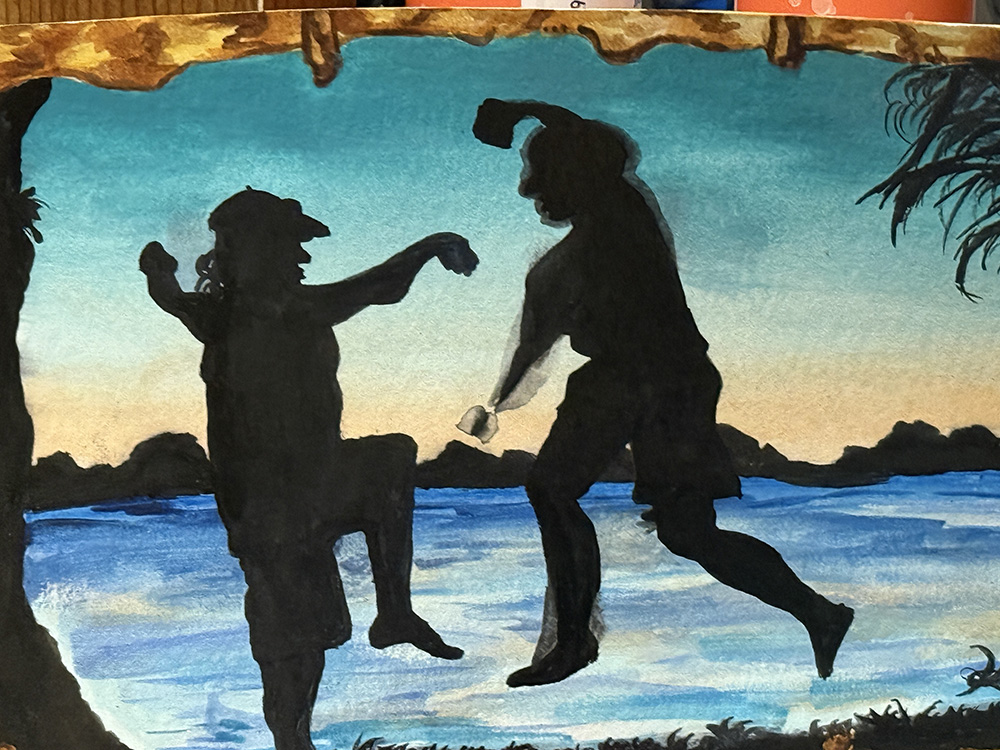
Anyway, here’s one photo that brought back fond memories of the adventure. While anchored one evening at Lifu Island, one of the islands in the Tanga Island group, we had a bunch of guys visit the boat (not unusual in PNG) and do an impromptu dance.

dancers

Light levels were low and fading quickly, but I had just enough time to run into the cabin, set up a camera, clamber down to dinghy level, and grab a few photos.

The key to lighting this scene was using a combination of land and underwater strobes, specifically a Canon 380EX speedlight (borrowed from Captain Craig’s nephew – thank you!) and an Inon Z220. With so little ambient light, I exposed for the background to capture the sunset colours, used the 380EX as secondary fill, and had someone hold the Z220 high above as main fill, triggered in slave mode. ISO 800, f4, 1/30th.

Why go to the trouble of using the Z220? First, because it was there. Second, taking the main artificial light source off the camera axis is usually much nicer than a typical on-camera strobe shot. And finally, because I had a filter on the Z220 to warm the colours up a bit.

When you’re on your next dive excursion, don’t overlook the possibility of using your underwater strobes as topside lighting.

Me At Work

whale and meOne of the people who was with me in early August snapped this photograph during what was probably the most interactive encounter that we had while I was in Tonga this year.

The whale in front of me in the photo is a female, one of a male/ female pair playing under and around a catamaran when we came across them. Once we got in the water, the pair continued their frolicking while making time to come around and check each and every one of us out.

I’m much closer to the camera than the whale is, so the whale is actually considerably larger than it appears…say roughly seven times my length or so!

I posted a few images of this playful pair on Flickr.

Thanks Kimura-san!

Tonga 2009 Trip Full

breachMy trip for Tonga 2009 is full.

The trip is still 11 months away though, so it’s possible that a space or two opens up in the interim.

If you’d like to be kept informed if spaces become available, please let me know.

Article: The Photographic Eye

lionfishI’ve just started contributing a regular column called The Photographic Eye for Wetpixel Quarterly, which is the print magazine covering underwater photography and related issues produced by my friends from Wetpixel.

The idea behind this column is to pick a photograph and discuss some of the thoughts, preparation and any other relevant considerations that went into creating the image. The column is not meant to be a “how to”, but more like a “how this image happened”, if that makes sense.

In this inaugural instalment (PDF 1.5MB), I discuss some of the considerations that went into creating an image of a lionfish on the prowl, taken last year at Suzie’s Bommie at Loloata Island Resort in Papua New Guinea.

There’s also a brief sidebar about a new dome that I used, which made all the difference in light and colour quality in the image…the Pro-One dome. I’ll write more about it in another post.

If you’re an avid underwater photographer and haven’t checked out Wetpixel or Wetpixel Quarterly yet, do so now.

Absolutely Certain

I wrote an editorial some time ago that’s been published in several places.

Through the discussion of two seemingly unrelated topics (stomach ulcers and global warming), my intention was to point out the potential risks of being “absolutely certain” about any point of view.

A friend recently sent me a link to a story from The Economist about the particular bacterium that I discussed in the editorial, Helicobacter pylori. As it turns out, using antibiotics to rid the body of these little critters might help you avoid stomach ulcers, but doing so may then lead to other adverse unintended consequences. (PDF (204 kB) of story)

So in short, what we originally thought to be true was overturned by something seemingly preposterous and ridiculed by those “in the know”, to be then accepted as a new version of truth, only to be overturned once again by something that was previously unconsidered. Which is to say…my point exactly.

No matter how obvious or certain something may seem, there’s always a possibility that it’s completely wrong, or right, or something in between. The only thing I’m ever absolutely certain of, is that nothing is absolutely certain.

Article: Food For Thought

coverThis is an editorial (720 kB) that appeared recently in ultraMARINE magazine, a bi-monthly publication in the UK for aquarists.

The cover of this issue is also one of my images, photographed in the Eastern Fields of Papua New Guinea.

Humpback Whale Calf Summary

calfFor the past several years, my friend Takaji and I have been counting humpback calfs during our stays in Tonga.

In the process of doing this, I noticed that there is a wide range of views on how many calfs there are in a given season, with many of the most experienced residents of Tonga believing there are only around six to eight calfs born in/ visiting Vava’u each year.

From direct observation, we know that there are many more calfs, even in seasons that we feel are “below average”. To support this view, we decided to be more methodical this year and put together a PDF file with a few photos and brief descriptions of the 16 calfs we identified over a period of six weeks this season.

Please note that I put this file together as a quick-and-dirty exercise. I’m not a graphic designer, and I didn’t spend any significant time cleaning up the images.

To the extent that it might be possible to draw inferences from our observations, I included a few key observations on page two of the summary.

The file has a lot of photos embedded in it, so it’s a large file, about 7.8MB. Click here to download.

Week Six in Tonga

whaleMy final week in Tonga was at once exasperating and incredibly interesting. It was exasperating because the strong winds that have been around for much of the season continued, as did the swells, choppy conditions and murky underwater visibility.

It was interesting for several reasons: We ID-ed three more calfs, bringing the total to 16 for the season; We helped to reunite a calf and mother that had become separated from one another; and our final drop in the water was with a massive eight-whale heat run that had come to rest in relatively shallow water.

Winds of (No) Change
The winds were supposed to have settled down a bit last week, but that never happened. Instead, wind levels remained strong all week long. To make matters more difficult, the winds were fickle…coming from the north for a while, switching to easterlies, then a bit from the northwest, a few hours from the south, then back to the east, and so on.

The net effect of the temperamental, almost schizophrenic winds was swell coming from multiple directions, which produced whitecaps and choppy seas, leading to relatively murky conditions underwater. All-in-all, the prevailing conditions this year have been the most difficult ones I’ve experienced in Vava’u.

breach

Besides just being a pain in the rear, the challenging conditions posed by the winds had several practical implications.

First, strong winds whisk away whale spouts, making them difficult to spot. As if that weren’t problem enough, swells, whitecaps and choppy conditions resulting from the wind exacerbate the situation. Third, when you do spot whales, if the seas are too rough, it may be difficult or impossible to reach them, keep up with them, or get in the water (actually, getting out of the water is the tough part)…as the case may be. Finally, when you are able to find whales and get in with them, the visibility underwater tends to be rather cr*ppy, due to lots of teeny tiny air bubbles stirred into the water by the frothy conditions, which makes for a milky white cloud that makes everything look fuzzy.

But of course, if observing, photographing and studying whales were easy, what fun would it be?

New Calfs
During my final week for this season, we identified three more calfs (Jet, Fuli Fuli, and Chibi-chan), bringing the total to 16 for this season (plus a couple more we believe are additional calfs, but can’t 100% confirm).

I’m putting together a PDF document summarising all the calfs we encountered, so instead of going into detail about these calfs here, I’ll post the document to my blog soon.

Reunited
A few weeks ago, a story came out in the mass media about a baby humpback whale in Australia that had somehow become separated from its mother (download 120KB pdf file). The little whale, which was found trying to suckle on boats, was but a few weeks old, and was no doubt hungry and confused. It eventually had to be put down, because there’s no way for humans to nurse and raise a baby whale, and no one was able to locate the missing mother.

Last week, we experienced a similar situation, with a baby whale somehow getting separated from its mother. Fortunately in this instance, we succeeded in locating the mother and reuniting her with the calf. Here’s what happened:

While we were following what appeared to be a heat run of three to five whales, we received a call from another boat in the area, asking for help to look for a female whale that had left its calf with the boat approximately an hour earlier.

In short, the boat was with the mother and calf during the morning. At some stage, male humpbacks approached the area, and the female seems to have left the baby to join the males. According to some of the people on the boat that I had a chance to speak with later, the mom spyhopped once as if taking a look at the boat, then swam off. Visibility underwater wasn’t good, so I don’t think anyone actually saw the precise moment the mom left.

When I heard the call for help, I contacted the boat and asked for a description of the whales. According to the captain, one of the males in particular had a unique pattern…a band of white that went far up the side of the body.

The heat run was moving rapidly, spending extended periods of time submerged, so it took some time until an opportunity to get into the water presented itself. Three whales (two others had peeled off and gone somewhere else by this point) surfaced nearby. When I dropped into the water, I got a clear view of the three whales…there was no mistaking the whale with the white band on its side.

I called over to the other boat and confirmed that I ID-ed the whale that the captain had described. The only problem was that he couldn’t describe any unique features for the mom, so I couldn’t ascertain whether one of the three whales I saw was the calf’s wayward mother or not.

three whales

There weren’t many options available at the time, so we decided to try to get the calf to follow one of the boats to the area where the three adult whales were cavorting. Problem is, the big whales had been travelling at high speed for quite some time (and were still doing so), which meant there was a lot of distance to cover. The complicate matters, the whales were heading out to open sea. With the wind and choppy conditions, we wouldn’t be able to follow forever, as we’d get too far from land to be safe.

We enlisted the help of another boat in the area, and with a total of five boats helping out (one with the calf following it, four with the adult whales), we managed to keep track of the whales until the boat with the calf was able to catch up (probably took 30-45 minutes or so).

The real challenge, however, came when we tried to get the calf near the adults.

Adult whales, when they’re engaged in a heat-run situation or something similar, tend to become preoccupied. They swim quickly, often haphazardly, and in many cases, they stay underwater for a long time…the net result being that it can be extremely difficult to predict when and where they’ll surface.

Of course, as the cetacean version of Murphy’s Law would dictate, the three whales in question were behaving precisely in this manner.

They dived and disappeared for extended periods, then surfaced a significant distance away. While it wasn’t a problem getting the boats over to them before they dived again, it was an issue getting the calf over. Even though the calf had followed the boat diligently all the way from where it had been abandoned, it seemed oddly oblivious to the fact that its mother appeared to have abandoned it.

The calf seemed reasonably happy to tag along with the boat (at slow speed), breaching and playing as they moved.

So…big whales moving quickly, but little whale moving slowly while playing with boat = frustratingly difficult to put big whales and little whale together.

It took several tries, but when the big whales finally settled down a bit and started spending more time at the surface, we finally succeeded.

mom and escortWhen the three adult whales stopped for a brief rest, the boat with the calf in tow approached within 15 metres or so. Soon thereafter, both the adults and the calf dived. Everyone on all five boats strained to make out any movement in the water, trying desperately to glean any bit of insight into what was happening below.

Several people on the boat that had led the calf to the area shrugged their shoulders and threw their arms in the air, signalling that they had no idea what was going on. Everyone fell silent. Time slowed, as if we were stuck in an ocean of molasses.

Then a slew of footprints appeared nearby in rapid succession, indicating that there was a lot of activity underwater. As I looked at the footprints, trying in vain to assign some meaning to them, the calf’s tiny dorsal fin broke the water’s surface, followed by a larger whale that surfaced alongside the calf.

The bigger whale snorted loudly and emphatically, in what I interpreted to be a sign of happiness, and the little whale and the bigger whale dived down in sync. Mom and baby were together again! Cheers and a round of applause arose from the boats, followed by an enormous sigh of relief.

The two other whales were still with the mom, and all the whales swam off together, still heading south and away from the islands, with one of the whale raising a pectoral fin, almost as if as waving goodbye.

Without another word, all the boats turned around and headed off in search of other whales.

Interpreting What Happened
I don’t know if it will ever be possible for humans to understand what goes on in a humpback whale’s mind, so I’m not sure if anyone can explain with any level of authority why the mother left the baby.

There are many possibilities to consider. Perhaps the mom accidentally left the baby behind, sort of like a mom and child getting separated in a shopping mall. Or perhaps the mom believed it safe to leave the baby in the “care” of the boat. Maybe the mom was indeed wayward and got distracted by the attention of several hunky males. It’s also conceivable that the males forced the female away from the baby. Perhaps the presence of the boat and people affected the situation.

escort

In addition to this incident and the recent story in the media about the baby whale in Australia, I’ve experienced this type of thing once before, in August 2005 in Tonga.

At that time, a female whale left her baby with my boat while she and an escort (male whale) disappeared for around an hour and a half. I think that particular baby was only hours old, as it was still wrinkly and seemed unable to control its movements. The baby was clearly hungry, as it tried to suckle on the boat (I have photos of the baby, but they’re on film and not with me).

Fortunately, the mother and escort eventually returned from wherever they had gone to do whatever they were doing. As the adult whales swam casually by, the baby appeared to recognise them. It left the boat behind and joined them, then the trio swam off as if nothing had happened.

I also emailed a cetacean researcher friend in Hawaii and told him about my recent experience. Here’s an excerpt from his reply:

“We’ve documented a number of lone calfs over the years, and of course they just had one in Australia. I’ve also observed two males separating a mom from calf. The calf frantically swam about our boat calling and calling. One of the males tried to wrap its pec fin around the mom and probe her with his penis. She would have none of it…and kicked him off but the males were relentless. Finally, mom managed to get away from the males and swoop up the baby. With the other lone calfs, we never saw the mom, just the baby who was trying to associate with anything including me (in water) and our boat. I was able to lead it to a group of whales but no mom was present in this group and unless it was this calf’s mom, unlikely it would take on the calf or begin spontaneously lactating as has been documented in some odontocetes.”

With these reference points in mind, I tend to believe that baby humpbacks getting separated from their mothers isn’t too rare an occurrence, and that the attention of male whales is a primary consideration. This type of behaviour occurs in other animals. Males of some species of dolphins, for instance, forcibly separate mommy dolphins from babies in order to mate with the females. Male cats (domestic and wild) are known to kill babies that are not their own, again for the same purpose…mating.

close-upIn last week’s incident, the female was definitely surrounded by males, and I can confirm from direct observation that at least one of the males was definitely sexually stimulated (i.e., horny).

It’s difficult to know or even attempt to guess whether the mom and baby last week would have eventually found one another, or whether the baby would’ve died as a result of being abandoned. And while we were all ecstatic that our efforts to reunite the baby with its mom succeeded, there were still two excited males with the mom and baby when we left. It’s possible that the males and mom left the baby behind again at some later stage, long after we’d gone.

Whatever the case may be, it was a fascinating and unforgettable experience.

Hats off to the boats from Whale Watch Vava’u, Dive Vava’u and Sailing Safaris who worked together to reunite the mom and calf.

Final Heat Run
And finally, as we headed back to port after swimming with mom and calf on our last day on the water, we came upon eight resting whales in shallow water.

Actually, it was a heat run that one of our other boats had been following for several hours. When I came upon them, the whales were taking a break. The water was about 20-25 metres deep, with a white-sand bottom.

The female (i.e., the center of attention) was lying on the bottom, while the males circled around and around her, coming and going, appearing and disappearing in the haze of the cloudy water.

circling whales

Being near one whale is inspiring enough, but being in the midst of eight humongous whales is absolutely amazing! We swam among the whales for 20 minutes or so as the competitive males circled the female and surfaced from time to time for air, until the female finally left the bottom and started to swim again, with all the males in hot pursuit.

I couldn’t have asked for a more perfect ending to our stay this season.

Wrapping Up
Six weeks is a long time. But surprisingly, six weeks in Tonga passed in a blink of an eye.

It’ll take a long time to go through photos and piece together the various things we saw and learned during this season’s stay, especially since I have to leave soon for my next trip.

Thanks for everyone who wrote to provide feedback, and I hope that my various ramblings in these blog posts have been interesting, perhaps even useful/ educational. And a really big thanks to all my friends in Tonga. See you next year!

I’m tidying up the calf summary this evening, so check back later for the PDF file.

Week Five in Tonga

red skyThis past week has been one of the toughest I’ve had in Tonga for many years. The winds have been consistently strong. We’ve had rain, lightning, thunder and even hail. There have been several power outages. Swells and high seas have hit from every direction. All-in-all, not a prime week for whale watching.

A Wet Dry Spell
Continuing from the previous week, the winds on Monday ranged from strong to stronger to strongest, sometimes all at the same time, and seemingly from every direction simultaneously. Fortunately, Monday was our day to pick up people arriving at the airport and also to run errands, so we weren’t out at sea.

We did go out the next day, however, when there were literally four- to five-metre swells, plus even more wind than on Monday. Despite the adverse conditions, I found four pairs of whales and a single.

The problem, of course, is that in heavy seas, you can get into the water, but it’s extremely difficult to get out of the water safely and easily…so we looked on while clinging to various parts of the boat, occasionally finding ourselves looking straight up at the sky, then straight down into the sea when the huge swells rolled through.

Sheets and buckets of torrential rain hit later in the evening, accompanied by thunder, lightning and wild winds. There were power outages at dinner time for good measure. At night, lightning struck ground three times or so just metres from my room (charring the road in one instance), and there was a mild hailstorm too.

waveThe best part, however, was that I slept right through everything, none the wiser to the climatic chaos until early the following morning. Who says you don’t sleep soundly as you get older?

Without going into much more detail, suffice it to say that the rest of the week was only slightly better. The forecast for lower winds and calm conditions never panned out, so we’ve had typhoon-like winds for nearly a week-and-a-half now, and the seas have been all stirred up. It’s windy, choppy and the visibility is…(what’s a polite, but emphatic word that means something along the lines of “worst-est ever”?).

Of course, for the people who arrived on Monday to go looking for whales this week, none of this was much fun.

Confined to quarters during the torrential rains, we went on a cart tour (arranged by Vava’u Adventures) on one of the sunny days with high winds. We visited the northern side of the island, where land meets sea at a sheer cliff face dropping perhaps 50 metres or more.

The sight of ocean swells crashing into the islands and breaking over the high, steep cliffs to cover us in spray hammered home the situation (as if we needed any reminder of how bad conditions were).

valDespite the hardship, we made it out on Friday, the last day of our friends’ stay in Vava’u. Luckily, we found a highly cooperative mom, baby and escort in a sheltered, calm area to end our week-long dry spell. Everyone got in for some quality time with the calf, so the week wasn’t a total loss. In fact, the whales were chilled out and laid back, and the mom gave the baby complete freedom to play with us.

The calf, which we named Val (Scandinavian for “whale”), turned out to be one we hadn’t identified previously, so that brings our total to 13 confirmed and one probable for this season.

Incidentally, I’m working on a summary of the calfs for this season, which I’ll post when I’m done, probably shortly after leaving Vava’u.

Pencil Diplomacy
There are a lot of other things my friends and I do while we’re in Tonga besides study the whales. Most of the time, I don’t have time or space to write about them, but there’s not much more to say about the whales this week.

One of the things we’ve started doing is trying to give back to the community. This year, we prepared audio-visual materials about whales for school kids, and our many friends from Japan (plus one from Korea) brought over 1,000 pencils with them for us to distribute to primary schools.

hollyThis may not sound like much, but many of the schools in the villages outside the main island have a difficult time getting basic supplies, so we’re hoping that essentials like pencils and erasers will go some way toward helping with the kids’ education.

We had also hoped to take groups of kids out whale watching so we could pass on some of what we’ve learned to them, but the logistics didn’t work out this season. It’s an ongoing project though, so I’m hopeful that next season we’ll be able to make this happen.

As an unintended knock-on effect, a person in the yacht community who heard about our efforts contacted me about doing a talk for yachtees, to help them understand what to do and not to do when they encounter whales. I ended up talking for slightly over an hour to about 15+ people one evening, showing slides, video and explaining basic whale behaviour. There was a guy from Radio New Zealand in town by chance, and I ended up doing an interview with him, which is going to be part of an upcoming program on whales (assuming the editors don’t decide to cut everything I said!).

Candid Cultural Conversation
Random excerpt from a conversation (with a Tongan acquaintance who has permanent resident status in New Zealand) I had earlier today:

Acquaintance: My kids prefer Tonga to New Zealand, and so do I.

Me: Why do your kids prefer Tonga?

Acquaintance: Because they can play outside any time with lots of neighbors. We all know each other, and it’s safe. In Auckland, no one knows each other even if you live next door.

Me: I see. I can understand why the kids would enjoy having lots of friends and playmates nearby. What about you? Why do you like Tonga more?

Acquaintance: Because I’m lazy (giggle). You have to work every day in Auckland. Can you imagine that (indignant tone)? If you don’t work, you can’t eat. Here, even if you don’t work, you can eat.

We had a good laugh after that. She was entirely serious. It’s not like this conversation was unusual for Tonga, but it was unusual for her to put things so bluntly.

Anyway, for anyone who’s headed here (or any other idyllic Pacific getaway), keep that conversation in mind, because it’s an excellent primer on island culture.

One More Week
My final week in Tonga for this year is coming up. As I write this, it’s sunny, but the winds are still strong. I’m hopeful that the upcoming days will bring a return of good weather, calm seas and decent visibility, but you never know with Mother Nature.

Better Photo with Chuck

chuck and rozI included a small photo of Chuck Nicklin and me together in Tonga in my update for last week, but I found a better photo…better than the other one for two reasons.

First, this one was taken in daylight, and it’s in focus (the other was at night, and somewhat out of focus).

Second, this one includes Chuck’s wife Roz, who brightens up the image and makes the two of us look more presentable.