Archive for September, 2007

Article and Podcast: Playful Pinnipeds

This is an article about the sea lions in Western Australia, from the most recent issue of FiNS Magazine.

Right click here to download the PDF file (1.2 MB).

The PDF file is also available as a download from my iTunes podcast.

Interview: The New Paper

An interview that appeared in the 27 September 2007 issue of The New Paper in Singapore. A friend who read it wrote me to say: “It makes you sound almost respectable.” How dare they do that?!

Me At Work

Below is a photo of me from my stay in Tonga earlier this year. My friend Takaji took the picture.

me

FiNS Magazine Podcast

FiNS Magazine has just started an iTunes podcast. Every issue of the magazine will be available in full in PDF format via iTunes, and there will be special features and videos too.

This is definitely the way forward. Publishers relying solely on print and snail mail (with occasional, somewhat pathetic forays into new media with static websites) are so yesterday.

Dinner with Gunther

guntherI was in Bangkok recently sitting with Aey and Mean from FiNS Magazine when a “tink!” sound on Mean’s computer signalled an incoming email. Lo and behold, Gunther Deichmann was also in town on his way back from conducting a photography workshop in Cambodia.

Of course, chance meetings like this call for a celebratory drink (or two, or three, or four…), so we went over to grab Gunther for dinner. Several hours later, we had just about solved all of the world’s problems, though having imbibed just one too many refreshments prevented us from remembering the ingenious plans we had hatched.

Guess this means we’ll have to reconvene the round table of wisdom(?).

Article and Podcast: ultraMarine

CoverHaving been on the road constantly for several months (and being still on the road), I’ve fallen behind on emails, correspondence, etc. While I was away, I’ve had a few more articles published in ultraMARINE magazine, a bi-monthly publication in the UK for aquarists.

The first an editorial article titled It’s a Small World After All (196 kB), the second an editorial called Twinkle, Twinkle Little Star (180 kB), and the third a short feature on an encounter with a jawfish (150 kB).

The cover image on the left is mine too. It’s a yellow hawkfish (Cirrhitichthys aureus) from the Izu Peninsula in Japan.

I’ve also combined the files into a single PDF file that’s available as a download from my iTunes podcast.

Whale Painting

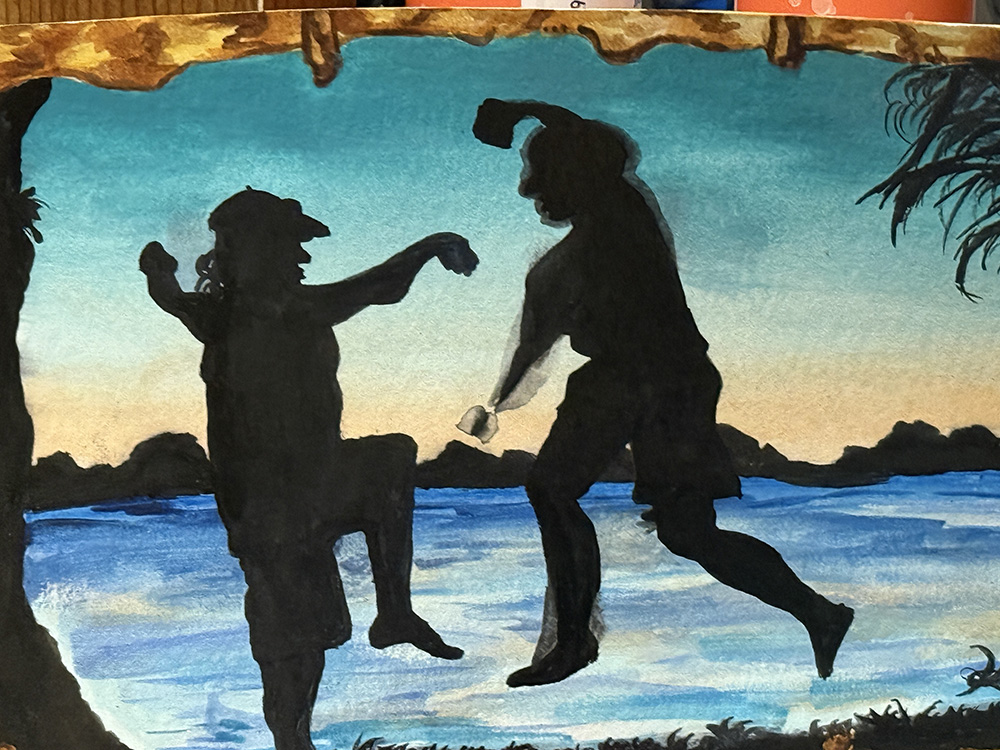
paintingSome time ago, I received an email from Montana Black, an artist who lives in Colorado, asking for permission to use one of my photos as reference for a painting. She saw my photo on Flickr, which is a great photo sharing site.

“What a great idea!” I thought, and wrote back to her to express my enthusiasm.

Upon returning from Tonga recently, I found an email waiting for me, letting me know the finished painting is on display at a retreat in Utah, and waiting in the snail mail for me was this very nice print of the finished image.

Thanks Montana!

Saltwater Energy

A scientist in the US claims to have found a way to burn saltwater. If true, this would clearly be among the most disruptive technologies ever to be invented/ discovered, leading to a complete recalculation of the energy-economics underpinning oil-based economies.

But of course, we’ve seen wild claims like this before, with cold fusion coming to mind. Extreme claims need extreme proof. While a number of questions immediately pop into my head (like how efficient the process is, how much energy input is required for a given unit of output, what happens to the leftover stuff in the water, etc.), I’m hopeful this particular wild claim has some basis in truth.

Time will tell.

Clicking Humpbacks

This is way too cool. Many people know that toothed cetaceans (like dolphins, sperm whales, killer whales, etc.) use echolocation as a sensory tool to find their way around and to hunt for food.

Researchers have traditionally viewed baleen whales (like humpbacks) as being unable to do this. Until now.

A research team (comprising members from the Hawaii Institute of Marine Biology, Woods Hole Oceanographic Institution, University of New Hampshire, NOAA’s National Marine Sanctuary Program) has documented humpback whales making clicking sounds, quite possibly in pursuit of prey.

A recent press release from NOAA on this exciting discovery is here. And here’s a recording of the humpbacks (Source).

This is beyond cool in so many ways, but what excites me is the fact that this is a discovery that flies right in the face of established “knowledge”. I get so fed up with people whose minds are closed to new possibilities that I absolutely love developments like this that turn fact into fiction.

Interview and Podcast: FiNSFotoFeature

This is an special photography feature and interview in the recent issue of FiNS Magazine, with me and a handful of fellow underwater photographers.

Most interview questions I get from magazines are mind-numbingly dry, dull and unimaginative: “Where is your favourite place to dive?”, “What kind of camera do you use?”, “What is your favourite animal?”, “Have you ever swum with sharks?”, etc. Truth be told, it’s nigh impossible to gather up the motivation to answer questions like that time and again.

Aey and Mean at FiNS came up with an entirely unique, if not oddball, set of questions which were actually a lot of fun to answer. Even more fun was reading everyone else’s answers, and seeing that at least one thing…a great (if warped) sense of humour…binds us all together.

Right click here to download the PDF file (2 MB…It’s a big file packed with lots of nice images).

The PDF file is also available as a download from my iTunes podcast.

Wrapping Up Tonga

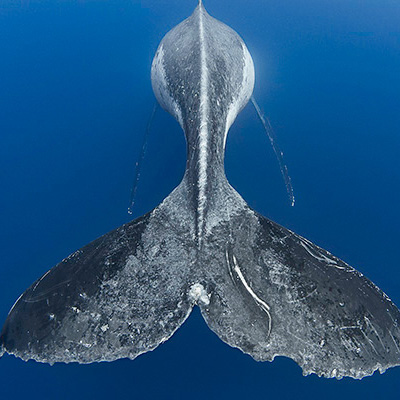
hina hinaAnother humpback whale season has come to a close…for me at least. The whales are still there, but I’m on my way back to face a mountain of work.

My final week in Tonga was hectic (as always). We had two excellent days with great weather and lots of whales…and then the winds came back, bringing harsh rain in the process. During those two days, we came upon two more calves, bringing the total to 14 for the season (#13 is Orion, named for a trio of marks reminiscent of Orion’s belt, and #14 is named Hayato).

When I get the free time (ever the optimist), I hope to put together a photo summary of the calfs and moms, as well as the white-pec whales we spotted this year. The total number of white-pec whales came to four adults and one baby this year.

reeftopA summary will come in useful next year, when we try to identify white-pec whales and see if any of the babies made it back. In practicality, it may be quite difficult to ID the babies as they mature, as they will have grown considerably larger by then, and many of the distinguishing marks may have become obscured (assuming the calfs return to the same islands or survive the long migrations).

Some summary observations for the season:

  • The weather seemed “off” this year. The winds were constantly strong, and the normal cool, winter air was often replaced by unseasonably hot, heavy, humid air. Unexpectedly however, the best days were the few days with the hot air, when conditions were calm and whales were all over the place. It’ll be interesting to see what the weather does in the next month or two…maybe the weather won’t return to normal, or perhaps weather conditions are slightly time-shifted this year.
  • I learned that most of the whale watch operators believe there are only a handful of calfs born in the Vava’u area each year, with estimates ranging from six to nine. We have photo/ video documentation of 14 this year, and that’s fewer than we believe we have from previous years (though admittedly we weren’t as methodical previously). I get the feeling that both locals and possibly researchers are significantly underestimating the local population and number of calfs. We’ll see what happens next year.
  • Calf births were late this year. Usually by end July/ early August, there are several calfs around. I have photos to prove this. This year, until we found Hina Hina in early August, no one credible had seen any babies. I use the term “credible” because it’s very easy to be fooled by fleeting glimpses of whales at the surface, especially if you’re desperately hoping to see a baby whale, so without photos or video…reports don’t count. Last year, there was one calf spotted in December, which is really late. Perhaps this phenomenon is related to the odd weather, or perhaps not. There certainly seemed to be more calves appearing in the past couple of weeks, so it might be that the timing of births is “late” this year. Again, we’ll see what happens next year.
  • We found four all-white pec adult whales and one baby whale this season. Given that these whales are much easier to identify than normally pigmented whales, it’ll be very interesting to see whether they show up again. I have to find time to assemble a photographic summary of the white-pec whales from last year and this year, so I have a handy reference tool next season.

twirlingAs I make my way back to the big city, I keep reminding myself of how lucky I am. How many people have a chance to spend a month or more each year studying humpback whales, swimming with them and learning about their behaviour through direct observation?

As I understand more each year, and as I reflect on the experiences when I get back to “normal” life, more and more questions arise.

…which reminds me, I’ve been sent a list of questions to answer for a newspaper interview in Singapore, and the overall gist of many of the questions is asking how I stay motivated.

When you see and experience amazing things like I’m fortunate enough to do, there’s no need to stay motivated. The more I think, study and learn about humpbacks all year long, the more I’ll enjoy my time with them, and the better my chances of figuring out what they’re doing. That’s all the motivation I need.

I’ll continue to upload photos to Flickr as and when I can…