Archive for Research RSS Feed

Humpback Whale ID Update

Figured it out!

humpback whale mother and calf in tonga
Footage of this female humpback whale and calf was taken 26 September 2002

The video footage of the humpback whale female that I recognised in the 2009 National Geographic documentary was taken on 26 September 2002.

Michele Hall helped track down the fact that the footage was procured via BBC Motion Gallery. Then, I searched through the online archive and found her.

Here is the relevant clip.

This means I can document that this prolific female humpback has had babies in 2002, 2008, 2009, 2012! (Updated 2012 Humpback Whale Calf Count file)

…you wouldn’t believe how giddy I am.

Another Humpback Whale ID!

Believe it or not, I confirmed another humpback whale mother/ calf pair ID while I was in Palau.

Now…before you commit electron to email and blast me with something along the lines of “Don’t be a nimwit (again)!”, please allow me to clarify.

I made the ID on TV.

Yes, that’s right. On TV.

You see, during my recent stay in Palau, there were some days when I didn’t go out on the water. On one of those occasions, I was chilling at my friend Ron’s house, catching up on programs I’ve missed.

So get this: while I was engrossed in a documentary called Kingdom of the Blue Whale, I recognised a friend at the 40-minute mark!

humpback whale female with calf in national geographic documentary
I recognised this humpback whale female immediately!

When I say a “friend”, I mean humpback whale mother #17 of the recent season in Tonga, which you can see in the picture above (snapshot of DVD footage on TV screen taken with my iPhone…how’s that for digital whiz-bangery?)

Of course, I immediately broke out my 2012 humpback whale calf ID summary file to confirm the onscreen ID, but there was no doubt in my mind…the humpback whale female that appears in the documentary is the same female that is the mother of calf 201217 Juunana.

If you’d like to confirm this for yourself, download my humpback whale calf count summary, v3 (71 pages, 29MB) and refer to pages 34-36.

But wait. The story gets better.

The mother of 201217 is the first female humpback I’ve confirmed with three calves: 200816 (Chibi-chan), 200929 (Floppy), and 201217 (Juunana).

Recognising the adult whale in the video footage, of course, begged the question of whether the calf on TV was one of the three babies previously ID-ed, or perhaps a completely different one.

With a bit of deductive reasoning, I was able to figure out that it’s different.

According to the DVD cover, the Kingdom of the Blue Whale was released in 2009 by National Geographic. Logically, this means that any footage in the video was taken before 2010.

I compared the DVD calf footage with images of calves 200816 and 200929, and it was clear that the babies do not match…which, of course, means that the footage must have been taken before the 2008 season…which, in turn, means that this female has had four babies that I can confirm with photo/ video proof.

Woohoo! You can imagine how giddy I was.

I rushed out, grabbed Ron, dragged him to the TV screen and spat out a convoluted concatenation of high-velocity syllables at him.

Being fluent in gibberish, Ron groked the situation right away, and commented that out of 6+ billion people on the planet, I’m probably the only person who could’ve made the connection.

We high-fived to mark the moment.

Anyway, I’ve updated my 2012 humpback whale calf count PDF file to reflect this exciting discovery. I don’t, of course, know the exact year in which the footage incorporated in the DVD was taken.

If anyone has friends at National Geographic Television or National Geographic Channel who might be able to help suss out this bit of information, please put me in touch! (Click here to see back cover of DVD with production credits.)

Update 13 December: The humpback footage in the program was stock footage from BBC Motion Gallery. (Thanks to Michele Hall for tracking that lead down.)

I looked through the online BBC Motion Gallery and found the clip. It is dated 26 September 2002. So that means this I can document that this female humpback has had babies in 2002, 2008, 2009, 2012!

National Geographic documentary Kingdom of the Blue Whale
The National Geographic documentary with my humpback whale friend
(…and Penguins of Madagascar documentary DVDs in the background)

Note: Incidentally, I cross-checked all the mother/ calf pair IDs that I have to date for 2012 against those for 2008, 2009, 2010, 2011, and I did not find any more repeat mothers.

52 Humpback Whale Calves!

Well…I didn’t think it was possible, but my humpback whale calf count for the 2012 season in Vava’u, Tonga has surpassed last year’s tally. In 2011, I was able to identify 48 baby whales. As of this writing, I have 52 IDs for the 2012 season!

Male humpback whale calf, Vava'u, Tonga
Humpback whale calf #19 of the 2012 season in Tonga, a bouncing baby boy

I’m sure there were many more out there, as there is no chance that I saw all the babies, or probably not even most of them. Plus…I have a number of calves which I think are different but I’m not sure, so I haven’t included them.

But going through thousands of images, re-confirming initial IDs, double-checking location data and uploading to Google Maps, editing photos, formatting my calf count file, writing text, etc. for 52 calves has kept me busy 20 hours/ day for an entire week. I’m pooped.

I had a couple of drama moments, in which I realised I had double-counted one calf, and when I thought I had lost a slew of data. Fortunately, friends sent me more calf IDs to make-up for my double-vision incident, and I found all the data I thought I had lost (turns out…I was just having a premature senile-moment and forgot where I had saved said data).

I have prepared two different files for download. The first is a 17-page, 1MB file that just contains the summary text, graphs and tables. The second is the full file, comprising summary text + photo-ID sheets for every ID-ed calf and comes in at 29MB.

Please right-click the links to download:

Humpback Whale Calf Count 2012 – Summary Only (17pp, 1MB, v1, 04 Nov 2012)
Humpback Whale Calf Count 2012 – Full PDF file, v1 (70pp, 29MB, v1, 04 Nov 2012)
Humpback Whale Calf Count 2012 – Full PDF file, v2 (71pp, 29MB, v2, 11 Dec 2012). Added additional ID of mother of 201217 Juunana. I spotted her with yet another calf (the 4th I’ve confirmed for her) in the 2009 National Geographic documentary Kingdom of the Blue Whale.
Humpback Whale Calf Count 2012 – Full PDF file, v3 (71pp, 29MB, v3, 13 Dec 2012). Confirmed that the documentary footage is from 2002 via BBC Motion Gallery. See blog post.

In addition, I’ve uploaded all the location data to Google Maps. In previous seasons, I’ve split up the map for ID-ed calves and the one for sightings of mother/ calf pairs for which I was unable to establish an ID, but this year, I put them all on one map. They are colour-coded, so it’s easy to tell the difference.

The light blue flags represent GPS data. The blue pins represent hand-marked data. The red pins are unknown calf sightings.


View Humpback Whale Calf IDs, Tonga 2012 in a larger map

And just for fun and to underscore the point that the humpback whale females and calves make use of every bit of available terrain in Vava’u, I amalgamated all my recorded encounters for 2009, 2010, 2011 and 2012 into a single map.

There are lots of data points, so Google Maps had to split the information into two pages. If you click through and take a look at the data, scroll down to the bottom of the first list of calf data, and you will see the option to click over to the second page.

Please do that so you can see just how many babies visit this area, and how they make use of every nook and cranny available in the island group. To paraphrase: “A Google Map is worth a billion words.”


View Humpback Whales 2009-2012, Tonga, Tony Wu in a larger map

If you take the time to read my ramblings and feel the urge to contribute some calf information (calves not in the summary, or additional sightings of calves already in the summary), or if you spot any mistakes, please let me know. I’m hitting the road again soon, but I’ll post updates and amendments when I can.

Oh…if you really feel ambitious…I haven’t had time to cross-compare the mother/ calf pairs from this season with the ones from previous seasons, so I could use some help in that area.

Nonie Silver spotted a repeat for me in 2009, with a female that had a calf in 2008 as well. By coincidence, that very same female has had a baby this season too (calf 201217), making her the first 3x mommy I’ve documented. I recognised her in part because Nonie pointed her out to me three years ago (thanks Nonie!).

And finally, in case you are really bandwidth-challenged, I’ve copied and pasted the text and graphs (no tables though) from the summary below.

Time for a break.

Summary of humpback whale calf encounters, Tonga 2012, Tony Wu
Summary of humpback whale calf encounters, Tonga 2012

Introduction
This document is a summary of encounters with humpback whale mother/ calf pairs in and around the Vava’u island group in the Kingdom of Tonga during the months of July to October 2012.

I use the term “mother/ calf pairs” because my IDs are based on looking at both the adult females and their calves. Baby whales grow and change rapidly in their first few months, whereas body shapes and pigmentation of adults tend to remain the same.

By making the fundamental assumption that an adult female and its calf remain together, i.e., humpback mothers do not swap calves, I can make use of all the physical traits of a given mother/ calf pair for ID purposes. Doing so provides multiple “check points”, so to speak, thereby increasing the odds of making definitive IDs, as well as augmenting the probability of recognising repeat sightings.

One disadvantage of this methodology is the near inability to keep track of the calves after the initial season. If a calf has extraordinary markings or possibly extensive wounds (as was the case with 201114 Tahafa), there is some possibility of recognition after the first season. Barring such obvious physical markers, the calves change too much from the juvenile to adult stages.

My intention with this ID effort is not to track the calves over time, however. The primary goals of this exercise are to:

  1. Gain insight into the absolute quantity of calves that pass through Vava’u each season (I use the phrase “pass through” because no one knows what proportion, if any, of the calves are born in Vava’u, and my experience to date indicates that most mother/ calf pairs are transient);
  2. Discern long-term patterns, if any, of relative concentration, movements, locational preferences and density of mother/ calf pairs while they are in Vava’u;
  3. Keep track of female: male ratio among calves for which I am able to determine sex;
  4. Attempt to identify repeat mothers in order to gain insight into the frequency of mating and calving;
  5. Quantify the level of escort interactions with mother/ calf pairs; and
  6. Record other interesting/ unusual behaviours I see and hear, such as: the sudden appearance of certain obvious physical traits in one season followed by a dearth of that trait in following seasons; the frequent use of vocalisations (not just song) and other sound for communication; heat run competitions among males for females; apparent same-sex intimacy among males; apparent “personalities” of individual whales; courtship behaviour between paired-up males and females; injuries due to both unidentified predators and manmade objects; and other related observations.

As of this writing, I have assigned IDs to 52 mother/ calf pairs for the 2012 season, 31 of which I photographed and ID-ed, with the balance comprising contributions from other people. This exceeds the previous high count of 48 mother/ calf pairs in 2011.

In addition, I recorded 28 mother/ calf pairs for which I had visual confirmation, but was unable to establish ID. Of these 28, I eventually assigned IDs to two, leaving 26 unknown mother/ calf pair sightings.

Highlights from this season include the following points:

  1. The early part of the season was characterised by unusually favourable conditions. Weather was mostly mild, climate warm, precipitation low, winds low-to-moderate, and underwater visibility excellent. There was however a prolonged drought, so the Vava’u area was suffering from a general lack of fresh water supplies. Toward the latter half of September, precipitation picked up.
  2. Subjectively, I would characterise overall whale behaviour/ disposition this season as neutral to friendly, similar to the overall mood in 2011 and 2009, and in contrast to that of 2010. There were, of course, exceptions to the general mood.
  3. The “density” of whales in the area seemed exceptionally high. This is reflected in an elevated Calf/ Boat-day figure and Calf-Sighting Ratio, both of which are significantly higher than the equivalent ratios for previous seasons.
  4. Once again, the ratio of female to male calves favoured the females. The fact that this has been the case for four years running suggests that this could be the norm.
  5. The overall level of escort activity seemed to be lower than for the 2011 season, as reflected in the metrics I’ve formulated to try to quantify and track the level of escort activity. As this is only the second season for which I have kept records pertaining to escort activity, there is insufficient data as yet to speculate much about possible explanations and/ or implications.
  6. I did not document any long-term escort associations with mother/ calf pairs, unlike for 2011.
  7. I documented the first three-time mother to date, with the mother of calf 201217 also being the mother of 200816 and 200929.
  8. The number of individuals with white pectoral fins was exceptional. I documented 21 such individuals (preliminary figure, subject to spending more time cross-checking), including four mother/ calf pairs with both individuals having white pectoral fins, and another six calves with white pectoral fins. For comparison, I documented two such calves in 2011 (201127 Uafitu and 201142 Faua), and zero in all previous seasons.
  9. I did not document any calves with the types extensive attack injuries seen on a number of the calves during the 2011 season.

For additional background information from the 2012 humpback whale season, please refer to the following blog posts:

Encounters with Humpback Whales in Tonga | 2012 Season Part 1

Encounters with Humpback Whales in Tonga | 2012 Season Part 2
Encounters with Humpback Whales in Tonga | 2012 Season Part 3
Encounters with Humpback Whales in Tonga | 2012 Season Part 4
Humpback Whale Heat Run

Encounters with Humpback Whales in Tonga | 2012 Season Part 5
Encounters with Humpback Whales in Tonga | 2012 Season Part 6

All of the work referred to in this document has been and is being done on my own time, with my own resources. I do not receive financial or other assistance, and I am not affiliated with any person or organisation involved with cetaceans.

Within this context, I would like to thank the people who have been kind enough to provide photographs, video and related information to help me with this undertaking for the 2012 season:

Jerry Allen
Frank Baensch
Kirsty Bowe
Ray Chin
Ma’ata Fifita
Howard and Michele Hall
Brenda Kaye
Emiko Miyazaki
Takaji Ochi
Douglas David Seifert

For the avoidance of doubt, any errors or silly statements contained in this document are my own, and do not reflect on any of the people noted above.

If you have photographs of humpback whale mother/ calf pairs from the 2012 season in Vava’u that are not included in this file, or additional information about whales already included in this document, please contact me.

Reference documents:
2008 Calf Summary, 2009 Calf Summary, 2010 Calf Summary; 2011 Calf Summary

Methodology

  1. I recorded GPS locations for all sightings of humpback whale mother/ calf pairs upon initial visual confirmation using a Garmin GPS 72H handheld unit and converted to Google KML format using HoudahGPS. When GPS units were not available, I marked locations by hand on a map.
  2. Where possible, I entered the water to photograph mother/ calf pairs, escorts and other associated whales if any. I made notes of behaviour, easily recognisable physical traits, and any other noteworthy circumstances.
  3. When I was able to take photographs of sufficient quality and quantity to establish an ID, I named and assigned a numerical ID to the relevant calf. I downloaded, keyworded and captioned my photos, using Aperture to stay organised. I determined IDs each evening, recorded GPS data, and wrote down notes to minimise passage of time between encounters and assigning of ID.
  4. In those cases where I was unable to get sufficient photographs to establish ID, I did not name the calves. I recorded the sightings as unknowns and cross-checked any photos of such juveniles with subsequent ID-ed whales to look for possible matches.
  5. This season, I received more ID photos from other people than I have in previous seasons. I have collected and organised such photos in a separate Aperture library, with relevant metadata, comments, and other pertinent information appended.
  6. In those instances, I have relied on the relevant people for images, location data and anecdotal encounter information. I have made every attempt to secure such data and information as soon after the relevant encounter as possible.
  7. I have uploaded all GPS and hand-marked location data to Google Maps, where the locations of all the calves are available for viewing. GPS locations are also embedded as hyperlinks throughout this document when there is text that refers to date and location of sightings. Clicking the hyperlinks will take you to Google Maps to view the relevant location.
  8. The photographs contained in this document represent a small portion of the images collected. For most ID-ed juveniles, I have additional images for verification purposes.

Observations

  1. Figure 1 below illustrates my cumulative calf counts over the past five seasons (incorporating all ID-ed juvenile whales each season, including those contributed by third parties). Once again, the slope of the cumulative calf ID curve appears similar despite inherent differences among seasons (different periods of stay, varying number of boat-days, different number of people helping, weather variations, etc.).
  2. Cumulative humpback whale calf count in Tonga 2012
    Cumulative humpback whale calf count in Tonga,2012

  3. During my stay this season, I ID-ed 31 mother/ calf pairs over the course of 34 boat-days (compared with 45 calf IDs over 76 boat-days in 2011; 22 calf IDs over 81 boat days in 2010; 26 calf IDs over 59 boat days in 2009; 16 calf IDs over 67 boat days in 2008; 14 calf IDs over 53 boat days in 2007). This worked out to 0.91 Calf/ Boat-day, with a boat-day being defined as a single day of approximately six hours on the water on a boat looking for whales. These figures do not include calf IDs contributed by other people.
  4. As is apparent from Figure 2 below, this season was exceptional, with the Calf/ Boat-day ratio significantly exceeding the levels recorded in each of the previous seasons. One contributing factor may be that I was only running one boat at a time this season, whereas in previous seasons, I had two boats on the water on many days. This change was precipitated by a number of factors, the most significant of which was consequential damage from the Tsunami on 11 March 2011. This event effectively eliminated visitor traffic from Japan. As a result, the denominator in my Calf/ Boat-day ratio was lower this year than in past years. It would seem logical however that this consideration should have been offset to a large degree, if not entirely, by my inability to cover as much area on a given boat-day compared to previous seasons.
  5. Number of humpback whale calves identified per boat-day on the water in Tonga
    Humpback whale calves identified per boat-day, Tonga

  6. On a subjective basis, the exceptionally high Calf/ Boat-day ratio for this season is consistent with the high probability and relative ease I experienced of encountering and ID-ing calves this season. There was a noticeably high “density” of mother/ calf pairs, and on balance, a relatively high proportion of those whales were settled, or at least settled enough for me to establish an ID.
  7. For argument’s sake, if I double the number of boat-days this season from 34 to 68, the resulting Calf/ Boat-day ratio would still be 0.46. In other words, even if there is a measure of positive bias deriving from a reduction in the number of my boats, an over-simplistic doubling of my boat-day count still results in a very high figure.
  8. Taking this season’s Calf/ Boat-day ratio together with those of previous years, there is a wide band, ranging from 0.24 in 2008 to 0.91 this season. This suggests to me that the Calf/ Boat-day figure may fluctuate substantially from year-to-year. In other words, there may be no “norm” for expected mother/ calf pair density.
  9. Moving on, Figure 3 on the following page depicts the total Calf Sighting Ratio for 2009 to 2012, where I have defined Calf Sighting Ratio as = (Total ID-ed calf count + Total unidentified calf count)/ Total boat-days. Once again, for consistency with previous seasons, I only took into consideration the whales I identified and not those contributed by other people. The ratio for this season was 1.68 (would be 0.84 if I doubled the boat-days), which compares with 1.01 for 2011, 0.49 for 2010, 0.85 for 2009. This ratio provides a reasonable indication of the overall level of humpback whale mother/ calf pair activity in the Vava’u area, and, once again, the high level this season is consistent with my experience on the water.
  10. We again found mother/ calf pairs scattered throughout the entire topography of the Vava’u Island group. Please refer to this Google Map.
  11. humpback whale calf sightings per boat day in Tonga
    Total calf sightings per boat day in Tonga

  12. As was the case in both the 2011 and 2010 seasons, there were not many calf sightings this year in North Bay; in contrast, there were quite a few in 2009. This season, there were also relatively few encounters in the main channel between Hunga and Nuapapu; there are normally many more in this area.
  13. Each season, there seem to be areas that are relatively popular among the mother/ calf pairs. The “in” places change, so statements applicable to the 2012 season may or may not have relevance to any other season.
  14. Within this context, it is worth underscoring the point that extrapolating from limited observation from limited days in any single season to draw conclusions about the dynamics of the humpback whale population that visits Vava’u is inadvisable, at best. Only long-term observation and consistent recording of data may eventually reveal underlying patterns and trends.
  15. Perhaps the best way to illustrate this is to amalgamate my mother/ calf pair sighting data for all ID-ed and unknown mother/ calf pairs for 2009-2012 (the period for which I’ve been keeping track). Please refer to this Google Map to see the result. Note: There is so much data that there are two pages to the map, scroll down to the bottom of the list of baby whales to click to the second page and see the complete sighting map.
  16. The reason I wish to highlight this is that each season, I come across people making sweeping statements about whales in Vava’u. In most cases, such statements reference doom-and-gloom, are seemingly intended to foment discord, and are backed by no data. Particularly disappointing are individuals purporting to represent large, multinational NGOs who make unsupported, disparaging statements about the whales and whale-watching in Vava’u. The above-referenced map should demonstrate beyond a shadow of a doubt that humpback whale mother/ calf pairs make abundant use of every area of Vava’u. Facts count. Zealotry does not.
  17. This year’s sightings once again supports my notion that, for the most part, humpback whale mother/ calf pairs use Vava’u as a transit area, visiting for a limited duration before moving on, returning to the area at a later date in some instances. Within this context however, there were a handful of repeat sightings over extended periods of time, as there have been in previous seasons:
    • 201209 Kyuu (2 encounters/ 10 days);
    • 201212 Juuni (2 encounters/ 10 days);
    • 201217 Juunana (2 encounters/ 26 days). 3x mother – see below;
    • 201221 Nijuuichi (2 encounters/ 37 days);
    • 201224 Nijuuyon (3 encounters/ 13 days);
    • 201226 Nijuuroku (2 encounters/ 21 days); and
    • 201235 Sanjuugo (3 encounters/ 21 days).
  18. The ratio of female to male juveniles once again favoured females. This has been the case for four years running. This year, we counted 16 females and 12 males (13 females and 10 males in 2011; 7 females to 4 males in 2010; 14 females to 9 males in 2009). Given the consistency of these sex-ratio records, I am discounting chance and other possible explanations, and leaning toward the conclusion that there may be a slight bias in female births to males among southern hemisphere humpbacks.
  19. Ratio of female to male humpback whale calves in Tonga
    Ratio of female to male humpback whale calves in Tonga

  20. The escort ratios this season were all lower than they were last year, as is apparent in Figure 5 below. Out of 52 ID-ed mother/ calf pairs, 27 were accompanied by escorts in at least one encounter with the relevant mother/ calf pair, a ratio of 0.52. Out of 68 total encounters with those 52 ID-ed mother/ calf pairs, 30 encounters involved at least one escort, a ratio of 0.44. In the case of unidentified mother/ calf pairs, the ratio was 0.23. I only calculated one ratio for unidentified mother/ calf pairs because we had only one encounter with each pair.
  21. Humpback whale escorts with mother/ calf pairs in Tonga
    Humpback whale escorts with mother/ calf pairs in Tonga

  22. Taken at face value, this seems to suggest the possibility that the ratio of eligible/ interested males to females already with calves could have been lower this year than it was last year. Possible contributing factors might include fewer males in the area (could they have gone elsewhere?); males heading back south relatively early (mated and lost interest early?); more single females than last year (though that might be difficult to reconcile with the high number of females with calves); less cooperative/ willing females with calves this year; and probably more potential considerations that have eluded me. In any event, it will take more observation and data collection to see what, if any, pattern might emerge.
  23. It is interesting to note that the Escort Ratio for the Unidentified mother/ calf pairs is lower than that for the ID-ed mother/ calf pairs in both 2011 and 2012. Common wisdom has it that the presence of escorts makes it more difficult to have successful encounters with mother/ calf pairs, the rationale being that escorts “push” mother/ calf pairs to keep moving. My own experience suggests that there is little to no such relationship, and that escorts “calm” mother/ calf pairs as often as, perhaps more than, they “push” them to move. Some females also seem predisposed to avoid contact from any species. It will be interesting to see if this disparity in the Escort Ratio between the ID-ed and non-ID-ed mother/ calf pairs remains constant going forward.
  24. Unlike the 2011 season, I did not document any long-term associations between escorts and mother/ calf pairs.
  25. Despite the lack of opportunity to document any long-term escort relationships this season, I did have an interesting observation relating to escorts. On two occasions (involving calf 201233 and calf 201242), there were males that appeared to be challenging one another for the right to claim primary escort position with the respective females. As the battles ensued, the males appeared to become so preoccupied with their competitive displays that they forgot about the females. The males traveled further and further from the mother/ calf pairs as they continued to jostle for dominance, until they completely lost track of the females, leaving the respective mother/ calf pairs in peace. I cannot recall ever having witnessed this type of behaviour before, but it is certainly possible that I did, but did not take notice, given that I really only became interested in escort behaviour last year.
  26. On 28 September, I witnessed and photographed a group of three male whales engaged in intimate behaviour. The first time I recorded such seemingly amorous interaction among males was in 2010. In that case, there were also three males involved. I have observed and photographed many intimate episodes between male and female humpback whales. In both 2010 and this year, the interaction among the male whales could easily have convinced me that male/ female courtship was taking place. I have learned that it is necessary to confirm visually with photos or video the sex of all whales involved in seemingly intimate interaction, as there is obviously some role for same-sex intimate behaviour among humpback whales. It is very tempting and easy for an inexperienced person to jump to conclusions. See this blog post for more details on this fascinating topic.
  27. One of the most rewarding aspects of keeping track of the mother/ calf pairs is documenting repeat mothers. This year marked the first three-time mother that I have documented to date. The mother of 201217 Juunana is also the mother of 200816 Chibi-chan and 200929 Floppy. There may be more repeat mothers among this year’s mother/ calf pairs. I have not yet had time to compare all of this season’s mothers with all of the mothers in previous seasons.
  28. Humpback whale females with calves in multiple years, Tonga
    Humpback whale females with calves in multiple years, Tonga

  29. I witnessed in the water for the first time two mother/ calf pairs socialising. They swam side-by-side, with the mothers in the middle and calves on the outside for five to ten minutes. The mothers interacted; it did not seem that the babies were permitted to do so. I was unfortunately unable to take a photograph, but I hand-drew a diagram of what I witnessed (see this blog post).
  30. There was an exceptional number of whales with white pectoral fins. As of this writing, I have documented 21 such individuals (subject to additional review when I have time). Among those whales are four mother/ calf pairs with both adult and baby having white pectoral fins, and another six calves with white pectoral fins. For comparison, I documented two such calves in 2011 (201127 Uafitu and 201142 Faua). Last year was the first time I documented calves with white pectoral fins, and this season, there were at least ten. There were also many other adult whales with white pectoral fins and with partial white pigmentation on their pectoral fins, many more than I’ve noticed in other seasons. I am interested in the sudden appearance and disappearance of obvious physical traits such as white pectoral fins because I believe they may be indicative of underlying genetic closeness. If this were to be the case, and if these traits appear in clumps, then there may be the possibility that individuals travel to some degree in tandem with relatively closely related whales. There is, to the best of my knowledge, no other information or evidence to suggest that this happens.
  31. A simple way to test this possibility would be to biopsy a number of whales with similar physical traits when they appear in substantial numbers within a single season and test for genetic similarity. There are at least two issues that make this difficult. First, it is impossible to predict in advance which physical traits will appear in large quantities in a given season, so it is impossible to know in advance which trait(s) to look for. Second, I do not have access to biopsy equipment or genetic laboratories. Keeping track of obvious physical traits is the best I can do for the time being. If and when I get sufficient time, I hope to go back through my archives and pick out all the whales with white pectoral fins (and split dorsal fins) for past seasons, in order to see if I can discern and document any patterns.
  32. I did not document any whales with split dorsal fins this season. There were two calves (201210 and 201216) with notches in their dorsal fins, and calf 201217 has a somewhat unique double dorsal fin.
  33. One of the babies with white pectoral fins, calf 201243, was not accompanied by its mother or any other adult whale. Given that juvenile humpbacks are entirely dependent upon their mothers for sustenance and protection, this calf most likely did not make it. I have seen abandoned/ lost calves in other instances, so this is perhaps not unusual. There was also a calf that stranded in Ha’apai earlier in the season. A number of people worked together to re-float that whale, but again, without its mother, a humpback calf has no chance for survival.
  34. Calf 201242 appears to have acorn barnacles (Coronula diadema) all over its body, with discolouration of skin appearing in patches where the barncales are most concentrated.
  35. A number of the babies also exhibited “scrape” wounds, for lack of a better term. I have noticed these in past seasons, but have not kept meticulous records. These wounds are characterised by scrape-like patterns along the dorsal area, between the dorsal fin and fluke. Most often, these wounds are on both sides of the body, and only affect the top ridge of the body, almost as if someone used a brillo pad or steel wool to scrape down the length of the calf’s body. Some adults also exhibit this wound pattern. I am certain that these are wounds and not pigmentation, as I have seen and photographed fresh wounds with scrape/ cut marks still bleeding. I have no idea what causes this, and am at a loss to imagine a scenario explaining these wounds, but they appeared on calves 201219, 201230, 201232, 201237, 201241, 201242, 201247.

Humpback Whales in Tonga 2012: Part 6

I’ve wrapped up my stay in Tonga for the 2012 season, and I’ve commenced the long journey back to Asia.

Once I’m back and settled, I’ll do my best to crank out a summary of this season’s calf IDs. The good news is that it’s looking very likely that we’ll surpass 50 calf IDs. Seriously!

Humpback whale calf in Tonga
Male humpback whale calf (#42) playing in the blue

The only reason I hesitate in being more definitive is that with so many mother/ calf pair ID candidates, I’m allowing for the fact that I may have made mistakes or double-counted somewhere along the way. I caught one error early on, so it only(!) cost me 2.5 hours of work to fix it.

As you can imagine, the more calf IDs there are, the more difficult it becomes to check every new calf against all the previous ones. As the season wore on, I spent two to three hours each night cross-checking photos…most of the time in a cross-eyed, discombobulated state of exhaustion.

Fortunately, I’ve had a lot of practice doing this for many seasons, and I have a (mostly) logical system set up to help minimise obvious error.

I’m hoping to finish and post my calf count summary file in relatively short order, though the sheer number of IDs (still increasing) plus a series of upcoming events are conspiring against me: (a) I need to head out for my next trip in early November; (b) I am giving a talk about whales in Osaka (in Japanese…yikes!) on 26 October; and (c) I’m preparing a presentation about my annual calf ID count to be given by Allan Bowe at Whale Fest in the UK the weekend of 27 October. (I really wanted to attend Whale Fest, but alas, it is still not possible to occupy two places in space at the same points in time.)

For the time being, please take a look at my humpback whale calf count summary file from 2011 for an idea of the daunting task ahead of me.

Half Century Mark
As I mentioned above, I’m relatively certain that we broke the 50-calf level this season.

Assuming I haven’t majorly screwed up the IDs, this is doubly amazing, as I actually wasn’t trying too hard this season.

Having hit 48 calves last year, I sorta figured that I had proven my point…that there are lots and lots of humpback whale mother/ calf pairs that pass through the waters around Vava’u each season.

One would think this wasn’t a particular point of contention, but it was for many years.

Having hit this particular ball out of the park, I was intent on concentrating on other things (calf sex ratio, escort behaviour, unique physical trait appearances, etc.) this season, while continuing the calf count more for fun than anything else.

Well, so much for that.

Humpback whale female with calf and escort in Tonga
Male calf (#46) with mommy and escort (one of two)

Subject to going through all the photos and associated information more carefully, here are some of the likely highlights to come out of this year’s data:

  1. The calf/ boat-day ratio, which is my indicator of “calf density” as it were, will be significantly higher this year than in any other year, including 2011. What this seems to suggest is that in addition to the absolute number of calf IDs being high, the mother/ calf pair density through the season here was perhaps the highest since I commenced counting. I’ll explain more about how and why I calculate this figure when I post my summary, but if you’re interested, I’ve defined and calculated this ratio for past seasons and included the figures in an easy-to-understand graph in my 2011 summary.
  2. There will, once again, be more female calves than males (among the calves for which I was able to determine sex). The ratio has favoured females in every season since I began keeping track. There is always the possibility of sheer coincidence, but given that this has been the case for four seasons running now, I’m feeling more certain that there is some significance to this.
  3. We did not see any “long stay” mother/ calf pairs as we did in 2010 and 2011. The whales were transient (which actually seems to be the norm).
  4. We did not see any calves with injuries akin to the those on calf 201114 Tahafa and several other baby whales in the 2011 season. This suggests that whatever was lurking in the neighborhood pouncing on the little ones last year (I guessed false killer whales) was not present this year.
  5. We did not document any long-term escort-to-mother/ calf pair associations as we did in 2011. If you think about it, this make sense, given point 3. Since we didn’t have multiple encounters with a given mother/ calf pair over a long period of time, it follows that we didn’t see any accompanying escorts over an extended period.

Once, Twice, Three Times A Mommy
In addition to these summary points, we documented our first 3x mother!

The mother of 200816 Chibi was the mother of 200929 Floppy (female) is the mother of 201247 Yonjuunana (tentative ID).

You can see the previous calf IDs in my previous summary files (2008 humpback whale calf IDs; 2009 humpback whale calf IDs).

Even more exciting is that I was only able to document this 3x mother due to the help of three other people: Nonie Silver and Karen Stone in 2009; and Kirsty Bowe in 2012. I made the original ID in 2008, but in both 2009 and 2012, I did not photograph the mother. These three women did.

I’ve been rambling on for years about the value of working together and making use of technology to leverage individual efforts. This is a perfect example!

Distinctive body print of female humpback whale in Tonga
Distinctive body print of female humpback that is a 3x mother

Total Bummer
We also had one bummer of an experience concerning a calf on 4 October.

In North Bay, we came across a lone calf with no mother or other adult whales in sight. I managed to get a few photos for ID purposes, so I know that it wasn’t a calf I had seen before.

The sad fact though, is that there is no hope for the calf.

Humpback whale babies rely 100% on their mothers for sustenance and protection. Without her around, the calf is doomed.

There was also a calf that stranded in Ha’apai earlier in the season. Though people there banned together to re-float the little whale, there was, as I understand, no mother in the vicinity…so it’s almost certain that the calf concerned also did not make it.

I’ve written in the past about calf separations; it’s not a new topic or experience for me. It’s always depressing to see a calf whose days are numbered, but it’s best to call a spade a spade and recognise that calf separations are most likely a normal occurrence.

We can certainly discuss and debate the possible causes underlying such a tragic turn of events, but there is zero point being wishy-washy and sugar-coating the issue with false hope and denial.

White Pecs
As of now, my White Pec count stands at 20 individuals.

In case you’re not familiar with what I’m referring to…the term White Pec is what I use to describe whales that have white on both the dorsal and ventral surfaces of their pectoral fins.

This is a common pigmentation pattern in the northern hemisphere. It exists down south as well, but it’s not as prevalent as up north.

Now…the reason I’m paying attention to this is that I first noticed such whales here in reasonable quantity during the 2006 season. Up until that point, I had never seen one, or if I had, I did not take note (nor had any of my friends…I asked around).

From 2007 to 2010, I didn’t see many, if any, each season.

Then in 2011, I recorded 10. And now in 2012, I have 20.

As a subset of the total count, I recorded my first two calves with white pectoral fins in 2011 (never saw/ noticed any before), and I have 9 calves with such pigmentation this season.

Hmmmmm.

Maybe there’s nothing to this, but it does make me wonder why such an obvious physical trait should be present in substantial quantity in a given season, but not in others. And also why calves with this pigmentation should suddenly appear in 2011, then show up in significant quantity in 2012.

And of course, it makes me wonder what will happen next year.

Earlier in the season, I made reference to the possibility that this outward physical trait may reflect an underlying genetic link, that perhaps the White Pecs are relatively closely related. If this were the case (which is far from certain), then perhaps these somewhat-related animals travel in loose association with one another.

If I had access to biopsy darts and a genetics lab, it’d be pretty easy to test for a possible genetic link, assuming the White Pecs show up again.

Lacking access to those things, I’m doing the next best thing I can think of, which is to use photos to track obvious physical traits and look for possible patterns.

As if the annual calf count weren’t time-consuming enough…I have to find time to go back through all my digital photos from 2005 onward (argh, argh, argh…not even going to contemplate trawling through film files) and dig out the White Pecs (as well as whales with split dorsal fins) to compile a summary of sightings over the 2005-2012 period.

Given my hectic travel schedule, I’m not sure when I’ll be able to do this, but I’ll do my best to hit the RAW files again at year end when everyone else is drinking and being merry. Sigh…what I wouldn’t give for some helper elves.

Oh…speaking of White Pecs, we had our first long-term, in-season re-sighting of a White Pec. A male White Pec that was part of an 11-whale heat run on 31 August appeared again on 25 September as an escort to a mother/ calf pair (one that I haven’t assigned an ID to yet).

Exhilarating stuff for a whale geek like me.

humpback whale in an 11-whale heat run, Tonga
Screen grab from video footage:
White Pec humpback in an 11-whale heat run on 31 Aug

humpback whale with all white pectoral fins, Tonga
Second sighting of the same White Pec whale on 25 September

Perfect People
I’m already pretty drained from the travel process (what’s not to love about schlepping baggage around, being asked to un-pack/ re-pack bags several times, lounging around in airport after airport, enduring the contortions of airplane seats, etc.), so I’m going to wrap this up and get another shot of caffeine to help me make it through the rest of the trip.

I do however want to take this opportunity to say “Thank You!!! (and thanks for putting up with me)” to everyone I spent time with during the season. The list is long and distinguished.

Once again, I had the privilege of spending time with incredibly fun, kind, intelligent, and accomplished people from many different walks of life…all of whom I hope will be life-long friends.

That’s it for now. Thanks for reading, and stay tuned for the 2012 calf count summary.

Happy people in Tonga
Just a few of the people who made the past two months a wonderful experience

Humpback Whales in Tonga | Part 1
Humpback Whales in Tonga | Part 2
Humpback Whales in Tonga | Part 3
Humpback Whales in Tonga | Part 4
Humpback Whales in Tonga | Part 5

Humpback Whales in Tonga 2012: Part 5

They are among the cutest, most inquisitive, and incredibly talented babies on the planet. I’ve observed and interacted with hundreds of them, and yet…I never tire of them. They never fail to surprise and delight me. Humpback whale calves are simply incredible.

As of today, my tally of humpback calves for this season stands at 38. For context…that’s only 10 shy of my record-breaking total of 48 ID-ed calves in 2011.

Wow!

In my summary blog post for the 2011 season, I “forecast” (i.e., took a wild guess) and wrote that the number of babies this year might revert to the mean, and as a result, my calf count for 2012 might end up somewhere in the 20s. Well…so much for that bright idea.

It was pretty obvious relatively early on that we were on track for a very healthy number of babies. In previous blog posts this season, I mentioned that we were on track to meet or exceed the 2009 count (31 mother/ calf pairs), and that’s exactly what’s happened.

Breaching humpback whale calf in Tonga
Breaching humpback whale calf (#38 of 2012 season, male)

Let that sink in for a moment.

The season isn’t over yet, and my calf count stands at 38 humpback whale calves. In light of the fact that just a few years ago, the common wisdom was that only a handful, perhaps six to eight, calves passed through Vava’u each season, this is absolutely amazing. (It also underscores the potential pitfalls of listening to common wisdom.)

The fact that the number of newborn humpback whales has remained high after a gangbuster year in 2011 is obviously a positive sign for the Megaptera population, one that we should all be thrilled about. Three cheers for a healthy humpback population!

Of course, I need to go through many thousands of photos with a fine-toothed comb after the season ends in order to reconfirm the IDs, but there is no doubt that the final tally will be significant.

It’s been about three weeks since I’ve posted a full summary, so I won’t attempt to discuss all the babies we’ve met in the interim, but here are a couple of noteworthy encounters:

Humpback whale female with calf, Tonga
Male humpback whale calf with mommy, #26 of the season

The first is calf #26, a male juvenile that was quite the mama’s boy. The mother/ calf pair were extraordinarily friendly and tolerant of our presence, but the calf stuck close to mommy all the time, never straying much beyond the adult’s pectoral perimeter.

And the photo below is of calf #30, a baby that was in the midst of an action-packed heat run that comprised the mother/ calf pair, a lead escort, and five additional hormone-fueled challengers. This also happened to be the first proper heat run I experienced this season, so it was doubly memorable.

As you may be able to discern from the photo, a heat run is not always the most relaxing of situations for mommy and baby:

Humpback whale female with calf in a heat run, with escort trailing behind
Humpback whale calf #30 with mom in a heat run, escort trailing behind

Weather, Winds, Water, Windbags
The overall conditions this season have been good. The weather has been generally benign, ocean conditions mild, and winds mostly conducive to heading out to sea. There have, of course, been some challenging days, but so far, we haven’t lost much time to inclement conditions. (Murphy’s Law: The morning after I wrote this sentence, we were hit by prolonged rain.)

If I had to characterise, I’d say it’s been an unusually dry and warm season…as evidenced by signs such as the very early ripening of kapok tree seed pods, and many-a-mango-tree positively bursting with fruit.

Also of note…the water visibility has been excellent, which is entirely unlike the situation in 2011. Visibility has been positively outstanding in many areas (I could see the bottom in the channel in front of Swallow’s Cave a couple of days ago for instance!), and even in the south, where the water is almost always stirred up and murky, visibility has been better than average.

Of particular interest, there is relatively little stuff in the water of biological origin (i.e., pink fuzzy things), which fortunately equates to less backscatter and other bits to clean up when going through photos…always a welcome relief.

I’m not sure why this is the case, but I suspect there may be some correlation to the el Nino/ la Nina weather cycles…more on this subject when I wrap up with a final blog post at the end of the season.

In tandem with the generally favourable conditions, the whales have also been reasonably friendly. As I’ve mentioned many times in the past, there seems to be an overall “mood” to every season, with whales in the area exhibiting a communal disposition that can span the entire range from proactive and engaging to downright rude. This season’s mood seems to fall somewhere in the neighborhood of “mostly affable, with scattered frumpiness”, if that makes sense.

As far as whale numbers are concerned…there have been a few periods when the whales seemed to go “poof” and vanish into the aether, though they’ve always returned. Of interest…when this happened in mid-September, we checked with a friend in Ha’apai, and learned that the situation was similar there at the time as well.

No one knows what’s behind these periodic disappearances and reappearances of whales in the area, but if you consider this topic for a moment…it totally makes sense.

Humpbacks are social animals, and they gather here for social purposes. So it should come as no surprise that their movements are coordinated to some extent. If the whales didn’t have some sort of shared (and communicated) agenda, why would they even bother to congregate?

Periods when the whales seem to be scarce obviously suck for people who are here at the time hoping to see them, but there’s a word of caution I’d like to throw out in this context…drawing conclusions from just a few days is a bad thing to do.

Periods of scarcity, as well as periods of abundance, occur each season. So basically, without a long-term view (over each season and over multiple seasons), any conclusion one makes about the presence or absence of whales is at significant risk of being invalid. There is ample potential for statements made based on limited observation to be inconsistent with fact (i.e., to be total BS).

Here’s the kicker…even if you’ve been here over multiple seasons…you have to be paying attention in order even to have a hope of teasing out possible patterns, trends or other meaningful observations. Paying attention requires a lot of effort and work, which can be tedious, labor-intensive and even painful at times.

And here’s the kicker on top of the kicker…even if you are paying attention, it’s very, very easy to be misled by events and to make mistakes. I should know…I make them all the time!

Forgive my little rant, but I’ve only just learned a couple of days ago about an alleged expert going around the world telling people blatant lies about the situation here, based on her “expertise”, i.e., a few days on the water (but no time at all in the water). It’s impossible to stop people from “flapping their traps” (as my 10th grade history teacher used to admonish us students against), but permit me to underscore the importance of applying critical thought to broad, sweeping generalisations put forth by erstwhile experts who’ve spent very little time in the places and with the subjects about which they expound.

I’ve heard such people in the past (and the present) make sweeping (usually alarmist) generalisations about things like whales running away because of boats, about a seeming scarcity of whales being indicative of unhealthy whale populations, about personally “never having seen such few whales”, etc.

I cannot fathom what drives such people to stupidity, but if you come across anyone fitting this description, please take such silly talk with an appropriately humongous grain of salt and with your BS meter on full alert.

Humpback whale cruising along the ocean surface, Tonga
Humpback whale cruising along the ocean surface

Social Cetaceans
Heat runs are my favourite humpback whale activity to watch. I’ve seen several over the past few weeks, the most action-packed of which was on 17 September (see previous blog post).

In short, they involve a bunch of boisterous boy baleens competing for the attention of a female whale. There’s always a frenzy of activity, and the specific dynamics among the participants are always unique and fascinating.

There’s usually a male or two that seem to be dominant, while the others appear to be trying their luck. There’s a lot of pushing, shoving, grunting and groaning that takes place, and occasionally there’s blood that’s shed, though none of the cuts and bruises ever seem serious.

Sometimes the action revolves around a single female, and at other times, the activity centres upon a female that has a calf. Some females seem to enjoy the attention, while others…well, would probably prefer the boys amuse themselves elsewhere. Some females with calves even appear oblivious…I’ve seen mommies serenely feeding their babies while a manic Megaptera maelstrom rages around them!

But in any case…testosterone + hundreds of tonnes of humpback always = Woohoo! (or should that be Wuhoo?)

Female humpback whale and calf in the midst of a heat run
Female humpback whale and calf #33 in the midst of a heat run

Among my recent experiences though…one social interaction, which we witnessed on 28 September, stands out. It wasn’t a heat run.

This encounter involved three individuals, whales that were moving along at a steady pace…not too fast, not too slow…diving down, coming up, rubbing against one another, executing exquisite, almost balletic movements in the process.

At first glance, their actions and body language reeked of a competitive situation, one in which perhaps two males were vying for the attention of a female.

During this encounter, I saw something I haven’t witnessed before…a whale stroking its head/ rostrum area gently against the underside of another whale. This happened on at least three different occasions, though I was only able to photograph it once:

Male humpback whale nuzzling underside of another male.
Third male in the background.

In this particular instance, I saw the strokee emit a small cloud of dark liquid, right into the “face” of the stroker.

I’ve seen and photographed humpback whales pooping here before. The emission kinda looked like liquid-y poop, but there wasn’t a lot of it, and the situation sort of suggested that…well…perhaps defecation wouldn’t be the most appropriate or socially acceptable response. But who knows? There are, as I understand, humans who are in to that sort of thing (yuck).

In any case, it happened too quickly and too far away for me to get a photo of the small puff of liquid. There is, however, no doubt about what I saw.

But wait. It gets even more interesting.

Had it not been for a similar encounter I experienced two seasons ago, I may have just assumed that this situation was two males trying to impress a female, and let it go at that. I may have even interpreted the intimate interaction as a prelude to courtship and mating.

Back in 2010 though, I spent quite a bit of time swimming among three whales engaged in just about the same type of behaviour while exhibiting the same type of intimate interaction.

In that case…it turned out that all three whales were male. I dubbed them the Three Amigos.

The Three Amigos...three male humpback whales
The Three Amigos…three male humpback whales

With that lead-in, I suppose it won’t come as any surprise that the three whales I encountered a few days ago also turned out to be three boys…another trio of males associating in an exceptionally intimate and seemingly affectionate manner.

For continuity with the Three Amigos, I’ve dubbed this recent triplet the Three Musketeers. (If I come across this type of situation again, the next trio will be the Three Stooges!)

You might wonder how I knew that they were boys and not girls. Well at first I didn’t…but I swam and I swam and I swam until I was able to get photos of the undersides of every whale. This allowed me to confirm their sex beyond a shadow of a doubt.

The lesson here is that you can’t assume anything. Even if whales are engaging in what appears to be intimate behaviour, you must have photographic proof of their sex. Otherwise, you can’t be certain of what’s taking place.

Now…the Three Amigos and Three Musketeers obviously beg the question of what exactly was going on in those two instances. Why would three male humpbacks invest time and energy engaging in such behaviour?

I have no answer, and I’m not prepared to speculate at this stage, but it’s certainly intriguing, and something that I’ll keep an eye out for in the future.

The one thing I’m quite certain of, however, is that the dynamics of humpback whale society are much more complicated and nuanced than we know.

Three male humpback whales socialising...the Three Musketeers
Three male humpback whales socialising…the Three Musketeers

More Megaptera Mystery
Speaking of cetacean conundrums…on 29 September, I came across what might have been a whale with a leak.

Yes…I know…that sounds preposterous, but let me explain.

Early in the morning, we came across a mother/ calf pair between Eueiki and Fua’amotu.

The visibility wasn’t great; the water was dark; the sea bottom was dark; the mom was deep; and she was mostly dark on top…so it would have been challenging (to say the least) to find the whales in the water…if not for the fact that the mom emitted a steady stream of bubbles, which allowed me to locate her with relative ease.

Humpback whales blow bubbles, so that’s nothing new. But this didn’t appear to be a conscious expelling of air. It was more akin to a leak.

At first, because the visibility wasn’t good, I thought the bubbles were coming from the sea bottom, sort of like what you see in areas with volcanic activity (PNG, Indonesia, Dominica, etc.), where gases escape from the ground and bubble into the sea. This worried me, because Tonga is adjacent to a trench, and there is certainly tectonic activity here. My gut reaction was…”Oh no! Do we have impending volcanic activity?!” I’m sure you can see why that might be a concern.

As I stared into the deep, dark, featureless water, I eventually saw a flash of white…the belly of the calf as it appeared from beneath its countershaded mother. It was only then that I realised that the bubble stream was coming from the adult whale, not from the sea floor.

I’ve never come across this before.

We did several drops with this mother/ calf pair (calf #38, a boy), so I eventually got a good look at the “leak” and was able to document it.

Female humpback whale, streaming air bubbles from her blowhole
Mother of calf #38, streaming air bubbles from her blowhole

I don’t know if the bubble stream was actually coming from a leak per se, but I can’t think of any logical reason why a whale would intentionally let perfectly good air escape in a steady, non-stop stream. She did this on every dive (5-6 drops) except the final time we got into the water with her.

The fact that she didn’t emit any bubbles on the last drop suggests that she may have had conscious control over whatever was causing the bubble stream, but then again…if that were the case, why emit the bubbles at all? Hmmmmm.

The only plausible/ possible explanation I’ve been able to come up with so far is that perhaps she was sleeping/ resting during the initial drops, and while she was in that state, she may have involuntarily relaxed motor control over the muscles that hold her blowholes shut…sort of like how you drool when you nod off (Yes you do…everyone does it.).

During our final drop with her, perhaps she was fully awake and therefore exercising full motor control over her blowholes.

It’s a mystery, but that’s my best guess for the time being.

If you can think of a better explanation, please let me know.

Anyway, the pair ended up putting on a spectacular tail-slap/ breaching display for us; mom and baby playing together and celebrating life is always a terrific spectacle.

So…that’s nowhere near everything that’s happened over the past few weeks, but the anecdotes above convey the gist of some of the more interesting experiences I’ve had.

I’ll wrap up this post with a thought shared with me by Tom Perkins. I was fortunate enough to have had the opportunity to spend some quality time with him recently, and I have come to admire, respect and hold Tom in the highest regard. There are few people I have encountered who are so positive and inspiring.

During a late afternoon chat about life, the universe and everything, he planted the following thought in my head, one that I believe worth remembering and sharing:

Q: What is the cure for boredom?
A: Curiosity.

Q: And what is the cure for curiosity?
A: There is none.

Thank you Tom.

Breaching humpback whale, mother of calf #38, Tonga
Breaching humpback whale, mother of calf #38

PS: We’re up to 17 White Pecs now!

Humpback Whales in Tonga | Part 1
Humpback Whales in Tonga | Part 2
Humpback Whales in Tonga | Part 3
Humpback Whales in Tonga | Part 4

Humpback Whales in Tonga 2012: Part 4

We’ve identified seven more humpback whale mother/ calf pairs this week, bringing the current tally to a total of 24.

Humpback whale calf, Tonga
Humpback whale calf #19, the first confirmed male I have this season

At this same date in previous seasons, we were at 33 ID-ed baby humpback whales in 2011, 16 in 2010, 26 in 2009, and 15 in 2008.

To help put this in context, the figure below is a graphical representation of the calf count tallies from the past four seasons, with the X-axis representing time starting on 1 August and continuing through 30 October, and the Y-axis representing the number of ID-ed mother/ calf pairs:

Humpback whale calf counts, Tonga 2008-2011

It’s important to bear in mind that these figures aren’t directly comparable, as I have different start dates each season, as well as a different number of boats and people helping each year. At the end of the season, I calculate a mother/ calf pair count per boat day figure, which helps make the calf count figures somewhat more of an apples-to-apples comparison.

On a subjective basis over the long term though, the total calf count figures for each season do seem to provide an accurate reflection of both the “mood” of each year, and also the total number of whales and babies we encounter in a particular year.

As you may have discerned from the graph above, we’re on track for a similar quantity and slope of sightings as in 2009. Subjectively, we have a similar mood this season among the whale encounters as in 2009, though obviously no two seasons are exactly alike.

Humpback whale calf in Tonga
Humpback whale calf #21 of the season, a healthy, happy baby boy

Poker Pairs
I have a lot of miscellaneous stuff to attend to this weekend, so I’m not going to write too much more about the baby whales we’ve seen. Just one quick anecdote…about an experience that was both incredibly exciting, and a total, utter bummer.

On 5 September, I saw for the first time ever, two mother/ calf pairs socialising together.

In Poker terms, two moms and babies might appear at face value to be a hand with two pairs. In humpback whale terms, it’s more like getting a royal straight flush on the first deal.

There was one occasion in the past when I saw two mother/ calf pairs come in close proximity, when I thought they may have associated for some time…but I wasn’t able to get into the water back then, so I didn’t see exactly what, if anything, happened.

In this case, I was in the water, and I unequivocally saw the two moms and babies together, swimming in sync, with the moms rolling over, one repeatedly lifting her pectoral fin in the air, and the babies happily playing alongside their mothers (though not with one another). There was perhaps three to four metres between the two adult female humpbacks. People who were on the boat confirmed seeing the same thing. (The two mom/ calf pairs involved were calf #20 and our second encounter with calf #12.)

The bummer part…and this is an extreme bummer for me…is that the visibility was poor(!!!), the whales were some distance ahead and swimming away from me (so I was huffing and puffing to keep up), and the skies were overcast (so light levels were low)…all meaning that although the two females and babies stayed together for somewhere between five and ten minutes, I was unable to get any photos.

When I finally gave up and got out of the water, I was simultaneously overjoyed and depressed…exuberant because I’d seen something that doesn’t happen often (in fact, I wasn’t sure it happened at all until 5 September), but disheartened because I wasn’t able to document it.

So naturally, I ate three extra-large portions of (delicious…Thank you Kirsty) lasagna for lunch to compensate. Karma was thus restored.

Anyway, for the record, here’s what it looked like:

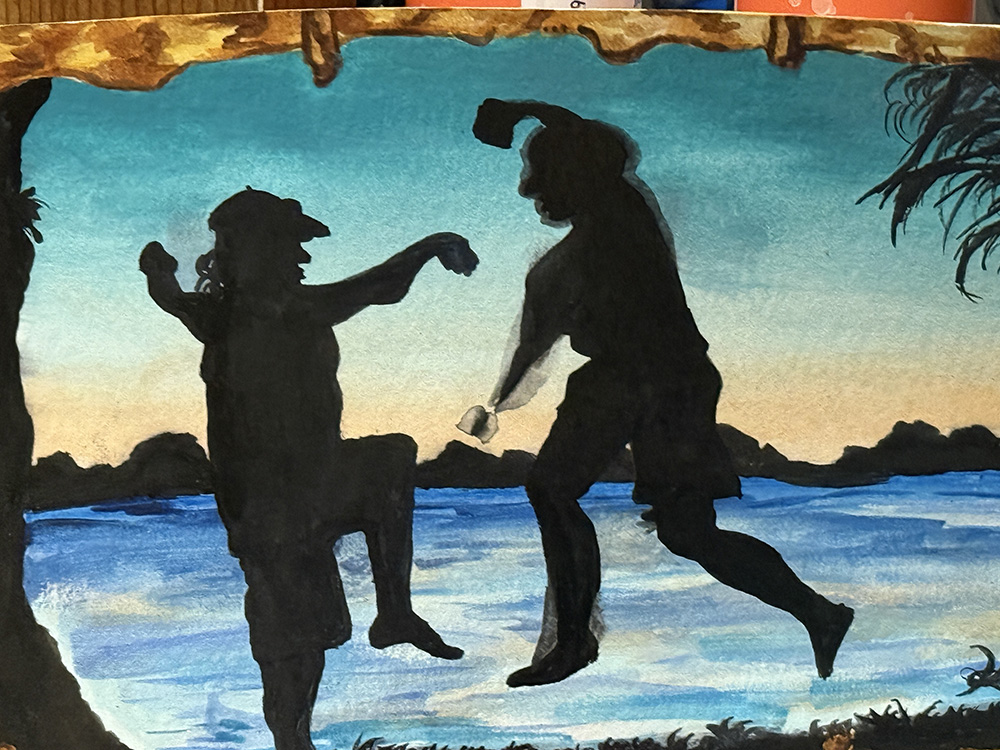
Artist's(?) rendition of two humpback whale mother and calf pairs playing together in Tonga
Artist’s(?) rendition of two humpback whale
mother/ calf pairs playing together in Tonga

Whale Song
I’ll write and post more later, but for now, here is an audio clip extracted from a video file that my friend Serene took of a singer. This is the song I referred to in my update last week.


Humpback Whales in Tonga | Part 1
Humpback Whales in Tonga | Part 2
Humpback Whales in Tonga | Part 3

Humpback Whales in Tonga 2012: Part 3

Wow. What an eventful week it’s been.

We’ve seen humpback whales singing, breaching, and even hooking up with members of the opposite sex. And we’re up to 17 ID-ed humpback whale babies now. Hurray!

Girls Just Wanna Have Fun
Consistent with the trend I highlighted in my previous update, every humpback whale calf that I’ve been able to sex with certainty over the past few days has been female.

Out of five new calf IDs this past week, two are definitely female, two indeterminate, and one possibly male (i.e., I think it’s male, but I didn’t manage to get a proof-positive photo.)

On top of this, there was another calf that Ma’ata managed to photograph a couple of times (but I’m not able to ID yet) that is definitely female. I’m waiting for additional photos from other people who were on that boat, in hopes that I can ID this calf in the near future as well.

In any event, of the 17 calves I’ve assigned IDs to so far this season, six are definitely female. Of the remaining 11, I think three more are possibly female, while one might be male. For the others, I don’t have enough photos to make an assessment.

Ever since I started keeping track of calf sex in 2009, I’ve recorded more females than males. I’m not sure what this means, but day-by-day, calf-by-calf, my belief that there is some significance behind this observation is growing. As interested as I am in the absolute number of newborn humpback whales here each season, this female-to-male sex ratio intrigues me even more.

If there really is a greater proportion of females than males among baby whales, what would cause this, and what purpose would this serve?

Female humpback whale with calf in Tonga
Female humpback calf 201217 with mommy

Love Me Two Times
In addition to the newly ID-ed calves, we had our first re-sighting for the season, female calf 201210 on 30 August. I first photographed this baby on 21 August.

As a photographer, my original purpose in traveling to Tonga was to create beautiful, inspiring images of the humpback whales that visit these waters each year. But being able to enter the water and observe whales directly affords me another opportunity…the chance to glean some insight into the lives of humpback whales.

Over the years, this has become as important to me, if not more so, than taking pictures. By the end of this season, I will have spent nearly 18 months of my life on and in the water here with the whales, probably more than any other person ever has. Over that time, I’ve seen and learned a lot, and each season, I look forward to recording everything I see and experience, then piecing together all the parts of the puzzle to try to figure out what the whales are doing.

Humpback whale calf in Tonga
Humpback whale calf 201210…female, like most of the others so far this season

Calf 201010 and her mom are a perfect example.

After my first encounter with this mother/ calf pair, this is what I recorded:

“Female, calf, escort. Escort laid back. Mom somewhat wary, but not too bad. Calf very inquisitive and friendly, approaching swimmers multiple times.”

After a couple of swims, we left the whales in the care of another boat with some of my friends aboard. Shortly thereafter, the trio started to move, and the escort commenced singing. Four other males appeared, turning the situation into a heat run and making it impossible to keep up with the whales, much less enter the water.

Fast-forward nine days.

On the morning of 30 August, I spotted a trio of whales (mother, calf, escort) moving at high speed just south of the main islands of Vava’u, with another whale giving chase several hundred metres behind. We watched as the trailing whale joined the leading trio, resulting a spectacular display by the escort…grunting, crocodiling, snorting…dispatching the would-be challenger in short order with fluke tucked under his tail.

The three whales bounced around for a while, clearly worked up to some extent by the intrusion, eventually calming down enough that it looked as if we might have a chance to take a peek underwater.

Just as we were getting ready…another male appeared from nowhere. The boys went at it again, sending all the whales off at high speed in random directions, until the escort once again prevailed and sent the newcomer packing.

Once that was settled, the whales did eventually calm down, and we were able to get in and take a good look.

So putting all that together:

  1. Calf 201210 and mom probably stayed in the Vava’u area between 21 to 30 August.
  2. Mommy whale seems to be attractive, given that she merited the attention of at least seven male whales through two encounters.
  3. The calf was highly inquisitive and friendly in both encounters. Mommy was neutral at best in both encounters. In other words, their dispositions/ personalities remained consistent through the two encounters separated by nine days.
  4. Perhaps most interesting…Mommy whale switched allegiances during the 9-day period. The escort that was with her on 30 August was not the same one that was with her on 21 August. I didn’t get a great look at the earlier escort, but the one on 30 August was a monster of a male. He was gigantic, both in length and girth, which may help explain how he got rid of the two challengers so quickly.

Huh…maybe size does matter after all.

Humpback whale calf and mother in Tonga
Second time around with humpback whale calf 201210 and mother

The Song Remains the Same
Those weren’t the only interesting observations though.

Just like the escort on 21 August, the big boy on 30 August started to sing after all the commotion had settled and the three whales stopped to rest: Escort the deepest, mommy above, and calf the most shallow…a typical configuration.

I’ve mentioned in seasons past that the humpbacks here sing in many situations (e.g. with mom/ calf, during heat runs, while swimming, while sitting horizontal, while hanging out with another whale, etc.), not just when they’re hanging head-down in the classic singer pose. This situation (and the singing escort with calf 201210) provided a perfect opportunity for me to share this information first-hand with my friends who are here with me now.

Floating not 15 metres above the whales, we watched as the calf nuzzled mommy, and escort belted out his best rendition of this season’s Megaptera melody.

Humpback whales make lots of sounds, so hearing a humpback vocalise doesn’t guarantee that you’ve heard THE song for the season. I’ve heard humpbacks vocalising for extended periods in a song-like manner, with a tune that wasn’t the actual song. In fact, my friend Dr. John Potter and I recorded a singer doing precisely this a couple of seasons ago, transitioning mid-melody into the actual song for that year.

But…in this case I’m 100% positive the escort was singing THE song, because later that day, we found a lone singer, courtesy of a pair of breaching/ playing whales that led us on a whirlwind tour for a while, then ditched us like yesterday’s news.

Breaching humpback whale in Tonga

We were in an area of horrendous visibility, with overcast skies, and the singer was deep (at least 30m down at the fluke), hanging in the classic head-down pose.

I took it as a personal challenge to find him, and fortunately managed to track him through three breath cycles over the period of 45 minutes or so. That gave me the opportunity to listen to the song over and over again. A couple of friends also recorded the audio on their cameras, so we were able to confirm later that the song was the same as the one the escort with calf 201210 performed.

Out of interest, this year’s song is characterised by a lot of scratchiness. The best I can describe it…is that parts of the tune sound almost as if the notes were being played on a badly out-of-tune squeaky violin.

I may be able to extract audio from my friends’ recordings and post it later. Posting large files is too much of a challenge right now, given limited and sporadic internet access. I can say that I don’t recall ever hearing so much scratchiness though. Also…the big booming bass is back, after not being so prominent in the song last year.

Humpback whale singer in Tonga
Humpback whale singer, Tonga

Waiting For A Girl Like You
We also watched “The Making Of A Calf”, so to speak this week, coming across at least one male/ female pair engaged in courtship.

I say at least one pair because I’m reasonably confident that the breaching whales that led us to the singer I highlighted above were also a courting couple (based on observing their behaviour), but I didn’t have an opportunity to get into the water and confirm by looking under their skirts, so I can’t be 100% certain.

In the case of the second pair, I am completely certain, as I had plenty of opportunity to observe them in clear water. Here’s a quick rundown of how things played out:

  • Drop 1: The whales approached the boat of their own accord, swam slowly by, taking a good look at the boat and us, then kept going.
  • Drop 2: The whale passed by once more. I swam along. When the whales were 15-20m ahead of me, the female did a 180 and turned back toward me, followed by the male. They swam straight for me, turned sideways when they were several metres away, stopped to look, then slowly swam away. The whales proactively checked me out.

Pair of courting humpback whales in Tonga
Pair of humpback whales turning to check me out

  • Drop 3: The whales were traveling at speed. I dropped in, saw them change heading. I altered my course to meet them. As the whales appeared out of the blue haze, the female approached, looked at me, slowly turned sideways while descending to about 15m depth, blocking the male’s path. Then the whales came to a dead stop. They hung in the water, resting, looking at us for at least 15 minutes.
  • Drop 4: The whales proactively approached people in the water…observing, circling, demonstrating what I can only describe as curiosity, perhaps even fascination.

While all this was happening, I was able to confirm visually that there was one male and one female. The inquisitive/ proactive nature of the whales was also consistent with past interactions I’ve had with male/ female pairs.

And finally, I now have a high degree of confidence in being able to confirm visually when a female humpback whale is ready to mate. In every case where I’ve encountered a female whale in a male/ female pair configuration or in a heat run, the female’s genital area has been discoloured and appears swollen/ engorged…as was the case once again in this experience.

Given the existence of outward signs of sexual receptivity in other mammals, I think it’s reasonable to propose that such discolouration + swelling is an indication of a female humpback whale’s readiness to mate. I’ll certainly keep an eye out for this in future encounters, but the first time I noticed this was in 2005, so I’m confident enough to state this publicly now.

We left the whales alone after our 4th drop. As we set off, I joked that I might be the world’s only whale wedding photographer, given that the pair were most likely on their way to consummating their nuptials:

Female and male humpback whale engaged in courtship, Tonga

Shiny Happy People
This week saw a few comings and going.

My friends Jon, Bryn, Jack, Julian, Ildi, Ai Lin and TK wrapped up their stay and headed out. Jon, Bryn and Jack have moved to Ha’apai and will be there for another week. They’ve already had some good encounters, and I hope they’ll have many more during their stay. I’m counting on them to send me some calf photos for the calf count (hint, hint guys!)

Who knows? Maybe one of the babies from here will show up there, or vice versa.

Mounu Island Resort
Ildi, Julian, me, Jack, Bryn, Jon, TK, Ai Lin and Emi

In their place, Serene, May, George, Debbie, Beverley and Karl arrived on Wednesday…just in time for the re-sighting of calf 201210, a crazy breach-fest, and the singers.

How fortunate I am to have such amazing people choose to travel with me. I am by nature a very private person, and I don’t suffer fools (such an understatement), so the fact that I have tremendously enjoyed the company of every single person I’ve had the privilege of sharing these experiences with really says a lot.

May, Serene, Emi, George, Debbie, Beverley, Karl at Mounu Island Resort

Being able to narrate what we see in real time and to recap the significance of our experiences during dinner conversation gives me great pleasure, and also affords me the opportunity to consolidate my own thoughts and conjectures. Thank you all.

Enough sappiness.

Both the weather and the mood of the whales has continued to be generally cooperative, so hopefully the week ahead will bring more exciting encounters and interesting insights into the behaviour of the whales.

Humpback Whales in Tonga | Part 1
Humpback Whales in Tonga | Part 2

Humpback Whales in Tonga 2012: Part 2

The past week has been a good one. The weather has been mostly cooperative, with a predominance of sunshine, only one day that was overcast and drizzly. We photographed and identified three new humpback whale mother/ calf pairs…bringing the total count for the season to 12 pairs. And we photographed a bunch of breaching, including White Pec #7 for the season.

Humpback whale female with calf, Tonga
Motherly love: Humpback whale female with 12th ID-ed calf of the season

Humpback Whale Calf Count
My annual count of humpback whale mother/ calf pairs in the Vava’u area reached 12 this week, with three new babies added to the list.

For comparison, the count last year by this same date was 19 ID-ed calves. 2011 was, however, an extraordinary season, with a bumper crop of 48 ID-ed babies in all, so 12 isn’t bad by any stretch of the imagination.

To put this in context, the ID-ed mother/ calf pair counts by this date in 2008, 2009, and 2010 were 4, 10 and 10.

It’s important to keep in mind that these figures don’t represent an apples-to-apples (or is that whales-to-whales?) comparison. I didn’t start the counts on the same day each season, and I don’t have the same number of boats helping each season.

At the end of each season, when I have all the data, I try to normalise the calf count with a figure I calculate by dividing the total baby tally by the total number of boat days spent at sea looking for them.

Though this is still not a perfect measure, it is perhaps a better standard by which to compare each season. I obviously won’t have this figure until after this season is wrapped up, but for reference, the figures were 0.44, 0.27 and 0.59 in 2009, 2010 and 2011, respectively.

These ratios give a much better indication of frequency (or rarity) of encounters with mother/ calf pairs.

One other interesting observation during the week…all three baby whales ID-ed this week were females.

female humpback whale calf with close-up showing developing mammary glands
Calf #12 (female) playing at the surface,
with close-up showing developing mammary glands.

The apparent abundance of female calves is consistent with my observations from past seasons, with the female-to-male ratio among calves being 1.56, 1.75, 1.30 in 2009, 2010 and 2011, respectively, i.e., more female than male babies each season. Of course, since I can’t determine the sex of every calf, these figures are just indicative

As I’ve mentioned in the past, the apparent prevalence of female over male babies could be due to any number of factors: There could actually be more female calves than male babies; it’s possible that mother/ calf pairs with females tend to be more accommodating toward interactions with people; or…it could just be sheer coincidence. Who knows?

If this year’s calf count once again follows this trend though, my confidence in this tendency will certainly increase.

For more background on my annual calf count + observations and speculations, see my humpback whale calf count PDF file from last year.

White Pec #7
Yesterday, we saw our 7th white pec for this season!

It was one of several whales breaching, slapping and generally having a good time southeast of the Fatumanga area. Having to choose among whales is a good predicament to have, but we stuck with a particular pair because they seemed to enjoy showing off (approaching the boat and breaching all around us), and also because of the white pec. I really wanted to get a good photo of this particular whale, which fortunately was the one that seemed to breach the most.

As I mentioned in my first update, there seems to be a concentration of whales with all-white pectoral fins this season. All-white pecs are relatively more common in the northern hemisphere than among the humpback whales in the south, so it’s pretty easy to pick them out from the crowd, so to speak.

Once again, this is just continued speculation on my part, but the fact that there appears to be a cluster of this obvious phenotypical trait this season suggests to me that there could be an underlying genetic closeness among a subset of the whales in the Vava’u area right now. In other words, I’m wondering whether some of the whales here might be closely related to one another, given the appearance of this trait among so many whales.

The last time this trait appeared with such a relatively high frequency was 2006. And in other seasons, other obvious physical traits (ones different from all-white pec fins) have appeared in similar clusters.

I’ve read some papers suggesting that humpback whales do not travel in related groups as many toothed whales are known to do. But this then begs the question – Why would a concentration of whales with all-white pectoral fins show up in 2006 and 2012, but not in intervening or preceding seasons?

humpback whale with all-white pectoral fins
7th humpback whale of the season with all-white pectoral fins

Behaviour
A couple of seasons ago in 2010, I characterised the “mood” of the whales that year as “unsettled”. Most of the experienced people I spoke with here at the time concurred that the whales seemed somewhat on edge, relatively difficult to approach. Last year was different, with lots of whales around, and “normal” interactions, if I had to pick one adjective.

It’s still early in my stay here for the 2012 season, but to date, it seems like the whales are behaving in the “normal” to “friendly” range. We did have a few mother/ calf pairs yesterday that were not particularly cooperative, but that is the case every season. We just leave those alone.

Most of our interactions so far have been with extremely accepting whales.

Of interest to me, this overall “mood” (for lack of a better word) is consistent with my experience in 2006, the last time there were a number of whales with all-white pectoral fins around.

Once again, this could be pure coincidence, but it’s another data point in my ongoing observation of humpback whale behaviour in this area. Something else to ponder.

Humpback whale calf, Tonga
Calf #9 of the 2012 season, a friendly little girl

Humpback Whales in Tonga | Part 1

Humpback Whales in Tonga 2012: Part 1

My first update from Tonga for this season is going to be short. I’ve only gone out on the water for one day, but it was an eventful one.

I arrived at Mounu Island Resort on 16 August, settled in, set up and tested my gear on the 17th, and went out to sea yesterday with my friends Douglas Seifert, Howard and Michele Hall, and Jerry Allen.

Tony Wu, Jerry Allen, Douglas Seifert, Howard and Michele Hall.
Me with Jerry, Douglas, Michele and Howard

The weather was so-so, mostly overcast with drizzles every now and then, but we were fortunate enough to come across a group of five humpback whales within short order. They weren’t in any particular hurry, but the whales also weren’t overly friendly, so we only saw them a few times underwater.

The whales passed mostly at depth, but I managed to get all five in a single frame…not bad for one of the first photos I’ve taken with my new Canon 5D Mark III camera and Zillion housing.

Group of five humpback whales in Tonga
Five humpback whales traveling together

Of particular note, there seems to be an abundance of whales with all-white pectoral fins this season (like the left-most whale in the above photo). The last time I recall seeing a large number of humpback whales with this trait visiting Vava’u was in 2006. In most seasons, I’ve seen very few, if any at all.

Most people probably wouldn’t get excited by something like this, but I’ve been tracking unique physical traits among the humpback whales that visit this part of Tonga for some time now, and the reappearance of a significant number of whales with white pectoral fins could be important.

In many seasons, there seems to be some obvious physical trait that a critical number of whales share. White pectoral fins is one example. All-black bodies, as well as split dorsal fins, are two more I’ve been on the lookout for.

I have a hunch that these shared outward physical traits are signs of genetic proximity. In other words, if a number of whales share a common physical trait, they might be relatively closely related…and they may coordinate their movements to some degree.

It’s tough to prove this without collecting DNA, but the fact that certain traits appear in greater-than-average quantities in certain years (but not in most years) is certainly suggestive of some sort of link.

I’ve rambled about this in updates in previous years, so on the off chance you’re interested in reading more, take a look in my blog archives for posts during August and September from past seasons.

So far this season, Ma’ata, who works at Mounu Island Resort, has photographed two mother/ calf pairs with all-white pectoral fins. The one in the photo above makes five individuals with this trait. And as if to hammer the point home, the next whale I photographed a few hours later was also one with white pectoral fins.

Humpback whale in Tonga with white pectoral fins
This is the sixth humpback whale with white pectoral fins this season.

So that makes six whales with all-white pectoral fins this season, and we’re just getting started! It’ll be interesting to see if we come across more as time goes on. In fact, it’ll be interesting even if we don’t see any more.

Speaking of mother/ calf pairs, Ma’ata has been photographing calves to contribute to my annual mother/ calf count, and we went through her photos this morning. So far, I can ID eight mother/ calf pairs from her photos…which is totally awesome.

By this time last year, we had 11 calves identified, so we’re not far behind. And I haven’t even spent any appreciable time in the water yet!

This season, I arrived in Tonga a couple weeks later than I normally do (I was in Alaska playing with northern humpbacks), so I was worried about falling behind in the count. Thanks to Ma’ata’s efforts though, the calf count is on schedule.

Request for help…If you are visiting Tonga this season, and you photograph any mother/ calf pairs, please save the photos for me, and please make a note of the date and location. I will compile all the data I receive into a file and publish the file for everyone to share, as I’ve done in previous years. Photos that are of most use are ones that clearly show physical traits of the mother and/ or calf…side-on views of the adult to see the body patterns; photos that show the shape of the dorsal fins; clear shots of flukes; photos of the underside of calves…to help determine the sex of each calf.

Our count for the 2011 humpback whale season in Vava’u was 48 humpback whale mother/ calf pairs…a record number that blew away all expectations! (and also made for a heckuva lot of work after I got home).

To wrap up, here is a photo of the whale that was accompanying the one with the white pectoral fins above. The pair were nice enough to slow down and stop for a break, giving us an opportunity to spend some quality time with them.

Resting humpback whale

My friend Jon Cornforth will be arriving tomorrow, for the continuation of our Megaptera Mania! dual-hemisphere humpback whale trip. The weather forecast looks good, so I can’t wait to take my friends out to look for more whales.

Minke Magic

The Great Barrier Reef, Australia. Clear blue water; sunshine above; sandy bottom below. Schools of fish down deep, meandering about patches of dark, amorphous stuff, seaweed perhaps, flowing with the current and swaying with rhythm of a slight swell.

Me…floating in 25ºC/ 75ºF water…decked out with 13mm of neoprene to stay toasty-warm, secured to a rope trailing from the back of our liveaboard vessel, along with nine other similarly tethered friends…all of us wriggling on the line like so much live bait.

We were fishing for dwarf minke whales (Balaenoptera acutorostrata).

Dwarf minke whale (Balaenoptera acutorostrata) Great Barrier Reef
Dwarf minke whale (Balaenoptera acutorostrata) making a close pass,
close enough to fill the frame!

“What exactly is a dwarf minke whale?” you might be wondering. Well, that’s actually a really good question, because…surprise, surprise…we aren’t really sure.

Allow me to explain.

Until relatively recently, we (meaning collectively, as in “humanity”) recognised only a single species of minke whale. But…as is often the case, we were wrong.

Upon realising our mistake, we eventually agreed to certify two species of minkes: Balaenoptera acutorostrata, which are known only from the northern hemisphere; and Balaenoptera bonaerensis, which are the Antarctic minke whales found only in the southern hemisphere.

Morphological differences between the two types of minke whales (plus the fact that one species lives exclusively up north while the other resides Down Under) make it relatively easy to tell them apart.

So with this binary classification, minke science was once again settled…until the mid-1980s that is, when some intrepid researchers noticed that most minke whales visiting the northern Great Barrier Reef were about two metres give-or-take shorter than Antarctic minkes. And they look somewhat different to boot.

Hmmmm.

The story is, of course, much more involved than my over-simplified narrative here, but in short, there seems to be a third type of minke…now colloquially known as the dwarf minke whale.

To date, there has been no scientific name assigned to dwarf minkes, but studies of the genetics and outward appearance of these animals suggest that they are more closely related to the northern minkes than to the Antarctic variety, which is why the Linnaean name Balaenoptera acutorostrata is often used to refer to the dwarf minkes, even though they are distinct from northern-hemisphere minkes, and they live down south, not up north, where their binomial namesakes reside.

Clear?

Don’t worry if it’s not. There is still a lot we don’t know about these whales, so the situation is somewhat muddled.

But if you’d like to learn more about these animals, I suggest taking a look at the Minke Whale Project site, which is probably the best source of information available about dwarf minkes.

female dwarf minke whale (Balaenoptera acutorostrata)
A friendly female dwarf minke whale (Balaenoptera acutorostrata)

Fishing for Minkes
I am accustomed to swimming, sometimes for quite a long time and distance, when I photograph cetaceans. Open ocean animals, after all, tend to move a lot.

It’s different with dwarf minke whales though. They come to you (under the right circumstances, of course).

Yup. That’s right. You hang onto a rope tied to the back of the boat, and the whales saunter over for a gander whenever the mood strikes them. It’s literally like fishing for minkes with human bait!

OK, I know. I was a total sceptic before this trip. Researchers, regulators and the marine tourism industry have cooperated to develop and implement a Code of Practice, which sets out the procedures, rules and standards of behaviour for permit holders to interact with the minkes and collect data for research. Most of the provisions are common sense, but the one that ran counter to my experience with other cetaceans is the “hang onto a rope and let the whales come to you” part.

I’ve known about this population of whales for many years, but I always figured that clinging to a rope and waiting for a random whale to pass by wasn’t really my thing.

I was wrong.

What I observed during my visit is that dwarf minkes can be really, really(!!!) inquisitive. They make frequent eye contact, and seem at times to “test” people on the line…almost to the point of being cheeky.

There was, for instance, one particular whale among a group of five that hung around our boat for hours. The whale in question often seemed to approach from a direction where no one was looking. It would “sneak up” from behind, then accelerate to zzzzzip past…precipitating a frantic (but inevitably fruitless) scramble among those of us on the line for a decent camera angle.

I could almost hear the cetacean snicker as it cruised into the blue, leaving a string of bobbing, bewildered bozos in its wake.

Dwarf minke whale (Balaenoptera acutorostrata) in the Great Barrier Reef
Head-on view of a dwarf minke whale (Balaenoptera acutorostrata)
visiting Lighthouse Bommie in the Great Barrier Reef

The first time, it seemed like a coincidence. The second as well. Then there was a third, a fourth…

Determined not to let a dwarf minke get the better of me, I prepped for counter-attack. (I know, this is not a normal thing to think/ write/ admit.)

Glancing out of the corner of my mask, I spied the sneaky cetacean lining up for another surprise appearance. Pretending not to notice, I waited, and waited, and waited…until it was just about in camera range. Then I turned to look straight at the oncoming whale.

Its reaction? A startled, almost befuddled look, accompanied by a rapid change of trajectory, fluke tucked between its legs (metaphorically, of course). Score one for H. sapiens!

We played our inter-species game for hours. Sometimes I won; most times though, the whale did.

Another experience worth mentioning…at one point, I heard several low rumbling sounds and felt the reverberation in my body. I thought the vibration might be from the boat, but when I felt it a second time, I looked down and saw a group of three whales materialise out of the blue.

In other words, I heard/ felt the minkes approaching before I saw them.

No one else seems to have noticed the low-pitched sounds, but that may just be due to the fact that I’m accustomed to listening for cetaceans when I’m in the water.

Later, on the boat, I learned that minke whales are known to produce a range of sounds, the most distinctive of which is a sound referred to as the “Star Wars sound”, for reasons that become obvious once you hear it. Listen to this recording (Source: Australian Government Department of the Environment and Water Resources) and you’ll understand:


Pretty cool, eh?

Some Science
Among the requirements for engaging in encounters with dwarf minkes on the Great Barrier Reef is having researchers on board. We had two people with us: Matt and Susie Curnock, a young couple who both did their PhD work on minkes at James Cook University in Cairns.

First off, Matt and Susie are totally cool and fun. I can’t overstate the importance of this, as they were a perfect fit for my motley crew of fellow travellers (Matt, Susie: That’s actually a compliment).

minke whale researchers Matt Curnock and Susie Sobtzick
Matt and Susie…our friendly neighborhood minke whale experts

Second, they know a lot. And they were kind and patient enough to share their knowledge via talks in the evening and by answering the many questions we asked.

Perhaps the one thing that left the strongest impression on me is their effort to ID the minke whales that visit the northern Great Barrier Reef each season. They do this by taking photos and video, as well as by asking for photo/ video contributions from tourists.

Yes. Tourists.

Eager visitors come equipped with lots of cameras, money and enthusiasm, which can all be harnessed to help with data collection.

By tapping into these resources, instead of working at odds with the tourism industry (as is unfortunately often the case elsewhere), Susie, Matt and their colleagues have been able to identify hundreds of individual whales, as well as track their movements in a given year, and also across multiple seasons. Moreover, tourists have a chance to get up-to-date information directly from experts…a clear win-win situation if there ever was one.

The bulk of the existing ID and tracking analysis has been done for the 2006 to 2008 period, which is when Susie was working on her PhD, and when there was sufficient funding for the time and labour required to go through mountains of image and video data.

They are still collecting data, but unfortunately, there isn’t enough funding right now to process the information in a systematic manner.

It was great to learn about their efforts, as the concept of using photographs to ID individual whales by body patterns strikes close to home, given my own efforts to count humpback whale mother/ calf pairs in Tonga.

At the end of our trip, many of us provided copies of our images to Susie, which led to two immediate IDs of whales they’ve encountered before. Hurray!

The first was Crescent, a female that was seen 4x in 2006, 3x in 2007, and 3x in 2008.

It’s possible she was also back during 2009-2011, but as I mentioned above, lack of funding has meant that much of the data collected during that period hasn’t been reviewed. The second whale (sex indeterminate) was previously seen in 2007, 2008 and 2009. Exciting stuff.

Here is a screenshot from Susie’s computer showing the markings on Crescent’s right pectoral fin:

Resighting of a female dwarf minke whale named Crescent

The ID efforts and resulting population research related to the dwarf minke whales that visit the northern Great Barrier Reef are a terrific example of multiple parties from academia, government and the general public working together toward a constructive objective.

Some Science?
Now…just so you don’t get the (mis)impression that I (or anyone else) took Matt seriously, here he is doing his Crocodile Dundee thing during our hike to Cook’s Lookout at the top of Lizard Island:

Matt Curnock eating green ants at Lizard Island, Australia

For what it’s worth, the ants really did taste like lemon, though it’d certainly take a lot of ant abdomens to make a decent meal.

There’s not much I can say about Matt’s acting talents(?), except perhaps to offer a pearl of wisdom that I got from Mr. Dundee Wannabe himself: “You can’t polish a turd, but you can coat it in glitter.”

Deep, Matt. Very deep.

Wrap-up and General Silliness
Heading out to sea always entails some risk of encountering bad weather. We were fortunate enough to have several days of beautiful conditions, with many hours of minke whale encounters each day. Strong winds hit during latter part of our trip though, which meant we had to take shelter.

We ended up at Lizard Island, where, among other activities, we ate a lot (in one case…10 large cannelloni rolls + associated helper food in a single sitting for me); hiked up to Cook’s Lookout (where Captain Cook is said to have climbed in order to scout for safe passage out of the inner waters of the Great Barrier Reef; snorkelled (actually, I stayed warm and dry while more foolish hearty souls got into the water); trekked to Blue Lagoon on the opposite side of the island (where we found a mysterious shrine constructed out of flotsam); and engaged in an anthropological study of Aussie culture (drank beer and watched the 2012 State of Origin rugby match at a bar).

In other words…we made the best of the circumstances and had loads of fun.

Key to the merriment were Captain Mark and his lovely partner Emily (MV Reef Connections). They took great care of us, (over)fed us, and made sure we had lots to do even when the weather wasn’t conducive to bobbing for Balaenoptera.

If you’re interested in learning more about dwarf minke whales, visit the Minke Whale Project site. If you have a group of friends and want to consider chartering a vessel, get in touch with John and Linda Rumney at Eye to Eye Marine Encounters. Or, if you’d rather join a pre-arranged commercial trip, Mike Ball runs regularly scheduled itineraries during the minke season.

[Correction (18 July): John and Linda Rumney organise scheduled itineraries as well as chartered trips.]

I may head back again in the future, so if you’re silly enough to contemplate spending time with me interested, email me to let me know.

Finally, to wrap up…following are some snapshots to give you an idea of what happens when a dozen+ idle minds converge. It’s a good thing I was around to provide adult supervision.

Vania Kam at Lizard Island
Vania “working”

Phil Sokol at Lizard Island
Phil giving Conquistadors a bad name

Julian Cohen at Lizard Island
Julian conveying his affection for me

Mating grasshoppers at Lizard Island, Australia
Mommy, what are the grasshoppers doing?

Julia Sumerling at Lizard Island
Julia sharing her thoughts

Patrik Nilsson at Lizard Island
Patrik being a tourist, taking photos of the flotsam shrine we found

Flotsam totem pole at Lizard Island

Patrik Nilsson in the distance
Patrik searching frantically for his shorts (don’t ask)

Stephane Bailliez at Lizard Island
Stephane pretending not to notice the camera pointed at his face

Emily Jane Griffen at Lizard Island
Emily whipping up more amazing food

Phil Sokol being silly
Phil…being Phil. Sigh.

Yvonne Pang at Lizard Island
Yvonne chowing down (See? I wasn’t the only one!)

Jenny Huang at Lizard Island
Jenny smiling because she enjoys my company so much

Matt Curnock at Lizard Island
Matt demonstrating why Susie doesn’t let him out much

Mark Gladwin at Lizard Island
Mark giving Elmer Fudd a run for his money

Mark Gladwin using an iPad
Mark demonstrating that it’s true. Anyone can use an iPad.

Vania Kam with underwater housing
Vania demonstrating the time-proven “lens cap in dome” photographic technique

Sunset at Lizard Island
Beautiful sunset at Lizard Island

Oh yeah…almost forgot. Here’s a video of the trip troublemakers putting their heads together to work on an important project just before we returned to Cairns:

Dead Humpback Whale Calf

Early on 2 January, a baby humpback whale washed up on the beach in Odawara, which is about 60km south of where I am in Japan.

Dead humpback whale calf on the beach in Odawara, Japan

Yesterday, I travelled to the site to meet friends from the scientific community, who were planning to perform an autopsy to try to ascertain the cause of death. As it turned out, the local authorities didn’t have the proper equipment available to handle the whale, so the autopsy had to be postponed for a few days.

Fortunately, it’s the middle of winter here, so the carcass will keep to some extent, but the laws of nature dictate that additional deterioration will occur by the time dissection takes place.

Also, the cetacean pathologists will be at a meeting outside of Japan by then, so unfortunately, the cause of death will probably never be known.

Researchers measuring deceased humpback whale calf

To the best of my knowledge, the animal was dead when it washed ashore.

Some patches of skin were missing, which is to be expected given the situation. There were some minor abrasions here and there as well, but nothing to suggest that injuries were the reason for the little humpback’s death.

All that we were really able to ascertain is that the baby was male, measuring 6.87m in length. It probably weighed one to one-and-a-half tonnes or so, though we didn’t have the equipment to confirm that.

Penis of dead humpback whale calf

Baleen of dead humpback whale calf

My friends told me that the whale was the smallest humpback ever to have been recorded in a beaching/ stranding in Japan. Most babies that have washed ashore here have been in the eight- to nine-metre range. This is the third such beaching of the 2011-2012 breeding/ calving season in these waters.

[Amendment: I misunderstood what my friends told me about the size of the calf. I've received the full list of recorded humpback whale calf strandings in Japan, and it is clear that this beached calf is the smallest to be recorded during the winter season. The other records for this time of year reflect body lengths of between eight and ten metres, which implies that they were older, perhaps yearlings. The actual smallest dead humpback whale calf record in Japan is 6.11m in Ibaraki prefecture, found on 24 June 2002. The second smallest is 6.60m in Oita prefecture, found on 19 May 2004. So this one becomes the third smallest on record, but the smallest during this time of year.]

I’ve literally seen hundreds of baby humpback whales, but this is the first dead one I’ve come across.

The size of the calf suggested to me that it was quite young, perhaps a couple/ few months at most. It appeared to be about the same size as the larger calves in Tonga attain by early September each season, which is about two to three months into the breeding/ calving season there.

Researchers with dead humpback whale calf
Researchers hard at work collecting data

I arrived on location quite early, around 07:15, so there weren’t many people around and the light was still subdued. There was a brisk, bone-chilling breeze coming in from the sea. It took a few moments to collect myself when I saw the carcass.

Death, I suppose, is never a pleasant subject, but I’ve rarely had problems dealing with reality. In this instance however, I got a little choked up. I’m not ashamed to admit that I feel a particularly strong emotional bond with humpbacks, given the hundreds, perhaps thousands, of hours of my life I’ve devoted to them.

With light levels changing rapidly and the prospect of spectators showing up, I had to work quickly though, so I whipped out my cameras and commenced photographing. As soon as I started concentrating on handling problems like balancing white-out from harsh backlighting against the all-black of the whale’s body, the immediate shock of confronting the dead whale wore off.

Single hair follicle protruding from tubercle of dead humpback whale calf
Single hair follicle protruding from tubercle

The most interesting part of the experience for me was seeing a hair follicle protruding from one of the tubercles on the humpback’s rostrum. I knew in concept, of course, that each of these tubercles has a single hair inside, but it’s normally not possible to observe tubercles so closely.

When the researchers pointed the hair out to me, I think I let out what can only be termed a shriek of excitement.

I flopped belly-down on the rocks and got soaked by the incoming surf a couple of times while looking at and photographing the hair, but the cold seawater drenching was worth it.

That single hair was confirmation that what lay before me was a mammal, evolutionary kin in a way, though we look almost nothing alike and lead such different lives.

It’s tempting to wonder, even speculate, about what led to this animal’s death, but in reality, there’s just no way to be certain. Even with an immediate autopsy, the ability to ascertain the cause of death wouldn’t be assured.

All we can do is measure, record, learn what we can…and hope that there aren’t too many more.

Researcher examining dead humpback whale calf in Japan
Researcher examining the humpback whale calf

48 Baby Humpback Whales!

48! That’s right…four dozen!!!

That’s the record-breaking number of humpback whale babies that I’ve ID-ed and catalogued since getting back from Tonga several weeks ago.

To put that into some context…that’s 2x the number of babies we counted in 2010.

Moreover, our previous record was 31 mother/ calf pairs (in 2009), meaning that we blew past the high tally two seasons ago by 17! Or to look at it another way, this year’s count trounced the previous high by a factor of more than 1.5x!

In case it’s not entirely obvious, I’m really excited. Like, giddy-little-kid-who-scarfed-down-too-much-halloween-candy excited.

First, because having so many baby whales is obviously terrific news for the ongoing recovery of the southern hemisphere humpback whale population. And second, because it’s vindication.

Back in the day, when I first started visiting Vava’u, the generally accepted wisdom was that there were perhaps a half dozen babies, maybe a few more, that were seen in the area each season. Within short order, I started to believe that there were more. Many more.

In fact, back in 2004, I went out on the proverbial limb (where I have tendency to find myself) and said there might be 40 or more babies in a season.

It’s taken a number of years, but this season’s calf count finally proves that 40 to 50 baby humpback whales in the Vava’u area is not only do-able, but is almost certainly an underestimate in some seasons.

Although I’ve photo-identified 48 mother/ calf pairs, there were many more whales that I either didn’t see, or did see but wasn’t able to ID. In fact, I have a number of photos of mother/ calf pairs that I think are additional ones. The thing is…I can’t be 100% sure, so I haven’t included them. Bummer, but all-in-all, it’s better to be conservative than to incorporate questionable data.

Summary of humpback whale calf sightings in Tonga during the 2011 season

One thing that I want to make clear…even though I’ve put in the time to organise, sort through and compile the data, there are actually a lot of people involved in this effort.

To name but a few: The many people who joined me in Tonga (62 people this season, hundreds more in the past!), who in effect, funded the time to undertake this project; Friends who’ve contributed photos and IDs this season, like Shawn, Douglas, Allan and Ma’ata; Friends like Mark and Karen, who sent me valuable information to help piece together theories about false killer whale attacks and escort relationships; The boat captains and crews (Endangered Encounters, Whale Watch Vava’u), whose dedication to keeping us safe and happy was invaluable; and Takaji and Emiko, who’ve been working with me on this project since we started.

In other words, this project is a group effort, involving dozens of people from all around the world. Thank you very much!!!

Given the high number of whales, the full summary is big. It’s a 64-page PDF file and about 196MB. To make this information as accessible as possible, I’ve prepared two different files available for download. The first is the 15-page summary, which is an overview of the key points but does not contain any of the photo-ID sheets. It is a 3.4MB file.

The second is the full 64-page document, which contains the 15-page summary plus photo-ID sheets for every ID-ed calf. It is 196MB.

Right click on the relevant link below to download the files.

Humpback Whale Calf Encounters in Tonga 2011 – Summary Only (v1, 31 October 2011)
Humpback Whale Calf Encounters in Tonga 2011 – Full File (v1, 31 October 2011)
Humpback Whale Calf Encounters in Tonga 2011 – Full File (v2, 01 November 2011, updated 201142 Faua to show split dorsal fin. Thanks to Robert Pierce for pointing out the split fin!)

In addition, I’ve uploaded all the location data for our calf sightings to two Google Maps. The first is this one, which shows the locations of all of our encounters with humpback whale mother/ calf pairs that I was able to ID:


View 2011 Humpback Whale Calf IDs Tonga in a larger map

The flags represent GPS data; the blue dots are hand-marked locations. I encourage you to click through to the full map, as there are notes for each of the encounters, and it’s much easier to view the information on the full map.

The second is a map that shows the locations of mother/ calf pairs that we encountered, but were unable to establish IDs for. The red pins are mother/ calf pairs I wasn’t able to ID; the green pins are mother/ calf pairs initially marked as unknowns, but later assigned IDs after reviewing photographs. Again, if you click through to the full map, there are notes for each of the sightings.


View 2011 Unidentified Humpback Whale Calf IDs Tonga in a larger map

Finally, in case you have a bad connection and can’t download either file, I’m appending the text of the summary to the end of this post. I can’t, however, include the four summary tables, which set out all the encounters and timelines. The only way to view those is to download one of the two files.

One request: If you have photographs and sighting information for humpback whale mother/ calf pairs from this season that are not in my summary file, please let me know. It would be just so awesome to cross the 50-calf mark!

I will post updated versions of my calf count file as and when additional data comes in.

Here’s the introductory text of my humpback calf count summary for the 2011 season in Vava’u, Kingdom of Tonga:

Introduction
This document is a summary of humpback whale calf encounters in and around the Vava’u island group in the Kingdom of Tonga during the months of August to October 2011.

During our stay this year (05 August to 01 October), we identified 45 humpback whale mother/ calf pairs over the course of 73 in-water encounters, with three additional IDs contributed by friends, for a total of 48 humpback whale mother/ calf pairs.

We initially recorded 33 sightings of calfs that we were unable to identify at the time of encounter. We were later able to assign IDs to two of those 33 in the process of preparing this summary, lowering the total unknown calf sightings to 31.

This is the highest number of mother/ calf pairs we have identified and tabulated since commencing this annual calf count project in 2008.

This season was notable in other respects as well:

  • There were reliable reports of whales arriving in the Vava’u area by mid-June, with calf sightings reported before the end of June. This is several weeks earlier than the timing in a hypothetical average season, and contrasts with the relatively late arrival of the whales in 2010. The whales did not, however, seem to leave the area any earlier than normal.
  • Overall whale behaviour/ disposition was “neutral”, meaning significantly less standoffish than in 2010, but not as approachable as in “friendly” seasons like 2009.
  • We documented three returning mothers. The mother of 201132 Toluua was also the mother of 200913 Luna, easily recognisable by her unique dorsal fin. Of note, her relaxed disposition was the same as it was two years ago, and both juveniles were friendly and inquisitive. The mother of 201107 Fitu was the same as the mother of 200920 Mama’s Boy. And the mother of 201115 Tahanima was the same as the mother of 200814 Jet.
  • We documented three mother/ calf pairs travelling between Vava’u and Toku Island, about 40km away. Travel among islands is not unusual, but it is the first time we have documented this taking place with photographs and GPS data.
  • For the first time, we recorded data pertaining to escort relationships with mother/ calf pairs. Over half of all mother/ calf pair encounters involved at least one escort, which seems to be a relatively high ratio viz. other humpback whale breeding and calving grounds.
  • We documented two long-term associations between an escort and mother/ calf pair: At least 14 days for 201114 Tahafa and at least 18 days for 201142 Faua. This is the first time we have observed/ noticed this. Such long-term associations seem to be unusual, or perhaps not well documented.
  • Of interest, in both cases of long-term escort association, the mother/ calf pairs undertook the 40km journey between Vava’u and Toku while in the company of their respective long-term escorts.
  • We also documented three occasions when escorts with mother/ calf pairs were singing, or vocalising in a song-like manner: 201114 Tahafa, 201121 Uataha and 201130 Tolunoa. We have come across this behaviour on multiple occasions in previous seasons as well.
  • There were two juveniles with all-white pectoral fins, the first we’ve seen in the Vava’u area. They were 201127 Uafitu and 201142 Faua.
  • We documented several juvenile whales with injuries that suggest coordinated attack by a pod of marine mammals, possibly false killer whales (Pseudorca crassidens).

Overall, there was an abundance of whales this season, a lot of interesting social interaction, and many opportunities to observe and record humpback whale behaviour. This document focuses upon the mother/ calf pairs and associated whales. For additional background information, please refer to the following blog posts:

Swimming with Humpback Whales in Tonga | 2011 Season Part 1

Swimming with Humpback Whales in Tonga | 2011 Season Part 2

Swimming with Humpback Whales in Tonga | 2011 Season Part 3

Swimming with Humpback Whales in Tonga | 2011 Season Part 4

Swimming with Humpback Whales in Tonga | 2011 Season Part 5

Swimming with Humpback Whales in Tonga | 2011 Season Part 6

Swimming with Humpback Whales in Tonga | 2011 Season Part 7
Swimming with Humpback Whales in Tonga | 2011 Season Part 8

All of this work has been and is being done on our own time, with our own resources. We are not receiving financial or other assistance, and we are not affiliated with any person or organisation involved with cetaceans.

If you have photographs of humpback whale mother/ calf pairs from the 2011 season in Vava’u that are not included in this file, or additional information about whales already included in this document, please contact Tony Wu.

Reference documents:
2008 Calf Summary, 2009 Calf Summary, 2010 Calf Summary

Methodology

  1. Our basic methodology has remained unchanged since commencing this calf count project, with our core ID team comprising Tony Wu, Takaji Ochi, and Emiko Miyazaki.
  2. We recorded GPS locations for all sightings of humpback whale calfs upon initial visual and/ or radio confirmation. We used Garmin GPS 60 and GPS 72H handheld units for marking GPS locations and converted to Google KML format using HoudahGPS. When GPS units were not available, we marked locations by hand on a map.
  3. Where possible, we entered the water to photograph mother/ calf pairs and other associated whales if any.
  4. We made notes of behaviour, easily recognisable physical traits, and any other noteworthy circumstances.
  5. For the first time, we have recorded the number of escorts with each mother/ calf pair sighting, for the purpose of tracking escort activity from this season onward.
  6. When we were able to take photographs of sufficient quality and quantity to establish an ID, we named and assigned a numerical ID to the relevant calf.
  7. In those cases where we were unable to get sufficient photographs to establish ID, we did not name the calfs. We recorded the sightings as unknowns and cross-checked any photos of such juveniles with subsequent ID-ed whales to look for possible matches.
  8. We have uploaded all the GPS and hand-marked location data to Google Maps, where the locations of all ID-ed calfs and unidentified calfs are available for viewing. GPS locations are also embedded as hyperlinks throughout this document when there is text that refers to date and location of sightings. Clicking the hyperlinks will take you to Google Maps to view the relevant location.
  9. The photographs contained in this document represent a small portion of the images we collected. For most ID-ed calfs, we have many more images for verification purposes.

Observations

  1. Figure 1 below illustrates our cumulative calf counts over the past four seasons (incorporating all ID-ed juvenile whales each season, including those contributed by third parties). While we recognise that there are inherent differences in each season (different periods of stay, varying number of boat days, weather variations, etc.), the slope of the line representing cumulative calf count has appeared relatively similar across previous seasons. With the addition of data for 2011 however, a divergence in the slopes of the curves for 2009 and 2011 from those for 2008 and 2010 is apparent. This makes intuitive sense against the backdrop of the number of calf encounters, overall whale mood and other conditions in each season.
  2. Cumulative count of humpback whale calf IDs in Tonga
    Cumulative count of humpback whale calf IDs in Tonga

  3. During our stay this season, we had 73 encounters with 45 mother/ calf pairs that we identified over 76 boat-days on the water (compared with 22 calf IDs over 81 boat days in 2010; 26 calf IDs over 59 boat days in 2009; 16 calf IDs over 67 boat days in 2008; 14 calf IDs over 53 boat days in 2007). This worked out to 0.59 Calf/ Boat-day, with a boat-day being defined as a single day of approximately six hours on the water on a boat looking for whales. These figures do not include calf IDs contributed by other people.
  4. Graph of humpback whale calf IDs per boat day in Tonga
    Humpback whale calf IDs per boat day in Tonga

  5. As is apparent from Figure 2, this season was exceptional, with the Calf/ Boat-day ratio significantly exceeding the levels recorded in each of the previous seasons. In our 2010 summary, we posited that a Calf/ Boat-day ratio of 0.25 might represent the norm, with 2009 being an outlier. With this season’s ratio of 0.59 however, the question of whether there is a normal level or not becomes more intriguing.
  6. It is certainly possible that our experience in 2011 is exceptional, and that we will not see a similarly high number and density of humpback whale mother/ calf pairs in the Vava’u area in the future. However, given the 0.44 ratio recorded in 2009, and our personal recollections of similarly high numbers and frequency of mother/ calf pair encounters in 2004 and 2005, it seems possible that there is no “norm”, and that the Calf/ Boat-day figure may vary unpredictably within a relatively broad band.
  7. What this underscores is that extrapolating from limited observation in any single season to draw conclusions about the dynamics of the southern hemisphere humpback whale population is inadvisable. Only long-term observation and consistent recording of data may eventually reveal underlying patterns and trends.
  8. In addition to the calf IDs we established, we received three more mother/ calf pair IDs from friends (201115 Tahanima from Shawn; 201143 Fatolu from Douglas, 201148 Favalu from Allan/ Ma’ata), bringing the total ID-ed calf count to 48.
  9. In 2009, we commenced recording sightings of unknown mother/ calf pairs (those whales which we are unable to ID at the time), by marking GPS location, taking notes about behaviour, and taking photos when possible, for the purpose of trying to establish IDs at a later point. This year, we recorded 33 unknown mother/ calf pairs. We were later able to establish IDs for two of those 33 (Unknown calf #10 = 201146 Faono; Unknown calf #27 = 201147 Fafitu), meaning that we ended up with 31 unidentified calfs (compared with 16 in 2010; 24 in 2009).
  10. Figure 3 depicts the total Calf Sighting Ratio for 2009 to 2011, where we have defined Calf Sighting Ratio as = (Total ID-ed calf count + Total unidentified calf count)/ Total boat-days. This ratio was 1.01, which compares with 0.49 for 2010 and 0.85 for 2009. This ratio provides a reasonable indication of the overall level of humpback whale mother/ calf pair activity in the Vava’u area.
  11. Graph ofCalf Sighting Ratio for 2011 Humpback Whale Season in Tonga
    Calf Sighting Ratio for 2011 Humpback Whale Season in Tonga

  12. We again found mother/ calf pairs throughout the entire topography of the Vava’u Island group without apparent clustering or preference for a specific area. As with 2010, however, there were not many sightings in North Bay, once again consistent with our experience from most previous seasons. 2009 was the exception, when we recorded a significant number of encounters in North Bay. We recorded more encounters in the Toku area than in previous seasons. This may, however, have been due to the fact that calm conditions prevailed for a number of days in the latter part of the season, allowing several visits to Toku. See map of ID-ed mother/ calf pairs and map of encounters with unidentified whales.
  13. The pattern of sightings once again supports our notion that, for the most part, humpback whale mother/ calf pairs use Vava’u as a transit area, visiting for a short duration before moving on, returning to the area at a later date in some instances. Within this context however, we have documented a number of repeat sightings over extended periods of time:
    • 201103 Tolu (4 encounters/ 30 days);
    • 201114 Tahafa (9 encounters/ 33 days, Vava’u to Toku to Vava’u);
    • 201120 Uanoa (3 encounters/ 27 days);
    • 201123 Uatolu (2 encounters/ 29 days, Toku to Vava’u);
    • 201130 Tolunoa (2 encounters/ 33 days); and
    • 201142 Faua (2 encounters/ 18 days, Toku to Vava’u).

    This adds to our long-term repeat sightings in previous seasons:

    • 201005 Ikumi (11 encounters/ 31 days);
    • 201008 Lele (3 encounters/ 11 days);
    • 200904 Stitches (4 encounters/ 23 days); and
    • 200912 Luna (3 encounters/ 13 days).
  14. Of note is that in three of the long-term sightings for 2011, the relevant mother/ calf pairs were sighted in both Vava’u and Toku. This is the first time we have documented travel by mother/ calf pairs between the two locations, which are about 40km apart.
  15. As was the case in 2009 and 2010, the ratio of female to male juveniles favoured females. This year, we counted 13 females and 10 males. In 2010, it was 7 female to 4 male. In 2009, it was 14 female to 9 male. Given that this relationship has remained in favour of females for three consecutive seasons, it’s tempting to speculate that females may represent a greater proportion of overall calf births than males. Since it is not possible to establish the sex of every juvenile encountered, we cannot be certain of this however, and need to consider other possible explanations as well. It could be the case, for instance, that mother/ calf pairs with female babies tend to be more favourably disposed to interacting with people.
  16. Graph showing ratio of female to male humpback whale calfs in Tonga
    Ratio of female to male humpback whale calfs in Tonga

  17. We documented long-term escort relationships with two of the mother/ calf pairs sighted over an extended period of time. In the case of 201114 Tahafa, the same escort stayed with the mother/ calf pair from at least 01 September to 14 September (14 days). In the case of 201142 Faua, the same escort remained with mother and calf from at least 20 September to 07 October (18 days). To the best of our knowledge, such long-term escort + mother/ calf relationships have not been documented previously in this area.
  18. Spurred in part by observation of these long-term escort + mother/ calf relationships, we commenced recording escort sightings this season. In several instances, we were able to observe the effects of escorts on mother/ calf behaviour. In some cases, the adult females appeared to dislike the attention of the males; in other cases, the presence of an escort seemed to have a calming effect. We have made notes of such behaviour in the individual ID pages that follow.
  19. Out of 48 ID-ed mother/ calf pairs, 30 were accompanied by escorts in at least one encounter with the relevant mother/ calf pair, a ratio of 0.63. Out of 76 total encounters with those 48 ID-ed mother/ calf pairs, 40 encounters involved at least one escort, a ratio of 0.53. In the case of unidentified mother/ calf pairs, the ratio was 0.35. We only calculated one ratio for unidentified mother/ calf pairs because we had only one encounter with each pair. In any event, the proportion of mother/ calf pairs accompanied by escorts was high. Subjectively, this is consistent with our experience in previous seasons.
  20. Graph showing frequency of escort whales accompanying mother/ calf pairs in Tonga
    Frequency of escort whales accompanying mother/ calf pairs in Tonga

  21. We documented three repeat mothers this season, making a total of five females that we’ve documented returning to the Vava’u area with second babies since 2008.
    • The mother of 201132 Toluua was the same as the mother of 200913 Luna. Her unique dorsal fin made it easy to recognise her, and her overall friendly disposition in both 2009 and 2011 made it relatively easy to photograph her and the calf. Of note, both Toluua and Luna were inquisitive and pro-active in their approach to people in the water.
    • The mother of 201107 Fitu was the same as the mother of 200920 Mama’s Boy.
    • The mother of 201115 Tahanima was the same as the mother of 200814 Jet.

    List of female humpback whales that we've documented returning to Vava'u with a second baby
    Female humpback whales that we’ve documented
    returning to Vava’u with a second baby

  22. We documented several juvenile whales with injuries that suggest coordinated attack by a pod of marine mammals, possibly false killer whales (Pseudorca crassidens). Refer to summary pages for 201107 Fitu, 201114 Tahafa, 201120 Uanoa, and 201144 Fafa to see the wounds. See also this blog post for a discussion of this topic.
  23. We documented two juveniles with all-white pectoral fins: 201127 Uafitu and 201142 Faua. This is interesting because these are the first such calfs we have seen in the Vava’u area. In previous seasons, we had wondered where the adults with all-white pectoral fins come from, as we had not seen any juveniles with this trait.