I shot all of the video footage and most of the photos during a month-long stay in Papua New Guinea last year aboard the MV Golden Dawn, a trip I co-organised with Eric Cheng and Wetpixel.
Of note…I captured all the video footage with DSLR cameras, using a Canon 5D Mark II underwater and a Canon 7D topside. This is also the first time I’ve edited anything with Final Cut Pro and Motion, both part of Apple’s Final Cut Studio software collection. (So cut me some slack if you see mistakes/ areas for improvement! I think I did an excellent job of making Craig look. No simple task by any means.)
In case it’s not obvious, the waters of Papua New Guinea are absolutely amazing. I’m planning a few more trips with Craig for June 2011 and January 2012. We’re still ironing out specifics, but check back soon for details!
Note: For contrast and comparison, here’s another video I posted earlier from the same trip, with footage taken with a very different type of camera.
As you can tell from the video, it was a fantastic trip…great participants, the perfect venue, and lots of amazing marine life!
Diving through the night was an experiment of sorts…one that fortunately worked out really well. To cut to the chase, the night life in Lembeh was totally fascinating.
Some of the same animals we encountered in normal daylight hours were out and about at night as well, but for the most part, there were different critters and/ or activities.
Not a big surprise, but there were many more crustaceans and cephalopods around in the wee hours than in the day, and even critters we came across during normal hours seemed to be more active at night (like flounders, octopuses, frogfish, etc.)
We managed to see a bit of courtship and mating activity as well, though some of it (like the porcupine pufferfish mating I photographed) took place after everyone else left.
The biggest surprise for me was how easy and pleasant it was to dive on a night schedule.
I expected to be cold most of the time (I even brought along a wool cap, sweater and sweat pants which I never used), but actually, the water temperature and conditions were great through the night.
In addition, waking up mid- to late-morning and jumping into the water for a first dive at 17:30 or so proved to be a very civilised schedule. With much of the morning and afternoon free to chill out, sort through photos, charge batteries, check gear, etc., the night schedule was…well…easy.
Having so much time before the first dive also meant I never went in without charged batteries, lens cap still attached, CF card missing…or any of the other common flub-ups that happen when you’re in a rush or don’t have sufficient time to double-check gear before hitting the water.
I hesitate to speak for everyone on the trip, but I think we all felt this way, and several people asked to be kept informed if there’s another night trip, because they liked this one so much!
I am, in fact, running another night trip later this year in Ambon together with Eric Cheng and Wetpixel.
It’s basically the same idea…diving mostly at night…concentrating on the dive sites collectively referred to as the Twilight Zone. It’s been difficult to dive these prolific sites at night for many years now, but with the new Maluku Divers resort situated close by, we’ll have easy access to Ambon’s critter central.
I have no doubt that it’s going to be an awesome adventure. The underwater topography is similar to, but different from, that of Lembeh, and though there’s certainly an overlap in the resident critter life, Ambon’s marine community is unique…which means lots of new animals and behaviours to see and enjoy.
If you’re interested in checking out Ambon’s night life in November I set out additional details toward the bottom of this post. Otherwise, take a look at the trip description on Wetpixel. Click here for an online presentation about Ambon that I put together previously.
Finally…something of note… I did almost all the sorting, adjustments, editing and output for this video using Aperture 3.
I upgraded to Aperture 3 just before heading out to Lembeh (I’ve used Aperture since the first version), and one of my goals for the trip was to figure out the strengths and weaknesses of this latest update.
Through the process of cataloging thousands of image, video and audio files, and then editing them into the video clip above…I learned a lot(!) about Aperture 3…much of which I think will be useful to other photographers.
Give me a bit of time to recover, and over the next week or so, I’ll jot down some thoughts about what’s good and what’s not with Aperture 3.
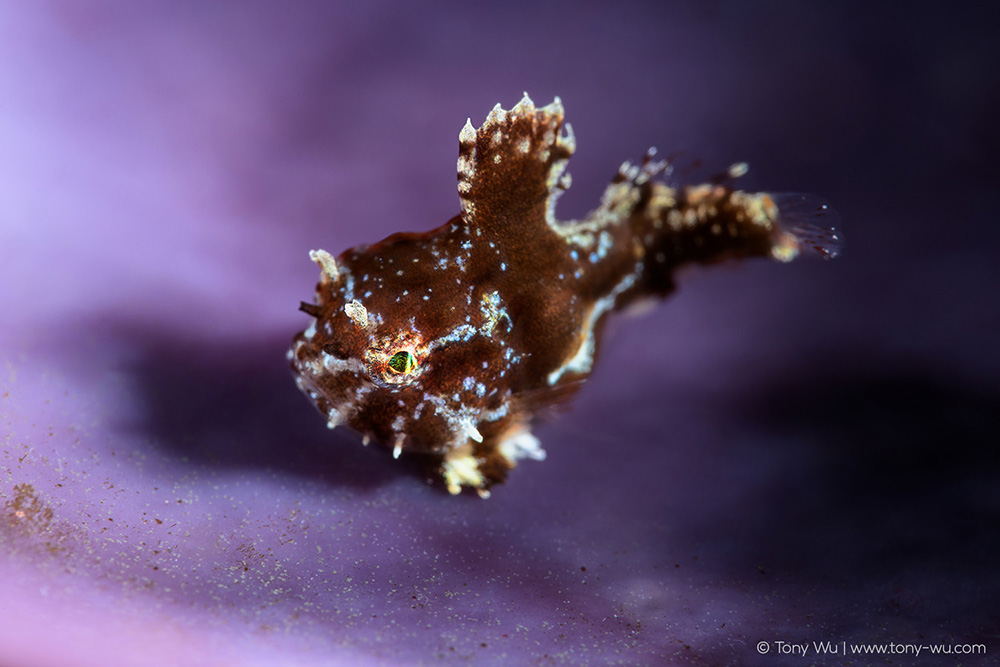
Note: Apparently, the little frogfish that gets run over by the urchin on a rampage is an as-yet unidentified species.<strong>Correction: Just received updated information that the unfortunate frogfish is a Histrio histrio, aka sargassum frogfish, which is unusual, since it’s sitting on the bottom with no sargassum seaweed around. Apparently, there is an article being written now about this, based on observations from the Virgin Islands.
There are many types of anemonefish, all of which live in association with host anemones. Some of the cuter, more charismatic species are often referred to as clownfish…like the false clown anemonefish (Amphiprion ocellaris) portrayed in the movie Finding Nemo.
All anemonefish, irrespective of whether they’re deemed movie-worthy or not, lay large clutches of eggs near their host anemones. The fish care for their offspring with remarkable devotion and energy by clearing away garbage, circulating water over the eggs, and fending off potential aggressors…until the young fry hatch and swim away.
There are many excellent photographs of anemonefish taking care of their eggs, but somehow, a single image doesn’t quite convey the vigour with which these fish attend to their next generation.
During my recent trip to the Lembeh Strait, I spent some quality time with one particular group of saddleback anemonefish (Amphiprion polymnus) at a dive site called Retak Larry.
The fish were in a nice, shallow location with minimal visual clutter. I took several hundred consecutive images of them tending their eggs, and assembled the photos into a couple of time-lapse sequences.
In this first sequence above, the eggs are to the right side of the frame. The bright orange colouration of the eggs indicates that they were laid not too long before I took these images. As the eggs mature, they gradually become transparent, with the nutrients represented by the orange colour morphing into eyes, gills, other vital organs and such.
Watch the video clip, and you’ll get a better idea of how dedicated these fish are. There are two large, mature fish that take care of the eggs, as well as a number of smaller individuals swimming around the anemone.
The second sequence below shows a different angle of the same group of anemonefish, with the bright orange eggs in the foreground.
Eating (too much) is an integral part of the new year celebration in Japan.
A staple of new year fare here is mochi (お餅), which is basically mashed-up sticky rice.
In times gone by, everyone made their own mochi by steaming and pounding the rice themselves. In our modern, civilised existence, most people just buy mochi pre-prepared.
Store-bought mochi can still be delicious and filling, but it’s even better hand-made, as I learned a few days ago when I had a chance to participate in a mochi-making party (餅つき) for the first time.
Besides the fact that we saw sperm whales, lots of dolphins, and giant squid parts(!), the trip to Ogasawara was a lot of fun. We had a terrific group of people, and Ogasawara is a laid-back, unspoiled bit of paradise in the middle of the Pacific that’s difficult not to fall in love with.
Below is a short video/ slideshow to give you an idea of what it’s like in Ogasawara. It’s a large file, so let it buffer before you play if you have a relatively slow internet connection.
All the images and video (including the sperm whale underwater) were shot with Canon cameras…5D, 5D Mark II, 1D Mark III.
I may be heading back to Ogasawara again next year. If you’re interested in joining, drop me a note via my contact form.
Here is a sentence that I’ve been wanting to write for a long time: “I swam down into the blue and retrieved the arm of giant squid.”
I know. For most people, doing something like this isn’t a life goal. I get it. I’m not normal.
But it doesn’t matter, because I did it, and it’s something I’ll never forget.
Here’s the condensed version of what happened:
While we were cruising along in deep water looking for signs of sperm whales, the captain’s wife shouted something from the top deck. I looked up and saw her gesturing frantically, but with the combined noise of the engine, wind and ocean swells, I could neither understand what she was saying, nor grasp the reason for her excitement.
Following the time-tested principle of “act first, think later”, I grabbed my mask, snorkel, fins and camera and jumped into the water. Visibility was excellent. I immediately saw a long, reddish object sinking into the blue…and swam down about 10 metres to take a closer look.
As I approached the squid arm, my brain finally kicked in (the “think later” part), and I realised that the only reason a rapidly sinking giant squid arm would be at the paltry depth of 10 metres is if a sperm whale (i.e., large animal with big mouth) had just dropped it…like perhaps only seconds earlier.
At that point, I looked around in a brief moment of panic (or sanity, depending upon your point of view)…thinking that perhaps the whale that had dropped such a tasty morsel might not appreciate my absconding with it. Fortunately, the previous owner was nowhere to be seen, so I avoided becoming whale food grabbed the squid arm and swam back to the surface.
We kept the arm segment on ice until the next morning, when we had sufficient space and light to measure it, then donated it to the research community.
Below is a short video of fellow underwater photographer Douglas Seifert measuring the (pungent) squid arm:
It’s been about a week since I got back from photographing sperm whales (Physeter macrocephalus) in Ogasawara with friends Eric Cheng, Douglas and Emily Seifert, and Julia Sumerling.
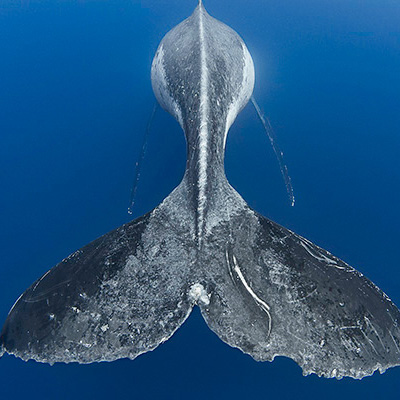
There is a lot I want to write about the trip, but as a first priority, I went through my photos and tried to do something that I don’t think anyone else has done/ is doing…ID individual sperm whales using in-water photos.
(b) We were fortunate enough to see a lot of whales in the water the first few days we were in Ogasawara, and I noticed that many of the sperm whales have what appear to be unique white markings on their bodies, particularly in the lower abdominal area.
At first, I wasn’t sure if the white markings were unique to the whales in this particular area, or whether all sperm whales have these markings. I’m still not entirely certain (since there aren’t that many in-water images of sperm whales), but after checking Hal Whitehead’s book about sperm whales, a copy of which Julia brought along on the trip, I saw that a few of the images in his book showed whales in other parts of the world with similar markings.
So I decided early on in the trip to try to take as many photos of the undersides of sperm whales as possible, and catalogue our cetacean encounters once I got home.
Here is the result (the video may take a while to download, so give it time to buffer if you have a slow internet connection):
In summary, I was able to identify nine individual whales, all of which I believe to be members of a group of relatively friendly whales…the ones that had the giant squid. There were almost certainly more whales in the group.
What also seemed to emerge from the pattern of encounters is that the whale that we eventually saw with the squid in its mouth may have been the matriarch or leader of this particular group, as she showed up in a large percentage of my photos, meaning she approached us relatively often.
ID-ing sperm whales is a lot more difficult than humpbacks. Humpbacks are surface-active whales, while sperm whales dive down hundreds, even thousands of metres…and they stay down. But still, it is possible to ID them, as this short video demonstrates.
Whether these IDs will come in useful over the long-term or not…only time will tell. If I get a chance to go back, I’m hoping to continue this endeavour, with the objective of seeing if it’s possible to document a consistent population and/ or frequent visitors to the area.
The video above is small, so it’s difficult to read the text. This is a PDF document (11MB) of the slides in the presentation, and this is a bigger Quicktime video file (640×360, 79MB…Do not click this link and try to open in your browser. Right click to download the file only if you have a good internet connection.). There’s also a .mp4 file available via iTunes.
I had a video camera with me this year while I was in Tonga. Nothing too fancy. A Sony HDR-XR500, with a Light and Motion housing and Fathoms 90-degree wide-angle port that David from Scubacam kindly let me abuse use.
I’m in the process of compiling a summary document for all the calfs that we encountered and ID-ed this season…a painstaking process that entails poring over thousands of images and hours of video footage.
Actually, while going through the footage of Mei Mei, I realised that I mis-identified one of our encounters. A couple of days after this video was taken, we had another encounter with a mom and calf. At the time, I ID-ed the calf as Mei Mei.
As it turns out…that encounter was with an entirely different mother and calf…which means I have one more calf to add to my list, bringing the total (for now) to 26 calfs (plus one more that Alexis and Nathalie ID-ed after I left Tonga).
A pleasant surprise, even though it means more work, as I need to amend photo tags, excel records, GPS files…aiyah.
If all goes well (i.e., I don’t go stark-raving mad from looking at so many whale photos), I’ll post my summary in the next few days.
In case it’s not completely obvious, I love the fact that I get to try lots of great food in many of the places I travel to, especially in Asia.
When I was in Phuket last year, we spent two entire days eating at local food stalls and restaurants…places not on the tourist map.
This is a short video summary of 10 recommendations for places to try, which goes together with this PDF file that has details of the specific locations and dishes…in case you’re heading over to Phuket.
This video stuff is turning out to be more fun than I imagined. Doing video coverage at DEEP Indonesia actually made going to a dive show fun (everyone knows that going to dive shows is generally at the very bottom of my want-to-do list).
Actually, I have more fun messing around than I do with the serious stuff that actually makes it into the final cuts…like in these outtakes from the DEEP Indonesia 2009 video footage:
I’m on the way back from the DEEP Indonesia 2009 show in Jakarta. Completely exhausted, but had a blast.
One of the reasons I’m so tired is that I spent every day running around the show with Aey and Mean to get photos and video, which we’re editing and putting up for the rest of the week.
Below is the first video from the event. There are more over on the FiNS TV site if you’re interested, and the videos are also available via iTunes.