Banggai Cardinalfish

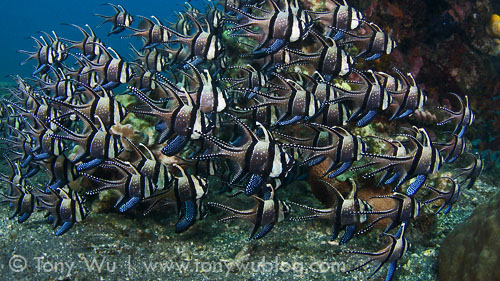
I posted this photo of a bunch of Banggai cardinalfish (Pterapogon kauderni) late last month during my stay in Lembeh:
luggage

I’m accustomed to seeing lots of Banggai cardinalfish in Lembeh, so it was kind of a surprise to receive a comment indicating that the aquarium community generally believes that these fish are on the verge of extinction.

Perhaps they are in other locations, but in Lembeh, they’ve been flourishing for years…even though they’ve been artificially transplanted there and may be displacing other fish.

Here’s a time-lapse sequence of one community of these fish, which should help convey how many there are, as well as how active they are in Lembeh:

As an aside, I tried every which way possible to upload this video to online video sharing services like my Vimeo account, but there was no way I could get the video to look good.

My original .mov file looked fine on my computer, but there is so much movement/ action in the sequence that the re-encoding process for Vimeo made the video look horrible. I tried encoding at really high bitrates (up to 70Mbit/s), but it didn’t make any difference.

So I gave up (after much head-banging and shouting of expletives) and encoded this .flv file and uploaded to my own server. The file is about 65MB, encoded at 20Mbit/s, so it might take a while to load if you’re on a slow connection.

Tags: , , , ,

  • http://echeng.com Eric Cheng

    Damn. 20Mbps for web viewing? You’re going to spoil us.

    What’s that red/purple cast on the Banggais? Did you white balance?

  • http://echeng.com Eric Cheng

    Damn. 20Mbps for web viewing? You’re going to spoil us.

    What’s that red/purple cast on the Banggais? Did you white balance?

  • http://www.tonywublog.com Tony

    Yeah, I white balanced a bit, but the ever-changing light means I’d have to go through and balance the entire sequence by eye. Too lazy to do that, especially after wasting many hours on trying to encode acceptable quality for web use.

  • http://www.tonywublog.com Tony

    Yeah, I white balanced a bit, but the ever-changing light means I’d have to go through and balance the entire sequence by eye. Too lazy to do that, especially after wasting many hours on trying to encode acceptable quality for web use.

  • Mary Lynn

    That looks great!! So much movement–takes a high data rate and good encoding to keep that sharp–good work!! (And you are going to spoil us…)

  • Mary Lynn

    That looks great!! So much movement–takes a high data rate and good encoding to keep that sharp–good work!! (And you are going to spoil us…)

  • http://www.tonywublog.com Tony

    Thanks Mary Lynn. Muddling my way through it.

  • http://www.tonywublog.com Tony

    Thanks Mary Lynn. Muddling my way through it.

  • http://www.thelivingsea.com Laz

    Tony,
    Are you doing the time-lapse using your Mark II? If so, could you tell me more about the circuitry you’re using to trigger the camera? I built one for my 20D some time ago, but it can be a little finicky at times. I’m curious to know of other solutions aside from trying to stick the Canon remote inside the housing.

  • http://www.thelivingsea.com Laz

    Tony,
    Are you doing the time-lapse using your Mark II? If so, could you tell me more about the circuitry you’re using to trigger the camera? I built one for my 20D some time ago, but it can be a little finicky at times. I’m curious to know of other solutions aside from trying to stick the Canon remote inside the housing.

  • http://glassbox-design.com Eric Michael Sanchez

    Terrific sequence Tony, many thanks for the 20mbps.

    Re: Banggai Cadinals–While I cannot speak for the entire aquarium community, many of those are aware of the healthy populations in Lembeh. As an aquarist and ocean lover it is a bittersweet situation as they are living their via man’s intervention… but alas they are alive and well.

    For myself the issue with this species in the aquarium trade comes from their placement on the IUCN endangered list. Correct or not, as an industry that is seen in poor light by many people, it would be most responsible to abide and respect IUCN’s listing.

    Additionally, Pterapogon kauderni is readily bred in the home aquarium…. Sustainable populations or not, captive breeding is the best option.

    My apologies for the aquarium sidetrack–thanks again for sharing this sequence.

  • http://glassbox-design.com Eric Michael Sanchez

    Terrific sequence Tony, many thanks for the 20mbps.

    Re: Banggai Cadinals–While I cannot speak for the entire aquarium community, many of those are aware of the healthy populations in Lembeh. As an aquarist and ocean lover it is a bittersweet situation as they are living their via man’s intervention… but alas they are alive and well.

    For myself the issue with this species in the aquarium trade comes from their placement on the IUCN endangered list. Correct or not, as an industry that is seen in poor light by many people, it would be most responsible to abide and respect IUCN’s listing.

    Additionally, Pterapogon kauderni is readily bred in the home aquarium…. Sustainable populations or not, captive breeding is the best option.

    My apologies for the aquarium sidetrack–thanks again for sharing this sequence.

  • http://www.tonywublog.com Tony

    Laz: Just used the TC-80N3. There might be a more high-tech way to do this, but I just went for the simplest solution. Housed the remote and triggered via a spare bulkhead. It’s clunky and unwieldy, but it works. Not something you can carry around on a dive and be spontaneous with though. I scoped the locations out first, then went back w/ the set up.

    Eric: Agreed. Assuming these fish are endangered elsewhere, it’s best to leave them alone in this location. I have mixed feelings about these fish too, since artificial introduction of species is almost always a bad idea, but it’s good to have a thriving population in at least one location.

    It’s good to know that these fish do well with captive breeding.

  • http://www.tonywublog.com Tony

    Laz: Just used the TC-80N3. There might be a more high-tech way to do this, but I just went for the simplest solution. Housed the remote and triggered via a spare bulkhead. It’s clunky and unwieldy, but it works. Not something you can carry around on a dive and be spontaneous with though. I scoped the locations out first, then went back w/ the set up.

    Eric: Agreed. Assuming these fish are endangered elsewhere, it’s best to leave them alone in this location. I have mixed feelings about these fish too, since artificial introduction of species is almost always a bad idea, but it’s good to have a thriving population in at least one location.

    It’s good to know that these fish do well with captive breeding.

  • Bart De Ridder

    Hi Tony,

    Good the see the fish are florishing in Lembeh Strait.
    Here’s some additional info I once posted on Wetpixel after meeting Dr Alex Vagelli, a world specialist on the Banggai Cardinalfish.

    http://wetpixel.com/forums/index.php?s=960435d98bfd87aa3e0bc983e5c00f21&showtopic=21558&pid=148074&st=0&#entry148074

    Best regards,

    Bart

  • Bart De Ridder

    Hi Tony,

    Good the see the fish are florishing in Lembeh Strait.
    Here’s some additional info I once posted on Wetpixel after meeting Dr Alex Vagelli, a world specialist on the Banggai Cardinalfish.

    http://wetpixel.com/forums/index.php?s=960435d98bfd87aa3e0bc983e5c00f21&showtopic=21558&pid=148074&st=0&#entry148074

    Best regards,

    Bart

  • Pingback: Jaw dropping time-lapse video of a shoal of invasive banggaii cardinalfish

  • http://blog.marinedepot.com jeffry j. johnston

    That was incredible. Took about 60 seconds to load but certainly worth the wait. I had to call a colleague over to witness it. Thanks for making my morning better! :-D

  • http://blog.marinedepot.com jeffry j. johnston

    That was incredible. Took about 60 seconds to load but certainly worth the wait. I had to call a colleague over to witness it. Thanks for making my morning better! :-D

  • Richard

    Hi, Tony I wonder if there is still any space available for the Tonga humpback whale acoustic research trip in August. Want to join in.
    I tried the Contact Form in your blog. But cannot find any “send” button after filling in the form. Please write back to my e-mail address.

  • Richard

    Hi, Tony I wonder if there is still any space available for the Tonga humpback whale acoustic research trip in August. Want to join in.
    I tried the Contact Form in your blog. But cannot find any “send” button after filling in the form. Please write back to my e-mail address.