Staying Wet

The water temperature while I was in Izu recently ranged between 19ºC and 21ºC, mostly hovering around the lower end.

The first time I dived in Izu back in 2006 was also the first time I used a drysuit, since up until that point, I had completely avoided getting into water below 28ºC…as any sane person would do.

Having lost my vestigial grip on sanity since that time, I let my friends persuade me into diving in Izu with a wetsuit during my recent squid search.

To this end, I had a custom wetsuit made, 6.5mm farmer-john style bottom with a 6.5mm pullover top and attached hood. On the recommendation of my friends at Dan’s Dive Shop, I went with the consensus top-of-the-line suit, made by a company named UGO.

(Side Note: UGO is an acronym for the company owner’s name, Yuki Goto, which is kind of funny, because a few friends mentioned that UGO 6.5mm suits are considered the Ferraris of wetsuits. If you take the first two letters of the owner’s name (instead of just using the letter “U”), you get “Yugo”, which…for those of you old enough to remember…was the antithesis of a Ferrari.)

The neoprene used by this company is special. I don’t completely understand why, but everyone agrees that it doesn’t compress as much as normal neoprene, it molds to your body, and it’s really warm.

Custom-tailored, the suit was a bit difficult to get into initially, but not as difficult as I had imagined. Actually, getting the suit off was more of a chore.
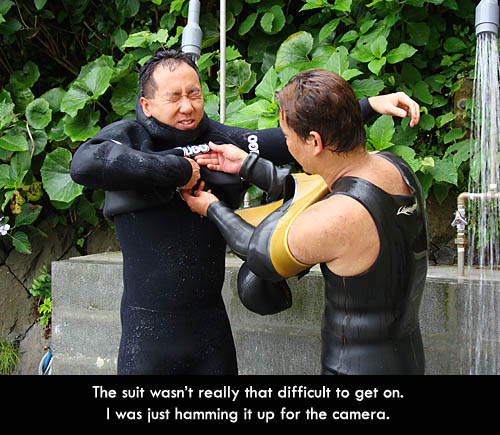
wetsuit

Anyway…I’m sold. The suit fit so well that I was almost entirely dry after I got out, and I was as toasty, if not toastier, than with my drysuit. Plus, it’s a lot easier to move around in a wetsuit, as you don’t have sudden shifts in buoyancy (air pockets move around inside a drysuit).

And never to be discounted is the fact that with a wetsuit, I can pee if the need arises. It’s the simple pleasures that really count sometimes.

The major drawback is the difficulty of learning how to take the pullover top off. It’s a tight fit, so it requires a nimble twist-and-flip technique. My initial attempts were more of a flop-and-squirm. But, on the last dive of my recent trip, I finally succeeded in dis-wetsuiting without external intervention…to a hearty round of applause from bemused onlookers.
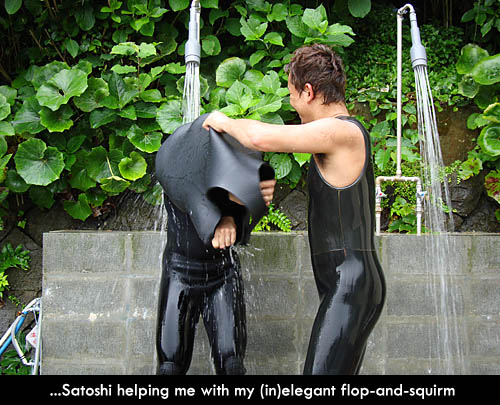
wetsuit

Tags: , , ,

8 Comments

  1. Robert says:

    Hi Tony, I so can’t believe this is the first time you have used a wetsuit. I find it hard to believe there is any diver on the planet who hasn’t!
    …Robert

  2. Tony says:

    First time using a wetsuit in that temperature…definitely!

  3. ROFL, Tony!
    Welcome to the world of freediving suits! This thing looks thick and maybe not as elastic. I suspect it’s a “sandwitch” and that’s why it’s more durable – but stiffer. I use 5mm for temp ~20C – waistband not farmer john. And 7mm in 10-14C water.

    Here’s a wearing tip from a spearo for wearing smoothskin wetuits. Make a solution of warm watter with some baby shampoo (no tears) in some bottle. Do not use too much shampoo – the task is to make the solution slippery. Spray the wetsuit (on the inside, dude, on the inside) well, et voila! You’ll be able to slip in the wetsuit without any effort even on dry land.
    Cheers for making me laugh again! :)

  4. tony says:

    Thanks Ivan. There’s some coating on the neoprene on the inside of the suit that actually makes it possible for me to slip in without any shampoo. Everyone else around me recommended shampoo too, but the manufacturer said I wouldn’t need it. I didn’t!

    The neoprene is like nothing I’ve seen or used before. Whatever it is, it’s great stuff.

  5. Oh, and for taking it off – flip up the waist part of the shirt up to chest level, and spray some of the same solution in the fold. Cross your hands in front of you and pull on the edge of shirt. If you still can’t take it off – reach with both hands over your head and pull on the dovetail.
    The slippery solution will let you get out of the suit in a blink.

  6. tony says:

    Yup, that’s the technique they taught me. I’m just not made to bend and contort in the optimal fashion though. Oh well. At least I keep everyone else entertained.

  7. No worries, mate… My Greek buddies also use a special wetsuit solution sold locally that was marketed as to eliminate the rather stinky effect of peeing in your wetsuit.
    Works fine for me, but not very well on real stinkers… :D

    I am really surprised about the nylon lining on the inside (if that’s what you mean by coating). That is the only thing I would avoid – it makes the wetsuit less stretchy and reduces it’s thermal properties. Lining on the outside – that’s other stuff cause it adds durability.

  8. tony says:

    It’s not nylon. I don’t know what exactly it is, but this suit is acknowledged to be the best in Japan by far. There’s no lining on the outside. I really don’t think there’s anything like this outside Japan.

Leave a Reply