Woman of the Sea

Traditions in Japan are dying. Not all of them of course, but enough that much of what I’ve come to know as Japan, and much of what I’ve learned about the country…will be gone before too long.

There aren’t, for instance, many Ama divers left.

Translated literally, Ama (海女) means Women of the Sea. In Japanese tradition, women who worked as Ama free dived for pearls, shellfish, seaweed, octopuses…products of the sea. In some areas, men also did this, but it’s generally been an occupation dominated by women.

Way back when, the Ama dived with minimal gear, but over time, they’ve adopted wetsuits, hookah compressors, scuba tanks and even uniforms in some instances (usually at tourist attractions)…to keep up with the times and maximise productivity.
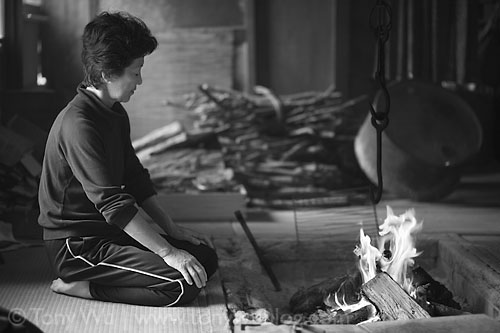
atsumaru-san

While I was in Izu recently, I met the last Ama in Futo harbour (there are other Ama divers in other areas). The name she goes by is Atsumaru. This is an adaption of her husband’s given name Atsuo. In fact, everyone refers to both of them as Atsumaru-san, even thought their actual family name is Inaba.

To cut a long story short, I was going to accompany Atsumaru-san out for a day of diving…to watch her work, ask questions, learn about the Ama tradition…and to document what I could of this vestige of Japanese culture.

As it turned out, the weather wasn’t cooperative, so we weren’t able to go out on the water, but I did spend an entire morning talking with Atsumaru-san and her husband. Here are some of the things I learned:

  • Atsumaru-san is originally from Mie prefecture. She moved to Izu somewhat over 37 years ago, because the water is deep in Izu. Back home, the water is shallow. In Ama circles, divers who work in deep water get more respect…so she moved to Izu, met her husband, and settled into the life she wanted…that of an Ama.
  • At around 07:00 every morning from the first of April through the end of November, she lights a fire inside a shed on the edge of the harbour. The fire is to warm herself before heading out on the water. She draws hot water from a volcanic spring into a tub too, but as she explained to me: “Fire is the only way to get warm all the way down to your bones.”
  • Her husband drives the boat, and she dives…but only when the weather and water conditions are right. Her husband decides when it’s good to go out. She trusts him completely.
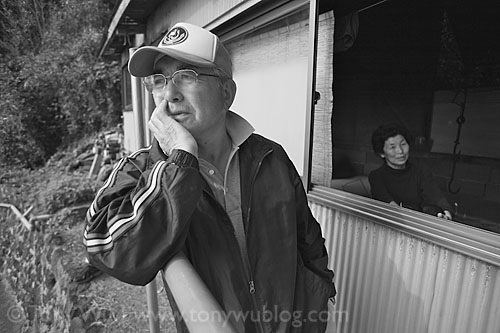
  • atsumaru-san

  • When conditions are right, they head out once in the early morning (after she’s warmed up by the fire), and she dives for around two hours. She wears a wetsuit, gets her air from a hose connected to a compressor on the boat, and uses red cotton gloves on her hands. Cotton makes it easier for her to feel around. Neoprene gloves might be safer and warmer, but it’s difficult to navigate by feel. Following a brief rest (and warming up again) after the first dive, they head out a second time in the late morning for another dive.
  • Lately, she’s been diving only around 1.5 hours instead of two. The water has been unusually cold.
  • The water was unusually warm over the past two years though. Perhaps that’s why there’s so little seaweed around. She’s never seen so little seaweed in her entire diving career here. “It’s troubling. Maybe it’s global warming. Maybe it’s bad for the harvest.”, she observed.
  • She mainly gathers four types of shellfish: sazae (Turbo (Batillus) cornatus), kuro awabi (Nordotis discus, a type of abalone), tokubushi (Suculus diversicolor aquatilis), and shittaka (Don’t know). Atsumaru-san says that there have been fewer and fewer tokubushi and shittaka recently, though she’s not sure why.
  • When she started in Futo harbour, there were 13 people (including herself and her husband) in five groups doing what she’s doing now. Gradually, everyone else has stopped. Now, only the two of them are left.
  • She’s been fortunate. She’s only had one instance when her air supply was cut off. She was close enough to the surface that she just popped up. Other people she knew suffered injuries though. Some died…accidentally struck by the props of the boats they were working on. “I’ve been fortunate.”, she repeated as she looked toward her husband.
  • I never asked Atsumaru-san her age, but I place her at around 60. She’s healthy in every respect and has a wonderful sense of humour, but she’s the first one to admit that her time remaining as an Ama diver is limited.
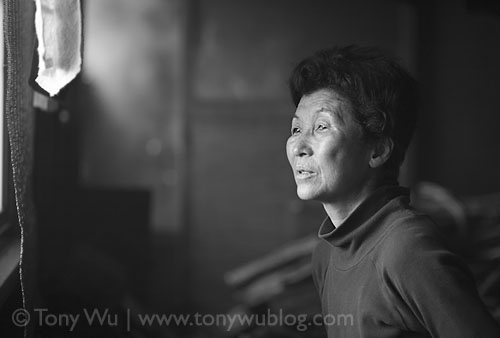
    atsumaru-san

    As I listened to her stories and asked her questions, I felt an undercurrent of melancholy, particularly as she described the glory days of when all 13 of the local Ama crew got together to talk, rest and relish the fruits of a day’s labour.

    By the time her husband made the call not to risk a day at sea, I had already decided that I need to come back, to spend more time with Atsumaru-san…to dive as deep into the details of her life as she’ll allow, so the stories, adventures and achievements of her life won’t go unrecognised.

    Tags: , ,

    • http://www.oceans4ever.com Alexa and Cindy

      Tony, beautiful post.

      I read this on my phone earlier, and just now got to come to the site to reread. She looks *exactly* as I pictured her from your writing, and your images do, too. I KNEW I’d see b/w done just this way.

      Amazing! Thanks for this post.

      ~Cindy

    • http://www.oceans4ever.com Alexa and Cindy

      Tony, beautiful post.

      I read this on my phone earlier, and just now got to come to the site to reread. She looks *exactly* as I pictured her from your writing, and your images do, too. I KNEW I’d see b/w done just this way.

      Amazing! Thanks for this post.

      ~Cindy

    • http://www.tonywublog.com Tony

      Thanks Cindy. I hope I get to spend more time with her. It takes a while to bring stories out of people. She was remarkably open and I’m amazed I got the information I did in such a short time.

      They invited me back, so keeping fingers crossed that I’ll have the time to sit with them to just listen and learn.

      Cheers,

      Tony

    • http://www.tonywublog.com Tony

      Thanks Cindy. I hope I get to spend more time with her. It takes a while to bring stories out of people. She was remarkably open and I’m amazed I got the information I did in such a short time.

      They invited me back, so keeping fingers crossed that I’ll have the time to sit with them to just listen and learn.

      Cheers,

      Tony

    • http://eclecticechoes.com Eric

      Amazing. I would love to have been in the room with you, but through your photo and words I feel almost there, the heat and smell of the fire in the brazier, the subtle crunch of fresh tatami. I mourn the loss of many of the traditions. Please do go back.

    • http://eclecticechoes.com Eric

      Amazing. I would love to have been in the room with you, but through your photo and words I feel almost there, the heat and smell of the fire in the brazier, the subtle crunch of fresh tatami. I mourn the loss of many of the traditions. Please do go back.

    • http://www.tonywublog.com Tony

      Hi Eric.

      The fire was a very sensory experience, from the placing of the wood, lighting of tinder, crackling of small flames, growing heat and wooden smoke that filled the shed.

      I’m sure there’ll be much more to see and experience on my next visit

      Cheers,

      Tony

    • http://www.tonywublog.com Tony

      Hi Eric.

      The fire was a very sensory experience, from the placing of the wood, lighting of tinder, crackling of small flames, growing heat and wooden smoke that filled the shed.

      I’m sure there’ll be much more to see and experience on my next visit

      Cheers,

      Tony

    • http://www.flemishamerican.blogspot.com David Baeckelandt

      Very moving story. Almost poetic. It is great that you are documenting this. But it is sad that this feature of traditional Japan is dying out.

      Out of curiousity, how many Ama are left in Japan? Are there any Ama schools? Thanks again.

    • http://www.flemishamerican.blogspot.com David Baeckelandt

      Very moving story. Almost poetic. It is great that you are documenting this. But it is sad that this feature of traditional Japan is dying out.

      Out of curiousity, how many Ama are left in Japan? Are there any Ama schools? Thanks again.

    • http://www.domeport.com Ivan (aka Wishbone)

      That was one of the best readings I had in a long time…
      You are lucky to be able to meet such extraordinary creature of the sea.
      I believe Atsumaru-san deserves a full scale documentary. But only if you make it…

    • http://www.domeport.com Ivan (aka Wishbone)

      That was one of the best readings I had in a long time…
      You are lucky to be able to meet such extraordinary creature of the sea.
      I believe Atsumaru-san deserves a full scale documentary. But only if you make it…

    • http://www.tonywublog.com Tony

      I’m not sure how many Ama are left, but I’m quite sure there aren’t many, and the number is dwindling rapidly. There are some at tourist attractions, but I don’t count them. I don’t think there are any Ama schools, or at least I’ve never heard of anything like that

    • http://www.tonywublog.com Tony

      I’m not sure how many Ama are left, but I’m quite sure there aren’t many, and the number is dwindling rapidly. There are some at tourist attractions, but I don’t count them. I don’t think there are any Ama schools, or at least I’ve never heard of anything like that

    • http://www.sarafreediver.com Sara

      Hi Tony
      Thank you so much for this. I am researching Ama divers to make a programme about them – particularly if they are a dying breed. I hold four world records in freediving and am keen to become as close to them as possible and learn their trade to make my programme on them as sensitive and understanding as possible – really feel what they go through. Atsumaru-san’s work isn’t freediving but I would still be interested in knowing more about these amazing people – anything you can share with me on private email would be extremely gratefully received.
      Beautiful photography too, by the way. I’m hoping to be in Japan in July
      x
      Sara

    • http://www.sarafreediver.com Sara

      Hi Tony
      Thank you so much for this. I am researching Ama divers to make a programme about them – particularly if they are a dying breed. I hold four world records in freediving and am keen to become as close to them as possible and learn their trade to make my programme on them as sensitive and understanding as possible – really feel what they go through. Atsumaru-san’s work isn’t freediving but I would still be interested in knowing more about these amazing people – anything you can share with me on private email would be extremely gratefully received.
      Beautiful photography too, by the way. I’m hoping to be in Japan in July
      x
      Sara

    • Davemill

      Hi tony, my Grandfather who was born in Japan and lived there for some years (an Englishman) told me that the Ama women dived for oysters with their babies strapped to their backs. Is this true?
      Carrie

    • http://www.tonywublog.com/ Tony Wu

      Hi Carrie,

      I don’t know for sure. The term “Ama” is a generic one, and there are slightly different traditions from area to area. It sounds a bit unlikely that women would dive with babies on their backs. But who knows?

      Cheers,

      Tony

    • Linda

      Have you seen Jolie Bookspan’s posts about the Ama divers?

      http://www.healthline.com/blogs/exercise_fitness/2009/07/amasan-japanese-diving-women.html

      Someone is making a documentary about them, too:

      http://shootingpeople.org/watch/film.php?film_id=78576

    • http://www.tonywublog.com/ Tony Wu

      Hi Linda,

      I had not seen either of these. Thanks for the links!

      Cheers,

      Tony

    • Naina Shahzadi

      Hey Tony Wu,
      I am delighted to read this write up.Thank you very much for this. I am a textbook writer in Bangladesh. I am one of the co-authors of the English textbook. At present I am working with the National Curriculum and Textbook Board. I was looking for something extraordinary to include in the book. Is it okay if I use your writing , might change or modify the language to suit the level of the students. I will be grateful if you let me use this as authentic material in the textbook.

      Shahzadi