I received a question asking whether it's ok to use a teleconverter (TC) to take super-macro photos. Actually, I get asked about this often, so I figured it's worth writing a bit about this topic.
Using TCs is no big mystery. Essentially, you're using an additional lens to increase the magnification of your primary lens...sort of a lens on top of a lens.
There are pros and cons to this arrangement. On the positive side, you can achieve greater magnification than without using them, which means you can shoot smaller subjects, or reveal greater detail of any given subject.
On the negative side, you're adding more glass, which means a drop in quality and quantity of light transmission, the extent of which depends on the quality of the particular TC you're using. Colour, sharpness and such do suffer, but it's manageable and worth the trade off if you're going for shots that otherwise wouldn't be possible.
In practical terms, you can achieve great macro results with teleconverters...just keep a few things in mind.
First, use the best primary lens you can. For my Canon system, this usually means the 100mm f2.8 macro lens. The equivalent in the Nikon world is the 105mm f2.8 macro lens.
Next, you'll need to use manual focus in most cases (getting the right gears and ports may be a challenge). Teleconverters reduce the amount of light reaching your camera's sensor, which makes autofocus relatively more difficult, especially if you're in low light to begin with, at high magnification, and/ or shooting something with low contrast (quite often, you have to contend with all three of these things at the same time). If you rely on AF, it'll probably be slow, and may end up "hunting" before locking focus.
Second, hike your ISO up a bit to help your strobes out. Third, open up your aperture to maximise light transmission. Normally, I start with f5.6 on-camera reading and close down from there, depending on the ambient conditions and desired result.
Finally, camera shake can be a real problem, so ideally, you should be in a situation where you are stable. Shooting super-macro while hovering in mid-water simply isn't feasible. And use a relatively high shutter speed. For example, 1/160-1/200 is the strobe sync speed for my Canon EOS 5D.
To illustrate, here are a few sample images I took using teleconverters (all with Canon 100mm f2.8 macro lens plus various TCs):
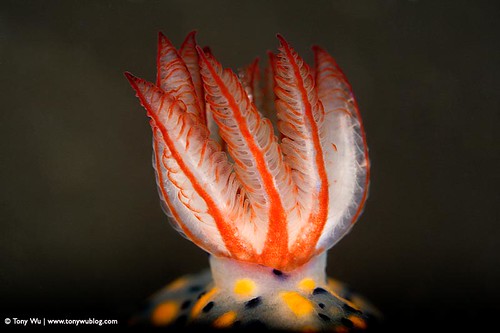
The challenge here was low light, low visibility, and a frickin' small nudibranch that wouldn't stop moving.
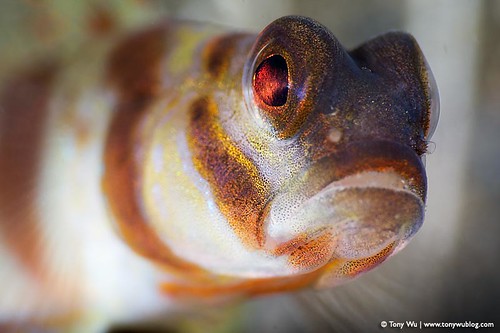
I adore gobies. The primary challenge is spending sufficient time with the fish to become friends.
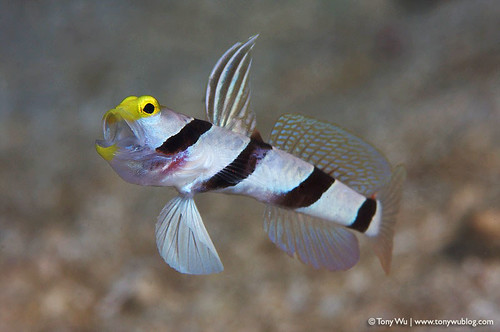
If you get really good with manual focus, you can learn to focus on rapidly moving subjects too, though you'll have to expect a higher miss-ratio than for more cooperative targets.
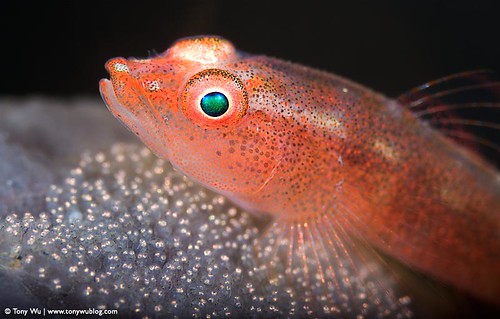
Getting in-camera high magnification is the best reason to use teleconverters.