The Oxford dictionary's online edition defines the term "flamboyant" as having as one of its meanings: "brightly coloured and showy".
Metasepia pfefferi, commonly known as the flamboyant cuttlefish, is actually only occasionally brightly coloured and showy. Most of the time, it's dull and drab, adopting the tone and texture of its background to remain unassuming.
I suppose calling it the "unassuming cuttlefish that occasionally shows off" would be more accurate, but it's not quite as catchy as the cephalopod's existing moniker.
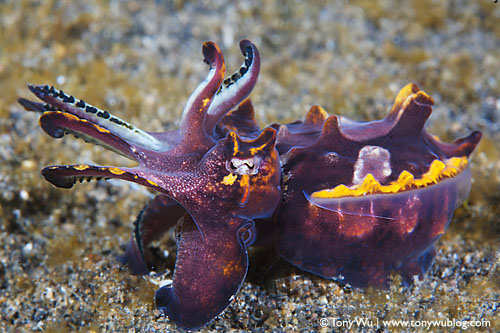
Anyway, I came across this photo I took a while ago in the Lembeh Strait (It's singular, not plural. Please don't refer to the strait as the Lembeh Straits.). The photo's nothing special per se, except perhaps that the cuttlefish is all lit up and perfectly posed.
Many marine animals that exhibit brilliant colouration are toxic. Blue-ringed octopuses, for instance, cultivate tetrodotoxin-making bacteria in their saliva glands, which is why their bite can be deadly. Mark Norman, who's in charge of cephalopod research at Museum Victoria, pointed out a few years ago to me that flamboyants are probably toxic too. From what I understand, his research has since confirmed that the muscle tissue of this cuttlefish contains a unique toxin that's as deadly as the blue-ring's. Cool, eh?
Another interesting thing about this animal is that it walks as often or more than it swims, as illustrated in the photo here. Mark also speculated that the cuttlefish may be evolving toward walking as its primary form of locomotion. Who knows? Stranger things have evolved.