Posts Tagged Sri Lanka

23 Sperm Whales Together

Continuing with my efforts to make progress with photo editing…thought I’d share this image.

There are 23 sperm whales (Physeter macrocephalus) here.

23 sperm whales together (Physeter macrocephalus)
There are 23 sperm whales in this photo!

There were more in the area, up to maybe 100 or so, but it was difficult to establish a firm count, given how spread out the whales were.

The reason this shot is from behind the whales is that they passed all around me. In other words, there were on all sides, too scattered to get into a single frame until they passed and coalesced into this formation.

Besides the fact that there are 23(!) whales in one image, the whale with the open jaw makes the shot for me. Sperm whales are the largest odontocetes (toothed whales), which the open jaw underscores nicely.

This is one of the stories I intend to share (complete with wild gesticulations and punctuated expletives) at my upcoming presentation in Nantucket.

Blue Whale in the Blue

I’ve been home for a few days now (after three months solid on the road), and have just managed to get started with a bit of photo editing.

A little while ago, I finished cleaning up this photo of a blue whale, which I took last month:

Pygmy blue whale (Balaenoptera musculus brevicauda) in the Indian Ocean, south of Sri Lanka
Pygmy blue whale (Balaenoptera musculus brevicauda)
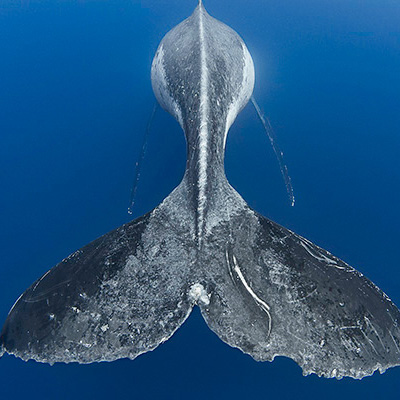
commencing its descent to forage for krill

Yes, the whale is in clear blue water, and yup, we are right next to each other, looking one another in the eye. Nice, eh?

In case you’re wondering, the characters 藍鯨 mean “blue whale” in Chinese. More specifically, they are the characters used in Taiwan. In mainland China, the characters are 蓝鲸, a slight difference.

I elected to use the Taiwanese characters because that’s where I’m originally from (to the extent that I have an “originally from” place).

Anyway, I labelled the photo with the Chinese characters in honour of my friends who were accompanying me at the time of this encounter, as they are from China and Taiwan.

Even though all of us are Chinese, we have a variety of backgrounds, so we communicated through a mix of English, Mandarin, Japanese and even some Taiwanese, a language I haven’t really used in over 25 years.

That served to keep us on our toes and ensure that everyone (eventually) understood everything, except, of course, for the guys driving the boat and taking great care of us, who seemed to laugh a lot with us (or was it at us?).

So I’m going to be at home for the next few weeks, which will be a nice change of pace. Besides catching up on work and getting back in shape for the second half of the year, at the top of my to-do list is to write about some of the amazing stuff I’ve seen and photographed in recent months.

I’ve been so busy that I haven’t had the time or energy to write as much as I’d like, so I’m going to make up for a little bit of that in the coming weeks, starting with some mind-boggling, absolutely insane(!!!) images and stories from Palau.

I don’t want to jump the gun, but if you’ve ever wondered what it’s like to be in midst of thousands of spawning fish, big ones at that…stay tuned.

Oh…and of course…there will be more whale photos coming too.

Presentation in Colombo

A few nights ago, I had the honour of giving a talk at the Cinnamon Grand hotel in Colombo to a rapt(?) audience comprising corporate leaders and avid photographers.

Presentation in Colombo, Sri Lanka, Tony Wu
These poor people had to listen to me for nearly an hour

Over the course of about 50 minutes, I showed a rapid-fire series of images, covering coral reefs, fish life, and whales.

I could’ve rambled for much longer, but it was Friday evening, and my hosts, being acquainted with my propensity for rambling, asked me to control myself and limit it to less than an hour. Oh well, they have no idea what they missed (insert smiley face).

The talk was the inaugural presentation for the Explore the World series of talks organised by Cinnamon Nature Trails, and supported by Nations Trust Bank, American Express, and the Cinnamon Grand hotel in Colombo.

Afterward, I was treated to an absolutely delicious dinner at the Mango Tree, which serves excellent North Indian cuisine. With food like that, I’m hoping they’ll ask me back again!

Invitation card for my talk in Colombo

Feeling Blue

Time to head out again. But before I do, I thought I’d share a couple of recent photos of blue whales, as partial offset for the silliness of my two previous posts.

blue whale (Balaenoptera musculus brevicauda) diving into the blue
Adult blue whale diving into the blue

As you can see, the time of day, visibility and quality of light determines the mood of an image. Even though both whales are diving, the feeling conveyed by each photo is completely different.

Lunging blue whale (Balaenoptera musculus brevicauda)
Lunging blue whale, fluke slicing through the water

With natural light photography, you can’t pick your light, but you can, and should, try to get into position to make the best use of whatever light is available. Assuming your subjects cooperate of course.

Note: Photos taken with permit.

My First Risso’s Dolphin

I don’t think these are particularly rare animals, but a few days ago is the first time I’ve come across a pod of Risso’s dolphins. They were body-surfing in the swells, clearly having a good time.

Risso's dolphin (Grampus griseus)
Risso’s dolphin (Grampus griseus)

Managed to get a few snapshots of these odd-looking cetaceans. They sort of look as if some over-ambitious person gave them a thorough scrubbing over with steel wool!

Green Turtle. Dead.

Some things just suck.

This is a juvenile green turtle (Chelonia mydas) that appears to have been killed by a fishing line and hook:

green turtle killed by fishing line
Juvenile green turtle killed by a fishing line and hook

We came across the carcass floating in the middle of the ocean. It was probably about 70cm in length…in other words, clearly a young turtle.

The flesh in the head area had either been eaten or had otherwise fallen off, leaving just a skull for the most part.

That’s my left hand in the photo. I’m holding the blue fishing filament that was entangled around the turtle’s head and neck. The clump of flesh below my hand is a piece of the turtle caught on the fishing hook.

A single careless act by one person = a lost life for an endangered turtle species.

Some things just suck.

Making Lemonade

When you’re dealing with Mother Nature, you can’t always get what you want. Yesterday was a perfect example.

Blue whale (Balaenoptera musculus) in Sri Lanka
Blue whale (Balaenoptera musculus) in low visibility

It was my first day on the water in about a month and a half, so I was full of anticipation and brimming with energy. As fortune would have it, Mother Nature decided to throw a major kink into my day…in the form of horrific visibility.

The visibility was so bad that I literally missed seeing whales that swam right by me. Several times. Sheesh.

Well, instead of becoming frustrated and sullen, I recalled a quaint snippet of folk wisdom: “When you’re given lemons, make lemonade.”

I had planned for crystal-clear, tropical-blue water, so I had to completely re-think my strategy, which involved switching lenses and adjusting my approach plan in the water.

The result is a series of images like the one above…moody, atmospheric, full of grain and backscattery goop (isn’t it great how I just make up words as I go along?).

I had to sleep on the photos for a night before evaluating them, as I was still bummed out about the visibility, but the more I look at the pictures, the more I like them.

I picked the one above as my favourite…my first officially approved photo of the year.

Anyway, if you’re on a photo excursion and find yourself facing adverse conditions, consider it a challenge and see if you can brew up a nice batch of cool, refreshing lemonade.

Note: Photograph taken under permit.

Beautiful Bryde’s Whale

This is a Bryde’s whale. It’s sleek, streamlined, and oh-so beautiful to behold in the water.

Bryde's whale (Balaenoptera edeni) in Sri Lanka
This is a Bryde’s whale, most likely Balaenoptera edeni,
though the taxonomy of Bryde’s whales is uncertain.

Given that whales are large (say roughly 12 metres give-or-take for this one), you might think that I could state with reasonable certainty that this whale is such-and-such species.

Well…in the course of reading up on Bryde’s whales, I’ve once again been reminded of how little we actually know.

There is considerable uncertainty relating to the classification of Bryde’s whales, with several possible species and/ or sub-species of cetaceans currently lumped together and known as Bryde’s whales. The taxonomy of the Bryde’s whale group is “confusing”, as several of my cetacean researcher friends have pointed out.

With the help of such friends, I’ve come to the conclusion that this whale is most likely a Balaenoptera edeni. (The others I looked into were Balaenoptera brydei and Balaenoptera omurai.)

This chance meeting in Sri Lanka with a Bryde’s whale was only my second such encounter, the first time being in Ogasawara in late 2009 (Bryde’s whale in Ogasawara).

I was much closer to the whale this time. I’m guessing that the animal was feeding, as it dived and surfaced near us on-and-off for over an hour. The whale eventually came close enough for us to slip in and take a look…leaving me with that familiar “wooooowwww” feeling.

Note: Photograph taken under permit.

Dead Blue Whale

Late last week, a number of media outlets in the UK published a series of photographs of a dead blue whale that I took during a recent visit to Sri Lanka (Daily Mail, Mirror, The Sun, Huffington Post).

Dead blue whale (Balaenoptera musculus) in Sri Lanka
Dead blue whale (Balaenoptera musculus)

I thought it worth augmenting what appeared in the mass media with some additional background information for anyone who might be interested, as well as to add some personal thoughts about the experience.

Cause of Death
Let me start by stating that I cannot be 100% certain that the cause of death was a ship. It is impossible to know exactly what happened without witnessing the actual event.

I put together what I saw with the information I gleaned from other people, and I pieced together a narrative that seemed to make most sense.

The exact text I sent to my media rep was:

I photographed this whale in the afternoon of 3 April 2012, between five and ten kilometres south of Weligama Bay, which is at the southern tip of Sri Lanka. Many people on whale watching boats saw it.

The whale was not significantly decomposed when I saw it, so it had probably not been dead for very long. My guess is that it may have been struck by a ship during the night, while the animal was resting at the ocean surface.

When whales die, internal decomposition causes gas to build up inside the whale’s body, causing the carcass to bloat. There was no visible bloating, so this suggests the whale had not been dead long when I photographed it.

Dead blue whale ship strike
Dead blue whale adrift in an area of heavy shipping traffic

Note that I wrote “My guess is…”, because that’s precisely what it was, an informed supposition, based on the lack of significant decomposition, absence of bloating, the nature of the wound, and the circumstances in which the whale was found.

More specifically, the whale was in a zone of high shipping traffic. Shipping lanes in the vicinity pass through prime blue whale habitat. Humongous ships (ones so big I initially mistook them for islands) cruise through the area on a constant basis.

Another consideration was the fact that another blue whale had arrived in port perched on the leading edge of a ship’s bow just a couple of weeks before I photographed this one.

Of course, nothing is impossible, so there is some chance that the whale died of other causes and was subsequently struck by a passing ship, or that the wound was caused by something else.

One possibility I considered was scavenging by a large shark. The wound was huge, so had it been a shark, it would have been an enormous one. I looked for teeth that may have been lodged in the wound, as well as for scrapes or other signs of scavenging, but was unable to see anything to suggest a large predator was the cause of the wound.

Moreover, there were no signs of any sharks (or any other scavengers) during the entire day, despite the fact that the whale carcass was leaking bodily fluids into the water. If a shark had been nearby, it would be difficult to imagine the fish passing up a free meal as tempting as a dead blue whale.

In the final analysis, the most probable cause of death seemed to be a ship strike.

Surface view of dead blue whale
Surface view of the dead blue whale

How Can a Whale be so Stupid? How Can a Ship be so Careless?
It is perhaps natural to wonder how a blue whale, a highly intelligent animal with senses finely attuned to surviving in its environment, could possibly let a loud, gigantic ship sneak up and clobber it.

Similarly, it is probably natural to wonder why ships don’t have a system to avoid such collisions.

Well…I don’t believe it’s really a case of unintelligent whales or negligent ships. It’s probably fair to say that whales avoid ships when they can, and most ships would probably choose to avoid whales as well. In other words, ship strikes happen despite the best of intentions by cetacean and human alike.

There was a good opinion piece that came out in the Independent discussing some of the possible reasons why whales sometimes aren’t able to avoid ships and vice versa. It’s worth a read, as the author does a better job of explaining the scenarios that I probably can.

But in any event, ship strikes on cetaceans are not a particularly unusual occurrence.

In fact, the International Whaling Commission (IWC) has a database of documented ship strikes, which you can access on this page: http://iwcoffice.org/sci_com/shipstrikes.htm

If you download and view the Excel file, you’ll see that there are a lot of entries, from all over the world, involving many cetacean species.

The IWC database is neither comprehensive nor definitive. There is inherent uncertainty when considering ship strikes, because there is no way that every incident is reported, and there is always the possibility of mistakes being made.

But…if you look at the table…there is little doubt that ship strikes are a serious issue. And with levels of commercial maritime traffic on the rise, it stands to reason that the chances of ship strikes are also growing. Of course, not all ship strike incidents are by large commercial vessels. Some involve whale-watching boats, military vessels, or private leisure craft.

One other thing worth noting from the file is the range of species: blues, fins, humpbacks, rights, orcas, sperms, Bryde’s, grays, and more.

Many people understandably get upset about the practice of whaling. It’s bloody, cruel, and arguably unnecessary. But whaling is targeted to specific species, mostly minke whales. By most estimates, there are hundreds of thousands of minke whales. That’s not an endorsement of whaling by any means (i.e., don’t flame me for stating a fact).

But the thing about ship strikes is that they are indiscriminate. Ships inadvertently injure and kill many species, including ones that are in serious trouble, such as blue whales or right whales in the North Atlantic, both listed as endangered on the IUCN Red List.

That’s an issue worth mulling over. The loss of a single blue whale or North Atlantic right whale represents a disproportionately large impact on those species’ depleted populations. And yet, there is not nearly as much public concern about ship strikes as there is about whaling.

Doesn’t seem right, does it?

For reference, here are whale population estimates from the IWC: http://iwcoffice.org/conservation/estimate.htm

Large wound, dead blue whale
Close-up view of the dead blue whale’s wound

A Bit of Math
To provide a sense of scale and perspective for what happens when a large commercial vessel and a whale meet, here are some representative numbers:

Blue whale: Let’s way(!) overestimate and say 30 metres long and 200 metric tonnes (200,000kg).

vs.

Example large container ship: 350 metres in length carrying 10,000 TEUs, with each TEU representing an average of 15,000kg = 150,000 metric tonnes, before accounting for the ship’s mass

You can certainly dispute my very-rough assumptions, but the end conclusion remains the same: a blue whale, as large as it seems to us, is puny by comparison to a large commercial vessel, both in size and mass.

In addition, large commercial ships can cruise at 20+ knots in open ocean (37km/ hr, 23mph), which means any cetacean that happens to be in the way doesn’t stand a chance. It also means that it’s very difficult for a large ship to change course quickly, even if it notices something in its path and tries to avoid it.

Thoughts About Sri Lanka
Although this specific experience was in the waters of Sri Lanka, I think it important to underscore that this is not an issue that is unique to that country. In fact, as is apparent in the IWC file, this is a global dilemma. Cetacean deaths from ship strikes occur in shipping lanes around the world.

It just so happens that there are active shipping lanes just south of Sri Lanka, where many large ships travel at high speed, ferrying consumer goods and supplies among major ports. And it just so happens that there is a nascent whale-watching industry in Sri Lanka, which is how I and other people ended up seeing this specific blue whale.

My view is that the development of a whale-watching industry in Sri Lanka is positive. It generates tourism revenue, introduces people (both locals and visitors) to the wonders of the oceans, and hopefully, in the long run, provides incentive to protect the whales, other marine organisms, and aquatic ecosystems in general.

Sri Lanka is a wonderful place, somewhere I may have never had the opportunity to visit were it not for the whales.

There are, however, challenges to be overcome, the most immediate of which stems from the rapid profusion of boats and visitors. As in other locations where marine-based tourism is popular, boating discipline on the water is of paramount importance.

Lots of boats trying to please lots of people, all of whom want to see lots of whales..is a situation that can potentially lend itself to less-than-ideal behaviour at sea. The challenge for all concerned is to understand and accept that in the long-term, safe encounters that don’t harass animals or place people at risk are the only way to ensure a solid reputation, ongoing revenue and happy cetaceans.

Dead blue whale
Rear view of the dead blue whale

The Silver Lining?
Whenever something bad happens, it’s a good idea to look for the silver lining.

I don’t know yet if there will be one that appears from this situation, but I’m hoping that documentation of this dead blue whale, as well as the one that was photographed in March this year, may give occasion for pause…for concerned people from many different walks of life to consider whether there may be a constructive way to reduce the chances of ship strikes taking place in Sri Lanka, with minimal, or ideally no, disruption to the flow of commercial shipping traffic.

On the positive side, there are existing examples of shipping companies, cetacean researchers and conservationists working together to do exactly this, notably in the North Atlantic to protect the few remaining North Atlantic right whales.

But to get to such a position, there must be consensus that this issue needs to be studied and addressed, and then, there needs to be sufficient funding dedicated to this task…funding for data collection about the ocean, about the blue whales and other large marine fauna in the area, and about shipping traffic…in order to derive conclusions and recommendations based on fact.

It’s easy, and tempting, to demand justice now(!) for the whales. But getting emotional rarely solves problems; it often exacerbates them.

In the long run, only meticulous gathering and analysis of data can lead to positive change.

Dead blue whale throat grooves
Close-up view of the dead blue whale’s throat grooves

The Soul of an Image

On one level, this is a photograph of a female sperm whale executing a playful flick of her fluke at the ocean surface.

female sperm whale at ocean surface
Stories are to images as souls are to people

The thing about photography though, at least for me, is that images should be about more than just taking a snapshot of a particular moment in time.

Compelling photos, those that make you sit and stare for a while, are ones that convey stories. In fact, the more intricate the stories are, and the “deeper” (excuse the pun) the tales go…the more memorable the image.

Take the photo above. It’s by no means the most exciting picture of a sperm whale I’ve ever taken, but I like it…in large part because there are multiple stories embedded within the image.

I could, for instance, describe the immediate experience of having a 12-metre toothed cetacean swim up, take a look at you, then saunter off in a nonchalant manner. Woohoo!

Or…to look beyond the actual encounter…I could tell you about the series of events that led up to this face-to-face rendezvous: the dozens of whales we came across, the interactions among them, and how this particular individual seemed to fit in to the cetacean family’s activities for the day.

To go beyond even that, I could tell you about the hundreds of hours I’ve devoted over the years to sitting and waiting for whales like this…enduring extreme boredom in the process but also loving every second.

I could elaborate, and talk about how little knowledge we have about large marine mammals in general, because…well…they just don’t spend much time in places and conditions that make it easy for us to observe them. And even when they do, they often have more pressing matters to attend to than entertaining inquisitive landlubbers.

I could tell you about how this whale and its family group were similar to, and different from, other sperm whale families I’ve encountered in the past.

I could tell you about the first time I met a sperm whale, about how scared I was due to ignorance (they do have big mouths and big teeth, after all); how it decided to take my leg into its mouth (which, naturally, exacerbated my trepidation); and how I finally ended up making friends with the inquisitive animal (after taking back possession of all my limbs), resulting an experience that literally changed the course of my life.

Stepping back even more, I could tell you about the sad history of men and leviathans, about how “intelligent” humans, for many years, saw these majestic animals as a source of blubber and spermaceti…used to make truly important things like margarine.

My point is this: Stories are to images as souls are to people.

There has been and continues to be a lot of chatter on the net about gear…new cameras, different formats, amazing lenses, manufacturer A vs. manufacturer B, lighting modifiers, and so forth.

Gear is important. There is no question about it.

But when it comes time to create an image, it’s what you do with the gear that matters. It’s the story/ stories you convey.

In the final analysis, it’s the soul of the image that counts, not your choice of hardware.

Blue Whale Poo

So I’m cruising along, and I see a blue whale take a massive dump. Naturally, I get in and swim through it:


That’s no surprise really, given my “talent” for being poo-ed upon by massive marine mammals (sperm whale poo, humpback whale poo, humpback whale poo too).

The unexpected, and entertaining part of the experience though, was that my (previously dignified) friend Serene also jumped in and swam through the pungent potage.

After we got back on the boat, she said: “That has to be the grossest thing I’ve ever done.”

To which my reply was: “See how much your life has improved since getting to know me?”

(Julia also jumped in, but I already expected nothing less from her.)

Delicious Food in Sri Lanka

Having good food is important to me. I’m Chinese. It’s in my genes.

It’s so important, in fact, that it’s a determining factor in where I spend time, as well as how long I can stay.

Yummy food = I can stay a while. Not so yummy = I want to go somewhere with yummy food.

During my recent visit to Sri Lanka, I was fortunate enough to sample a lot of great cuisine, courtesy of my new friend Chef Champika. Suffice it to say that I scarfed down everything he made, no matter the quantity.

Delicious food in Sri Lanka

Of all the dishes I tried, my favourite was coconut sambal. It’s not too difficult to make, so I got the recipe…both so I can make it at home, and also to share with anyone else who might want to give it a try:

Ingredients:
1 freshly grated coconut
6 cloves garlic
8pc small purple shallots (bawang)
1 1/2 tsp salt
2 tsp chili powder
Juice of 1 1/2 limes

Procedure:
1. Roughly chop garlic and shallots.
2. Put into a pestle add salt. Pound the mixture.
3. Add chili powder and pound again until quite fine.
4. Add a handful of the grated coconut and mix.
5. Add this mixture to the rest of the grated coconut, pour in lime juice. Mix well.
6. Enjoy!

Delicious Sri Lankan coconut sambal
Chef Champika making delicious coconut sambal