Posts Tagged Scorpionfish

Face Off

One of my favourite perspectives for fish portraits is head-on, full-face.

If you find yourself with a cooperative (i.e., stationary) subject and want to try a face-on shot, it may help to keep a few things in mind.

First, make sure you pay attention to symmetry. One way to do this is to keep your eyes on the fish’s eyes. Ideally, the fish should be looking at you, not away or to the side…and both eyes should be equidistant from the center of the frame. Lining up the dorsal fin/ long axis of the fish along the center of the frame often helps.

Once you’ve lined everything up, double check framing. Just like when you’re crossing the street…look left, then look right, then look left again. Make sure the position of the fish is balanced in the frame, and keep an eye out for extraneous visual distractions. Usually, you’ll want to keep the composition as simple and clutter-free as possible, but there are exceptions of course.

For instance, this scorpionfish in Ambon just happened to be sitting among a pretty patch of tunicates and other stuff, which although visually chaotic, ended up making for a nice pattern around the fish.

scorpionfish

I don’t generally think of scorpionfish as cute, but this one nearly qualifies.

Another thing you’ll want to consider is lighting (yes, I’m babbling on about lighting again).

The photo below is of a particularly grotesque scorpionfish. It was large, ugly and mean-looking. More importantly, it was puke-patterned…meaning “having a hue and texture reminiscent of stale vomit”. The rocks around it weren’t any prettier, so all-in-all, it was a fairly hopeless scenario…photographically at least.

Being a sucker for lost causes, I sat with my aesthetically challenged acquaintance for a while, contemplating what, if anything, to do. After several minutes, I decided to try to emphasise the fish’s inherent charms and go for a spooky, haunted-house kind of effect.

scorpionfish

The lighting here is one light from below, one light from above at reduced power and at a sharp angle. The effect is to frame only the fish with light. Hitting the scene with more light would’ve brought out the ugly rocks around the fish…something I didn’t want to do.

Incidentally, I took this photo during the day…not at night. Closing the aperture down to f14 at ISO100 and using a shutter speed of 1/200 was sufficient to darken the scene down so that I had complete control over all the light in the image.

The fish’s puffed-up look was a bit of luck. It’s a threat gesture, probably intended to make itself look bigger and badder than it already did…the fish’s way of telling me: “I don’t like having my picture taken.”

I’m sure the fish would’ve felt differently if it could’ve seen how flattering the result turned out.

A Few More Photos From Izu

Before I head out on my next trip, here are a few more photos from Izu.

The first is an adorable juvenile yellow hawkfish (Cirrhitichthys aureus), which is known as an oki-gonbe (オキゴンベ) in Japanese. There are, of course, lots of hawkfish in tropical waters, but this hawkfish is the most striking variety I’ve come across, ranging from a nice tangerine colour to a deep orange hue sometimes.

They’re not particularly shy. The big ones can be fairly inquisitive, swimming right up to check you out on occasion.

yellow hawkfish

But of course, not everything I saw was necessarily cute…at least not in the traditional squishy mushy sense.

This fish, for instance, is a yellowfin scorpionfish (Scorpaenopsis neglecta), its common name referring to yellow patches on the underside of the fish’s pectoral fins.

Known as satsuma-kasago (サツマカサゴ) in Japanese, these fish resemble the scorpionfish I’m accustomed to seeing in tropical waters.

In fact, this one reminded me somewhat of the white devil scorpionfish I recently photographed in Lembeh, which I initially mis-identified as a stonefish. Thankfully Cheryl was ever-alert and pointed out my stupidity!

From what I gather, satsuma-kasago spotted in Izu are not usually white in colour, so this one is a bit unusual.

scorpionfish

And finally, here’s a photo for my young friend Alexa, who has told me she likes seeing photos of frogfish.

This is a spotfin frogfish (Antennarius nummifer) or beni-izari-uo (ベニイザリウオ) in Japanese. I’ve only ever seen this species in Japan, though they have a much wider distribution.

This particular one was plastered against the underside of a rock formation, flush against the rock and coral so that it was virtually impossible to distinguish from the background.

The only reason I saw it was that I spent a long time near it while photographing another fish. The only reason you can see it in this picture is because of the lighting I used to bring out the outline of the fish. Amazing camouflage artists these fish are.

frogfish

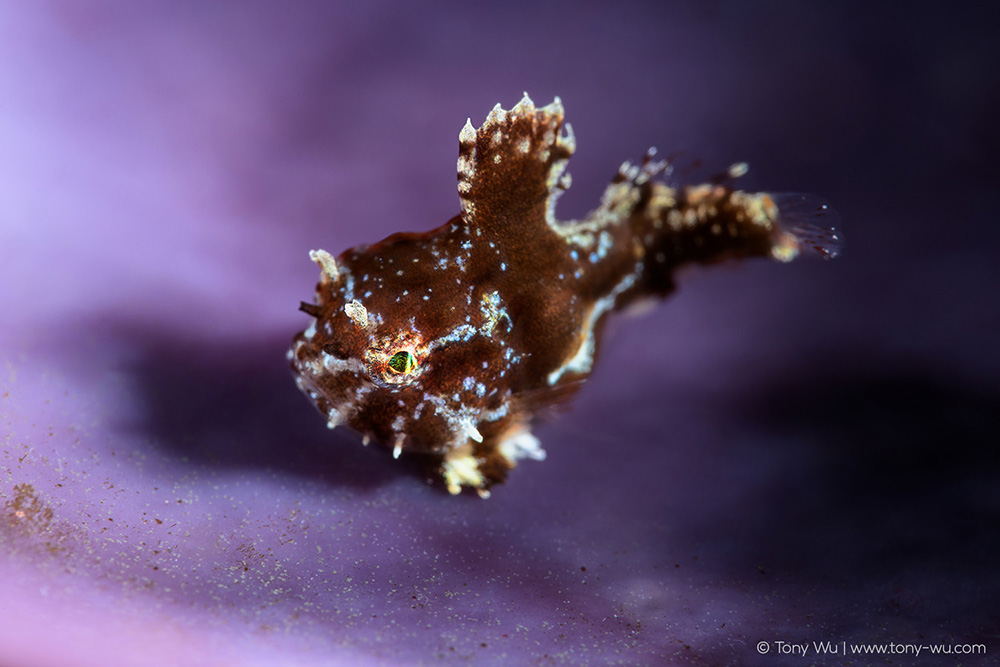
Speaking of frogfish, I can’t resist adding a couple more photos for Alexa. These are extremely rare frogfish. In fact, they’re yet to be properly classified.

For the time being, I’m calling this one the fuzzy tank frogfish:

frogfish

And this one the stumpy desktop frogfish:

frogfish

Moody Stonefish

Stonefish are ugly. There’s no way around it. I did my best with this image to at least make the fish look somewhat aesthetically pleasing. It’s always an uphill struggle with stonefish.

stonefish

The Scubacam group just arrived, got checked in, and a few are preparing to go out for a check dive, while the others assemble camera gear.

The spacious camera room at Kasawari is ideal for gatherings like this. There’s lots of space to fiddle with gear, and you have a chance to check out what everyone else has.

David and SanahFor the next week, we’ll be diving together, practicing photo techniques, doing daily Q&A sessions, and selecting photos for the list of prizes that David and Sanah (pictured to the left checking in) have prepared. Actually, I haven’t seen the prizes, so checking out the goody bag is on my to-do list for this evening.

But first, a night dive…

Note: Cheryl Fan corrected my lousy ID. This is probably a devil scorpionfish (Scorpaenopsis diabolus) instead of a stonefish. Thanks Cheryl!