Posts Tagged Megaptera novaeangliae

Too Pooped to Post

It’s the weekend again, and I’ve just been through another full-on week that has left me too exhausted to gather my thoughts and write a long post.

I’m up to calf #33 now, and I’ve seen another 2.5 heat runs since my last post (hurray!).

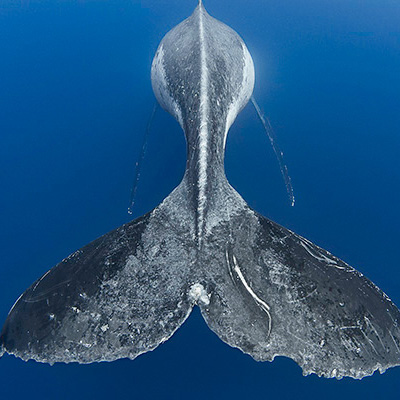
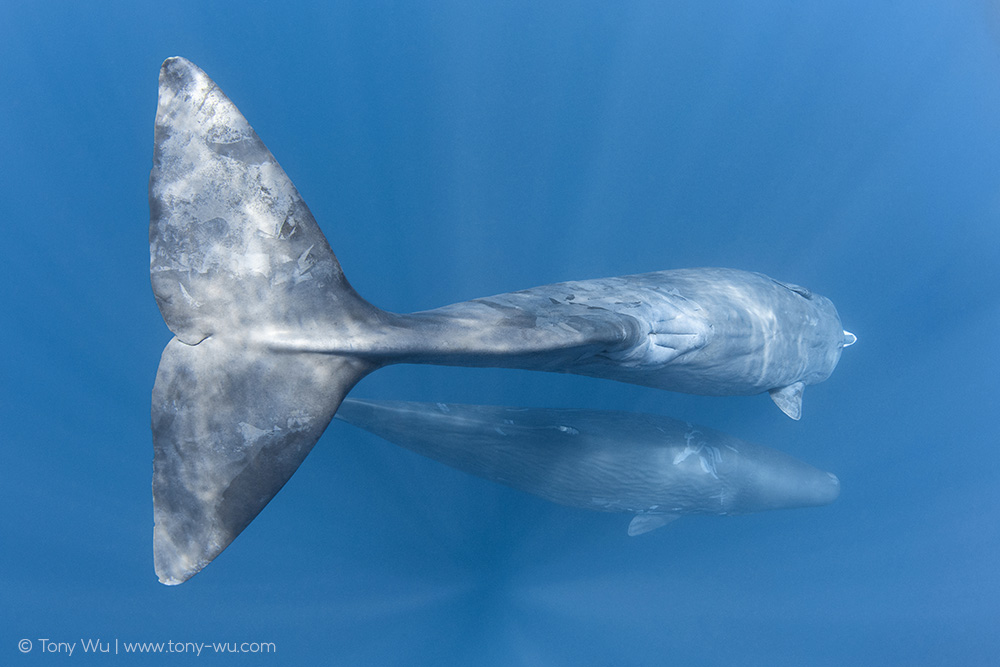
For the time being, here’s a recent photo I like…a fluke-side view of a male humpback whale diving into the beautiful blue waters of Tonga:

Male humpback whale diving into blue water in Tonga
Male humpback whale diving into the deep blue

Humpback Whale Heat Run

My days and nights have been jam-packed for the past week+, so I haven’t had an opportunity to write a long-form post for a while.

The action has been great though, and I wanted to share a couple of quick snapshots from a heat run yesterday, the first I’ve had this season.

Humpback whales engaged in a high-energy heat run, Tonga

This particular heat run centred upon a female with a calf, which I ended up designating as calf #30 of the 2012 season.

Accompanying the mother/ calf pair was the lead escort, a male humpback that was busying blowing bubbles, charging and fending off challenger males.

At the peak, we saw five males (besides the escort) jockeying for position…presumably trying to displace the lead escort and currying the favour of the female humpback.

Mommy and baby were chilled out for the most part, though one can’t help but think that the female was probably tired of all the fuss, and was perhaps even wishing that the boys would just finish all the chest-thumping nonsense and shut up already.

Anyway, high-energy heat runs are my favourite(!), so I hope to see some more before my season winds up in a few weeks.

Humpback whale swishing its fluke during a heat run, Tonga
Humpback whale swishing its fluke during a heat run

Humpback Whales in Tonga 2012: Part 4

We’ve identified seven more humpback whale mother/ calf pairs this week, bringing the current tally to a total of 24.

Humpback whale calf, Tonga
Humpback whale calf #19, the first confirmed male I have this season

At this same date in previous seasons, we were at 33 ID-ed baby humpback whales in 2011, 16 in 2010, 26 in 2009, and 15 in 2008.

To help put this in context, the figure below is a graphical representation of the calf count tallies from the past four seasons, with the X-axis representing time starting on 1 August and continuing through 30 October, and the Y-axis representing the number of ID-ed mother/ calf pairs:

Humpback whale calf counts, Tonga 2008-2011

It’s important to bear in mind that these figures aren’t directly comparable, as I have different start dates each season, as well as a different number of boats and people helping each year. At the end of the season, I calculate a mother/ calf pair count per boat day figure, which helps make the calf count figures somewhat more of an apples-to-apples comparison.

On a subjective basis over the long term though, the total calf count figures for each season do seem to provide an accurate reflection of both the “mood” of each year, and also the total number of whales and babies we encounter in a particular year.

As you may have discerned from the graph above, we’re on track for a similar quantity and slope of sightings as in 2009. Subjectively, we have a similar mood this season among the whale encounters as in 2009, though obviously no two seasons are exactly alike.

Humpback whale calf in Tonga
Humpback whale calf #21 of the season, a healthy, happy baby boy

Poker Pairs
I have a lot of miscellaneous stuff to attend to this weekend, so I’m not going to write too much more about the baby whales we’ve seen. Just one quick anecdote…about an experience that was both incredibly exciting, and a total, utter bummer.

On 5 September, I saw for the first time ever, two mother/ calf pairs socialising together.

In Poker terms, two moms and babies might appear at face value to be a hand with two pairs. In humpback whale terms, it’s more like getting a royal straight flush on the first deal.

There was one occasion in the past when I saw two mother/ calf pairs come in close proximity, when I thought they may have associated for some time…but I wasn’t able to get into the water back then, so I didn’t see exactly what, if anything, happened.

In this case, I was in the water, and I unequivocally saw the two moms and babies together, swimming in sync, with the moms rolling over, one repeatedly lifting her pectoral fin in the air, and the babies happily playing alongside their mothers (though not with one another). There was perhaps three to four metres between the two adult female humpbacks. People who were on the boat confirmed seeing the same thing. (The two mom/ calf pairs involved were calf #20 and our second encounter with calf #12.)

The bummer part…and this is an extreme bummer for me…is that the visibility was poor(!!!), the whales were some distance ahead and swimming away from me (so I was huffing and puffing to keep up), and the skies were overcast (so light levels were low)…all meaning that although the two females and babies stayed together for somewhere between five and ten minutes, I was unable to get any photos.

When I finally gave up and got out of the water, I was simultaneously overjoyed and depressed…exuberant because I’d seen something that doesn’t happen often (in fact, I wasn’t sure it happened at all until 5 September), but disheartened because I wasn’t able to document it.

So naturally, I ate three extra-large portions of (delicious…Thank you Kirsty) lasagna for lunch to compensate. Karma was thus restored.

Anyway, for the record, here’s what it looked like:

Artist's(?) rendition of two humpback whale mother and calf pairs playing together in Tonga
Artist’s(?) rendition of two humpback whale
mother/ calf pairs playing together in Tonga

Whale Song
I’ll write and post more later, but for now, here is an audio clip extracted from a video file that my friend Serene took of a singer. This is the song I referred to in my update last week.


Humpback Whales in Tonga | Part 1
Humpback Whales in Tonga | Part 2
Humpback Whales in Tonga | Part 3

Humpback Whales in Tonga 2012: Part 3

Wow. What an eventful week it’s been.

We’ve seen humpback whales singing, breaching, and even hooking up with members of the opposite sex. And we’re up to 17 ID-ed humpback whale babies now. Hurray!

Girls Just Wanna Have Fun
Consistent with the trend I highlighted in my previous update, every humpback whale calf that I’ve been able to sex with certainty over the past few days has been female.

Out of five new calf IDs this past week, two are definitely female, two indeterminate, and one possibly male (i.e., I think it’s male, but I didn’t manage to get a proof-positive photo.)

On top of this, there was another calf that Ma’ata managed to photograph a couple of times (but I’m not able to ID yet) that is definitely female. I’m waiting for additional photos from other people who were on that boat, in hopes that I can ID this calf in the near future as well.

In any event, of the 17 calves I’ve assigned IDs to so far this season, six are definitely female. Of the remaining 11, I think three more are possibly female, while one might be male. For the others, I don’t have enough photos to make an assessment.

Ever since I started keeping track of calf sex in 2009, I’ve recorded more females than males. I’m not sure what this means, but day-by-day, calf-by-calf, my belief that there is some significance behind this observation is growing. As interested as I am in the absolute number of newborn humpback whales here each season, this female-to-male sex ratio intrigues me even more.

If there really is a greater proportion of females than males among baby whales, what would cause this, and what purpose would this serve?

Female humpback whale with calf in Tonga
Female humpback calf 201217 with mommy

Love Me Two Times
In addition to the newly ID-ed calves, we had our first re-sighting for the season, female calf 201210 on 30 August. I first photographed this baby on 21 August.

As a photographer, my original purpose in traveling to Tonga was to create beautiful, inspiring images of the humpback whales that visit these waters each year. But being able to enter the water and observe whales directly affords me another opportunity…the chance to glean some insight into the lives of humpback whales.

Over the years, this has become as important to me, if not more so, than taking pictures. By the end of this season, I will have spent nearly 18 months of my life on and in the water here with the whales, probably more than any other person ever has. Over that time, I’ve seen and learned a lot, and each season, I look forward to recording everything I see and experience, then piecing together all the parts of the puzzle to try to figure out what the whales are doing.

Humpback whale calf in Tonga
Humpback whale calf 201210…female, like most of the others so far this season

Calf 201010 and her mom are a perfect example.

After my first encounter with this mother/ calf pair, this is what I recorded:

“Female, calf, escort. Escort laid back. Mom somewhat wary, but not too bad. Calf very inquisitive and friendly, approaching swimmers multiple times.”

After a couple of swims, we left the whales in the care of another boat with some of my friends aboard. Shortly thereafter, the trio started to move, and the escort commenced singing. Four other males appeared, turning the situation into a heat run and making it impossible to keep up with the whales, much less enter the water.

Fast-forward nine days.

On the morning of 30 August, I spotted a trio of whales (mother, calf, escort) moving at high speed just south of the main islands of Vava’u, with another whale giving chase several hundred metres behind. We watched as the trailing whale joined the leading trio, resulting a spectacular display by the escort…grunting, crocodiling, snorting…dispatching the would-be challenger in short order with fluke tucked under his tail.

The three whales bounced around for a while, clearly worked up to some extent by the intrusion, eventually calming down enough that it looked as if we might have a chance to take a peek underwater.

Just as we were getting ready…another male appeared from nowhere. The boys went at it again, sending all the whales off at high speed in random directions, until the escort once again prevailed and sent the newcomer packing.

Once that was settled, the whales did eventually calm down, and we were able to get in and take a good look.

So putting all that together:

  1. Calf 201210 and mom probably stayed in the Vava’u area between 21 to 30 August.
  2. Mommy whale seems to be attractive, given that she merited the attention of at least seven male whales through two encounters.
  3. The calf was highly inquisitive and friendly in both encounters. Mommy was neutral at best in both encounters. In other words, their dispositions/ personalities remained consistent through the two encounters separated by nine days.
  4. Perhaps most interesting…Mommy whale switched allegiances during the 9-day period. The escort that was with her on 30 August was not the same one that was with her on 21 August. I didn’t get a great look at the earlier escort, but the one on 30 August was a monster of a male. He was gigantic, both in length and girth, which may help explain how he got rid of the two challengers so quickly.

Huh…maybe size does matter after all.

Humpback whale calf and mother in Tonga
Second time around with humpback whale calf 201210 and mother

The Song Remains the Same
Those weren’t the only interesting observations though.

Just like the escort on 21 August, the big boy on 30 August started to sing after all the commotion had settled and the three whales stopped to rest: Escort the deepest, mommy above, and calf the most shallow…a typical configuration.

I’ve mentioned in seasons past that the humpbacks here sing in many situations (e.g. with mom/ calf, during heat runs, while swimming, while sitting horizontal, while hanging out with another whale, etc.), not just when they’re hanging head-down in the classic singer pose. This situation (and the singing escort with calf 201210) provided a perfect opportunity for me to share this information first-hand with my friends who are here with me now.

Floating not 15 metres above the whales, we watched as the calf nuzzled mommy, and escort belted out his best rendition of this season’s Megaptera melody.

Humpback whales make lots of sounds, so hearing a humpback vocalise doesn’t guarantee that you’ve heard THE song for the season. I’ve heard humpbacks vocalising for extended periods in a song-like manner, with a tune that wasn’t the actual song. In fact, my friend Dr. John Potter and I recorded a singer doing precisely this a couple of seasons ago, transitioning mid-melody into the actual song for that year.

But…in this case I’m 100% positive the escort was singing THE song, because later that day, we found a lone singer, courtesy of a pair of breaching/ playing whales that led us on a whirlwind tour for a while, then ditched us like yesterday’s news.

Breaching humpback whale in Tonga

We were in an area of horrendous visibility, with overcast skies, and the singer was deep (at least 30m down at the fluke), hanging in the classic head-down pose.

I took it as a personal challenge to find him, and fortunately managed to track him through three breath cycles over the period of 45 minutes or so. That gave me the opportunity to listen to the song over and over again. A couple of friends also recorded the audio on their cameras, so we were able to confirm later that the song was the same as the one the escort with calf 201210 performed.

Out of interest, this year’s song is characterised by a lot of scratchiness. The best I can describe it…is that parts of the tune sound almost as if the notes were being played on a badly out-of-tune squeaky violin.

I may be able to extract audio from my friends’ recordings and post it later. Posting large files is too much of a challenge right now, given limited and sporadic internet access. I can say that I don’t recall ever hearing so much scratchiness though. Also…the big booming bass is back, after not being so prominent in the song last year.

Humpback whale singer in Tonga
Humpback whale singer, Tonga

Waiting For A Girl Like You
We also watched “The Making Of A Calf”, so to speak this week, coming across at least one male/ female pair engaged in courtship.

I say at least one pair because I’m reasonably confident that the breaching whales that led us to the singer I highlighted above were also a courting couple (based on observing their behaviour), but I didn’t have an opportunity to get into the water and confirm by looking under their skirts, so I can’t be 100% certain.

In the case of the second pair, I am completely certain, as I had plenty of opportunity to observe them in clear water. Here’s a quick rundown of how things played out:

  • Drop 1: The whales approached the boat of their own accord, swam slowly by, taking a good look at the boat and us, then kept going.
  • Drop 2: The whale passed by once more. I swam along. When the whales were 15-20m ahead of me, the female did a 180 and turned back toward me, followed by the male. They swam straight for me, turned sideways when they were several metres away, stopped to look, then slowly swam away. The whales proactively checked me out.

Pair of courting humpback whales in Tonga
Pair of humpback whales turning to check me out

  • Drop 3: The whales were traveling at speed. I dropped in, saw them change heading. I altered my course to meet them. As the whales appeared out of the blue haze, the female approached, looked at me, slowly turned sideways while descending to about 15m depth, blocking the male’s path. Then the whales came to a dead stop. They hung in the water, resting, looking at us for at least 15 minutes.
  • Drop 4: The whales proactively approached people in the water…observing, circling, demonstrating what I can only describe as curiosity, perhaps even fascination.

While all this was happening, I was able to confirm visually that there was one male and one female. The inquisitive/ proactive nature of the whales was also consistent with past interactions I’ve had with male/ female pairs.

And finally, I now have a high degree of confidence in being able to confirm visually when a female humpback whale is ready to mate. In every case where I’ve encountered a female whale in a male/ female pair configuration or in a heat run, the female’s genital area has been discoloured and appears swollen/ engorged…as was the case once again in this experience.

Given the existence of outward signs of sexual receptivity in other mammals, I think it’s reasonable to propose that such discolouration + swelling is an indication of a female humpback whale’s readiness to mate. I’ll certainly keep an eye out for this in future encounters, but the first time I noticed this was in 2005, so I’m confident enough to state this publicly now.

We left the whales alone after our 4th drop. As we set off, I joked that I might be the world’s only whale wedding photographer, given that the pair were most likely on their way to consummating their nuptials:

Female and male humpback whale engaged in courtship, Tonga

Shiny Happy People
This week saw a few comings and going.

My friends Jon, Bryn, Jack, Julian, Ildi, Ai Lin and TK wrapped up their stay and headed out. Jon, Bryn and Jack have moved to Ha’apai and will be there for another week. They’ve already had some good encounters, and I hope they’ll have many more during their stay. I’m counting on them to send me some calf photos for the calf count (hint, hint guys!)

Who knows? Maybe one of the babies from here will show up there, or vice versa.

Mounu Island Resort
Ildi, Julian, me, Jack, Bryn, Jon, TK, Ai Lin and Emi

In their place, Serene, May, George, Debbie, Beverley and Karl arrived on Wednesday…just in time for the re-sighting of calf 201210, a crazy breach-fest, and the singers.

How fortunate I am to have such amazing people choose to travel with me. I am by nature a very private person, and I don’t suffer fools (such an understatement), so the fact that I have tremendously enjoyed the company of every single person I’ve had the privilege of sharing these experiences with really says a lot.

May, Serene, Emi, George, Debbie, Beverley, Karl at Mounu Island Resort

Being able to narrate what we see in real time and to recap the significance of our experiences during dinner conversation gives me great pleasure, and also affords me the opportunity to consolidate my own thoughts and conjectures. Thank you all.

Enough sappiness.

Both the weather and the mood of the whales has continued to be generally cooperative, so hopefully the week ahead will bring more exciting encounters and interesting insights into the behaviour of the whales.

Humpback Whales in Tonga | Part 1
Humpback Whales in Tonga | Part 2

Humpback Whales in Tonga 2012: Part 2

The past week has been a good one. The weather has been mostly cooperative, with a predominance of sunshine, only one day that was overcast and drizzly. We photographed and identified three new humpback whale mother/ calf pairs…bringing the total count for the season to 12 pairs. And we photographed a bunch of breaching, including White Pec #7 for the season.

Humpback whale female with calf, Tonga
Motherly love: Humpback whale female with 12th ID-ed calf of the season

Humpback Whale Calf Count
My annual count of humpback whale mother/ calf pairs in the Vava’u area reached 12 this week, with three new babies added to the list.

For comparison, the count last year by this same date was 19 ID-ed calves. 2011 was, however, an extraordinary season, with a bumper crop of 48 ID-ed babies in all, so 12 isn’t bad by any stretch of the imagination.

To put this in context, the ID-ed mother/ calf pair counts by this date in 2008, 2009, and 2010 were 4, 10 and 10.

It’s important to keep in mind that these figures don’t represent an apples-to-apples (or is that whales-to-whales?) comparison. I didn’t start the counts on the same day each season, and I don’t have the same number of boats helping each season.

At the end of each season, when I have all the data, I try to normalise the calf count with a figure I calculate by dividing the total baby tally by the total number of boat days spent at sea looking for them.

Though this is still not a perfect measure, it is perhaps a better standard by which to compare each season. I obviously won’t have this figure until after this season is wrapped up, but for reference, the figures were 0.44, 0.27 and 0.59 in 2009, 2010 and 2011, respectively.

These ratios give a much better indication of frequency (or rarity) of encounters with mother/ calf pairs.

One other interesting observation during the week…all three baby whales ID-ed this week were females.

female humpback whale calf with close-up showing developing mammary glands
Calf #12 (female) playing at the surface,
with close-up showing developing mammary glands.

The apparent abundance of female calves is consistent with my observations from past seasons, with the female-to-male ratio among calves being 1.56, 1.75, 1.30 in 2009, 2010 and 2011, respectively, i.e., more female than male babies each season. Of course, since I can’t determine the sex of every calf, these figures are just indicative

As I’ve mentioned in the past, the apparent prevalence of female over male babies could be due to any number of factors: There could actually be more female calves than male babies; it’s possible that mother/ calf pairs with females tend to be more accommodating toward interactions with people; or…it could just be sheer coincidence. Who knows?

If this year’s calf count once again follows this trend though, my confidence in this tendency will certainly increase.

For more background on my annual calf count + observations and speculations, see my humpback whale calf count PDF file from last year.

White Pec #7
Yesterday, we saw our 7th white pec for this season!

It was one of several whales breaching, slapping and generally having a good time southeast of the Fatumanga area. Having to choose among whales is a good predicament to have, but we stuck with a particular pair because they seemed to enjoy showing off (approaching the boat and breaching all around us), and also because of the white pec. I really wanted to get a good photo of this particular whale, which fortunately was the one that seemed to breach the most.

As I mentioned in my first update, there seems to be a concentration of whales with all-white pectoral fins this season. All-white pecs are relatively more common in the northern hemisphere than among the humpback whales in the south, so it’s pretty easy to pick them out from the crowd, so to speak.

Once again, this is just continued speculation on my part, but the fact that there appears to be a cluster of this obvious phenotypical trait this season suggests to me that there could be an underlying genetic closeness among a subset of the whales in the Vava’u area right now. In other words, I’m wondering whether some of the whales here might be closely related to one another, given the appearance of this trait among so many whales.

The last time this trait appeared with such a relatively high frequency was 2006. And in other seasons, other obvious physical traits (ones different from all-white pec fins) have appeared in similar clusters.

I’ve read some papers suggesting that humpback whales do not travel in related groups as many toothed whales are known to do. But this then begs the question – Why would a concentration of whales with all-white pectoral fins show up in 2006 and 2012, but not in intervening or preceding seasons?

humpback whale with all-white pectoral fins
7th humpback whale of the season with all-white pectoral fins

Behaviour
A couple of seasons ago in 2010, I characterised the “mood” of the whales that year as “unsettled”. Most of the experienced people I spoke with here at the time concurred that the whales seemed somewhat on edge, relatively difficult to approach. Last year was different, with lots of whales around, and “normal” interactions, if I had to pick one adjective.

It’s still early in my stay here for the 2012 season, but to date, it seems like the whales are behaving in the “normal” to “friendly” range. We did have a few mother/ calf pairs yesterday that were not particularly cooperative, but that is the case every season. We just leave those alone.

Most of our interactions so far have been with extremely accepting whales.

Of interest to me, this overall “mood” (for lack of a better word) is consistent with my experience in 2006, the last time there were a number of whales with all-white pectoral fins around.

Once again, this could be pure coincidence, but it’s another data point in my ongoing observation of humpback whale behaviour in this area. Something else to ponder.

Humpback whale calf, Tonga
Calf #9 of the 2012 season, a friendly little girl

Humpback Whales in Tonga | Part 1

Humpback Whales in Tonga 2012: Part 1

My first update from Tonga for this season is going to be short. I’ve only gone out on the water for one day, but it was an eventful one.

I arrived at Mounu Island Resort on 16 August, settled in, set up and tested my gear on the 17th, and went out to sea yesterday with my friends Douglas Seifert, Howard and Michele Hall, and Jerry Allen.

Tony Wu, Jerry Allen, Douglas Seifert, Howard and Michele Hall.
Me with Jerry, Douglas, Michele and Howard

The weather was so-so, mostly overcast with drizzles every now and then, but we were fortunate enough to come across a group of five humpback whales within short order. They weren’t in any particular hurry, but the whales also weren’t overly friendly, so we only saw them a few times underwater.

The whales passed mostly at depth, but I managed to get all five in a single frame…not bad for one of the first photos I’ve taken with my new Canon 5D Mark III camera and Zillion housing.

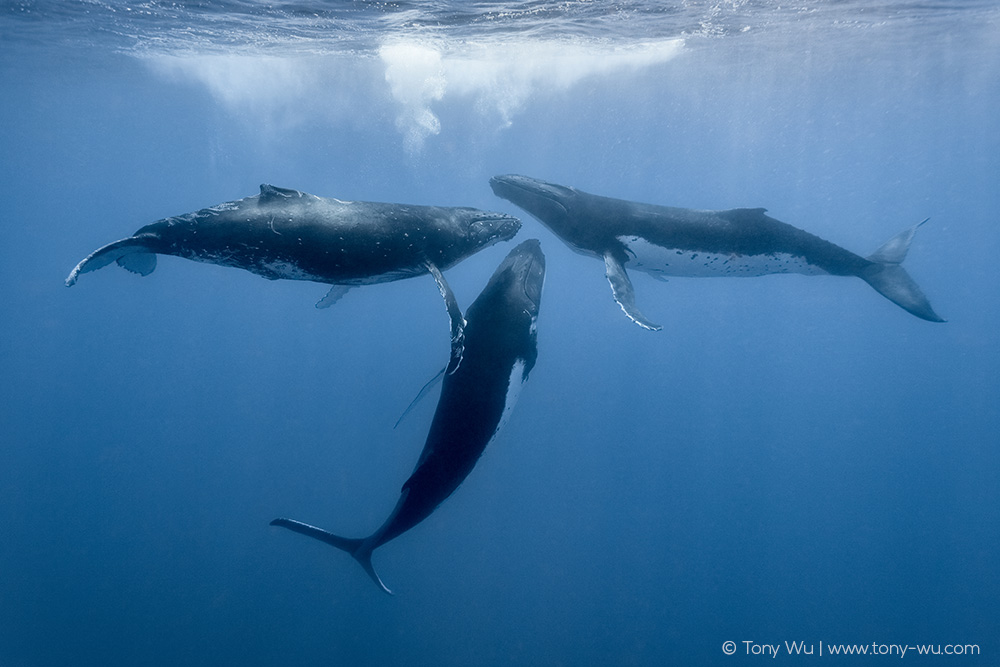
Group of five humpback whales in Tonga
Five humpback whales traveling together

Of particular note, there seems to be an abundance of whales with all-white pectoral fins this season (like the left-most whale in the above photo). The last time I recall seeing a large number of humpback whales with this trait visiting Vava’u was in 2006. In most seasons, I’ve seen very few, if any at all.

Most people probably wouldn’t get excited by something like this, but I’ve been tracking unique physical traits among the humpback whales that visit this part of Tonga for some time now, and the reappearance of a significant number of whales with white pectoral fins could be important.

In many seasons, there seems to be some obvious physical trait that a critical number of whales share. White pectoral fins is one example. All-black bodies, as well as split dorsal fins, are two more I’ve been on the lookout for.

I have a hunch that these shared outward physical traits are signs of genetic proximity. In other words, if a number of whales share a common physical trait, they might be relatively closely related…and they may coordinate their movements to some degree.

It’s tough to prove this without collecting DNA, but the fact that certain traits appear in greater-than-average quantities in certain years (but not in most years) is certainly suggestive of some sort of link.

I’ve rambled about this in updates in previous years, so on the off chance you’re interested in reading more, take a look in my blog archives for posts during August and September from past seasons.

So far this season, Ma’ata, who works at Mounu Island Resort, has photographed two mother/ calf pairs with all-white pectoral fins. The one in the photo above makes five individuals with this trait. And as if to hammer the point home, the next whale I photographed a few hours later was also one with white pectoral fins.

Humpback whale in Tonga with white pectoral fins
This is the sixth humpback whale with white pectoral fins this season.

So that makes six whales with all-white pectoral fins this season, and we’re just getting started! It’ll be interesting to see if we come across more as time goes on. In fact, it’ll be interesting even if we don’t see any more.

Speaking of mother/ calf pairs, Ma’ata has been photographing calves to contribute to my annual mother/ calf count, and we went through her photos this morning. So far, I can ID eight mother/ calf pairs from her photos…which is totally awesome.

By this time last year, we had 11 calves identified, so we’re not far behind. And I haven’t even spent any appreciable time in the water yet!

This season, I arrived in Tonga a couple weeks later than I normally do (I was in Alaska playing with northern humpbacks), so I was worried about falling behind in the count. Thanks to Ma’ata’s efforts though, the calf count is on schedule.

Request for help…If you are visiting Tonga this season, and you photograph any mother/ calf pairs, please save the photos for me, and please make a note of the date and location. I will compile all the data I receive into a file and publish the file for everyone to share, as I’ve done in previous years. Photos that are of most use are ones that clearly show physical traits of the mother and/ or calf…side-on views of the adult to see the body patterns; photos that show the shape of the dorsal fins; clear shots of flukes; photos of the underside of calves…to help determine the sex of each calf.

Our count for the 2011 humpback whale season in Vava’u was 48 humpback whale mother/ calf pairs…a record number that blew away all expectations! (and also made for a heckuva lot of work after I got home).

To wrap up, here is a photo of the whale that was accompanying the one with the white pectoral fins above. The pair were nice enough to slow down and stop for a break, giving us an opportunity to spend some quality time with them.

Resting humpback whale

My friend Jon Cornforth will be arriving tomorrow, for the continuation of our Megaptera Mania! dual-hemisphere humpback whale trip. The weather forecast looks good, so I can’t wait to take my friends out to look for more whales.

Heading to Tonga

After a brief, chaotic few days on the ground, I’m on my way out the door again, heading south for the summer to visit my friends in Tonga.

It’s kind of shocking to contemplate, but this will be my 11th season photographing humpback whales in Tonga. To put this in context…by the end of this season, I will have devoted around a year and a half on the water to this endeavour.

Crazy talk!

While I’m there, I will, of course, work hard to make interesting observations, capture nice photographs, and share via regular updates as I’ve done in the past:

Tony Wu in Tonga
Me, hard “at work”
(Note: This photo is from several years ago, when I was younger and less mature.)

It’ll certainly be interesting to see how things pan out this year, given the banner crop of humpback whale babies in the 2011 season.

One thing I’m looking forward to from a photographic standpoint is using my 5D Mark III cameras underwater. This will be the first time in four humpback whale seasons that I have new hardware to deploy.

I’m the first to underscore that hardware is not the most important aspect of photography, but the vastly improved autofocus and frame rate of the 5D Mark III over the 5D Mark II certainly won’t hurt!

And better ISO performance will hopefully mean I can crank it up a stop or two when necessary, without worrying too much about degrading image quality.

Zillion housing for Canon 5D Mark III camera
The first Zillion Canon 5D Mark III camera housing

I’ll be using the Zillion 5DMkIII housing pictured above (picked up fresh off the assembly line a few days ago), plus a modified 5DMkII housing that I used while I was Down Under photographing minkes in early July.

For all the lucky(?) people travelling with me this season…have a safe, uneventful journey, and see you soon!

Humpback Whale Calf in Alaska

One final image from Alaska before I head out for the humpback whale season in Tonga:

Playful humpback whale calf in Alaska
Playful humpback whale calf celebrating a beautiful day in Alaska

Northern or southern hemisphere, baby whales love to play.

Megaptera Mania: Alaska

Humpback whale season started early for me this year.

Instead of heading south in August like I normally do however, I went north in July to Alaska, where I had an opportunity to witness and photograph one of the most extraordinary spectacles in the natural world…humpback whales engaged in cooperative bubble net feeding, also known as social foraging.

Humpback whales bubble net feeding in Alaska

Planning for this trip started many moons ago, back in March or so 2011, when I had a brain splat during a Skype conversation with my friend Jon Cornforth.

We were chatting about possibilities for working together, and it occurred to me that between us, we had extensive experience and success documenting just about every well-known aspect of humpback whale behaviour.

Jon had spent several seasons tooling around the waters near Juneau, Alaska following and photographing the movements of humpback whales during their feeding season in that area.

Meanwhile, I had spent ten seasons in Tonga photographing the other half of humpback whale life…competing for mates, engaging in courtship, having and raising babies, etc.

As luck would have it, the humpback whale seasons in Alaska and Tonga dovetail nicely, so it seemed logical to combine the two destinations into one grand adventure…an ambitious trip in which our fellow travellers would have the unique opportunity to see a broad range of humpback whale activity…a dual-hemisphere humpback extravaganza that we dubbed Megaptera Mania!

Following are a few highlights from the first part of our Megaptera Mania! trip in Alaska, which, as I’m sure you’ll see, was an unequivocal success.

Humpback Whale Bubble Net Feeding
Picture yourself floating in a small dinghy with a few friends. It’s sunny, with a gentle, almost imperceptible breeze that’s cool, but warmer than you’d expected. Snow-capped mountains line the horizon. A bevy of boats populated with eager fishermen and women pass by, casting lines in hopes of landing salmon, herring, halibut, possibly other tasty fish.

It’s a picture-perfect summer day in Alaska. Conditions are just right to doze off. But you don’t want to.

Because somewhere below, humpback whales are on the prowl.

Humpback whales resting between bubble net feeding sessions

During the northern hemisphere summer, humpback whales travel from warmer climates to higher latitudes like the waters around Alaska for exactly the same reason that many people do…to catch tasty fish.

Here’s where it gets interesting…some of the whales that visit Alaska engage in a fascinating cooperative foraging technique called bubble net feeding. In essence, a number of whales join forces and work together to corral fish (primarily herring I think) and herd them to the surface. They do this by using a choreographed combination of sound and air bubbles.

It’s one thing to describe this tag-team technique in words, but there’s really no adequate way of conveying in writing the sensation of seeing (and feeling) hundreds of tonnes of cetacean-mass explode through the water’s surface, sending scores of freaked-out fish flying frantically through the air. It’s just kick-b*** awesome.

Humpback whales with mouths wide open
Humpback whales with mouths wide open.
See the helpless herring flying through the air?

Hearing some audio of the coordinated attack strategy might help to transport you to the scene though.

Close your eyes and listen to what an attack squadron of humpback whales sounds like…from a fear-filled fish’s point of view:

(Note: At 53 seconds, you can hear to splash of the whales breaking the surface of the ocean, swallowing heaps of horrified herring in the process)

One thing we noticed is that there was variation in the sounds that the whales make, both among different groups of humpbacks, and also among different attacks coordinated by a given group of whales. In addition, one group of whales we came across made nearly no sounds, appearing to round-up prey primarily with bubbles.

Given that this was my virgin experience with bubble net feeding, I’m not certain whether this has any significance.

I also don’t know whether the different groups we encountered comprised the same whales, entirely different whales, or a mixture of both.

We did see a number of whales that left feeding groups, as well as other whales that joined the groups throughout the day. We also recognised a few whales across multiple encounters, so overall, it seemed as if the size and composition of the bubble net feeding groups were somewhat malleable.

The largest number of whales we counted in a given group was 15 individuals, plus a calf that wasn’t involved in the bubble net feeding. The calf’s mother was among the whales in the foraging group.

Humpback whale calf, Chatham Strait, Alaska
Humpback whale calf playing. Mommy was part of a bubble net feeding group.

Anyway, here’s another audio sample. Compare this to the audio above, and you’ll hear that the sounds are quite different in places. Note in particular the “Tarzan” sound after the 40-second mark, and the odd baby-burping sounds that come in from time to time. All very cool.


One final audio snippet, which I personally find to be the most interesting. Listen to the clip below and see if you can think like a humpback whale and figure out what happened. It’s extremely different from the two sound segments above.

(Warning: The humpbacks overwhelmed our poor little hydrophone in a few spots, so the audio cracks a bit. Turn the volume down if you’re listening with headphones, so it doesn’t hurt your ears.)


Pinnipedia
I love pinnipeds. They’re generally cute, playful, inquisitive…and often comical to boot.

During our stay in Alaska, we came across two species of pinnipeds…Steller sea lions (Eumetopias jubatus) and harbor seals (Phoca vitulina).

The Stellers were a noisy lot, barking at each other constantly, making an enormous racket that could be heard from a long distance. They also smelled. Bad. As in…it wasn’t pleasant being downwind of them. Or upwind, for that matter.

But hey…what they lacked in personal hygiene, they made up for in entertainment value.

For example, here are some sea lions occupying prime waterfront real estate:

Steller sea lions in Alaska
Steller sea lions chilling out in the evening

As is the case with exclusive residential estates the world over, space was at a premium. Quite naturally, the established residents were inclined to safeguard their posh premises with considerable vigour.

In this instance, along came a big-bottomed bully sea lion, who, in a clear breach of pinniped etiquette, attempted to expropriate a portion of said waterfront property for himself, much to the consternation of the existing tenants.

Steller sea lions, Alaska
Steller sea lion interloper disturbing the peace

A few barks, nips and shoves later, the big bully with the big butt ended up right back in the water where he belonged.

Steller sea lion falling into the water
Bottom-heavy Steller sea lion falling back into the water

I’m sure there’s a profound moral in there somewhere, but I’m far too jet-lagged to work it out.

As for the harbor seals, I think the best way to convey how cute ‘n cuddly they appeared is with a few photos:

Adorable harbor seal

Harbor seal sticking its tongue out while asleep

Harbor seal perfectly perched on ice

Harbor seal sleeping on iceberg. How cute is this?!

Figured it Out?
Did you figure out what happened in the third audio clip above?

If you didn’t (or didn’t listen to it) go back and listen again. Pay attention to the abrupt change at the 38-second mark.

The sounds morph from high-pitched hunting tones to a serious of gurgles, grunts and general pandemonium.

If it sounds like a bunch of whales hurling obscenities at one another, that’s because it might be. Not literally of course, but in this particular instance, it appeared as if the whales had to abort their hunt mid-bubble-curtain. We didn’t see them execute the bubble net manoeuvre, and after a while, they surfaced some distance away to take a series of breaths, then dive down to try again.

Who knew that humpbacks had such tempers?!

Humpback whales bubble net fishing in Alaska
Humpback whales giving some fishermen a surprise

Wrap Up
I’m experiencing discombobulated desynchronosis (severe jet lag), so I’m going to wrap this up.

I’m departing this week for the southern hemisphere part of our Megaptera Mania! trip…which means total and utter chaos for the next few days. What else is new?

Just a quick note to clarify that the humpback whales we’ll see down south are a separate population from the ones we saw in Alaska. The whales in the northern hemisphere and southern hemisphere run on opposite cycles, since the seasons are diametrically opposed. It’s summer in Alaska (feeding time) and winter in Tonga (breeding/ calving time).

So technically, we’re not seeing the entire lifecycle of a single population of humpback whales. We are crossing the equator to see two different populations of whales at two different stages in their annual lifecycles.

I wish it were possible to follow a single population through the entire year, but the logistics and costs that would entail boggle the imagination!

To conclude, I’d like to thank Jon for making Megaptera Mania! Alaska a success, as well as to acknowledge our fellow travellers…Colin, Nana, Julian, Ildi, Bryn and Bert…for being awesome.

And finally, I’d like to thank Captain Phil (aka Papa Smurf) and Mary for taking such great care of us, and for putting up with our very early mornings and late evenings.

Tonga…here we come!

Perfect summer day in Alaska
We had one day with absolutely perfect weather…and whales too!

PS: Jon enjoyed my company so much that we’re considering running the trip again in the future. Let me know if you’re interested: My contact form.

Rob’s Rorqual Rendition

Rob Dunford, an amateur artist based in Reading in the United Kingdom, contacted me some time ago to ask if it would be OK to use my photos of humpback whales as reference materials for a painting.

Rob recently completed his painting, and sent me a nice photo:

Acrylic painting by Rob Dunford, based on Tony Wu humpback whale photographs
Acrylic painting by Rob Dunford,
based on some of my humpback whale photographs

It’s sort of a composite of two photos I took: one in 2005 of a male and female humpback whale engaged in courtship; and the other of the first baby whale I photographed in the 2007 calving season in Tonga, which I nicknamed Hina Hina. (Amazing how I can remember each whale I’ve met, but can never recall where I left my keys, isn’t it?)

Rob took this painting to the Reading Guild of Artists last month for comment, and apparently, they would like him to present it again to the Exhibiting Panel in August. He’s also in discussion with a fine art gallery about the possibility of exhibiting this painting and creating more marine art.

Congratulations Rob!

I’ve written in the past about how uncool it is for people to paint replicas of photographs and try to pass it off as “original” work, but it can be different when people like Rob contact me in an open, honest manner.

We’re in regular communication now, and I’m hoping to see more of Rob’s work in the future.

Related posts:
Rant, Rave, Respect
Whale Painting

Dead Humpback Whale Calf

Early on 2 January, a baby humpback whale washed up on the beach in Odawara, which is about 60km south of where I am in Japan.

Dead humpback whale calf on the beach in Odawara, Japan

Yesterday, I travelled to the site to meet friends from the scientific community, who were planning to perform an autopsy to try to ascertain the cause of death. As it turned out, the local authorities didn’t have the proper equipment available to handle the whale, so the autopsy had to be postponed for a few days.

Fortunately, it’s the middle of winter here, so the carcass will keep to some extent, but the laws of nature dictate that additional deterioration will occur by the time dissection takes place.

Also, the cetacean pathologists will be at a meeting outside of Japan by then, so unfortunately, the cause of death will probably never be known.

Researchers measuring deceased humpback whale calf

To the best of my knowledge, the animal was dead when it washed ashore.

Some patches of skin were missing, which is to be expected given the situation. There were some minor abrasions here and there as well, but nothing to suggest that injuries were the reason for the little humpback’s death.

All that we were really able to ascertain is that the baby was male, measuring 6.87m in length. It probably weighed one to one-and-a-half tonnes or so, though we didn’t have the equipment to confirm that.

Penis of dead humpback whale calf

Baleen of dead humpback whale calf

My friends told me that the whale was the smallest humpback ever to have been recorded in a beaching/ stranding in Japan. Most babies that have washed ashore here have been in the eight- to nine-metre range. This is the third such beaching of the 2011-2012 breeding/ calving season in these waters.

[Amendment: I misunderstood what my friends told me about the size of the calf. I've received the full list of recorded humpback whale calf strandings in Japan, and it is clear that this beached calf is the smallest to be recorded during the winter season. The other records for this time of year reflect body lengths of between eight and ten metres, which implies that they were older, perhaps yearlings. The actual smallest dead humpback whale calf record in Japan is 6.11m in Ibaraki prefecture, found on 24 June 2002. The second smallest is 6.60m in Oita prefecture, found on 19 May 2004. So this one becomes the third smallest on record, but the smallest during this time of year.]

I’ve literally seen hundreds of baby humpback whales, but this is the first dead one I’ve come across.

The size of the calf suggested to me that it was quite young, perhaps a couple/ few months at most. It appeared to be about the same size as the larger calves in Tonga attain by early September each season, which is about two to three months into the breeding/ calving season there.

Researchers with dead humpback whale calf
Researchers hard at work collecting data

I arrived on location quite early, around 07:15, so there weren’t many people around and the light was still subdued. There was a brisk, bone-chilling breeze coming in from the sea. It took a few moments to collect myself when I saw the carcass.

Death, I suppose, is never a pleasant subject, but I’ve rarely had problems dealing with reality. In this instance however, I got a little choked up. I’m not ashamed to admit that I feel a particularly strong emotional bond with humpbacks, given the hundreds, perhaps thousands, of hours of my life I’ve devoted to them.

With light levels changing rapidly and the prospect of spectators showing up, I had to work quickly though, so I whipped out my cameras and commenced photographing. As soon as I started concentrating on handling problems like balancing white-out from harsh backlighting against the all-black of the whale’s body, the immediate shock of confronting the dead whale wore off.

Single hair follicle protruding from tubercle of dead humpback whale calf
Single hair follicle protruding from tubercle

The most interesting part of the experience for me was seeing a hair follicle protruding from one of the tubercles on the humpback’s rostrum. I knew in concept, of course, that each of these tubercles has a single hair inside, but it’s normally not possible to observe tubercles so closely.

When the researchers pointed the hair out to me, I think I let out what can only be termed a shriek of excitement.

I flopped belly-down on the rocks and got soaked by the incoming surf a couple of times while looking at and photographing the hair, but the cold seawater drenching was worth it.

That single hair was confirmation that what lay before me was a mammal, evolutionary kin in a way, though we look almost nothing alike and lead such different lives.

It’s tempting to wonder, even speculate, about what led to this animal’s death, but in reality, there’s just no way to be certain. Even with an immediate autopsy, the ability to ascertain the cause of death wouldn’t be assured.

All we can do is measure, record, learn what we can…and hope that there aren’t too many more.

Researcher examining dead humpback whale calf in Japan
Researcher examining the humpback whale calf

Happy New Year!

Humpback whale (Megaptera novaeangliae) courtship in Tonga
“Welcome to 2012…”

Endangered Australian sea lion (Neophoca cinerea)
“…see you underwater!”