Posts Tagged Equipment, Technique

Equipment Note: Preventing Flooding

vacuumOne thing I forgot to mention in my previous equipment post about camera housings was the vacuum seal that David at Scubacam installed in my Seacam 5D Mark II housing.

The principle behind this quick modification is simple. Once you close the housing, you can test the integrity of your O-ring seals by pumping out some air and creating a vacuum inside.

If your housing is properly sealed, the vacuum will hold. If it’s not properly sealed, then air will leak in, and the vacuum won’t hold.

By watching the pressure gauge on the vacuum pump, you get immediate visual feedback.

I have to admit I was a bit sceptical about the practicality of pumping out air every time I open and close the housing, but after a few weeks with this little modification…I love the peace of mind I get from knowing with 100% certainty that my housing is closed properly before I head out on the water.

Contact David if you want him to install one of these in your housing.

RAW Results

I’m back from a great trip to Ambon, in the midst of going through images, which essentially means staring at a computer screen for hours on end while downing litres (or quarts, depending on your preference of measurement units) of caffeinated beverages. It’s amazing how glamorous underwater photography can be sometimes.

One of the issues I have to contend with is choice of RAW converters. If you shoot in RAW (Note: If you don’t…you should.), then your choice of RAW converters can make a substantial difference in how your final output looks.

Each converter interprets files slightly differently, and after extensive experimentation, I’ve concluded that there’s no one clear choice for every occasion. In short, this means having to take a look at each image with different converters, then selecting the output I like best…a time-consuming, eye-straining process.

Taking a short break from seemingly perpetual pixel-pushing, I did a quick comparison to illustrate this point.

Below are four versions of a nice, simple image. There’s not a lot of colour, so the primary emphasis is on how the blue portion looks and how contrasty the image appears. The RAW converters I used are (in order of images below): Aperture 2.1.2, Canon DPP 3.2.0.6 (Standard picture style), Adobe Camera Raw 4.6, Canon DPP 3.2.0.6 (Landscape picture style).

aperture

dpp_standard

adoberaw

dpp_landscape

All the files were converted with the same settings with no additional modifications (except minor sharpening), so in theory, the only differences should result from the RAW converters. As you can see, there’s a noticeable difference in how the colours, saturation and contrast levels appear.

There are other RAW converters out there, and (in the case of Canon files) with Canon DPP, there are several alternative picture styles you can select, so the potential variation doesn’t end here.

As I mentioned above, there’s no one formula that I follow for converting files, but here are a few guidelines I use:

  • For blue images (like the ones above), I try Canon DPP first, tuning the white balance settings to try to achieve the precise hue and saturation I want. One thing I’ve learned is that with DPP, you have to be careful of potentially over-saturating the image.
  • For colourful macro images, I use Canon DPP the most. The high saturation is often a bonus, and smooth colour transitions make the files looks really nice. The major exception is with intrinsically high contrast subjects (see next point).
  • For images with a lot of inherent contrast, I try Aperture first. Aperture seems to reduce/ minimise contrast (as is apparent in the images above).
  • Adobe RAW is a good middle ground, giving a not-too-contrasty, not-too-saturated, not-too-mute result. This makes sense, as you can then proceed to fine-tune with Photoshop.
  • When I’m lazy or short on time, I use Aperture, because it’s quick and convenient. I use Aperture to organise my files, so it’s easy to find a file, do minor adjustments, then export to the specs I need.

Back to picture processing…

Dome Delight

lionfishThe pursuit of photography underwater is often characterised by one over-riding emotion…frustration. Let me explain.

If you’re a photographer, or at least have played around with photo equipment, you’ve probably experienced some level of frustration with your camera gear. Sub-optimal optics, having the wrong equipment at the right time, having the right equipment at the wrong time, nailing the perfect composition with the most imperfect of camera settings, and so forth are but a fraction of the challenges inherent to capturing captivating compositions.

When you take a camera (or worse, cameras) underwater, the complexity of such complications increases exponentially, and…just for fun…you’re confronted by additional issues that our land-bound brethren never have to consider.

To take a couple of simple examples…if you’re on land and your camera battery goes flat, just pop the battery out, stuff a new one in…and you’re ready to go. Underwater, you’re screwed. On land, if you point your camera at a subject and find that your lens cap is on, all you have to do is reach over ever so subtly and remove the cap, maintaining a suave demeanor in the process, as if you knew all along that your cap was still on (c’mon, admit it, you’ve done this many times!). Underwater, once again, you’re screwed.

sea lionOne of the biggest frustrations I’ve had to face that’s unique to underwater photography relates to glass…specifically, dome ports. For most of my underwater photography career (I hesitate to use such a serious word, but I can’t think of anything better right now), I’ve used Japanese camera housings.

All the brands I’ve used have had their strengths and weaknesses, but there was one common denominator. Japanese dome ports suck. I know I’ll catch flak for making that statement, but hey, a spade is a spade no matter what the origin.

The domes I’ve used didn’t all suck for the same reason. Some were made of acrylic, which…well…results in less-than-optimal light transmission. Others were glass, but somehow shaped to create maximum “runniness” at image corners, which is just plain yucky (that’s a technical term that means “not pretty”). Optical coating on all of the domes was so-so at best, horrible in some instances.

The sum result is that I suffered from severe dome envy for the longest time. In particular, my friends who use European housings had access to much better domes, with higher quality glass and optics overall. Of course, this isn’t to say that European domes are perfect, but they are a lot better than what’s generally available in Japan. And it’s also not to say that I was never able to take nice photos with Japanese dome ports, just that it was a lot harder than it could’ve/ should’ve been.

Of course, me being me…I complained endlessly to friends in the Japanese underwater photography community, pointing out specific examples, explaining theory behind dome ports (to the best of my limited understanding) and just whining for help. It took a long time, but finally, someone listened. The result is a new dome port called the 180mm Pro One dome port.

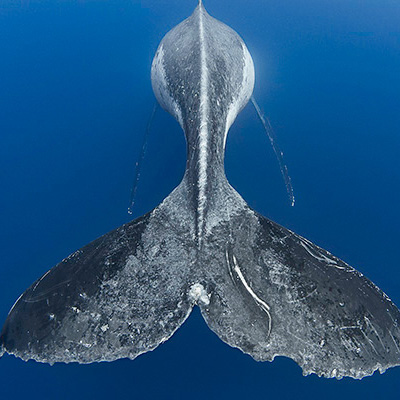
humpback whaleTranslating to imperial units, it’s about seven inches in diameter, which is smaller than most (perhaps all?) European domes. I’ve used/ tested this dome over the past nine months, and I can say without reservation that it’s the best Japanese dome port I’ve ever had.

The glass is high-grade optical glass from Germany; the shape is matched perfectly to my favourite wide-angle perspective (fisheye lens on full-frame DSLR); the glass is coated five times (similar to the process used to make high-end camera lenses; this makes an enormous, enormous difference to light transmission); it’s small enough for me to carry two on trips (for redundancy, and for the ability to use different perspectives) but large enough to provide solid optics. It’s also the first Japanese dome I’ve used that makes it possible to take reasonably nice half-half shots.

I’m not one to do in-pool tests with charts and lines, etc. I don’t have access to the facilities, and I’m not methodical or patient enough. Perhaps someone with more patience than I have will do that at some point. But I can say hand-held-to-heart that if you have a Zillion, Sea & Sea or Olympus housing and want to take really nice wide-angle photos, this dome is a fantastic choice.

Some potential issues with this port: I have yet to test it extensively with rectilinear zoom lenses (planning to do so during next couple of trips), so it’s possible that there will be issues that arise with zooms. To date, the dome is only made to fit Zillion, Sea & Sea and Olympus mounts. That might change in the future, but for now, the dome is only a realistic option for owners of these housings.

If you’re interested in seeing more examples of this dome in action, see my column from Wetpixel Quarterly that I posted recently. All the underwater wide-angle images in that article were taken with this dome, most using a Canon 5D and 15mm fisheye lens. All the images are uncropped.

sea lionIf you want more information about the dome, here’s the website, though it’s all in Japanese for now. You can contact the manufacturer in English via the website for more information or at this email address.

And finally, for the sake of clarity, I had a hand in developing this dome in the sense that I bugged my friends endlessly about the sad state of underwater wide-angle optics in Japan, contributed to the theoretical discussions underlying the dome design, insisted on draconian quality control, and tested prototypes, but beyond that, I have no stake.

This dome has significantly improved my wide-angle image results, and that’s the reason I feel compelled to share this information.

Incidentally, if you’re going to DEMA, there will be one or two prototype domes on display at the Sea & Sea booth. Hold one up to the light and you’ll see what I mean about the five-layered coating.