Marine Life, Places, Adventures, Research
One thing I’ve found the Totomega lens to be really useful for is making fish look almost manga-esque.
Take porcupine pufferfishes (Cyclichthys orbicularis) for instance. Oversized eyes, perpetually puckered lips, prickly unstreamedlined body…what’s not to love?

With the combination of my Totomega lens and the red-light function of a SOLA 600 light, I was able to get really close to one particular pufferfish during a night dive at the Air Manis jetty in Ambon and capture a series of pretty porcupine pufferfish portraits.

When I first visited Ambon a couple of years ago, I went for a tour of the island and bought some grilled fish (I think it was bonito or small tuna) along the way, together with a spicy, somewhat tangy sauce. The fish was fresh, and the sauce was out-of-this-world delicious.
Turns out that the sauce I had is a local specialty called colo colo (pronounced cholo cholo). Dewa, one of the chefs at Maluku Divers, made the sauce for dinner a few nights ago (yes!).

The best way to describe the flavour is probably to say that it’s somewhat like salsa with a Southeast Asian flair. Not quite accurate, but at least you get the idea.
Pak Dewa was kind enough to make some more today, and even to write down the ingredients for future reference (to stop me from pestering him, no doubt).

Ingredients for Colo Colo Sauce:
- Chopped red chili
- Sliced tomato
- Sliced red onion
- Lime juice
- Hot water
- Salt
- Fresh basil
If you visit Ambon, make sure to try this sauce, which is primarily served with grilled fish. Be aware that it carries a bit of a punch from the chili peppers.

Incidentally, there’s apparently a similar sauce in the Manado area called dabu dabu, with the primary difference being that colo colo is made with water, while dabu dabu is made with vegetable oil. Whatever the name, I can at least verify that colo colo is yummy yummy, so I’m confident dabu dabu is as well.
Oh…Hafes, one of the ever-jovial staff members at the resort, saw me taking photos of Dewa and wanted in on the action, so here’s a portrait of Hafes giving his thumbs-up to the colo colo:

For a tiny little tyke, this jawfish sure had attitude:

The look of indignation on its face is unmistakeable, no doubt in response to my having the temerity to interrupt its all-important sand-spitting routine.
In a classic illustration of: “What goes in must come out”, here’s a juvenile star pufferfish (Arothron stellatus) grabbing a treat:

…then getting serious about the task at hand:

…and finally, defecating in my general direction:

I don’t know what it is that makes animals want to poop around, in front of, or at me, but as long as it’s happening, I might as well photograph it, right? (Note: See Shrimp Poo and Whale Poo).
This has been the trip to try new stuff.
In addition to the Totomega insect eye lens, I’ve been using three SOLA 600 lights (made by Light & Motion) for the first time.
I normally don’t use focus lights on my camera, primarily because most lights made for underwater use are some combination of large, heavy and awkward. In addition, many have bulky, brick-like chargers, which can be a pain to pack/ carry.
To date, I’ve relied on natural light during the day and help from a dive guide at night. On occasion I’ve hand-carried a standard dive torch, shining the light with one hand while working my camera with the other. Not the most ideal set-up, but I’ve been making do for many years.
All that’s changed now with the SOLA lights. Here’s why:
First, the lights are small. Really small. Like “fits-in-your-palm, Japanese-miniaturised” small, which means they’re easy to transport, no trivial consideration in this age of draconian baggage restrictions. As a bonus, the chargers for the SOLA are also tiny.

The lights are self-contained, so there’s minimal flooding risk, and no worrying about which batteries to buy/ replace before/ during your trip. Just plug the charger into the back of the light and let the power grid do its thing.
Most importantly, the lights are oh-so-simple to use: Push the toggle on the top of the light forward to cycle through medium, high, and low power; push forward (or backward) and hold for two seconds to turn the light off; twist the toggle sideways to lock the power button; And the best part…pull the toggle backward for red light.
The built-in red light means you don’t have to wrap red plastic around your light for night dives, and you can easily switch back-and-forth between white and red illumination. How’s that for convenience?
In case you couldn’t tell, I love these lights.
After diving with them for a couple of weeks, I’ve found three uses:
1. As a torch. Strap a lanyard onto the SOLA 600, and it’s a lightweight, versatile torch.
2. As a focus light. As I mentioned above, I’ve never used focus lights on my cameras, because underwater lights tend to be bulky and/ or fiddly. SOLA lights are small, light, decidedly non-fiddly.
Also, the red light function is invaluable for night dives. Some of the critters I’ve come across in Ambon still seem to be able to see the red light, but this built-in stealth mode works in most instances, allowing you to sneak up on unwary photographic quarry.

3. As video lights. Two to three SOLA 600s have been enough to light video footage (which I’ll post after I get back) I shot during the Ambon Night Safari with my DSLR cameras. I was able to use a decent ISO (160 to 640 range on my Canon cameras), with exact settings depending upon lighting I wanted, subject size, colour and distance. (Note: Light & Motion has just released a new SOLA 1200 light, which provides even more light for video, in the same compact package.)
It was probably no small coincidence that there were lots of SOLA lights on the Ambon Night Safari trip, since all the participants were dedicated, well-informed divers. We also had a couple of prototype SOLA 1200 units that Eric Cheng brought along.
In summary: For travelling photographers, who need to cut down on baggage, standardise equipment, and have maximum redundancy…SOLA lights are a no brainer. In fact, if you have a dive-addicted person in your life, SOLA lights would make a perfect stocking stuffer for the coming holiday season (how’s that for a subtle hint?).
No product is perfect, of course, so if you get the lights, I’d recommend going easy on the toggle switch that turns the lights on-and-off. I’ve had no issues, but one person who was here snapped the toggle off by accident. The light still worked fine, but without the plastic toggle, it can be a bit more cumerbersome to operate.
Also, a few people experienced a red tint to their photos when they used the red light. This can happen if you allow a lot of light into your photo, i.e., open up aperture, slow down shutter and/ or pump up ISO. I haven’t had this issue, but it’s something to take into consideration when you use the red light function.

To wrap up, I’d like to thank Light & Motion and Scubacam for providing me with the use of the SOLA 600 lights. The lights were critical to getting many shots, particularly several of the photos I took with the Totomega lens at night. Sneaking up with the red light made all the difference.
Rest assured that I wouldn’t talk-up a product I don’t truly love. I’ve lent the lights to several divers who arrived in Ambon after the Night Safari participants left. Based on their reactions, I think it’s pretty safe to say there will be several people purchasing SOLA lights when they get home.
Bottom line…The SOLA 600 lights are a home run.
If you’re an underwater photographer, you may have noticed that the photos I recently posted of Barney the moray eel and the red frogfish have a somewhat unusual perspective.
I took the photos with a new insect-eye lens.
By way of background…the purpose of an insect-eye lens is to allow you to take wide-angle photographs from the vantage point of a very small animal, such as an insect. Some people call it a bug-eye lens, or a WAM lens (short for wide-angle macro).
Whatever your choice of nomenclature, the concept isn’t new. People have been using lenses like this for many years, especially for land photography.
The use of insect-eye lenses in underwater photography has been less prevalent however, probably because major lens manufacturers don’t make such lenses, which means they’re not readily available.
In addition, designing and making an insect eye lens with good optics is complicated and costs a lot of money, which is always a bit of a bummer.
And finally, assuming you actually make a decent insect-eye lens, you then have to waterproof it! What a hassle.
In recent months, several of my friends have been using the insect-eye lens manufactured by Inon and have been producing some really interesting images and video.
This of course made me really anxious to test the new lens pictured below:

The lens is made by a photographer friend of mine in Japan, who calls his creation the Totomega lens. It’s a self-enclosed relay lens that fits on to a custom-built port, which houses a lens attached to an APS sensor camera…in my case, a Canon EOS 7D. The main lens is a 28-80mm Sigma lens, stacked on a 1.4x teleconverter.
When all is said and done, the resulting field of view underwater is somewhere in the 160-degree range.
Shooting with this type of lens is unlike anything I’ve tried before. Given that it’s my first experience with the lens and that there aren’t exactly a lot of people I can ask for advice, it took me a few dives to figure out how to use the Totomega.
Autofocus works like a charm, with one significant catch: The actual focus isn’t where the camera’s focus point locks on, meaning I have to adjust the camera position to take into account the differential in what the camera thinks is in focus and what actually is in focus.
The method I’ve developed to deal with this conundrum is to estimate the lens-to-subject distance for the point I want to be in focus, estimate a distance of approximately 1+ cm closer than my desired focus, AF lock at that distance, then reposition to my actual desired focus distance and shoot, keeping in mind that my desired focus distance usually means lens-to-critter-eye distance, not simply lens-to-critter distance.
Sound complicated?
It is.
I’m sure you can see why it took me a bit of trial-and-error over several dives (accompanied by considerable muttering under my breath) until I figured out a system that works. At this point, I can nail a significant proportion of the shots I try.
Two people on the Ambon Night Safari trip, Eric Cheng and Julian Cohen, had Inon lenses with them, so we inevitably traded notes and compared images. Here’s what we concluded (Eric, Julian: please correct me if I mis-stated or forgot something):
1. The Inon lens requires manual focus. The Totomega uses AF, but the AF position is not where it seems (or at least, I haven’t yet been able to get the actual AF to be where the AF point locks).
2. The Inon lens can focus right up to the lens surface. The Totomega can focus to about 1cm away from the lens surface.
3. The Inon lens can make really small things look big in the frame. Eric came up with the best description for the Totomega’s optical characteristics. In his words: “It makes big things look like small things made to look big.” I love that description.
4. When both lenses are at their sharpest, the Totomega lens is sharper than the Inon lens.
5. Both lenses are good for shooting video.
6. Both lenses exhibit significant chromatic aberration.
The bottom line is that the two lenses were created with a similar objective, but have different optical characteristics. Both are a challenge to shoot, but the unique perspective can make the effort worthwhile.
I’m sure there are still many things I’ll figure out in the next couple of weeks, and I’ll have to cross-check my experience with my friend in Japan after I get back home.
I have a suspicion that there may be some way to tweak my lens set up so that I can focus more closely. I hope that’s the case, so that I’ll be able to use this lens for smaller subjects in the future.
Given my limited experience with the lens so far, please consider my views on the Totomega an evolving (mis)understanding, rather than a definitive description.
If you’re keen to see frogfish, there are a lot in Ambon (major understatement)!
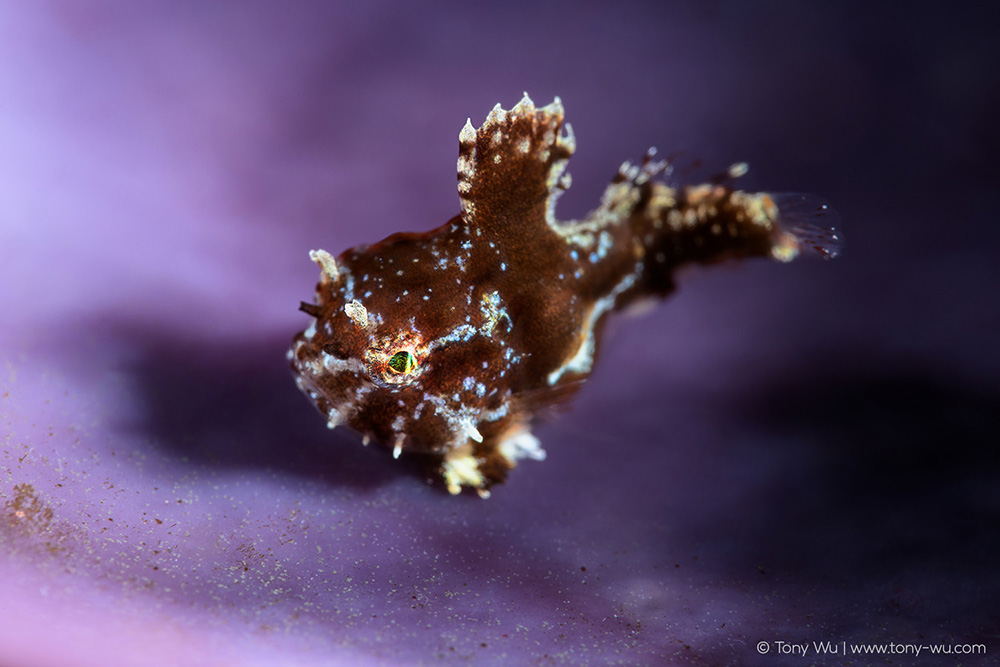
Phil, one of the keen-eyed divers on the Ambon Night Safari trip, counted 18 (or was it 20?) different frogfish over the course of eight days of diving, including this pretty reddish one:

Among other frogfish highlights I can recall were several pitch-black frogfish, a few yellow ones, a white one, several mottled-puke colour individuals, and a lovely lavender fish.
Unfortunately, we didn’t see the Maluku frogfish, but that’s not surprising given how rare sightings of that enigmatic piscine are.
Internet access at the Maluku Divers Resort in Ambon is now live!
Bandwidth is limited though, so I’ll keep my updates short and sweet.
The Night Safari was a huge success, with all sorts of critters coming out after dark to play. In fact, I’m so infatuated with diving after dark now that I’m taking the days off and saving the bulk of my bottom time for the night shift.
One of the highlights of my recent nocturnal forays was an extended encounter with the largest(!) moray eel I’ve ever come across:

I think it’s a honeycomb moray (Gymnothorax favagineus).
If you have kids (or you have childish tendencies like me), you might note the uncanny resemblance to Barney the dinosaur, except for the colour of course. (For the uninitiated, Barney is a talking purple dinosaur. Really.)
I felt compelled to name this eel Barney, because well…an animal that’s as thick as a sumo wrestler’s thigh and looks like a cuddly T. rex deserves a proper name.
If you visit Ambon and want to pay respects to Barney, he (I don’t actually know if it’s a he or a she) makes nightly appearances at the Laha 1 dive site.
Finally. My junk gear is sorted. My batteries (both literal and figurative) are charged. My head is (as) clear (as can be expected). And I’m headed to Ambon.
This will be my third visit to Ambon in as many years, but this trip will be anything but routine.

It’ll be my first opportunity to stay at the new Maluku Divers resort, which is conveniently located right next to the area’s main muck diving sites. The new resort was designed and built by my friend Yos.
Also, this will be the second Night Safari I’ve run this year. The first was at Kasawari Lembeh Resort (also designed and built by Yos) in the Lembeh Strait back in late February. Here’s a video from the Lembeh Night Safari to give you an idea of some of the awesomely cool stuff we saw.
The basic idea behind the Night Safari concept is simple. Instead of diving during the day, we’ll spend several days diving only after dark, when lots of creepy crawlies come out. Life doesn’t get much better than that now, does it?
Given the new resort’s prime location next to the main muck sites, access to Ambon’s nightlife should be easy, and I’m hoping that we’ll see lots of neat things like mating behaviour, predation, and of course, a plethora of bizarre, butt-ugly critters.
I also have a lot of new equipment and crazy ideas to try out. For example, I have three SOLA 600 lights with me, which I’m planning to use both as focus lights and for video.
I’ve never attached a focus light to my housing before, mainly because underwater lights tend to be bulky, unwieldy and clumsy…not exactly conducive to sneaking up on wildlife. The SOLA lights are unbelievably compact and easy to use, so putting one on my housing is a no-brainer. The built-in red light should also be quite handy for approaching shy animals at night.
I’ve also downsized strobes and am only taking Inon S-2000s, six to be precise. Some people seem to think that you need strobes the size of VW beetles in order to take decent photos. I relied almost entirely on YS-50s and YS-30s back in the day (how many of you remember those?), so I’m hoping that my “small is beautiful” gamble will pay off, especially since I don’t anticipate doing much wide-angle work on this trip.
Finally, I have a bunch of knick-knacks I’ve knocked together to try out (with a lot of help from my friends at Aquaforum and Zillion), some of it geared toward trying to take better video footage underwater with my DSLR cameras, some of it just experimenting with light as I always do. I have no idea if any of the stuff will work, but there’s only one way to find out. Right?

If you’re joining me in Ambon…see you soon! If you’re not, I’m hoping to have a decent enough net connection during my month-long stay to post photos every once in a while, so please check back for updates.
Incidentally, here’s a bit of video (shot by Chutinun Mora) of the recently described Maluku frogfish, aptly named Histiophryne psychedelica, which to date has only been seen in Ambon.
A package from Ogasawara arrived for me while I was in the UK, and I finally had time to open it a little while ago.
Inside were the trio of smiling sperm whales below, which will go nicely with the spectacular sperm whale carving I got from Ogasawara last year:

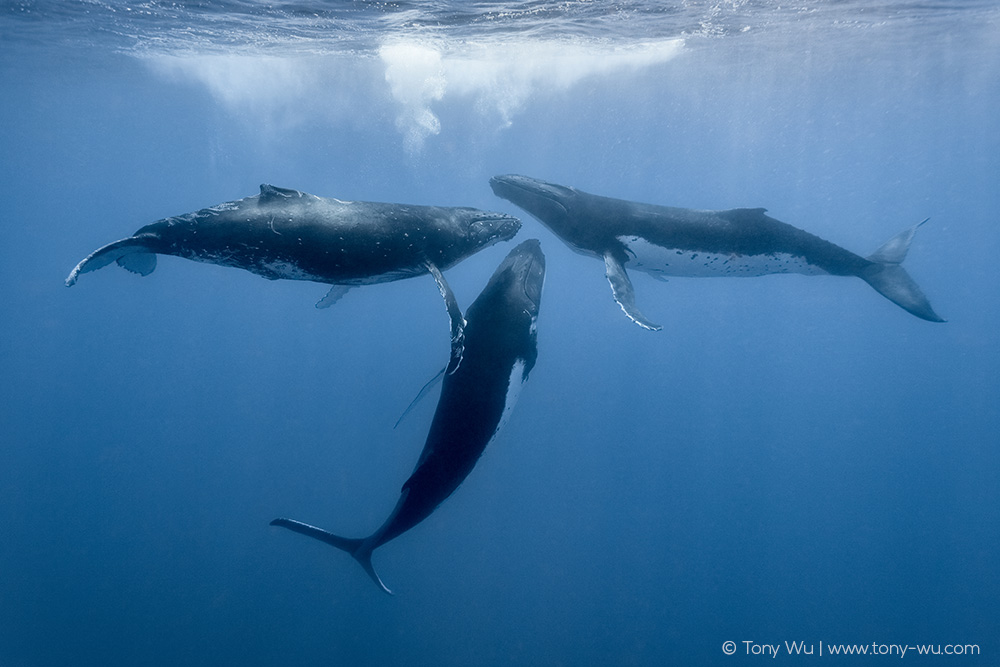
…and also this lovely humpback whale, which I named Poto, in honour of a wonderful baby whale we had the privilege of encountering toward the end of my stay in the Tonga this season.

Poto was the 19th calf we ID-ed in Tonga.
Yes…I know I’m way behind on putting together my calf summary for Tonga this season. Please bear with me. After I get back from Ambon, I should be staying put for a while, so I’ll have a bit of time to catch my breath and catch up with the calf ID project.
Late last night, while browsing for books to download and take with me to Ambon, I had the crazy, some would say insane, notion that I might try reading Moby Dick again (I’ve tried and failed at least a dozen times).
When I typed “Moby Dick” into my chosen online bookstore, this is what I saw:

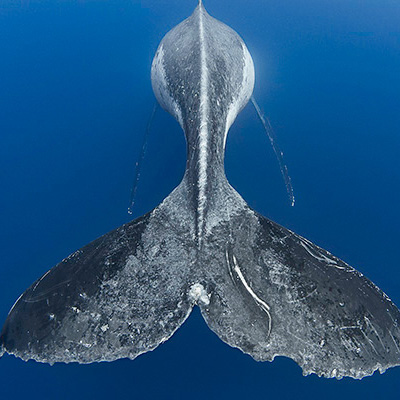
Any way you look at it, this is a well-mannered humpback whale enjoying a frisky frolic in the sun. And here I was thinking for so many years that Moby was an all-white sperm whale with a bad attitude and a penchant for torturing semi-deranged seamen.
Amazon.com had more than one Kindle edition of Melville’s masterpiece available, at least two of which featured the same species shuffle.
So…I guess this means that Amazon’s mistake wasn’t just a fluke (Sorry, I couldn’t resist the horrible pun).