Archive for December, 2011

My Top 10 Underwater Photographs for 2011

Putting together Top 10 lists is a popular thing for websites to do at the end of the year.

I generally avoid trends, but I like this one, because the process of stepping back and getting perspective on what you’ve experienced and achieved over the preceding 12 months is an excellent way to set goals for the upcoming year.

It’s also a nice opportunity to recap and share some highlights of the year…to recall the good times, as well as the challenges.

I’ve just skimmed through my blog posts from 2011, and picked out ten of my favourite photos, listed in chronological order.

The first is this image of Ron Leidich and Terry Ward in the entrance of one of the hidden lakes in Palau’s Rock Islands:

Entrance to hidden lake in Palau rock islands
Ron and Terry in a tunnel leading to a hidden lake in Palau’s Rock Islands

I like this picture because it encapsulates everything about the unique and educational experience I had in February of exploring Palau by kayak. Getting into and out of concealed lakes was often a logistical challenge, to say nothing of the difficulty involved in documenting the experience with photos.

To capture this image, I had to swim several times between our mother boat and the island in order to haul my gear up and over sharp rocks and hydroids into the narrow opening, then get Ron and Terry into position and set up the lighting before ambient light levels fell and the incoming tide trapped us.

We were on a tight schedule and only had one try, with a window of 20, no more than 30, minutes, so I was elated (shocked almost!) when the shot actually worked.

The second photo I picked from the trip is a more traditional underwater image of a coral reef in shallow water.

Thriving coral reef in an area that was devastated by El Niño in 1998 and crown of thorns thereafter
Thriving coral reef in an area that was devastated by
El Niño in 1998 and crown of thorns thereafter

It’s not technique, lighting, composition, etc. that makes this photo stand out for me. It’s the fact that this reef is living testimony to the tremendous self-healing and recovery capability of Mother Nature. It’s a symbol of hope…a reef system that defied all the doom-and-gloom, end-of-days pronouncements by experts in the wake of the massive El Niño in 1998. It’s cause for optimism.

Next up are two photos of Australian sea lions (Neophoca cinerea), the first of a friendly young sea lion coming in to give my camera a neighborly nuzzle and kiss:

Young Australian sea lion coming in for a kiss

…and the second of two sea lions play-fighting:

Two fighting Australian sea lions
Two male sea lions having a friendly discussion

I love interacting with pinnipeds, and these two photos taken together show the extremes of their behaviour. If you’re a dog-lover like me, you’ll have no problem imagining what it’s like to swim with these precocious animals. It’s like being surrounded by hyperactive labrador retrievers…except that you’re in the water, and they can swim (a lot!) better than you.

A shadow hung over my time with the sea lions this year, as the earthquake+tsunami+nuclear reactor meltdowns in Japan took place just as I arrived in Western Australia, but the fact that I was with great friends (including three terrific kids who had an absolute blast with the sea lions) helped to balance things out.

I’m planning a return visit in March 2013, so let me know if you’re interested.

Pretty soon after playing with the sea lions, I took an exploratory trip to Sri Lanka, where I had some amazing luck. Among the highlights was an encounter with a manta ray that head-butted me twice:

Rear view of a manta ray feeding at the ocean surface

I like this angle, because it’s different from most manta images. It took a lot of swimming and a number of attempts to get the manta’s tail lined up just right, when the tips of both of the animal’s wings were out of the water.

The back story of this head-butting manta is interesting, and worth a read if you like enigmas. Naturally, there was some debate about whether the manta really made a sound or not before colliding with me.

I’m 100% certain of what I heard, and there was another person in the water with me who heard/ saw the exact same things. Capt. Craig of Golden Dawn also reported a similar sound from a manta in PNG; I’ve appended a note to my original blog post with Craig’s comments. Have a read, and please let me know if you come across mantas (or other rays) making odd sounds.

Also during that trip, I managed to swim through the biggest cloud of sperm whale poo I’ve come across so far. You gotta admit, it’s impressive!

This is the biggest dump I've ever seen from a sperm whale.
This is the biggest dump I’ve ever seen from a sperm whale.

You might think it odd that I’d pick such a photo for my ten favourites of the year, but c’mon, no one can resist gawking at that enormous effluent emission.

As if batoid head-butts and odontocete defecation weren’t amazing enough, I had the mind-blowing experience of having two blue whales swim toward me, slow down to make eye contact, wish me a good day, then merrily carry on with their official whale business:

Blue whales swimming in blue water
Blue whales(!) swimming in blue water

In case there was any doubt, I can confirm that blue whales are…big!

Then it was off to Papua New Guinea, where I spent a month aboard MV Golden Dawn, harassing Captain Craig and Bob Halstead.

I didn’t do much macro photography this year, but on this trip, I nailed a super-macro shot of Dinah’s goby (Lubricogobius dinah), a fish I’ve been wanting to photograph for a decade or so:

Super-macro shot of Dinah's goby (Lubricogobius dinah)
Super-macro shot of Dinah’s goby (Lubricogobius dinah)

Photographing Dinah’s goby involved using a rebreather, lugging an elaborate camera set-up, and putting in some deco time, but it was worth the effort. Bob and Dinah Halstead documented this fish and had it described, so it was an honour to have Bob find the fish for me, and to be able to help Bob get a print made for Dinah!

My final two picks for the year are from Tonga. It was such an amazing season, with a record 48 humpback whale mother/ calf pair IDs, that it’s extremely difficult to select just two photos.

This picture is special because the adult female is one that I first photographed and ID-ed in 2009. I recognised her immediately on sight. She had the same even-keeled temperament that she did two seasons ago, and her calf was playful, confident and friendly, just like her calf in 2009.

Humpback whale mother and calf in Tonga
Toluua, humpback whale calf #32 of the 2011 season, with mommy

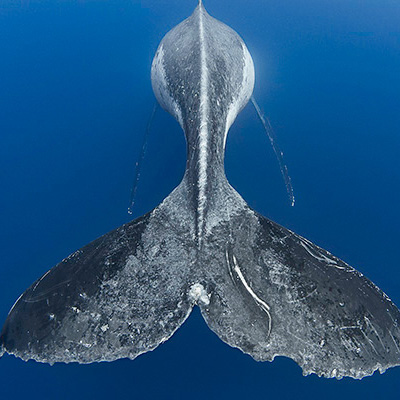
And last but not least, I am quite fond of this photo of a male humpback whale singing:

Fluke of a humpback whale singer

I’ve spent time with and photographed a lot of singers, but this had to be the most cooperative one ever. From the moment we made eye contact, I could tell that the whale didn’t mind my presence. The white along the sides of its body, and the curly, twisty scar on the right side of its fluke really give the whale character, making for a beautiful portrait of a beautiful animal.

Well…there are certainly many more photos that I liked, but a Top 47 list doesn’t have quite the same ring to it as Top 10 does.

All of these images are more than just pictures to me. They are reminders of incredible experiences, of memories and lessons learned that no amount of money can buy, of another year well spent exploring the world, making friends, and…hopefully…becoming a better photographer and person.

A Christmas Tail

Here’s a happy holiday story for you. This has nothing to do with underwater photography, but I hope it inspires some appropriately warm, mushy feelings for the festive season.

The protagonist in this tale is Muji, a feline friend I made in 1999, pictured here sunning himself in the swank London apartment where he now resides:

Cat sunning himself in window sill
Muji sunning himself at his London residence

Muji started life as a homeless street kitty in Holland Village in Singapore, where, one balmy evening, he decided to enlist my assistance to better his lot in life.

I was standing on the sidewalk, talking with a friend after dinner. Just as I was about to head to my car, I felt something rub my ankle. I looked down and saw a scrawny little kitten, barely big enough to cover the palm of my hand, rubbing itself against my ankles, wrapping its tiny tail around me while making that low-pitched, deep-throated gurgling sound that furry felines specialise in.

Kneeling down, I picked the kitten up by the scruff of its neck and did a quick visual inspection. Male. Ears, nose, eyes, paws, teeth…all clean. No scratches or wounds. No fleas. No ticks. Perfectly normal, other than the fact that it was far too small to be on its own.

I spun around several times in search of a mommy cat or sibling kittens. No luck. There were no homes nearby, so it probably wasn’t lost.

Growing anxious, I held the kitten out to passersby and asked if it belonged to them. All I got were strange looks. More than a few people hurried away, with callous disregard for the plight of an increasingly desperate man, standing in the middle of the pavement, at night, holding a kitten, calling out to anyone who would listen.

After a while, my muscles started to fatigue from holding said kitten out at arms length, so I placed it in the crook of my left arm. Kitty pushed and pulled, shifted and shoved to make a few adjustments to my limb position, then snuggled in, gurgled, purred…and fell asleep.

That was how I came to be the owner of a cat.

Cat curled up asleep
This is how Muji got me to adopt him

When I first took Muji home, Pasta (my golden retriever) sauntered over for a salutory sniff, as amiable goldens are wont to do. Tiny though he was, Muji hissed and growled up a storm, leaving no room for doubt about who was top dog now (so to speak), giving poor Pasta a considerable fright in the process.

Muji’s less-than-cordial initial greeting made Pasta a nervous wreck for a few days, until the two reached an inter-species détente of sorts and learned to like one another (meaning Muji used Pasta as a fluff pillow while Pasta accepted her fate with stoic canine dignity).

Somewhat unusual for a cat, Muji stayed with me 24/7. He followed me everywhere. His favourite activity (besides sneaking up on Pasta and snickering when she jumped) was sitting on my shoulder, going along for the ride wherever I walked, drove or sat.

Instead of a footloose and carefree pirate with a multi-hued parrot on his shoulder, picture a Chinese guy with scrawny stray cat on his shoulder.

Muji and I shared many (mis)adventures together…far too many to relate here…but one in particular stands out…the day I gave Muji a shower.

It seemed like a good idea at the time. Pasta, after all, was enjoying her weekly shower, basking in the spray of water as I hosed the suds off her in our driveway. It was sunny; sparrows were chirping. It was the perfect day to shampoo one’s four-legged friends.

When the first drop of water touched Muji, he screamed. Literally so loud that I’m sure everyone within a kilometre heard him. Up until then, I wasn’t aware that cats were capable of screaming, but it seems that they’re pretty good at it when the occasion warrants. Go figure.

Anyway, Muji was still a tiny tyke, so I was able to hold him down during his involuntary ablution, suffering only a thousand or so scratches on my forearms in the process.

When all was said and done, I had the cleanest, best smelling cat in Singapore. It was therefore somewhat unfortunate that Muji was far too incensed to appreciate the faint bouquet of lilac that wafted up whenever he slunk by.

For many days thereafter, Muji wouldn’t come near me, much less sit on my shoulder. He scowled, snarled and sulked, refusing to acknowledge my existence (except at meal times of course).

It took a contrite apology and sincere promise from me never to inflict such an indignity upon him again (along with a good chunk of catnip) for Muji to let bygones be bygones and re-establish his quasi-permanent perch on my clavicle.

Cat on a cabinet
Muji on a cabinet in his new home

Along came the day when I had to prepare for an extended trip. Pasta had quite a few friends she could go stay with, but I needed to find someone to take care of Muji. Fortunately, Yoko-san, a friend who lived not too far away, agreed to take him in.

I have to confess that when I dropped Muji off, I felt a pang of separation anxiety, exacerbated by a nagging concern that my little kitten might suffer trauma at being abandoned…especially given his origins as a stray.

To make a long story short…Muji and Yoko-san got along famously. In fact, they got along so well that when I went back to pick Muji up and was about to leave with kitten (and kitty bed, kitty food, kitty litter, kitty toys, kitty treats, kitty blankets, kitty pillows, etc.) in tow, I saw a tear forming in the corner of Yoko-san’s eye.

Now…here’s the thing. Fond as I was of the young lad, it wasn’t never my intention to have a cat. My dog was responsibility enough, and the most important thing to me was to ensure that Muji had a good home.

In fact, the reason I named Muji Muji was that the term is a contraction of “Mujirushi” (無印), the name of a brand in Japan, which literally translates to “no name”. In other words, I didn’t want to name Muji, because I didn’t want to get attached.

Sensing opportunity, I asked Yoko-san if she wanted to adopt a kitten. The answer was obvious.

So that was how Yoko-san came to be the owner of a cat.

Two cats sleeping together
Yoko-san eventually became the owner of two cats

After Muji settled in with his new family, another stray kitten joined them, and they’ve been living the good life ever since.

From his humble beginnings as a homeless street kitty, Muji has come a long way. After enjoying a peaceful, pampered life in Singapore (with the minor exception of the aforementioned shower incident) and Japan, Muji has most recently taken up residence in London (via cross-continental flight Tokyo to Paris, hotel in Paris to recover, car ride to Calais, ferry to Dover, car ride to London), where he’s looking forward to many a new adventure, good English food (or maybe not), and lots of lazy afternoon naps.

On that happy note, permit me this opportunity to wish you a happy holiday season, and a wonderful new year ahead.

Cat in window sill looking outside
Muji surveying his new domain

Humpback Whale Singer Audio

Locating humpback whale singers underwater is a challenge, but it’s fun. There’s nothing quite like tracking down a singer bit-by-bit, swimming along, scanning the water until the vague outline of a cetacean emerges from the misty blue haze.

Sound travels so well underwater that it’s extremely difficult to gauge direction and distance. Also, singers can stay down for extended periods of time, often diving too deep to see, sometimes swimming as they sing, sometimes sitting in plain sight but countershaded so well that you cruise right past them.

We found 14 singers this season, which is pretty high. Single-digit tallies are more common, not necessarily because there aren’t more singers around, but due in large part to the amount of time and effort it takes to track a singing whale down.

We came across the first singer of the season on 13 August, pictured below:

Humpback whale singer, Tonga 2011. Note the lopsided fluke.
First humpback whale singer I came across in the 2011 season.
Note the lopsided fluke.

The water wasn’t clear (bad viz. characterised the season), but the whale wasn’t too deep, about 15m (around 50ft) or less at the fluke from what I remember. It stuck around long enough for everyone to get a good look, and for my friends Debbie and George to record some video. (Debbie actually recorded the video. It was enough for George just to stay out of the way.)

They just forwarded me the following audio tracks of the singer, which they extracted from the video footage (Thanks Debbie, George!).

It may not come across in these recordings, but it seemed like the bass this year wasn’t as deep and booming as normal. I hung directly overhead this one and several others this season, and I didn’t get the same intense reverberation in my body as I have in the past.

Here’s a video from the 2010 season showing what it’s like to make a short courtesy call to a singing humpback whale. This one was considerably deeper, 20-25m at the fluke.

10 Tips to Help You Win Photo Contests

The winners of the 2011 Ocean Art Photo Contest were just announced a few days ago.

If you get a chance, it’s worth clicking through to take a look at the selected photographs. There are some real “crackers” among them…to borrow a term that Marty Snyderman used many times during our group chat with fellow judges Martin Edge and Bonnie Pelnar, along with contest organisers Scott Gietler and Michael Zeigler.

The judging process for competitions like this is opaque, at least to people who submit photos. After you enter a contest, the next thing you hear is either “Congratulations, your image placed!”, or nothing. Zip. Crickets.

In either instance, you might scratch your head and wonder why your photo was selected or why it wasn’t, as the case may be.

This can be frustrating. Especially if you’re looking to enter more contests in the future and could do with some feedback on the things you did well, as well as hints on how you could improve your odds of success.

I’ve had the honour of helping to judge several contests in recent months (DEEP Indonesia, Underwater Festival, Ocean Art) so I thought I’d share a few pointers as a means of providing some insight into how photos are selected or weeded out…pre-game mental prep for next year’s contests, so to speak.

One caveat…the thoughts below are personal; they are things that affect my decision process. I am not in any way speaking for any of the other judges or contest organisers, so please don’t give them grief if you take issue with anything I’ve written.

Whether you find yourself nodding and thinking: “Go figure. Tony actually has some good points” or shaking your head in disgust and sighing: “What an numbskull,” I hope the issues I raise below will be thought-provoking and perhaps even help with your entries in upcoming contests.

For what it’s worth, following are some of the key points that go through my mind when looking through photos.

1. Weed Out the Obvious
I’m referring to things like out-of-focus images, poorly lit photos, blurry shots (not intentionally so), and other basic issues with the techniques and mechanics of photography. In many contests, the organisers pre-screen entries, so a lot of these get taken out before the judges see them. But sometimes a few slip through, and in some cases, there isn’t any pre-screening.

To cut to the chase…there’s just no point entering images with issues like these. I know, that’s harsh, but in order to stand a chance in any decent competition, you need to be your own worst critic.

If you find it difficult to be cold-hearted and objective about your own images, try to find someone you trust who can tell you: “This sucks!” without hurting your feelings.

Bonus points if that person can explain why as well.

2. Weigh the Subtle
These are considerations like composition (just a tad to the right, cropped a bit tighter, etc.), overall eye-catchiness (a bit hard to define, but obvious when you see it), minor blemishes and irritants.

Subtle issues are things that could go either way, depending to a large extent on the level of competition. What I usually do is take a quick run through all the images in a given category and make an initial gut assessment of overall quality level.

I don’t pick any photos. I just make a mental note of whether the category is say super strong, so-so, weak, etc. When I go back through to do a first cut, the stronger the entries are, the harsher I am with subtle points.

Images in a photo competition are, after all, judged against peer entries.

Here’s one example of something that might sway my opinion: Say you have a mind-blowing photograph of a bunch of manta rays taken near the surface, but just visible in the background is a diver with his head out of the water…so what you see, in effect, is a headless diver. This doesn’t necessarily mean I’ll cut the photo in question, but if there are other strong entries in the category, it’ll definitely affect my decision.

3. Bemoan the Tragic
In every contest I’ve helped judge, there have been great photographs that were entered into the wrong category. In the most recent Ocean Art Photo Contest, there was a very nice photo entered into the Marine Life Behavior category, one that I immediately pegged as a high quality entry.

The thing is, when we got together via the magic of the internet to discuss our choices, we came to the reluctant consensus that the photo didn’t actually show any behavior per se. Had it been entered in the Portrait category, I’d wager that it would’ve been among the top choices.

Bummer…because I really liked the photo and wanted to give it recognition. (Translation: I whined, but the other judges were correct.)

I suppose this goes without saying, but when you enter a competition, it’s a good idea to read the category descriptions and ensure that you put your images up for consideration in the most appropriate one.

4. Nix Xerox Shots
There is a fine line between emulating someone’s photo style, and just plain copying it. One of the advantages of being involved with several major contest is that I’ve seen lots of images. I don’t always pick up on photos that are straight copies of other winning photos, but when I do, I immediately cut them. No questions asked.

I might be more of a stickler about this than other people are, but to me, photography is art. Art, by definition, requires originality.

There’s certainly nothing wrong with studying other people’s images and learning from them (in fact, that’s the best way to improve), but if you want your images to receive recognition in a competition, avoid using the Xerox machine.

5. Bin Trendy Shots
Trends and fads come and go. I hate fads of all types, not just ones pertaining to photography. Fads can be subjects; fads can be techniques; fads can be places. But in all cases, fads are easy to recognise, and they’re bad…especially in the context of entering contests.

With the ease of communication and information flow facilitated by the internet these days, it’s particularly easy to sucked into the latest trend. There is absolutely nothing wrong with going to the latest “in” destination, photographing the latest “cool” animal, or trying the latest “new” gadget, but just keep in mind that when everyone is visiting the same place, photographing the same animal, or using the same tool…it’s difficult for your image to stand out from the crowd, because by definition, fads foster conformity, not originality.

An example here is the use of snoots. Snoots are not new or original by a long shot. In recent months though, they’ve become an “in” thing, with lots of photos that were obviously taken with a snoot showing up on the net and in contests. Whenever I see a photo with an overexposed spot/ cone of light surrounded by black, I want to gag.

Don’t get me wrong. I have used snoots and snoot-like instruments for dog years, and I love them. But the thing about snoots is that they are tools. They are not magic sauce that makes an otherwise dull photo into a prize-winning image.

And as with the use of other tools, it’s usually best when the result is subtle. In other words, if the first reaction that someone has when looking at your photo is: “Oh, you used a snoot”, then the tool has overpowered the subject.

Photography is about subjects, not tools.

6. View Greyscale/ Monochrome Shots with Scepticism
If you greyscale an underwater image or convert it to black and white, there has to be a good reason. Too often, people do this just because the visibility is bad. That’s not a good reason; bad viz. is just part of underwater photography.

There are certainly some images that work well in greyscale or black/ white, but shooting in monochrome is a different discipline, requiring a dedicated thought process/ approach, and in many respects, can be more difficult than photography in colour. This is true whether you’re shooting underwater or on land.

Simply using software to change colour to monochrome doesn’t cut it in most cases for underwater images.

If by converting your image to monochrome, you bring out an important point or evoke a feeling/ emotion that wouldn’t work in colour…terrific! But if that point, feeling, etc. isn’t immediately obvious, don’t bother.

7. Consider Photo Quality Over Subject Matter
Photo competitions are first and foremost about photo quality.

This may sound like a “duh” statement, but there are always photos that appear to have been entered for subject matter rather than photo quality.

Photos of big animals most often fit this description, but this also applies to photos of rare animals or amazing events.

Big animals have charisma and presence, so as subjects go, they stand out. More people can relate to sharks, rays, dolphins, whales, and such than to teeny-tiny crustaceans, for instance. But there isn’t an automatic hierarchy that dictates that big animal shots are better than small animal shots.

Ditto for amazing events like the Sardine Run, sailfish in Isla Mujeres, mantas at Hanifaru, whale sharks in Cenderawasih, and so forth.

It’s easy to get carried away by the excitement of seeing amazing events, or getting a photo of a great white shark, but in my book at least, if you enter a photograph of a big animal or spectacle, the picture has to be more than good. It has to be out-of-this-world fantastic (like this winning manta image taken by Tobias Friedrich).

Bottom line…I’ll always choose a fantastic shot of a smaller animal over a mediocre photo of megafauna or mega-event.

8. Look for Originality
By this stage, I will have reduced the number of photos to a manageable number, and I’ll shift gears from looking for reasons to toss out entries to seeking reasons to choose winners.

The first thing I look for is originality. This is, in a way, the inverse of #4 above.

There is no easy way to define originality, but I know it when I see it. Look at the winning photos in any decent photo contest, and there will be a high originality quotient.

As but one example, look at this winning photo in the Nudibranch Category, taken by Salvatore Ianniello.

The radiating tube worm “ceiling” made this shot stand out like a penguin in Times Square. Maybe someone else has taken an image like this before, but I haven’t seen one like it. It was an instant “Like!” for me.

9. Look for the Wow! Factor
A related, difficult-to-describe attribute I look for is the Wow! factor. Perhaps above all else, this is the single most important ingredient in a prize-winning photo.

It’s the quality in an image that makes you stop, take a second look, and mutter “wooooow” as you stare at the picture. It’s often an intangible quality not attributable to any one factor, but is something that’s conveyed by the entirety of the photo in question.

Again, take a look at the winners of any photo contest, and you should experience a number of “oooooh” and “aaaaaah” moments.

10. Listen to the Force
Finally, it comes down to personal choice.

The best competitions receive lots of technically perfect entries that are original and have Wow!-factor appeal.

Every judge has different likes and dislikes, so given the same pool of photos, it’s highly unlikely that any two judges will come up with the same selections. In the most recent contest judging, I had a chance to group chat/ discuss with the other judges, which was useful and fun, as it allowed us to exchange views and share observations about photos that we felt deserved recognition.

Listening to the reasons why someone else liked a photo changed my perspective in a few instances. As with many aspects of life, listening was as important as talking, if not more so.

Conclusion
So that’s it. There’s certainly nothing earth-shattering in what I’ve spelled out, but I hope that writing out some of my thoughts will help shed a little light on what happens behind the scenes, not just in this most recent competition, but for all photo contests in general.

While the list above applies just to me, and there are some points that are unique to underwater photography, I suspect that most judges for most photo contests go through a similar mental process.

You may have already picked up on this, but the selection process is often as much, if not more, about elimination as it is about picking winners.

So when you’re deciding which photos to enter, it might be a good idea to make like you’re a judge, and edit/ cut/ select photos accordingly.

One last note before wrapping up…always bear in mind that if your photo wasn’t picked, it doesn’t necessarily mean your photo wasn’t good, or even great. The best contests are the ones that receive a plethora of mind-blowing entries, which often makes it impossible to give recognition to every photo that deserves it.

Santa Claus(e)

I guess I’ve been a good boy this year. Santa Clause just added me to his Google+ Circles:

Santa Clause added me to his Google+ circles :)

Whales, Whales, Whales

If you’ve been following my ramblings in recent months, it’s probably obvious that I’ve been spending an increasing proportion of my time with large cetaceans. My schedule for next year is no exception, with 12 to 13 weeks or so planned for sitting on a boat staring at the ocean hoping something will show up whale photography.

For those of you who are crazy enough to contemplate joining me on one of these adventures, I’ve set out basic trip descriptions below.

If you read on, you’ll no doubt notice that many of the trips are already booked. This is because I keep a list of people who contact me in advance, and I do my best to get in touch with anyone who’s expressed interest before announcing trips on my blog. I also send out an e-newsletter in advance of posting to this site.

If you’d like to get a heads-up for future trips, please contact me via my contact form, or sign up for my trip newsletter.

Please let me know if you’re interested, even if the itinerary you’re keen on is full, as I keep a wait list for each of the trips. Life happens sometimes, and people who’ve signed up end up needing to change their plans.

Blue Whales, Sperm Whales in Sri Lanka
Dates: March/ April 2012
Availability: Fully booked

This trip requires someone who is accustomed to less-than-ideal circumstances, can deal with frustration, and can accept the possibility of being totally and utterly skunked.

Sounds like fun, no?

To be a good fit for this adventure, you need to be very, very experienced in the water, be easy-going and cooperative, and have a stable, mature personality.

On the upside, there is the prospect of seeing scenes like the images below, as well as other potential surprises:

Sperm whale swimming upside-down to check me out with sonar

Blue whales(!) swimming in blue water

Minke Whales in Australia
Dates: 28 June to 7 July
Availability: One spot available
Location: Fly into/ out of Cairns, transfer to Port Douglas
Accommodation: Liveaboard trip

Minke whales have been on my to-do list for a long time. As far as baleen whales go, they’re relatively small, running six to ten metres in length. They’re inquisitive…as in, they’ll come right up to boats and people in the water given the right mood. They’re also reasonably easy to find…if you get the timing and location right.

For these reasons, I’ve planned a trip Down Under to spend some quality time with the minkes that congregate at the Great Barrier Reef.

We're heading over during absolute peak minke whale season
We’re heading over during absolute peak minke whale season.

The plan is to get on a boat in Port Douglas on 28 June, cruise overnight to minke central and sit there until we leave on 6 July to head back. That’s eight full days with minkes, only minkes, and just minkes.

We’ll be in the Great Barrier Reef Marine Park, so we’ll be following the well-established guidelines for in-water interactions with the small cetaceans, letting the whales dictate the pace and proximity of interactions.

I specifically picked the timing for this trip based on advice from my friends John Rumney, who is one of the leading authorities on minkes Down Under, and Julia Sumerling, who has many years of minke experience under her belt from working as the video/ photo pro on Mike Ball’s boat.

To cut to the chase, our trip will be during peak, peak minke time.

For whatever reason, the minkes show up like clockwork at this time, and more importantly, they demonstrate the greatest level of interest in people around this period.

Incidentally, the minkes in this area are a subspecies known as dwarf minke whales, which were first described in 1986. From what I gather, there is still no population estimate for this subspecies, and no consensus on the taxonomy for minke whales in general.

For more information about the dwarf minkes, please see the excellent summary prepared by the CRC Reef Research Centre (PDF file).

Minkes are curious, and some will approach really close
Minkes are inquisitive, and some will approach really close.

Humpbacks Whales in Alaska
Dates: 22 to 31 July
Availability: Fully booked
Location: Trip begins and ends at Juneau, Alaska
Accommodation: Liveaboard

This is the Megaptera Mania! trip I’m running with Jon Cornforth.

I’m really excited about heading to Alaska for the first time. I’m not so keen on the fact that it’ll be colder than I normally like, but bubble-net feeding and dramatic, mountainous terrain in the background will hopefully make it worthwhile, and also worth a repeat visit in 2013.

Humpback whales bubble-feeding at sunset in Alaska

Humpback whale breaching in Alaska

Humpback Whales in Tonga
As soon as we wrap up in Alaska, I’ll be heading over to Tonga for my annual stay, and to continue my calf count project. After the record number of baby whales I ID-ed this year, I can’t wait to see what happens in 2012!

My schedule for Tonga is still evolving, but here’s how it looks at this time:

Trip 1: 21 to 28 August. This is the second part of the Megaptera Mania! trip. Fully booked.
Trip 2: 29 August to 06 September. Two spots available.
Trip 3: 08 to 17 September. Fully booked.
Trip 4: 25 September to 3 October. Four spots available.

Tahafa, calf #14 of the 2011 season, with mommy

Fluke of a humpback whale singer

Eastern Fields Trip

A couple of places have opened up for one of the trips I’m leading to the Eastern Fields in PNG in association with Wetpixel. [Update 5 Jan: Spots filled]

The trip is for 10 to 20 January 2012, aboard MV Golden Dawn. We’ll be heading out to a submerged coral reef atoll system in the middle of the Coral Sea, where the corals are unspoiled and fish teeming, like this:

Millions of fish at Carl's Ultimate dive site in the Eastern Fields of Papua New Guinea
This is what my favourite dive site
in the Eastern Fields looks like when it’s rockin’

The photo above is from the most intense, fish-filled, absolutely insane reef dive I’ve ever done, at a site in the Eastern Fields called Carl’s Ultimate, named for my friend and mentor Carl Roessler. There’s so much action that you’ll want to go right back in (or, if you’re on rebreather like me, you’ll just stay in for three hours or so at a time, come up to scarf down cookies and chocolate cake, then drop in for another three hours).

To give you a better sense of the diving in the Eastern Fields, below is a video from my previous visit. I’ve posted this before, but in case you haven’t seen it, please take a quick look:

If you have time next January, this is an amazing trip that’s sure to knock your dive socks off.

Please get in touch with Dan Baldocchi for more information, or send me a message via my contact form.

Lots of fish and pristine corals at Carl's Ultimate dive site in the Eastern Fields of PNG
…and hungry predators like this is why the small fish need to swim quickly

Update: Requests for Free Photographs

One thing that I forgot to mention in my post yesterday was the time I’ve been spending on maintaining the Reasons Why Professional Photographers Cannot Work for Free site that I set up a few weeks ago.

What started as a small project to give my friends and me an easy link to send out and save time when we receive requests for free images has mushroomed into a major(!) undertaking.

There are now hundreds of signatories from around the world, representing many different types of photography, and the text has been translated into 11 languages so far. Many photographers have written to tell me that the text has already worked for them, and I know the template has been reproduced and/ or modified and posted on a bunch of major photography forums and sites.

I’ve spent a lot of time updating the site, answering emails, and looking through URLs featuring amazing images created by the photographers who’ve written in. (If you have a bit of free time, click a few of the signatory links to peruse the sites.)

Form letter for photographers to respond to requests for free images

From this experience, one thing has become extremely clear…the explosion in requests (sometimes demands) for free or dirt-cheap images is a global phenomenon that affects photographers in all areas (and other creative artists as well). I of course knew that this was a growing problem, but I didn’t really appreciate how extensive and insidious it’s already become.

I’m certainly not naive enough to believe that one template letter will fix this problem, but I’m pretty sure that it will improve the lives of many photographers.

If nothing else, it’s much easier to send a link to a form letter with hundreds of signatories than it is to type a response to every request. It’s also much easier to be polite when all you’re doing is sending a link than it is when you’re responding while feeling irritated about getting yet another request.

There are a number of recurring themes in the communications I’ve received from fellow photographers, but two really stand out.

First is the sentiment that: “It’s much worse here than anywhere else,” or words to that effect. With so many photographers all around the world telling me the same thing, it stands to reason that everywhere can’t be “worse”. But since so many people feel that the problem is really bad where they are, the only logical conclusion to draw is that it’s bad just about everywhere. Sucks, huh?

Second is a sense of relief expressed as: “I thought I was the only one.” Perhaps more than the text itself, the sense of community and mutual support arising from having a common response to this all-too-common problem is something that has value.

So basically, though this has taken up far too much of my time, I’m happy that the template is up on the web for everyone to use, and it’s been great “meeting” so many photographers I probably would never have otherwise communicated with.

Oh…one additional bonus is that the site has been attracting its fair share of comment spam (all of which has been caught by WordPress’s spam filter). Most are just inane gibberish with links to libido-enhancing pharmaceutical sites and other cyberspace flotsam. Some are entertaining though.

Here’s an example of a spam comment that’s highly complimentary of my “substantially passion” and massive statement:

“This is a intelligent weblog. I mean it. You have got so significantly information about this concern, and so substantially passion. You also know the best way to make people rally behind it, certainly from the responses. Youve got a style here thats not too flashy, but makes a statement as massive as what youre saying. Fantastic job, indeed.”

I was feeling rather chuffed after reading that (for non-Poms, “chuffed” in UK-speak roughly translates to “stoked” in normal-speak).

The risk of my chuffed-ness getting out of control escalated with the following unsuccessful attempt to use flattery to get me to approve a comment (I took exception to the “probably” qualification):

“I’ve been surfing on-line greater than 3 hours today, yet I never discovered any fascinating article like yours. It’s lovely worth enough for me. In my view, if all website owners and bloggers made excellent content as you probably did, the internet shall be much more useful than ever before.”

Fortunately, the next spammer brought my blogging ego back down to earth:

“The next time I learn a blog, I hope that it doesnt disappoint me as a lot as this one. I mean, I do know it was my option to read, but I really thought youd have one thing fascinating to say. All I hear is a bunch of whining about something that you would repair for those who werent too busy on the lookout for attention.”

Whining? Who me?!

Season’s Greetings…almost

A confluence of circumstances has kept me from posting anything since I hunkered down and cranked out my calf count summary at the end of October.

I’ve answered approximately three million emails (give or take a handful); I’ve caught up on current events (given the way things are going, I kinda wish I hadn’t); I’ve finally rid my site of hacks that were doing all sorts of funky things (in the worst possible connotation of the word funky); I’ve had a bunch of meetings (both physical and virtual); I’ve helped judge a photo contest; I’ve hit the gym and gotten back into decent shape; I’ve organised most of my trips for next year; I’ve read a pile of research papers about cetaceans and other marine life; I’ve managed to sleep at least a few hours a night; and I’ve even gotten some work done. Whew.

By way of proof that I’ve actually been working, here is a video of sperm whales that Smithsonian Magazine posted recently to complement an article about these amazing animals in the December 2011 issue, titled Call of the Leviathan:

The footage is from recent trips I took to Dominica and Ogasawara to photograph sperm whales. I can’t take credit for the excellent editing though. Brendan, the photo editor at Smithsonian Magazine, did a bang-up job of making my footage look decent. (Thank you Brendan!)

And this is a link to an interview I did with Radio Australia recently about the humpback whales in Tonga. It’s short, but important.

Here’s the audio in case you can’t access the link:

There were suggestions by another person in an earlier interview that humpback whales use their pectoral fins to stroke swimmers in the water, sometimes even lifting swimmers en masse into the air out of exuberance. Poppycock.

I’m the first to admit that being in the water with humpbacks can be a magical, almost mystical, experience, but there’s no good that can come of people visiting Tonga and expecting to be stroked by whales. None whatsoever.

Bruce Hill, the presenter of Radio Australia’s Pacific Beat program, was kind enough to give me an opportunity to set more realistic, and safe, expectations for anyone who might be contemplating a trip to Tonga. (Thanks Bruce!)

Anyway, I’m back at the helm, and I’ll be posting more from now on, including information about upcoming trips.

To get back into the swing of things, here is one of my favourite humpback whale fluke photos. It was a stormy day back in 2005, and it’s the only time I’ve ever seen two adult humpbacks tandem tail-slapping. Their slaps weren’t in sync, plus the seas were rocky, so it took quite a few tries to nail the right timing and composition.

Humpback whales tandem tail-slapping in Tonga