Archive for 2009

A Valuable Lesson

I suppose this comes as no surprise, but my first day of diving in Lembeh was terrific. Nudibranchs, octopuses, frogfish, Rhinopias…a nice sampling of the fascinating critters that have made this area world-renowned.

Among the encounters I had today, one in particular stands out.

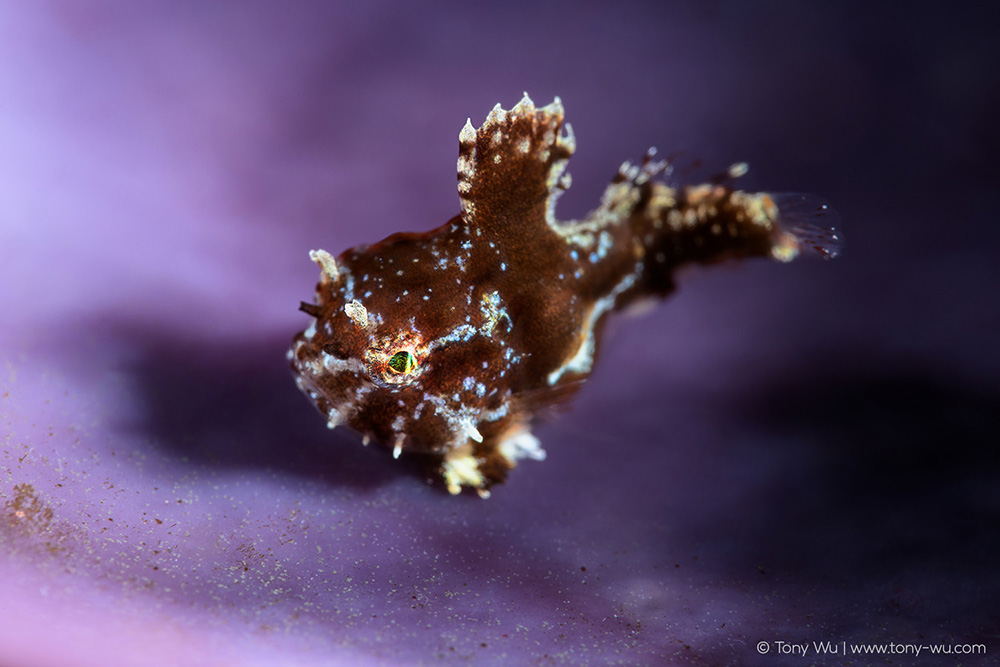
This is picture of a female hairy frogfish (Antennarius striatus). When I took this photo, she was clearly hungry, as she unfolded her worm-like lure and started wiggling it around, fishing for a meal…as frogfish do.

frogfish

This is a picture of the same female hairy frogfish just moments later. In front of her is a smaller, darker hairy frogfish…a male. Given their proximity, the male may have been a suitor hoping to mate with the female.

frogfish

There was, however, just one minor problem with his plan.

Seconds after I took this photo, the female ate the little guy. Seriously.

Gulp. Swallow. Burp. In the blink of an eye…without the slightest hint of guilt or remorse.

Guys…surely there’s a valuable lesson here for us.

Related Post: A Very Hungry Frogfish

Bryde’s Whale

I’ve just arrived at Kasawari Lembeh Resort, and I’m getting ready to get some sleep to rest up for a full day of diving tomorrow (hurray!). Before I hit the sack, I thought I’d post one final set of images from Ogasawara…a couple of photographs of Bryde’s whales.

Our final day in Ogasawara was a beautiful one…winds calm, sun bright, water a perfect blue…but not a sperm whale in sight. After we had cruised around for several hours without much to show for our efforts, keen-eyed Julia Sumerling spotted something far off in the distance.

We lost whatever it was, then saw it again, then wandered around semi-aimlessly…and eventually, late in the afternoon, we zeroed in enough to see that Julia had spotted a pair of elusive Bryde’s whales (pronounced “brooda’s” whales).

There are at least two species of Bryde’s whales, Balaenoptera brydei and Balaenoptera edeni. According to the captain and his wife, the pair we came across were the latter.

I believe that encounters with Bryde’s whales are rare. They certainly are in Ogasawara. Makoto-san has been working with cetaceans in Ogasawara for over 20 years, and this was only his second encounter. Tomoko-san had never seen a Bryde’s whale in local waters.

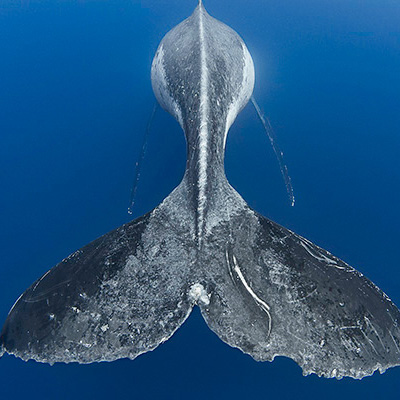
whale

The pair was travelling at high speed, spending a lot of time submerged, coming up for a few short breaths before diving again.

Though obviously together, the pair didn’t stay with one another all the time. They split up and put quite a bit of distance between them on several occasions, which contributed to the difficulty of tracking them. Fast-moving, zig-zagging, submerged whales aren’t exactly easy to follow.

At one point, the pair pulled up alongside the boat. With crystal-clear visibility and bright sun overhead, we could see their entire bodies.

My first impression was: “Wow…beautiful.”

At roughly 12 metres in length, the Bryde’s whales were sleek, streamlined, refined. The best word I can think of to describe them is “elegant”.

By the time we had found the whales and managed to get close, it was late in the afternoon, so we weren’t able to track them for long. The chances for an in-water encounter were slim, given their high-speed and general elusiveness, but after securing a few topside ID images, I suited up and waited for an opportunity to get in…which came just as we were about to give up.

One of the whales swam alongside, the captain dropped engine power, and in we went. The whale kept going, but when I dived down to get a better look, it turned and swam parallel to me for just a few brief seconds…long enough for me to take a handful of pictures…before it turned away and continued going wherever it was going.

The crater-like scars on the whale’s body (clearly visible in the image below) are probably from bites by cookie-cutter sharks, deep dwellers that make a living by carving out chunks of flesh from larger animals like this.

whale

My virgin experience seeing a Bryde’s whale in the water…a perfect end to a perfect trip.

Note: Photographs taken under permit.

Seven-arm Octopus

This is what’s left of a seven-arm octopus (Haliphron atlanticus). We came across a couple of these while in Ogasawara.

octopus

Seven-arm octopuses are the largest known octopus species, allegedly growing up to something like four metres in length and weighing 75kg! The ones we saw were from significantly smaller animals, as you can tell from this photo of my friend Tomoko-san photographing the floating blob:

octopus

Despite the common name, this octopus has eight arms, just like all other octopuses. The “seven-arm” name derives from the fact that the mating arm is coiled away and obscured from view in males…often giving it the appearance of having one less arm than it should.

In case you’re wondering, the octopus was slimy, and left behind a sticky film/ residue if you touched it (Of course…I had to touch it!). Otherwise, it was gelatinous and slippery, similar to what the bell of a large jellyfish feels like (Yes, I’ve touched those too).

I’m not sure if anyone knows for certain, but I suspect the bits we found floating at the surface were leftovers from sperm whale meals, or maybe from other deep-diving whales. Perhaps these octopuses don’t taste very good, and the whales spit them out? (No, I didn’t taste one).

Note: Incidentally, the plural of octopus is octopuses, not octopi. The word derives from Greek (okto+pous), not Latin, so the Latin plural form (ending in “i”) isn’t correct. Octopodes is ok too, but no one uses this word.

Choose Your Travel Companions With Care

If you travel as frequently as I do, you learn to be careful about the people you associate with. I pride myself on being highly discriminating, choosing to fraternize only with individuals of the utmost sophistication and grace:

giant squid

People who, when confronted with a scientifically valuable discovery of a 351cm giant squid arm segment, would behave in a manner befitting the circumstances:

Though I must admit error in judgement from time to time, as during my most recent excursion, when imprudent choice of travel companions precipitated the need for me to undertake an impromptu ablution to expunge the unyielding aroma of decomposing cephalopod:

Article: The Photographic Eye

fishThis is the most recent instalment of my column in Wetpixel Quarterly, called The Photographic Eye.

The subject of this issue’s column is Vision vs. Technology.

I love all the new gadgets and functionality that the camera manufacturers are cranking out these days, and I’m usually the first in line to play with new stuff. But what I try to highlight here is that it’s still the basics…vision, creativity, interpretation…that produce great images.

To paraphrase a pithy bit of wisdom I heard from another photographer: “99% of all equipment is better than 98% of all photographers.” So my point is, concentrate on getting into the 2%, instead of obsessing over the 99%.

Updated Humpback Whale Calf ID File

I’ve just updated my humpback whale calf summary file with another calf addition…calf #30 (a female), contributed by Nonie Silver.

Nonie named the calf “Kiran”, which means “ray of light” in Hindi/ Sanskrit.

The good news is…there is more calf information coming in, with at least two that look to be baby whales that are not in the PDF file yet.

The bad news is…it’s a lot of work(!) to go through all the information, verify IDs, prepare images, update and upload the file. Since I’m leaving for my Eastern Fields trip soon, I probably won’t have another opportunity to update until I’m back at the end of the year.

Click to download the Summary of humpback whale calfs: 2009, v4.


View Calf IDs Tonga 2009 in a larger map

Ogasawara

Besides the fact that we saw sperm whales, lots of dolphins, and giant squid parts(!), the trip to Ogasawara was a lot of fun. We had a terrific group of people, and Ogasawara is a laid-back, unspoiled bit of paradise in the middle of the Pacific that’s difficult not to fall in love with.

Below is a short video/ slideshow to give you an idea of what it’s like in Ogasawara. It’s a large file, so let it buffer before you play if you have a relatively slow internet connection.

All the images and video (including the sperm whale underwater) were shot with Canon cameras…5D, 5D Mark II, 1D Mark III.

I may be heading back to Ogasawara again next year. If you’re interested in joining, drop me a note via my contact form.

How to Measure a Giant Squid Arm

Here is a sentence that I’ve been wanting to write for a long time: “I swam down into the blue and retrieved the arm of giant squid.”

I know. For most people, doing something like this isn’t a life goal. I get it. I’m not normal.

But it doesn’t matter, because I did it, and it’s something I’ll never forget.

giant squid arm

Here’s the condensed version of what happened:

While we were cruising along in deep water looking for signs of sperm whales, the captain’s wife shouted something from the top deck. I looked up and saw her gesturing frantically, but with the combined noise of the engine, wind and ocean swells, I could neither understand what she was saying, nor grasp the reason for her excitement.

Following the time-tested principle of “act first, think later”, I grabbed my mask, snorkel, fins and camera and jumped into the water. Visibility was excellent. I immediately saw a long, reddish object sinking into the blue…and swam down about 10 metres to take a closer look.

giant squid arm

As I approached the squid arm, my brain finally kicked in (the “think later” part), and I realised that the only reason a rapidly sinking giant squid arm would be at the paltry depth of 10 metres is if a sperm whale (i.e., large animal with big mouth) had just dropped it…like perhaps only seconds earlier.

At that point, I looked around in a brief moment of panic (or sanity, depending upon your point of view)…thinking that perhaps the whale that had dropped such a tasty morsel might not appreciate my absconding with it. Fortunately, the previous owner was nowhere to be seen, so I avoided becoming whale food grabbed the squid arm and swam back to the surface.

We kept the arm segment on ice until the next morning, when we had sufficient space and light to measure it, then donated it to the research community.

Below is a short video of fellow underwater photographer Douglas Seifert measuring the (pungent) squid arm:

Free Willy

If you understand the pun in the post title, I don’t think it’s necessary for me to write anything more about this photo, except to note that the dolphin is a Tursiops aduncus.

If you don’t get the reference, then nothing I write will make a difference…so there’s no point in writing more.

dolphin

Dolphins

During my stay in Ogasawara, I was fortunate enough to encounter four species of dolphins, three of which I was able to photograph.

First up were pan-tropical spotted dolphins (Stenella attenuata), which we encountered several times. Pan-tropicals are a lot of fun to watch from the boat, as they can be really active and playful, but they’re the total opposite in the water.

dolphin

There can be a few dozen swimming like crazy around the boat, but the second you get in the water…poof! They vanish quicker than kegs at a frat party.

We also saw two different species of bottlenose dolphins. The first was the kind that most people are familiar with…common bottlenose dolphins, or Tursiops truncatus…recognisable by their short snouts.

dolphins

I’ve seen this particular species of dolphin in many places around the world. Their temperament varies from location to location, with some populations being highly approachable, and others just downright rude. In Ogasawara, they’re somewhat standoff-ish…generally ok with boats, but not easy to approach in the water.

dolphins

There was also a second species of bottlenose…Indo-Pacific bottlenose dolphins (Tursiops aduncus), which are relatively slimmer, and a heckuva lot more friendly than their truncatus cousins…at least in these waters. They’re accustomed to boats and people, so if you’re a decent swimmer, you can swim along with them…if they’re in the right mood.

dolphins

Finally, we saw some rough-toothed dolphins (Steno bredanensis), though we weren’t able to get photos. In fact, images of rough-toothed dolphins are quite rare, though I was lucky enough to get a nice in-water shot a couple of years ago in Tonga.

Rough-toothed Dolphins.jpg

Sperm Whale IDs

It’s been about a week since I got back from photographing sperm whales (Physeter macrocephalus) in Ogasawara with friends Eric Cheng, Douglas and Emily Seifert, and Julia Sumerling.

There is a lot I want to write about the trip, but as a first priority, I went through my photos and tried to do something that I don’t think anyone else has done/ is doing…ID individual sperm whales using in-water photos.

The somewhat crazy idea came to me because:

(a) My humpback whale calf ID project in Tonga is going well, with interesting revelations and help starting to come in from other people; and

(b) We were fortunate enough to see a lot of whales in the water the first few days we were in Ogasawara, and I noticed that many of the sperm whales have what appear to be unique white markings on their bodies, particularly in the lower abdominal area.

At first, I wasn’t sure if the white markings were unique to the whales in this particular area, or whether all sperm whales have these markings. I’m still not entirely certain (since there aren’t that many in-water images of sperm whales), but after checking Hal Whitehead’s book about sperm whales, a copy of which Julia brought along on the trip, I saw that a few of the images in his book showed whales in other parts of the world with similar markings.

So I decided early on in the trip to try to take as many photos of the undersides of sperm whales as possible, and catalogue our cetacean encounters once I got home.

Here is the result (the video may take a while to download, so give it time to buffer if you have a slow internet connection):

In summary, I was able to identify nine individual whales, all of which I believe to be members of a group of relatively friendly whales…the ones that had the giant squid. There were almost certainly more whales in the group.

What also seemed to emerge from the pattern of encounters is that the whale that we eventually saw with the squid in its mouth may have been the matriarch or leader of this particular group, as she showed up in a large percentage of my photos, meaning she approached us relatively often.

ID-ing sperm whales is a lot more difficult than humpbacks. Humpbacks are surface-active whales, while sperm whales dive down hundreds, even thousands of metres…and they stay down. But still, it is possible to ID them, as this short video demonstrates.

Whether these IDs will come in useful over the long-term or not…only time will tell. If I get a chance to go back, I’m hoping to continue this endeavour, with the objective of seeing if it’s possible to document a consistent population and/ or frequent visitors to the area.

The video above is small, so it’s difficult to read the text. This is a PDF document (11MB) of the slides in the presentation, and this is a bigger Quicktime video file (640×360, 79MB…Do not click this link and try to open in your browser. Right click to download the file only if you have a good internet connection.). There’s also a .mp4 file available via iTunes.

Note: Photographs taken under permit.

The Last Supper

A few weeks ago, I welcomed Eric, Julia, Douglas and Emily to Japan for the start of our quest to photograph and video sperm whales by taking them to dinner at a small sushi restaurant outside Tokyo.

Our trip was a wild success, and Eric and Julia have already gone back. Tonight, we had dinner with Douglas and Emily to say goodbye, as they’ll be boarding a plane for the long trip home tomorrow. Tom, one of Douglas’s friends from high school, joined us too.

kushiyaki

I took them to a small kushiyaki restaurant called Kushihana (串花) in Nishi-azabu. In case you’re not familiar with kushiyaki cuisine, it’s basically delicious bite-sized morsels of stuff skewered and deep-fried on little sticks, generally washed down with copious quantities of beer, shochu, or whatever other form of alcohol is on hand.

Nishi-azabu a swank neighborhood in Tokyo with lots of fancy shops, restaurants and clubs, but this place is quaint and cozy, and just about everyone who goes there is a diver. The owner is a diver and a big fan of underwater photography, so it seemed like an appropriate place for our last dinner together.

Of course, we couldn’t let the evening go by without a bit of fun…at Douglas’s expense:

I’m sure Douglas had a nagging feeling that he was being set up, but he was a good sport and played along, much to the amusement of all the other people in the restaurant (who were all in on the gag).

If you’re ever in Tokyo and feel like going to a small place that’s not packed with tourists and socialites, this is a map to Kushihana, and the address is Minato-ku, Nishiazabu 4-2-15, 106-0031 (港区西麻布4-2-15, 106-0031). You have to speak Japanese though.

And make sure you visit the bathroom, where one of my sperm whale photos is on display.